
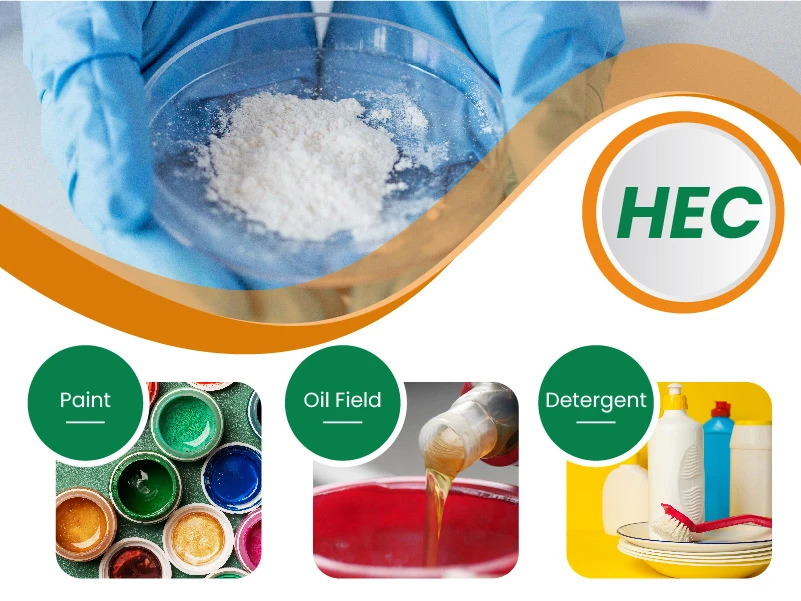
The global hydroxyethyl cellulose (HEC) market
reached 814 million in 2021 and is projected to hit 814 million in 2021 and is projected to hit 1.2 billion by 2030, growing at a CAGR of 4.5% according to Grand View Research. Paint and coatings drive the largest share. Oilfield drilling, detergents, and personal care add to demand. All of these sectors depend on consistent thickener quality.
If you import or distribute HEC, you are not just buying a white powder. You are selecting a manufacturing partner whose batch consistency, certification compliance, and technical support will directly affect your business. This guide explains what to look for in hydroxyethyl cellulose manufacturers and how to evaluate them before placing a large order.
What to Look for in an HEC Manufacturer
Not all HEC manufacturers operate at the same level. Some produce only one or two viscosity grades. Others invest in broader product lines, in-house lab testing, and export documentation support. Before you shortlist a supplier, check these five areas:
Production capacity and reliability. Ask about actual annual output, not just nameplate capacity. A factory claiming 20,000 tons per year may only run one shift. Confirm MOQs and typical lead times for both sample orders and full containers.
Quality consistency across batches. HEC viscosity can drift between batches if the manufacturer does not control etherification conditions tightly. Request COAs from three different production lots and compare the main parameters: viscosity, moisture content, and ash level.
Certification coverage for your target markets. If you sell into Europe, you need REACH compliance documentation. If you supply oilfield customers, API or ISO 9001 matters. We cover this in detail in the Certifications section below.
Technical support and formulation assistance. Some manufacturers just sell powder. Others help you troubleshoot viscosity issues in your customer’s paint line or recommend the right grade for a drilling fluid specification. That support saves you time and returns.
OEM and custom packaging options. Many distributors need private-label packaging or custom viscosity ranges that fall between standard grades. Not every factory can do this, and those that can often have higher MOQs for custom runs.
HEC Specifications That Matter for Importers
When you evaluate hydroxyethyl cellulose manufacturers, you need to understand the specs your customers care about. Here is a practical breakdown.
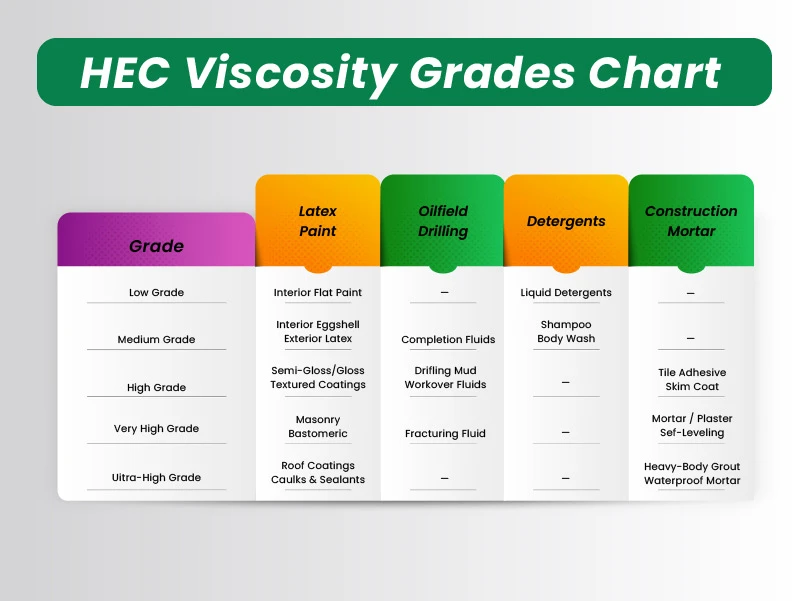
Viscosity Grades
HEC viscosity is measured on a 2% aqueous solution at 20°C, reported in mPa·s. Different applications require different ranges:
| Application | Typical Viscosity Grade (mPa·s) | What Your Customer Needs |
|---|---|---|
| Latex paint (thickener) | 30,000 – 60,000 | Good spatter resistance, color acceptance |
| Water-based ink | 4,000 – 10,000 | Low viscosity for flow, still provides body |
| Oilfield drilling fluid | 150,000+ | High viscosity for fluid loss control |
| Detergent and cleaner | 4,000 – 15,000 | Low-to-medium viscosity, easy dissolution |
| Personal care / cosmetics | 4,000 – 30,000 | Transparent solution, low ash |
| Construction mortar | 30,000 – 100,000 | Water retention, workability |
Stock the grades your market demands most. If your customers are primarily paint formulators, the 30,000–60,000 range covers most needs. If you serve oilfield clients, you need the high-viscosity grades above 150,000.
Degree of Substitution (DS)
DS measures how many hydroxyethyl groups attach per glucose unit. Most commercial HEC has a DS of 1.5–2.5. Higher DS means faster hydration and better salt tolerance, which matters in detergent and oilfield applications. Lower DS products tend to have better film-forming properties, which paint formulators prefer.
Moisture Content and Ash
These two specs get overlooked but they affect shelf life and formulation stability. Moisture should be below 5%. Ash content below 1% indicates higher purity. If a manufacturer’s COA shows moisture at 8% or ash at 3%, that product will clump in storage and cause inconsistent viscosity in your customer’s formulations.
HEC Applications: What Your Customers Use It For
Understanding downstream applications helps you have better conversations with your customers and stock the right grades.
Paints and Coatings
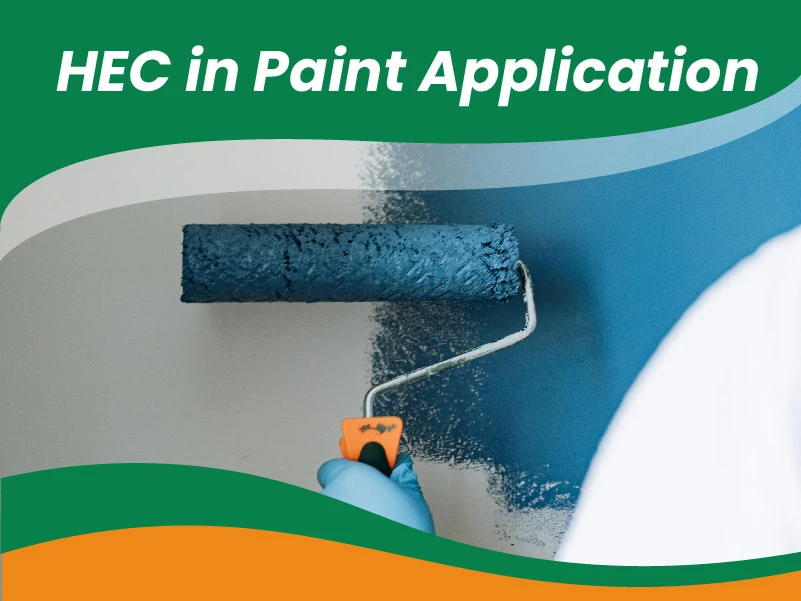
This is the largest HEC application segment, accounting for over 25% of global demand. Water-based architectural paint uses HEC as the primary thickener because it provides spatter resistance during roller application and good color acceptance when tint bases are mixed at the point of sale. Your paint customers care about viscosity stability over time and compatibility with associative thickeners like HEUR.
Oilfield Drilling Fluids
HEC serves as a viscosifier and fluid-loss reducer in water-based drilling muds. It works in both fresh water and brine systems. Oilfield customers typically need high-viscosity grades (150,000+ mPa·s) and demand consistent performance under high temperature and pressure. If you supply this segment, ask your manufacturer about API-related testing and documentation.
Detergents and Cleaners
Liquid detergents use low-to-medium viscosity HEC as a thickener and stabilizer. The product must dissolve quickly without forming fish-eyes, and it needs to tolerate surfactants and salts in the formulation. Fast-dissolving or surface-treated HEC grades are available specifically for this market.
Personal Care and Cosmetics
Cosmetic-grade HEC requires low ash, transparent solutions, and compliance with pharmacopeia standards. If you plan to sell into personal care, verify that your manufacturer can provide the documentation and purity levels this segment demands.
Construction Mortar
HEC works as a water-retention agent in cement-based mortars, tile adhesives, and renders. It competes with HPMC and HEMC in this space. Construction customers tend to be price-sensitive and often use HEC where HPMC is not strictly required.
Certifications and Compliance for HEC Imports
Importing HEC into different markets requires specific documentation. Missing certifications can delay your shipment at customs or disqualify you from selling to regulated customers.
| Certification / Document | Applies To | Why It Matters |
|---|---|---|
| ISO 9001 | Global | Baseline quality management. Most B2B buyers expect this. |
| REACH compliance | European Union | Required for importing cellulose ethers into the EU. Cellulose ethers fall under HS code 3912.39, and REACH registration or pre-registration must be confirmed with your supplier. |
| COA (Certificate of Analysis) | All markets | Must accompany every shipment. Should list viscosity, moisture, ash, DS, and pH. |
| SDS (Safety Data Sheet) | All markets | Required for customs clearance and downstream customer compliance. |
| Halal / Kosher (optional) | Select markets | Relevant if your customers use HEC in food-contact or personal care applications. |
| API documentation (optional) | Oilfield | Some drilling fluid specifications reference API standards. Having supporting documentation adds credibility. |
EU import duties on HEC under HS 3912.39 range from 0% to 6% depending on the member state and trade agreements. Check the specific rate for your destination country before quoting landed cost to your customers.
HEC vs HPMC: When to Recommend Each
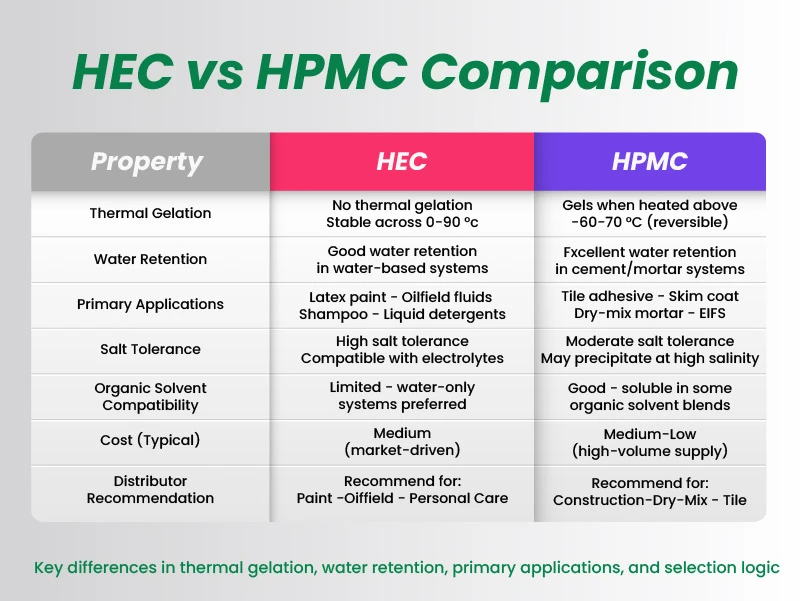
Distributors often get asked whether HEC or HPMC is the right product. The answer depends on the application.
| Factor | HEC | HPMC |
|---|---|---|
| Primary use | Paint thickener, oilfield, detergent | Construction mortar, tile adhesive |
| Thermal gelation | Does not gel below 100°C | Gels at 55–75°C |
| Water retention in cement | Moderate | High |
| Spatter resistance in paint | Excellent | Moderate |
| Salt tolerance | Good (higher DS) | Lower |
| Price position | Generally lower for paint grades | Higher for construction grades |
| Dissolution | Can form fish-eyes without surface treatment | Generally easier to dissolve in cold water |
If your customer is a paint manufacturer, HEC is the standard choice. If they make cement-based products, HPMC is more common. Some distributors stock both to cover their entire customer base.
Evaluating a China-Based HEC Manufacturer
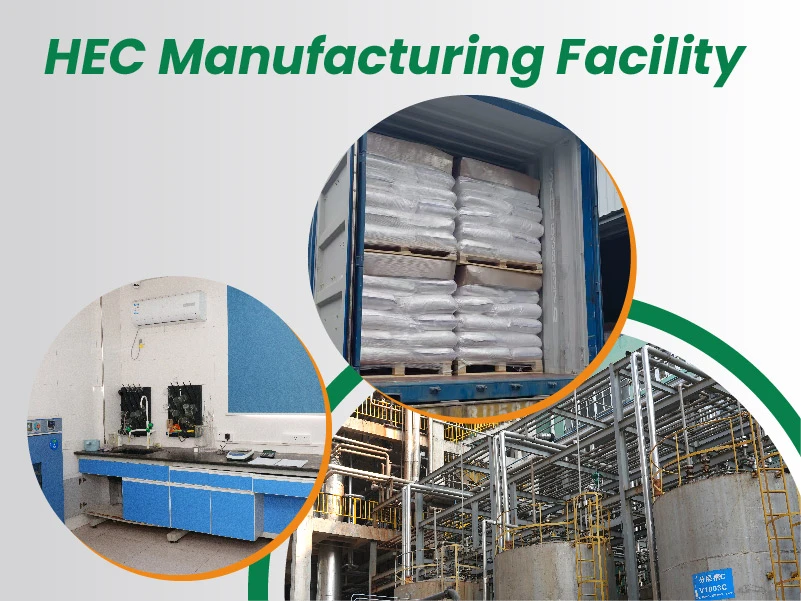
China produces the majority of the world’s HEC supply. But quality varies significantly between factories. Here is how to evaluate a potential supplier.
Verify capacity claims. Visit the facility or request a video tour. Nameplate capacity means little if the plant runs at 50% utilization. Ask for recent production records or shipping documents as evidence.
Test batch consistency. Order samples from two or three different production dates. Test viscosity, moisture, and dissolution time yourself or through a third-party lab. Compare results. If the numbers swing more than 10% between batches, that manufacturer will cause problems for your customers.
Check raw material sourcing. HEC is made from refined cotton or wood pulp. Refined cotton generally produces higher-purity HEC with lower ash content. Ask your manufacturer what raw material they use and whether the supply is stable.
Confirm OEM capabilities. If you need private-label packaging, custom viscosity grades, or specific mesh sizes, get this in writing before you commit. Some factories outsource packaging, which adds a layer of risk to quality control.
Evaluate communication and support. How fast do they respond to technical questions? Do they provide formulation guidance? Can they troubleshoot issues your customer reports? A manufacturer who answers within 24 hours and provides real technical input is worth more than one who offers a slightly lower price but goes silent when problems arise.
Zhiwei (Jinan) New Materials Co., Ltd. produces HEC alongside HEMC, HPMC, RDP, and PCE at its facility in Zhejiang, China. The factory has 15,000 tons of annual capacity and uses Xinjiang refined cotton as its primary raw material. Multiple patents and provincial-level technology certifications support the production process. Zhiwei supplies HEC for paint, oilfield, detergent, and construction applications with COAs provided for every batch. For inquiries: info@zhiweichem.com or +86 183 6616 3707.
Frequently Asked Questions
How do I verify an HEC manufacturer’s quality before placing a large order? Request COAs from three different production lots and compare viscosity, moisture, and ash values. Run your own viscosity test on sample material. Consider a third-party lab test if the order value is significant.
What viscosity grades of HEC should I stock for general distribution? For a broad customer base, stock 30,000 and 60,000 mPa·s grades. These cover most paint and coating applications. Add 150,000+ mPa·s if you serve oilfield customers, and 4,000–10,000 mPa·s for detergent clients.
Can I get custom viscosity or private-label packaging from a Chinese HEC manufacturer? Yes, but not every factory offers this. Custom viscosity typically requires a higher MOQ (often 5–10 tons minimum). Private-label packaging is more widely available. Confirm lead times and minimums in writing.
What certifications should an HEC manufacturer have for export to Europe? At minimum: ISO 9001, REACH compliance documentation, and COA/SDS for every shipment. If you sell into personal care, pharmacopeia compliance (USP or EP) adds credibility.
Is HEC the same as CMC, and can I substitute one for the other? No. HEC is a non-ionic cellulose ether. CMC (carboxymethyl cellulose) is anionic. They behave differently in formulations — CMC is more sensitive to salts and has different thickening mechanisms. Substitution is not recommended without reformulation testing.
Conclusion
Selecting a hydroxyethyl cellulose manufacturer comes down to batch consistency, certification coverage, and the technical support you receive after the sale. Price matters, but a cheap product that drifts between batches or arrives without proper documentation will cost you more in returns and lost customers.
Test samples from multiple production lots. Verify certifications for your target markets. Choose a manufacturer who responds to technical questions and can grow with your business.
For HEC, HEMC, HPMC, RDP, and PCE supply, contact Zhiwei (Jinan) New Materials Co., Ltd. at info@zhiweichem.com or +86 183 6616 3707. Visit zhiweichem.com for product specifications and sample requests.