
Choosing between HPMC and HEMC affects everything from open time to water retention to your final material cost. This guide breaks down the technical differences, application performance, and sourcing considerations — so you can make an informed decision for your specific formulation needs.
Both HPMC (hydroxypropyl methylcellulose) and HEMC (hydroxyethyl methylcellulose) are water-soluble cellulose ethers derived from natural cellulose. They share a common methylcellulose backbone. The difference lies in the substituent groups attached to that backbone — and that difference drives measurable changes in how each performs in construction applications.
If you are comparing HPMC vs HEMC for a real project, keep reading. This article covers chemical structure, viscosity, gel temperature, water retention, application-specific guidance, and a practical decision framework you can apply immediately.
Quick Comparison: HPMC vs HEMC at a Glance
| Property | HPMC | HEMC |
|---|---|---|
| Full Chemical Name | Hydroxypropyl Methylcellulose | Hydroxyethyl Methylcellulose |
| Substituent Group | Hydroxypropyl + Methyl | Hydroxyethyl + Methyl |
| Water Retention | Good | Very Good (higher DS) |
| Viscosity Range | 3,000–200,000 mPa·s | 3,500–100,000 mPa·s |
| Gel Temperature | 60–70°C | 65–75°C |
| pH Stability | Excellent (pH 4–11) | Good (pH 6–10) |
| Freeze-Thaw Stability | Better | Moderate |
| Price | Moderate | Slightly higher |
| Best for High-Temperature Climates | Moderate | Excellent |
| Best for Cold/Freeze-Thaw Climates | Excellent | Moderate |
Use this table as a starting reference. The sections below explain the why behind each difference and help you match the right product to your actual application.
What Are HPMC and HEMC?
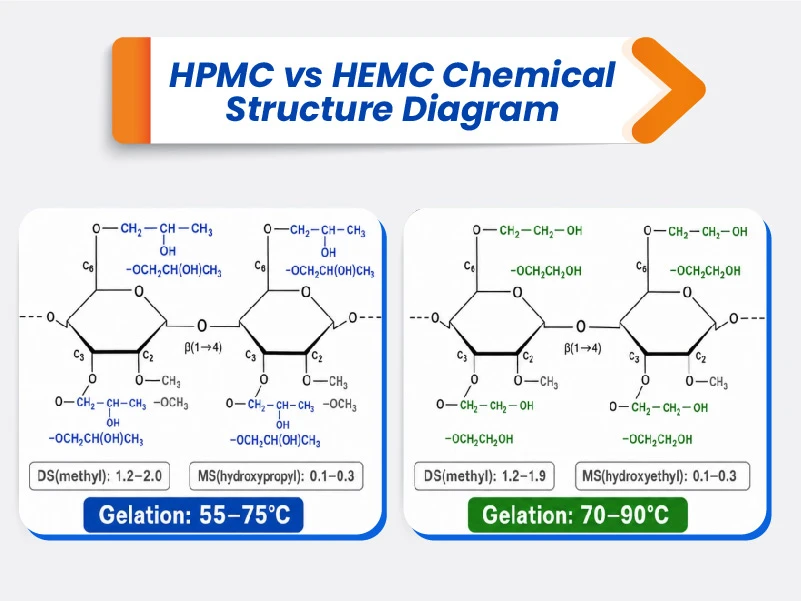
HPMC and HEMC are both cellulose ethers — water-soluble polymers produced by chemically modifying natural cellulose through etherification.
HPMC (Hydroxypropyl Methylcellulose) is modified with both methyl and hydroxypropyl groups. The hydroxypropyl substituent is what gives HPMC its name. Suppliers typically list it as HPMC or hydroxypropyl methylcellulose.
HEMC (Hydroxyethyl Methylcellulose) is modified with methyl and hydroxyethyl groups. You will also see it written as hydroxyethyl methylcellulose in technical data sheets.
Both start from the same raw material: natural cellulose, usually sourced from cotton linter or wood pulp. The cellulose undergoes alkaline treatment followed by reaction with methyl chloride (for the methyl group) and either propylene oxide (for HPMC) or ethylene oxide (for HEMC).
The key functional properties they share include water retention, thickening, workability improvement, and film formation. Water retention slows water evaporation from cement-based systems during hydration. Thickening controls viscosity and prevents sagging or segregation. Workability improvement makes mortars and plasters easier to apply. Film formation creates a protective barrier on freshly applied surfaces.
Where they diverge — in water retention strength, gel temperature, and pH compatibility — is what matters for your specific formulation.
Chemical Structure and What It Means in Practice
Understanding the underlying chemistry explains the performance differences. You do not need a chemistry degree to follow this. The core concept is straightforward: different substituent groups change how the molecule interacts with water and cement.
Degree of Substitution (DS) and Molar Substitution (MS)
Two numbers define a cellulose ether’s behavior: the degree of substitution (DS) and the molar substitution (MS).
DS measures how many hydroxyl (OH) sites on the cellulose backbone have been replaced by methyl groups. MS measures how many hydroxypropyl (HPMC) or hydroxyethyl (HEMC) groups have been added per glucose unit.
HEMC typically has a higher DS than HPMC — meaning more methyl substitution and stronger hydrophobic character. That higher DS is the primary driver behind HEMC’s superior water retention in the same viscosity grade.
HPMC, by contrast, offers a wider MS range. Manufacturers can tune the hydroxypropyl level more precisely, which gives HPMC more grades to choose from and more flexibility in formulation design.
Viscosity Range and Shear Thinning
Both HPMC and HEMC are non-ionic (they do not carry electrical charge). Both behave as pseudoplastic (shear-thinning) fluids — meaning viscosity drops under agitation and recovers at rest.
The practical consequence: mortars thickened with either product flow easily when mixed but hold their shape during application.
HPMC covers a wider viscosity spectrum. You can find HPMC grades from around 3,000 mPa·s up to 200,000 mPa·s in the same product family. HEMC’s range tops out around 100,000 mPa·s, which covers most construction applications but does not reach the ultra-high viscosity grades that HPMC can achieve.
For tile adhesive formulations targeting C2TES1 or C2TES2 classifications, grades in the 40,000–80,000 mPa·s range are common for both products.
Gel Temperature and Thermal Gelation
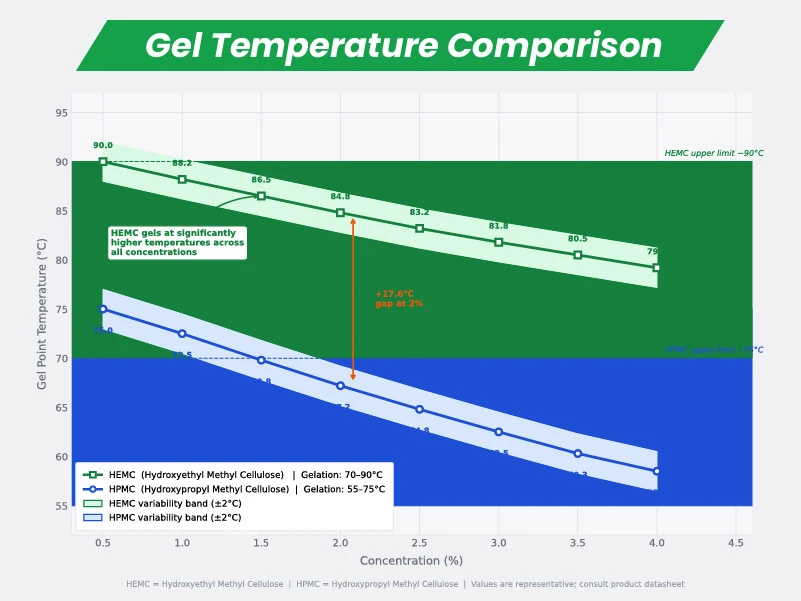
Both HPMC and HEMC undergo thermal gelation — meaning they lose viscosity when heated above a certain temperature and form a gel. This matters in hot-weather construction.
HPMC typically gels at 60–70°C. HEMC typically gels at 65–75°C, slightly higher.
The practical range is narrow, but it matters in the field. A mortar applied in direct sunlight on a surface at 50°C+ may experience premature thickening loss. In those conditions, the higher gel temperature of HEMC gives the mortar a real edge. It stays workable longer before hitting the gel point.
Research published in Construction and Building Materials (2025) confirmed that HEMC-modified mortars maintain better fluidity retention and extended setting times compared to HPMC-modified counterparts under equivalent high-temperature conditions.
Water Retention Capacity
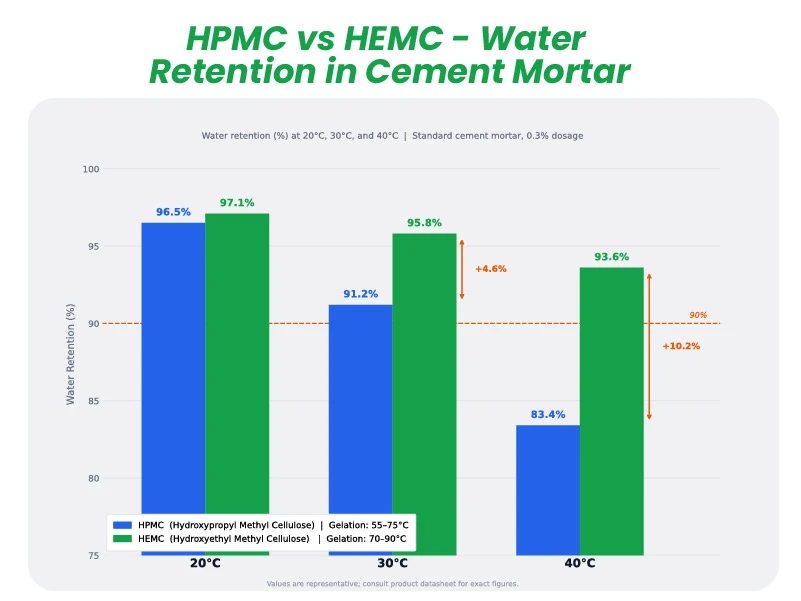
This is where HEMC typically outperforms HPMC. Under identical viscosity grades, HEMC consistently shows higher water retention in cement-based systems.
The mechanism: HEMC’s higher degree of substitution creates a more hydrophobic polymer chain that binds water more tightly within the matrix. Water stays in the cement paste longer, which leads to more complete hydration, fewer shrinkage cracks, and better bond strength over time.
For applications where water loss is the primary failure mode — thin-bed mortars on porous substrates, exterior render in hot climates, or one-coat plaster systems — HEMC’s water retention advantage translates directly into better performance on the job.
HPMC vs HEMC in Construction Applications
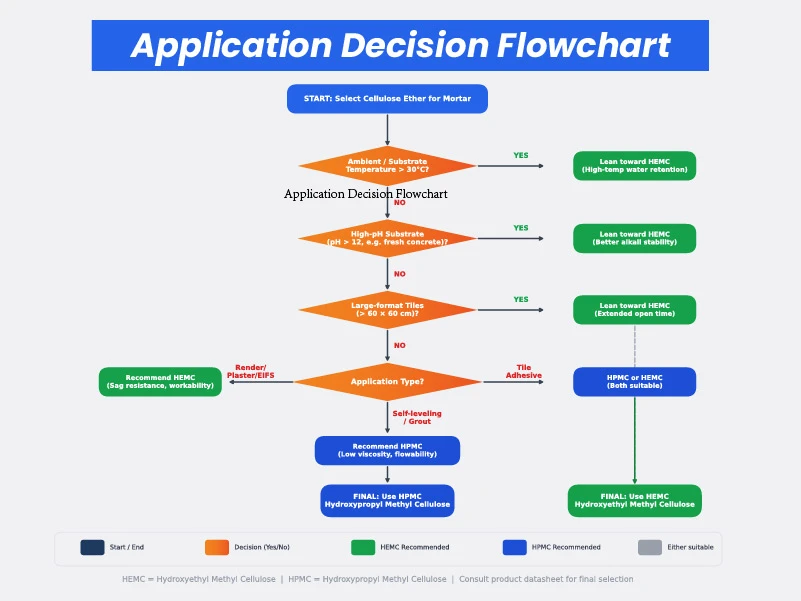
This is the section that matters most for formulation decisions. Here is how each product performs across the main construction applications.
Tile Adhesive and Grout
Both HPMC and HEMC appear in tile adhesive formulations worldwide. HPMC is the more conventional choice — it has been in the market longer and offers a wider selection of viscosity grades suited to different tile sizes and substrate conditions.
HEMC has gained ground in recent years, particularly for large-format porcelain tiles and installations on high-absorption substrates. The superior water retention helps the adhesive maintain wet-edge time for longer — important when working with tiles that do not absorb water at all (porcelain) or substrates that pull water fast (aerated concrete blocks).
Modern tile adhesive formulations sometimes combine both: a lower viscosity HPMC for workability and a higher viscosity HEMC for water retention. This approach lets formulators fine-tune the open time and sag resistance simultaneously.
For grout formulations, lower viscosity grades of HPMC dominate because the final product needs to flow into joints without excessive thickness.
Plaster and Render
This is where HEMC often wins the comparison outright.
Exterior render in hot climates faces a specific problem: the plaster dries out before the cement fully hydrates, leading to hairline cracks and poor adhesion. HEMC’s higher water retention addresses this directly. Many exterior insulation finishing systems (EIFS) manufacturers have moved toward HEMC-dominant formulations specifically for this reason.
Interior plaster in controlled environments can use either product, but formulators who prioritize smooth application and good sanding tend to prefer HPMC. HEMC-based interior plasters can feel slightly “tighter” and may require more effort to sand flat.
For wall putty and skim coat applications, HPMC is the more common choice in global markets — it provides the right balance of water retention, smooth application, and ease of sanding. HEMC appears in premium skim coat products targeting high-humidity regions.
Self-Leveling Compounds
HPMC, almost exclusively, in self-leveling underlayments. The reason is straightforward: self-leveling compounds need low to medium viscosity to flow, and HPMC’s lower viscosity range (starting from around 3,000 mPa·s) fits better. HEMC’s viscosity floor is higher, and its water retention characteristics are less critical in a system designed to flow and self-level rather than resist water loss.
Decorative Concrete and Stamped Concrete
Both HPMC and HEMC see use in decorative concrete formulations. HPMC’s better freeze-thaw stability makes it the preferred choice in cold climates where decorative concrete surfaces face winter conditions. HEMC appears more in warm-climate decorative concrete, where water retention during curing helps achieve a more even color development.
Head-to-Head Performance Comparison
| Property | HPMC | HEMC |
|---|---|---|
| Chemical Name | Hydroxypropyl Methylcellulose | Hydroxyethyl Methylcellulose |
| Substituent Groups | Hydroxypropyl + Methyl | Hydroxyethyl + Methyl |
| Degree of Substitution (DS) | Moderate | Higher (more methyl) |
| Molar Substitution (MS) | Wide range (adjustable) | Narrower range |
| Viscosity Range | 3,000–200,000 mPa·s | 3,500–100,000 mPa·s |
| Water Retention | Good | Very Good |
| Gel Temperature | 60–70°C | 65–75°C |
| pH Stability | Excellent (pH 4–11) | Good (pH 6–10) |
| Freeze-Thaw Stability | Better | Moderate |
| Compatibility with Lime | Moderate | Good |
| Hot Weather Performance | Moderate | Excellent |
| Cold Weather Performance | Excellent | Moderate |
| Typical Tile Adhesive Use | Wide use, most common | Large format, high-absorption substrates |
| Typical Render/Plaster Use | Interior plaster, wall putty | Exterior render, EIFS, hot climate plaster |
| Price Level | Moderate | Slightly higher |
| Market Availability | Very high | High |
| Combined Use in Formulations | Possible (complementary) | Possible (complementary) |
The takeaway from this table: HPMC and HEMC are not interchangeable. Each has a performance sweet spot. Matching the product to the application — not just the specification sheet — is what separates a formulation that works in the lab from one that works on the job site.
Price and Sourcing: What Affects Your Cost
Pricing for both HPMC and HEMC varies by grade, purity, and supplier origin.
HPMC commands a larger global market share — roughly $5.35 billion in 2025 according to DataBridge Market Research — and benefits from more established supply chains and manufacturing capacity. That scale gives HPMC a price advantage in many regions.
HEMC production is less consolidated. The supply base is smaller, and that tightness translates to a slightly higher price per ton in most markets. The premium is typically 5–15% over equivalent HPMC grades, though this varies by region and order volume.
Several factors drive your final landed cost:
- Raw material source: Cotton linter-based cellulose produces higher-purity grades than wood pulp. Most premium construction-grade HPMC and HEMC use cotton linter as the cellulose source.
- Purity and ash content: Lower ash content (below 1%) improves water retention and cement hydration compatibility. High-ash grades are cheaper but perform worse in cement-based systems.
- Particle size and bulk density: Affects dispersion behavior in dry-mix formulations. Fine particles dissolve faster but may generate dust during mixing.
- Supplier location: Chinese manufacturers — particularly those with vertically integrated cotton-to-cellulose ether operations — offer competitive pricing due to large-scale production and lower raw material costs.
China-based manufacturers with 10,000+ ton annual capacity can supply HPMC and HEMC at price points that compete directly with European and North American suppliers, often with comparable or better technical consistency when properly qualified.
When sourcing from China, ask your supplier for:
- Current production capacity (ask for actual output, not nameplate)
- Third-party test reports for each batch
- REACH or equivalent compliance documentation for European markets
- Technical data sheets in your language
How to Choose the Right Cellulose Ether: A Decision Framework
Stop reading comparison articles that end with “it depends.” Here is a practical decision guide based on your actual conditions.
Answer these questions in order:
1. What is your substrate? High-absorption substrate (AAC blocks, porous brick) → HEMC Standard concrete or ceramic tile → Either, HPMC is more common
2. What is your climate? Hot climate, high evaporation, direct sun exposure → HEMC Cold climate, freeze-thaw cycles, winter construction → HPMC Temperate, controlled environment → Either
3. What is your binder system? Cement-only system → Either Lime-cement blended system → HEMC (better compatibility) Gypsum-based system → HPMC (better pH compatibility)
4. What is your pH environment? High pH (above 10) → HPMC (wider pH stability) Moderate pH (8–10) → Either
5. What tile size are you installing? Standard format (up to 60×60 cm) → Either Large format (60×60 cm and above) → HPMC at higher viscosity grade, or HPMC + HEMC combination
6. Do you need freeze-thaw durability? Yes → HPMC No → Either
Most formulations that need both strong water retention and cold-weather durability use a combination approach: a lower viscosity HPMC for workability and freeze-thaw resistance, plus a medium viscosity HEMC for water retention.
Frequently Asked Questions
Is HPMC or HEMC better for mortar?
It depends on the mortar type and conditions. For exterior render in hot climates, HEMC is generally better because of its superior water retention. For tile adhesive in cold climates or freeze-thaw zones, HPMC is the more common choice. Most professional mortar formulations are tested with both before finalizing the grade.
Can I use HPMC and HEMC together in the same formulation?
Yes. Many commercial mortars use both cellulose ethers to balance water retention, open time, and workability. A typical approach is to combine a lower viscosity HPMC (for sag resistance and flow) with a medium viscosity HEMC (for water retention under heat stress). The combination often outperforms either product used alone.
Which has better water retention, HPMC or HEMC?
HEMC generally has better water retention under equivalent viscosity grades. This is due to HEMC’s higher degree of substitution, which makes the polymer chain more hydrophobic and better at holding water within the cement matrix. The difference is most noticeable in high-temperature conditions.
Is HEMC more expensive than HPMC?
HEMC is typically 5–15% more expensive per ton, reflecting its smaller global production base and more specialized manufacturing process. For high-volume applications, this premium is often justified by better field performance — fewer callbacks, better bond strength, and reduced cracking in the finished work.
What viscosity grade should I choose for tile adhesive?
For standard cement-based tile adhesive (C1 or C2 per EN 12004), a viscosity grade of 40,000–80,000 mPa·s is common for either HPMC or HEMC. Large-format tiles and high-sag-resistance requirements push toward 80,000–100,000 mPa·s. Always test in your actual formulation — the viscosity behavior depends on the full additive package (RDP, PCE, other rheology modifiers).
Conclusion: Making the Right Choice for Your Project
HPMC vs HEMC is not a competition with one winner. Each product has a performance profile that suits certain conditions better than others.
Choose HPMC when your project involves cold climates, freeze-thaw exposure, lime-cement systems, a wide viscosity range requirement, or cost sensitivity on large-volume formulations. It is the more versatile, widely available, and well-documented option.
Choose HEMC when you are working in hot climates, on high-absorption substrates, or on applications where water retention is the primary performance driver. Its higher gel temperature and superior water retention make it the better performer in demanding exterior conditions.
Consider a combination if your formulation needs both water retention and cold-weather durability. Testing both products together — rather than choosing one — often reveals formulation space that neither product covers alone.
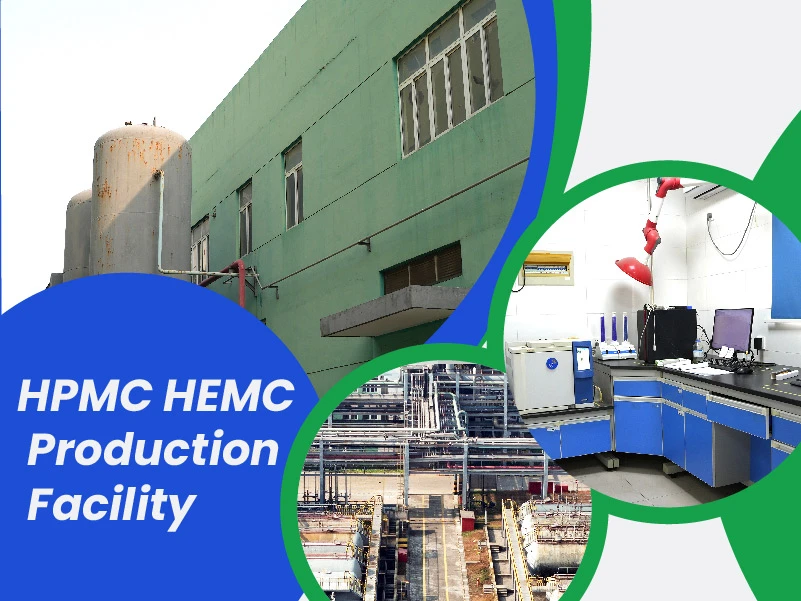
If you are sourcing HPMC, HEMC, or both for a construction project, Zhiwei manufactures both product lines from Xinjiang cotton linter at an annual capacity of 15,000 tons. We supply distributors and direct buyers globally with consistent batch quality, REACH documentation for European markets, and technical support for formulation development.
Contact: info@zhiweichem.com | +86 183 6616 3707