

Hydroxyethyl cellulose, commonly called HEC, is used in oilfield applications as a nonionic water-soluble polymer. Its main function is to build viscosity and control flow in freshwater, seawater, and different brine systems.
In a properly designed fluid, HEC can improve solids transport, support proppant or gravel suspension, reduce flow resistance, and provide pseudoplastic behavior. It is particularly useful in completion fluids, workover fluids, drill-in fluids, saline fracturing fluids, and selected production-support fluids.
HEC is not a universal solution for every drilling or completion problem. Its performance depends on molecular weight, concentration, brine composition, temperature, shear history, solids content, mixing method, and compatibility with other additives. Laboratory testing is therefore necessary before field use.
What Is Hydroxyethyl Cellulose?
Hydroxyethyl cellulose is a cellulose ether produced by introducing hydroxyethyl groups into a cellulose backbone. The modification makes the cellulose soluble in water and gives it useful thickening and rheology-control properties.
HEC is nonionic. It does not carry the same strong electrical charge as anionic cellulose derivatives such as carboxymethyl cellulose, or CMC, and polyanionic cellulose, or PAC. This nonionic structure is one reason HEC can remain compatible with many concentrated salt solutions.
When dispersed and hydrated correctly, HEC forms a clear or slightly hazy viscous solution. The solution normally shows pseudoplastic or shear-thinning behavior. It can have relatively high viscosity under low shear but become easier to pump when shear increases.
This balance is valuable in an oilfield fluid. The fluid needs enough low-shear viscosity to suspend and transport solids, but it should not create unnecessary pressure loss during circulation.
Why Is HEC Suitable for Oilfield Fluids?
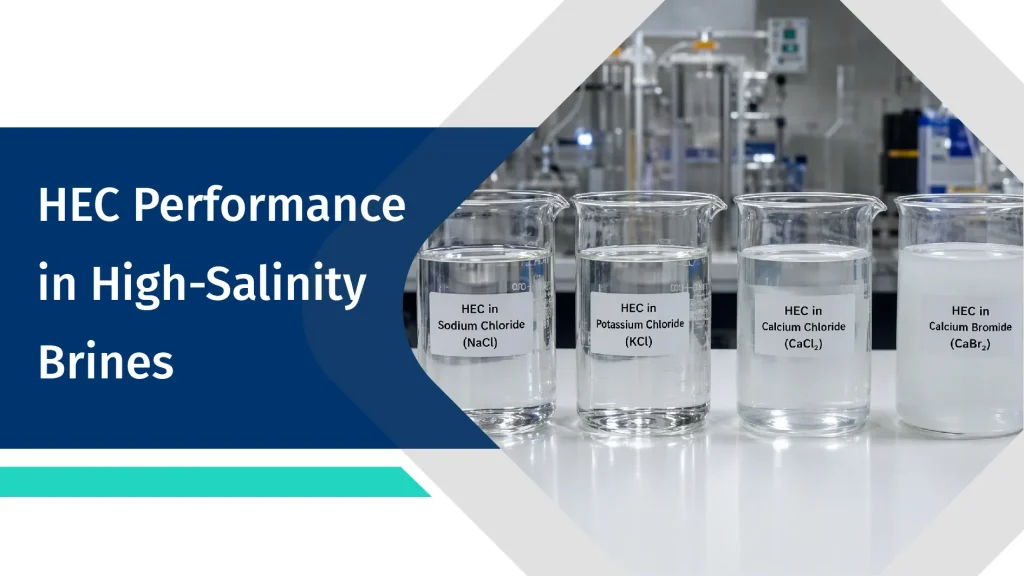
Brine Compatibility
Salt tolerance is one of the most important reasons for using hydroxyethyl cellulose in oilfield applications.
A conventional ionic thickener may lose solubility or viscosity when exposed to high concentrations of sodium, calcium, magnesium, zinc, chloride, or bromide ions. HEC is less likely to precipitate simply because hardness ions are present.
It can be evaluated in systems containing sodium chloride, potassium chloride, calcium chloride, calcium bromide, and mixed halide brines. This makes it useful when the fluid must combine controlled density with low solids content.
However, salt tolerance does not mean that every HEC grade behaves identically in every brine. Salt type, brine density, water quality, temperature, degree of substitution, and polymer concentration can all change hydration time and final viscosity.
The brine should therefore be reproduced in the laboratory rather than replaced with fresh water during product screening.
Pseudoplastic Flow
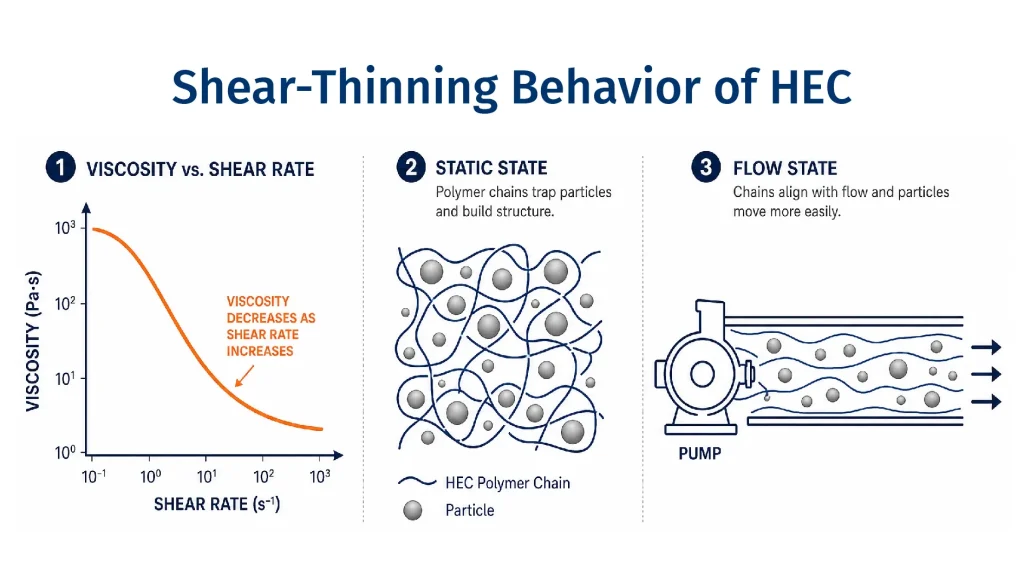
HEC solutions usually become less viscous as the shear rate increases. This is known as shear thinning or pseudoplastic flow.
At rest or under low shear, the hydrated polymer chains form an entangled network. The network produces viscosity and helps slow the settling of sand, cuttings, gravel, or other suspended materials.
Under higher shear inside pumps, pipes, nozzles, and narrow flow paths, the polymer chains become more aligned with the direction of flow. Resistance decreases, and the fluid becomes easier to circulate.
This behavior can be represented by the power-law model:
tau = K x gamma^n
In this model, tau is shear stress, gamma is shear rate, K is the consistency index, and n is the flow behavior index. A value of n below 1 indicates shear-thinning behavior.
The model helps engineers estimate how a fluid may behave under different circulation conditions. A single viscosity reading cannot fully describe this behavior. Low-shear rheology, high-shear response, temperature, and gel development should all be measured.
Limited Gel Development
HEC can provide pseudoplastic flow without developing the high gel strength associated with some other thickening systems. Limited gel build can make circulation easier to restart after a static period.
This is useful in completion and workover operations where excessive gel strength may increase initial pump pressure. At the same time, the fluid still needs sufficient low-shear viscosity for its transport function.
The SLB Energy Glossary describes HEC as a viscosifier for brines, saline fracturing fluids, workover fluids, completion fluids, and drill-in fluids. It also identifies pseudoplastic rheology with essentially little gel-strength development as an important characteristic.
Fluid-Loss Behavior
HEC is sometimes described as a fluid-loss additive, but this claim needs context.
In clear brines and many drilling-related fluids, HEC mainly changes rheology. The higher viscosity may reduce the movement of liquid into a permeable formation, but HEC should not automatically be treated as a complete filtration-control system.
Where strict fluid-loss control is required, the formulation may need a dedicated fluid-loss additive, bridging particles, a crosslinked pill, or another treatment designed for the formation.
In cement slurries, selected HEC grades can help control water loss. The effect must be balanced against slurry viscosity, pumpability, setting behavior, and cement strength development.
The correct question is not simply whether HEC reduces fluid loss. The question is whether the complete formulation meets the required filtration value under the expected pressure and temperature.
Main Uses of HEC in Oilfield Operations
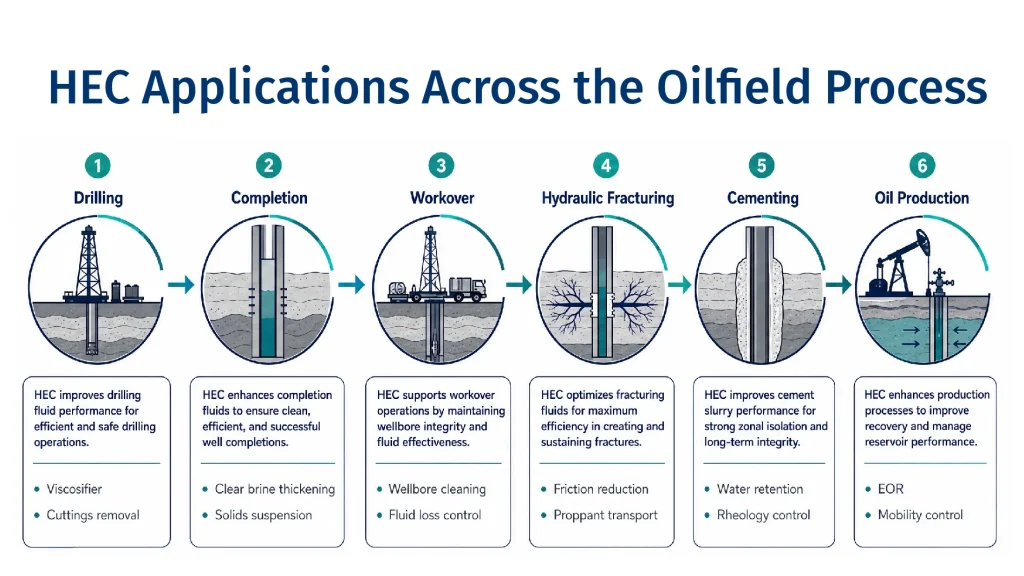
| Oilfield Operation | Main Function of HEC | Important Design Factors |
|---|---|---|
| Drilling and drill-in fluids | Viscosity control, cuttings transport, flow modification | Brine type, solids, shear rate, hole-cleaning requirement |
| Completion fluids | Viscosifying clear brines, carrying solids, supporting displacement | Fluid density, cleanliness, formation compatibility |
| Workover fluids | Transporting sand and debris, supporting circulation and intervention | Pumpability, clean-up method, static stability |
| Fracturing and gravel packing | Carrying proppant or gravel and controlling rheology | Polymer residue, breaker system, temperature, shear |
| Cementing fluids | Water-loss control and rheology adjustment | Cement compatibility, thickening time, compressive strength |
| Production-support fluids | Thickening brines used in intervention, packer, or displacement work | Brine composition, temperature, clean-up requirement |
HEC in Drilling and Drill-In Fluids
HEC can be used in selected water-based drilling and drill-in systems to increase viscosity and improve the transport of drilled cuttings.
At low shear, the fluid can hold particles in suspension and help move them toward the surface. At higher shear near the drill bit and inside the circulation system, the viscosity decreases. This can support smoother pumping and reduce unnecessary hydraulic resistance.
HEC can also be evaluated in potassium chloride fluids used around water-sensitive shale. The potassium salt provides part of the shale-inhibition strategy, while HEC controls viscosity and transport behavior.
It should not be assumed that HEC alone stabilizes every shale formation. Wellbore stability also depends on mud weight, ionic activity, filtration control, inhibition chemistry, pressure, and rock characteristics.
Modern technical references indicate that HEC is used less often in general drilling mud than CMC, PAC, xanthan gum, and other established drilling polymers. Its strongest position is in brine-based, drill-in, completion, and workover systems where nonionic salt compatibility and limited gel build are required.
Zhiwei’s HEC for Oilfield Drilling Fluids is presented for brine-based systems that need viscosity, pseudoplastic flow, solids transport, and consistent circulation behavior.
HEC in Completion Fluids
A completion fluid is placed in a well during the final operations before production begins. It may be used while installing screens, liners, valves, packers, or other completion equipment.
Clear brines are widely used because they can provide the required fluid density without introducing large amounts of suspended solids. According to the SLB definition of completion fluid, these fluids are normally filtered carefully to reduce the risk of introducing particles into the near-wellbore area.
HEC can build viscosity in these brines without requiring clay or another permanent solid thickener. The increased viscosity can support gravel transport, displacement efficiency, and fluid handling.
Because HEC is shear thinning, a properly designed completion fluid can provide suspension at low shear while remaining pumpable during circulation. Its limited gel build may also help reduce the pressure needed to restart circulation.
Formation protection still depends on the entire system. Polymer purity, undissolved material, fluid filtration, breaker selection, compatibility with formation water, and clean-up efficiency must all be evaluated.
Zhiwei’s HEC for Completion Fluids is intended for clear brine systems that require viscosity control, limited gel development, and possible acid-soluble clean-up behavior.
HEC in Workover Fluids
During workover operations, a fluid may need to carry sand, scale, corrosion products, or other debris out of the well. It may also support well control, circulation, displacement, and equipment intervention.
HEC can increase the carrying capacity of a low-solids or solids-free brine. This can help transport debris while reducing dependence on suspended clay.
A suitable HEC workover fluid should remain stable during preparation and pumping but should also be removable after the operation. Depending on the formulation, acid, enzyme, or oxidizing breaker systems may be evaluated to reduce viscosity.
The breaker must not be selected only by how quickly it destroys the polymer. It must also be compatible with the metallurgy, formation minerals, elastomers, completion equipment, and environmental requirements.
The Zhiwei HEC workover fluid application page emphasizes brine viscosity, pseudoplastic flow, limited gel strength, and controlled fluid handling during intervention.
HEC in Fracturing and Gravel-Packing Fluids
HEC can be used as a viscosifier in saline fracturing fluids and as a carrier polymer in selected gravel-packing systems.
The fluid must carry proppant or gravel through surface equipment, tubing, perforations, and fractures. Sufficient low-shear viscosity helps slow particle settling. Shear-thinning behavior can reduce pumping resistance during injection.
HEC has also been used where low residue after breaking is important. A properly selected breaker can reduce polymer molecular weight after placement, lower fluid viscosity, and support flowback.
Low residue does not mean zero formation damage. Undissolved polymer, incomplete hydration, contaminated mixing water, excessive dosage, unsuitable breaker chemistry, and poor filtration can still affect permeability.
Temperature is another critical factor. The viscosity of a conventional HEC solution generally decreases as temperature rises. High-temperature performance depends on grade, brine, concentration, residence time, oxygen exposure, shear, and stabilizer package. Any temperature limit should come from a test that reproduces the actual well conditions.
HEC in Cementing
HEC can serve as a water-loss control and rheology-modifying additive in selected oil-well cement slurries.
Reducing uncontrolled water loss can help maintain slurry consistency and protect the intended water-to-cement ratio. This is important when cement is pumped past permeable formations.
The HEC grade and dosage must be controlled carefully. Too much viscosity can increase pumping pressure and affect slurry placement. HEC may also interact with dispersants, retarders, accelerators, defoamers, and other cement additives.
A lower-viscosity grade may be more suitable when water-loss control is needed without a large increase in slurry consistency. Final selection requires tests for fluid loss, rheology, free water, thickening time, compressive strength, and compatibility with the cement source.
HEC in Production-Support Fluids
HEC may also be used in packer fluids, intervention pills, clean brines, and other fluids handled around producing wells.
Its role is usually to control viscosity, maintain suspension, and support smooth displacement. The formulation can be adjusted according to fluid density, expected temperature, solids load, and clean-up method.
Zhiwei’s HEC for Oil Production Fluids describes HEC as a nonionic viscosifier for sodium, potassium, calcium, and bromide brines used in production-support operations.
How to Mix HEC Into an Oilfield Fluid
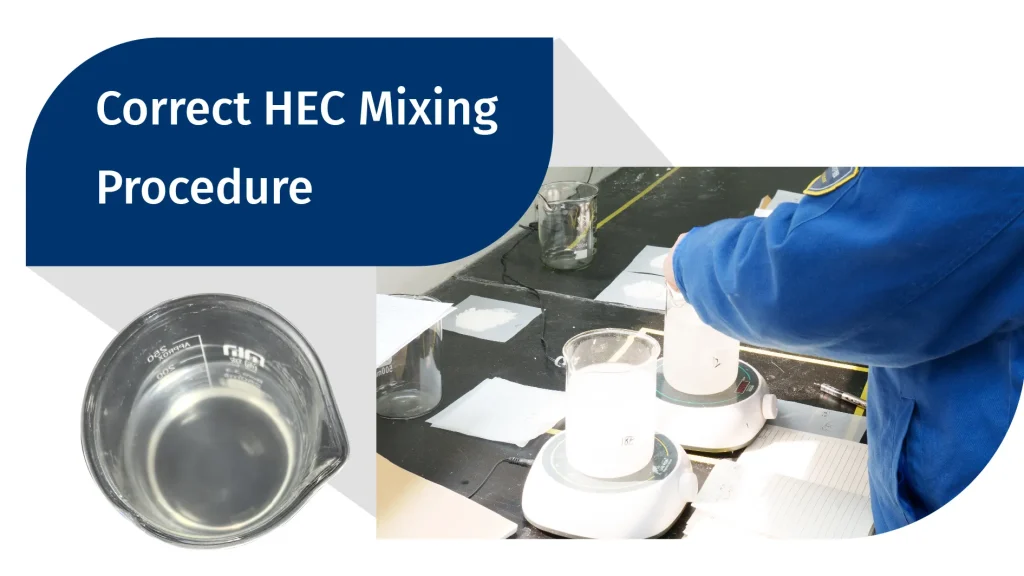
Poor mixing can prevent a suitable HEC grade from reaching its expected performance. When dry powder contacts water too quickly, the outside of each particle can hydrate first and form a gel layer. Dry material becomes trapped inside, producing lumps commonly called fisheyes.
A controlled mixing procedure reduces this risk.
- Clean the mixing tank and confirm that no incompatible chemical residue remains.
- Add the required water or prepared brine and begin steady circulation.
- Add HEC slowly through a hopper or controlled powder feeder. Do not dump entire bags directly into a low-shear tank.
- Maintain enough agitation to separate the particles without introducing excessive air.
- Allow the polymer to disperse before making a major pH adjustment. Surface-treated grades may use delayed hydration to improve initial dispersion.
- Continue circulation until hydration is complete. Record mixing time, temperature, pH, salt concentration, and shear conditions.
- Measure viscosity after the specified rest period. Add other chemicals in the validated order and repeat the rheology test after each important addition.
Increasing pH or temperature may accelerate hydration in some systems, but this should not be done before the powder is well dispersed. Rapid hydration at the wrong stage can increase lump formation.
Older field practices sometimes used diesel or another hydrocarbon to pre-wet HEC. Current operations should instead follow the product instructions, local environmental rules, and site safety requirements. Surface-treated powder, a supplier-approved slurry, or a compatible liquid carrier may provide a safer and more controlled option.
Common Problems and Corrective Actions
| Problem | Possible Cause | Practical Response |
|---|---|---|
| Fisheyes or gel lumps | Addition is too fast or agitation is inadequate | Slow the feed rate and improve powder dispersion before hydration |
| Final viscosity is too low | Incomplete hydration, unsuitable grade, high temperature, or brine incompatibility | Extend hydration time and repeat the test in the actual brine |
| Viscosity continues rising | Hydration was incomplete at the first measurement | Establish a fixed mixing and rest procedure |
| Excessive pump pressure | Dosage is too high or the grade has excessive molecular weight | Reduce concentration or screen a lower-viscosity grade |
| Poor solids suspension | Low-shear viscosity is insufficient | Evaluate concentration, molecular weight, and complete rheology profile |
| Viscosity falls during storage | Microbial contamination, enzyme activity, oxidation, or thermal degradation | Check water quality and use a compatible preservation program |
| Excessive foam | Air entrainment or incompatibility with surfactants | Adjust mixing conditions and evaluate a suitable defoamer |
| Poor clean-up | Incomplete breaker action or excessive polymer concentration | Optimize the breaker system under reservoir conditions |
Water quality deserves particular attention. Surface water and reused water may introduce microorganisms, enzymes, suspended solids, or dissolved chemicals that interfere with hydration and storage stability.
A suitable biocide or preservative may be necessary. Selection must follow local regulations and compatibility testing. Adding a biocide after severe viscosity loss has already occurred may stop further microbial growth, but it may not reverse polymer degradation.
HEC Compared With Other Oilfield Polymers
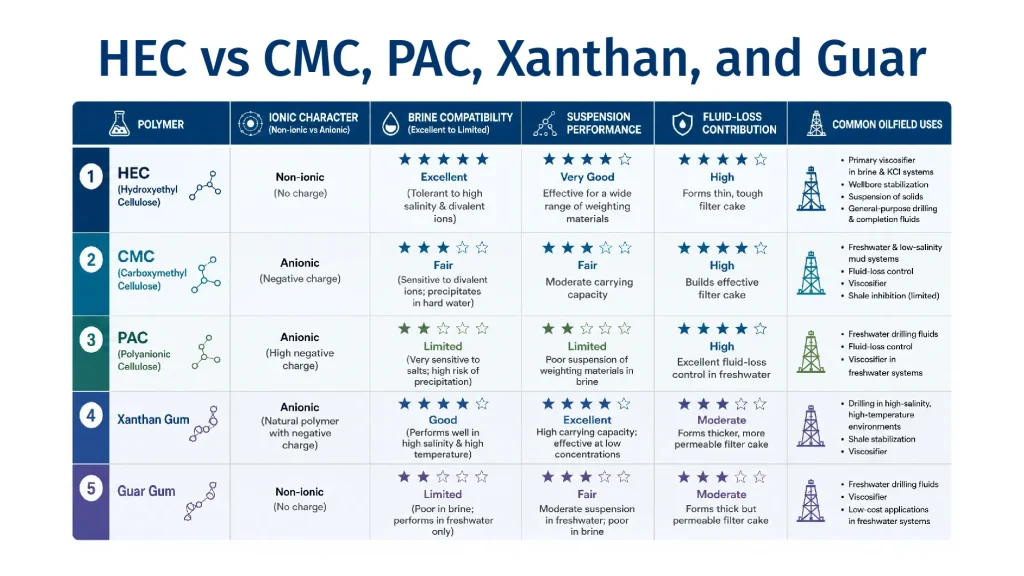
| Polymer | Ionic Character | Typical Strength | Main Limitation |
|---|---|---|---|
| HEC | Nonionic | Brine compatibility, pseudoplastic flow, limited gel build | Limited standalone fluid-loss control in many clear systems |
| CMC | Anionic | Viscosity and fluid-loss control in water-based mud | Performance can be affected by high salinity and hardness |
| PAC | Anionic | Strong filtration control and drilling-fluid performance | Grade and brine compatibility must be checked |
| Xanthan gum | Anionic biopolymer | Strong low-shear viscosity and suspension | Biological stability and high-shear behavior require control |
| Guar and modified guar | Nonionic or modified | High viscosity and proppant transport in fracturing fluids | Residue, hydration, and breaker efficiency can be concerns |
HEC is often selected when the system needs clean brine compatibility and smooth shear-thinning behavior. CMC and PAC may be preferred when filtration control is the main requirement. Xanthan can provide strong low-shear suspension, while guar derivatives remain common in hydraulic fracturing.
The choice should be made by fluid performance rather than chemical name alone.
Selecting a Zhiwei HEC Grade for Oilfield Testing
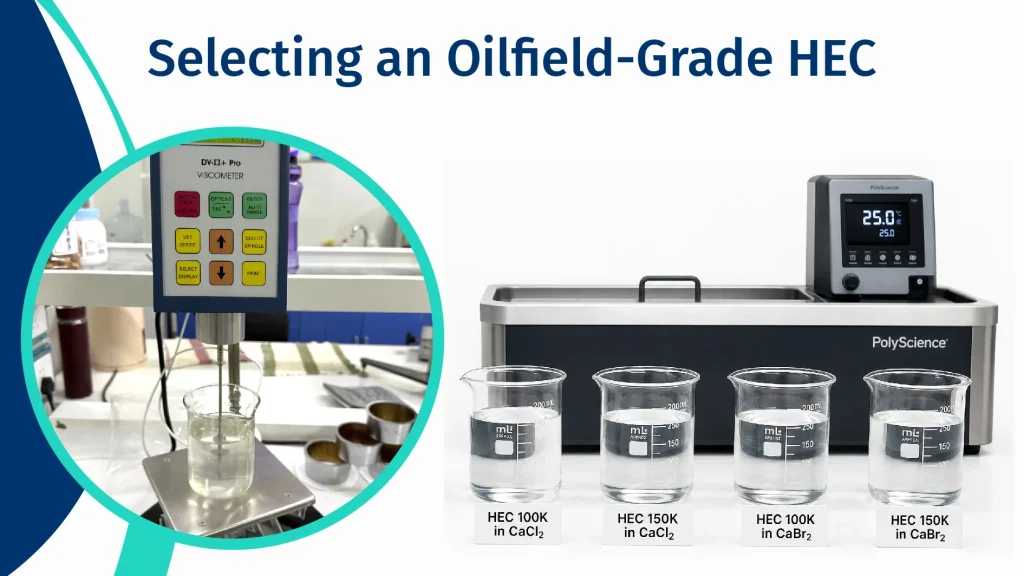
Zhiwei (Jinan) New Materials Co., Ltd. supplies several HEC viscosity grades. For oilfield systems that require strong viscosity development, HEC 100K and HEC 150K can be considered as initial laboratory screening options.
| Zhiwei Grade | Published Viscosity | Possible Screening Direction |
|---|---|---|
| HEC 100K | Brookfield LV, 1% solution at 25 C: 3,401 to 5,500 mPa.s | Drilling, completion, workover, or production-support fluids requiring high viscosity with workable flow |
| HEC 150K | Brookfield LV, 1% solution at 25 C: 5,501 to 8,000 mPa.s | High-body brine systems requiring stronger low-shear viscosity and suspension support |
Zhiwei HEC 100K is a high-viscosity nonionic HEC grade. The product is positioned for water-based systems that need strong thickening, suspension support, and stable handling.
Zhiwei HEC 150K provides a higher viscosity range and can be evaluated where a stronger viscosity contribution is required.
These model names should not be used as a substitute for fluid testing. A value measured in a 1% freshwater solution at 25 C cannot directly predict performance in concentrated calcium bromide, mixed halide brine, hot cement slurry, or a sheared fracturing fluid.
Before recommending a grade, the supplier should receive the brine composition, fluid density, target rheology, temperature profile, solids level, mixing equipment, required clean-up method, and other additives in the formulation.
A proper qualification program should compare initial and aged rheology, hydration time, low-shear viscosity, gel development, filtration behavior, thermal stability, contamination tolerance, foam, and breaker response.
Frequently Asked Questions
Is HEC Soluble in Salt Water?
HEC can dissolve and build viscosity in many salt solutions because it is nonionic. It is commonly evaluated in sodium, potassium, calcium, chloride, and bromide brines.
The final viscosity and hydration rate still depend on the grade, salt concentration, temperature, pH, and mixing conditions.
Is HEC Used in Drilling Mud?
HEC can be used in selected drilling and drill-in fluids, especially brine-based and low-solids systems. It is not the most common polymer for every conventional drilling mud.
CMC, PAC, xanthan, starch, and other additives may be more suitable when the main requirement is filtration control, shale inhibition, or a different rheology profile.
Does HEC Reduce Fluid Loss?
HEC may reduce fluid movement through its effect on viscosity, and selected grades can help control water loss in cement slurries. In many clear brines, however, it should not be treated as a complete standalone fluid-loss additive.
A dedicated filtration-control system may still be required.
Why Is HEC Useful in Completion Fluids?
HEC can thicken clear brines without adding clay or another permanent suspended solid. It provides pseudoplastic flow, supports solids transport, and can maintain limited gel development during static periods.
These properties can support pumping, displacement, gravel transport, and later clean-up.
Can HEC Be Used in High-Temperature Wells?
HEC can be formulated for elevated-temperature service, but its viscosity normally decreases as temperature rises. Performance depends on exposure time, brine composition, molecular weight, shear, oxygen, and stabilizer package.
The actual temperature limit must be established through aging and rheology tests that reproduce the well conditions.
How Can HEC Lumps Be Prevented?
Add the powder slowly into moving fluid and maintain steady agitation. Allow the particles to disperse before accelerating hydration with a pH change or another chemical addition.
A delayed-hydration or surface-treated HEC grade can also reduce fisheye formation.
What Information Does an HEC Supplier Need?
The supplier needs the fluid type, complete brine composition, density, target viscosity, operating temperature, solids content, mixing procedure, other additives, and clean-up requirement.
Providing only the requested viscosity grade is not enough for a reliable recommendation.
Conclusion
Hydroxyethyl cellulose in oilfield applications is valued mainly for its nonionic character, brine compatibility, pseudoplastic flow, and ability to build viscosity without excessive gel development.
It can support drilling and drill-in fluids, completion brines, workover fluids, fracturing and gravel-packing systems, cement slurries, and production-support fluids. Its exact role changes with the formulation.
HEC should be selected as part of a complete fluid system. Brine chemistry, temperature, shear, filtration requirements, microbial control, clean-up, and formation compatibility all influence the result.
Zhiwei HEC 100K and HEC 150K provide practical starting points for high-viscosity oilfield fluid screening. Final selection should be based on laboratory testing under representative field conditions.