
Detergent is not a single cleaning chemical. It is a coordinated formulation in which surfactants remove soil while builders, polymers, enzymes, bleaching agents, pH regulators, solvents, and other additives support the cleaning process.
The main detergent ingredients can be divided into two broad groups:
- Primary surfactants, which wet surfaces, loosen soil, emulsify oil, and keep contaminants dispersed in the wash water.
- Detergent auxiliaries, which control water hardness, alkalinity, redeposition, viscosity, foam, bleaching, fabric feel, product stability, and appearance.
A detergent may still produce foam when some of these supporting ingredients are missing. However, foam alone does not guarantee effective cleaning. Reliable performance comes from the way the complete formula behaves in real water, on real stains, and throughout storage.
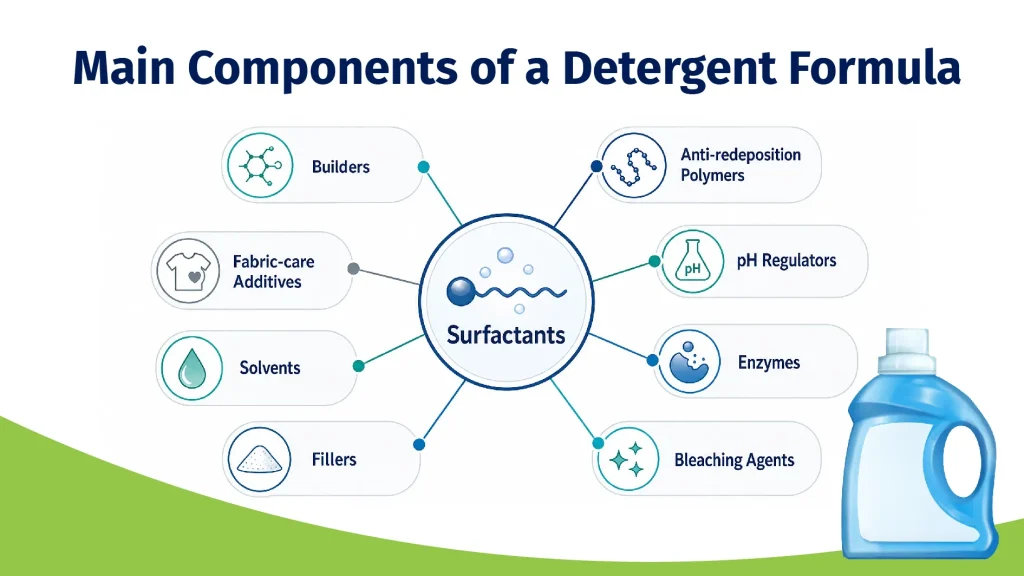
Detergent Ingredients at a Glance
| Ingredient category | Main function | Common examples | Typical application |
|---|---|---|---|
| Anionic surfactants | Strong detergency and foam generation | LAS, AES, AOS | Laundry powders and high-foam liquid detergents |
| Nonionic surfactants | Grease removal and hard-water tolerance | AEO and other nonionic surfactants | Concentrated powders and liquid detergents |
| Amphoteric surfactants | Formula balance, softness, and improved hand feel | Amphoteric surfactant blends | Premium liquid detergents |
| Chelating agents and builders | Control calcium and magnesium ions | STPP, EDTA, citrate, gluconate, polyacrylates, zeolite | Powder and liquid detergents |
| Anti-redeposition agents | Keep removed soil away from the fabric | CMC-Na, HPMC, HEMC, PVA, PVP | Laundry detergents |
| pH regulators | Provide and stabilize alkalinity | Sodium silicate, sodium carbonate | Mainly powder detergents |
| Bleaching agents | Oxidize colored and difficult stains | Sodium hypochlorite, sodium percarbonate, sodium perborate | Bleaching cleaners and laundry powders |
| Fluorescent whitening agents | Improve the visual whiteness of fabrics | Fluorescent dyes | White-fabric laundry detergents |
| Enzymes | Break down protein, fat, and starch stains | Detergent enzyme systems | Powder and liquid laundry detergents |
| Fillers | Improve powder flow and balance composition | Sodium sulfate | Powder detergents |
| Hydrotropes and solubilizers | Improve solubility and clarity | Ethanol, urea, polyethylene glycol, toluenesulfonates | Concentrated liquid detergents |
| Softeners and antistatic agents | Improve fabric feel and reduce static | Cationic and amphoteric surfactants | Fabric-care detergents |
| Bacteriostatic agents | Support odor and hygiene control | Product-specific antimicrobial systems | Selected cold-wash products |
| Solvents | Assist with oily soil and ingredient distribution | Alcohols, ethers, esters, pine oil | Liquid and nonaqueous detergents |
The presence of an ingredient does not automatically make a detergent better. Its usefulness depends on concentration, compatibility, product form, washing temperature, water hardness, target stain, and the material being cleaned.
Surfactants Are the Main Cleaning Engine
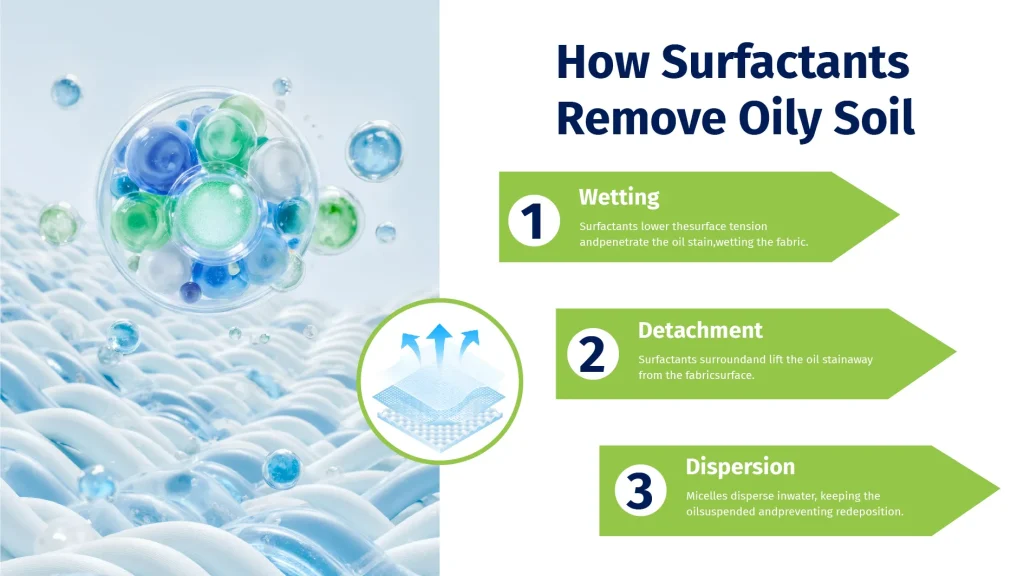
Surfactants are the foundation of most detergent formulas. Their molecular structure allows them to interact with both water and oily soil. This helps the wash solution wet the surface, separate dirt from the substrate, and disperse the removed material.
Three surfactant groups are particularly important in detergent formulation.
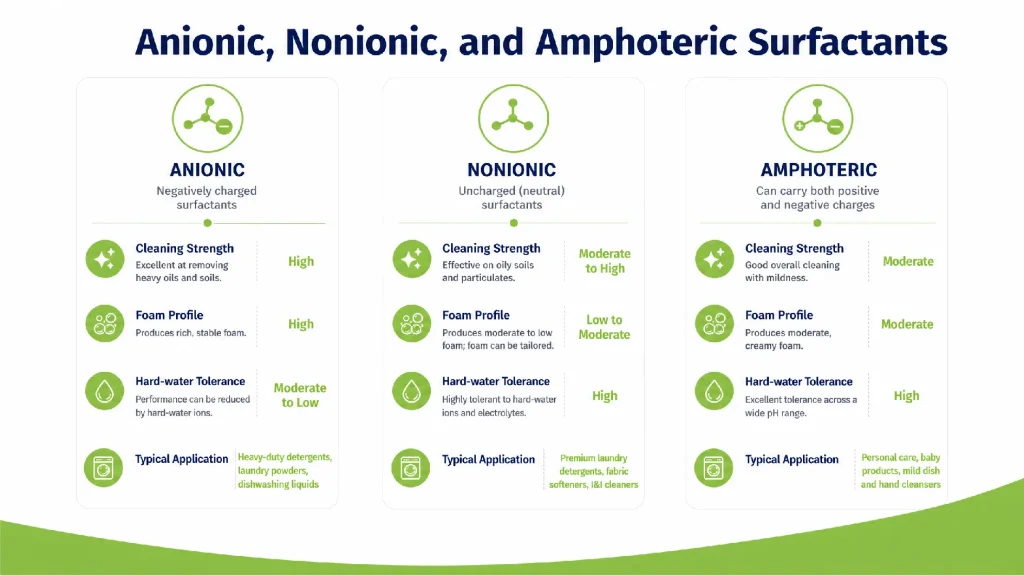
Anionic Surfactants
Anionic surfactants are widely used where strong detergency and noticeable foam are required. Common examples include linear alkylbenzene sulfonate (LAS), alcohol ether sulfate (AES), and alpha-olefin sulfonate (AOS).
These materials are effective at removing particulate and oily soil. Their high foaming characteristics also meet consumer expectations in hand-washing and some general-purpose cleaning products.
The limitation is that anionic surfactants can be more sensitive to hard-water ions. Calcium and magnesium may reduce cleaning efficiency or affect the appearance of the wash solution. A suitable builder or chelating system is therefore important when anionic surfactants form the main cleaning base.
Nonionic Surfactants
Nonionic surfactants generally provide strong oily-soil removal and better tolerance to hard water. Alcohol ethoxylates, often abbreviated as AEO, are common examples.
Because nonionic surfactants do not carry the same electrical charge as anionic materials, they can remain effective under conditions that reduce the performance of some charged surfactants. They are frequently used in concentrated laundry powders, liquid detergents, and formulas designed for grease removal.
Their foam profile can differ from that of anionic surfactants. That is not necessarily a disadvantage. In machine washing, excessive foam may interfere with rinsing or mechanical action, so the ideal formula should match its intended washing process.
Amphoteric Surfactants
Amphoteric surfactants can contribute to cleaning while improving formula balance, softness, and the feel of washed textiles. They are often combined with other surfactants in premium liquid products rather than used as the only cleaning active.
Their role is particularly valuable when a detergent must combine acceptable cleaning power with improved handling or fabric feel. The final result still depends on the total surfactant system and the ratios used.
Why Detergents Often Use Surfactant Blends
A single surfactant rarely provides the best result in every area. It may clean well but perform poorly in hard water. Another material may control oily soil effectively but produce an unsuitable foam profile.
Combining compatible surfactants can compensate for these limitations. An anionic and nonionic blend, for example, can bring together strong detergency, grease removal, and improved hard-water tolerance. Amphoteric surfactants may be introduced when the formula also needs a softer after-feel.
Optimized blends can reduce surface tension more effectively than an individual surfactant. They may also reach micelle formation at a lower total concentration. This point is described by the critical micelle concentration, which is commonly abbreviated as CMC.
Not every mixture is automatically synergistic. The benefit depends on surfactant structure, ratio, electrolyte level, temperature, pH, and the other ingredients in the formula. A blend should therefore be evaluated as a complete system instead of being judged only from the individual raw materials.
Why Surfactants Need Detergent Auxiliaries
Many detergent auxiliaries have little cleaning power when used alone. Their value comes from helping the surfactant system work more efficiently.
They can soften hard water, stabilize pH, improve soil suspension, prevent redeposition, control viscosity, increase ingredient solubility, support foam stability, or provide a specific fabric-care effect.
These materials also influence the commercial properties of a detergent. Flow, clarity, fragrance delivery, color, powder density, pourability, and storage stability all affect whether the finished product is practical to manufacture and convenient to use.
For this reason, a detergent should be treated as a functional system rather than a mixture of unrelated ingredients.
Builders and Chelating Agents Control Hard Water
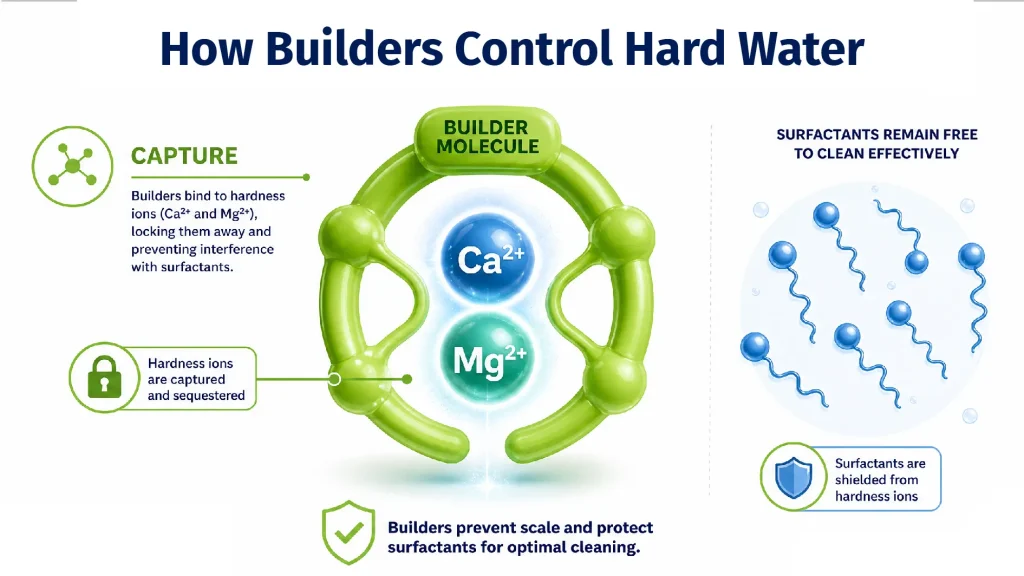
Hard water contains calcium and magnesium ions that can interfere with detergency. Builders and chelating agents bind or control these ions, allowing the surfactants to remain available for cleaning.
Phosphate Builders
Phosphate salts have traditionally been used as detergent builders. Examples include trisodium phosphate, sodium tripolyphosphate (STPP), and tetrapotassium pyrophosphate.
STPP is effective because it forms water-soluble complexes with hardness ions. It can also support alkalinity, improve cleaning, and help maintain the physical condition of detergent powders.
Traditional synthetic laundry powders may contain a substantial proportion of STPP. However, phosphorus released into water can contribute to nutrient enrichment and excessive algae growth. This may consume dissolved oxygen and damage the natural self-purification capacity of the water body.
Consequently, low-phosphate and phosphate-free builder systems have become important formulation directions.
Phosphate-Free Alternatives
Possible alternatives include citrate, gluconate, EDTA, NTA, polyacrylate salts, and synthetic zeolite. Each option has a different balance of water-softening capacity, solubility, cost, compatibility, and suitability for powder or liquid production.
No single replacement reproduces every function of STPP under all conditions. A phosphate-free detergent may need a combination of chelating agents, polymers, alkalinity sources, and dispersants to achieve the required performance.
The builder package should therefore be selected alongside the surfactant system. Choosing it separately can lead to precipitation, reduced detergency, poor powder flow, or unstable liquid products.
Anti-Redeposition Agents Keep Removed Soil in the Wash Water
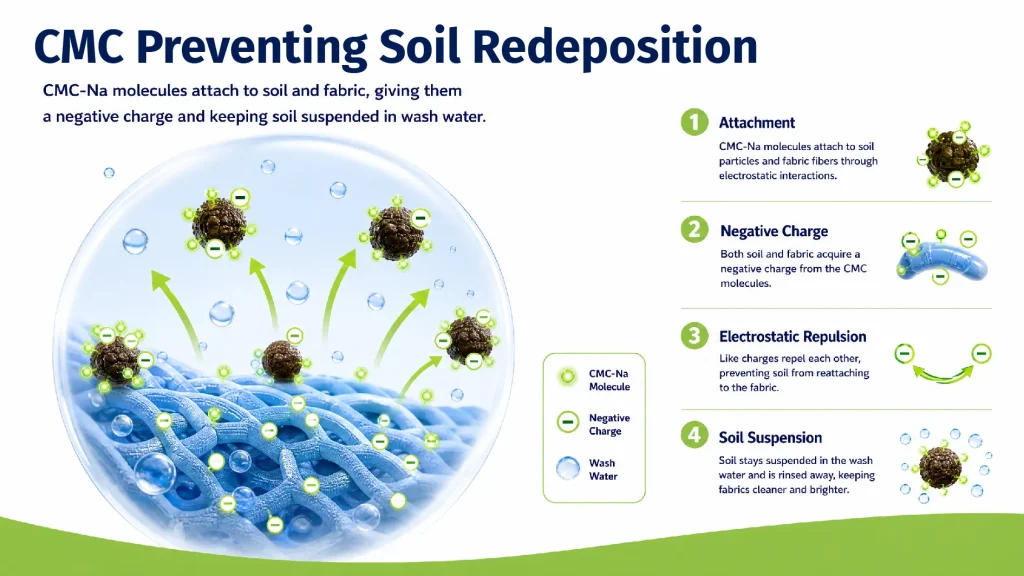
Removing dirt from fabric is only part of the washing process. After soil is detached, it must remain suspended until the wash water is drained.
Without an effective suspension mechanism, dispersed soil can contact the textile again and settle back onto the fibers. This process is known as soil redeposition. Repeated redeposition can make fabrics look grey even when the detergent produces plenty of foam.
The Role of CMC-Na in Detergent
Sodium carboxymethyl cellulose, written as CMC-Na or cellulose gum, is an important anti-redeposition agent in laundry detergent.
CMC-Na can adsorb onto the surfaces of fabrics and soil particles. The resulting negative charges create repulsion between the two surfaces, making it more difficult for removed soil to return to the textile.
A traditional detergent formulation may use approximately 1%-2% CMC-Na as a reference range. This is not a universal dosage. Polymer molecular weight, degree of polymerization, degree of substitution, surfactant concentration, fabric type, and target viscosity all influence the required level.
In addition to anti-redeposition, CMC-Na may contribute to thickening, dispersion, emulsification, suspension, and foam stability. Its film-forming and binding characteristics can also help distribute the formula over the textile surface.
The complete product still requires fabric compatibility and safety testing. A polymer cannot compensate for an excessively harsh surfactant or bleaching system.
Two Meanings of CMC
The abbreviation CMC has two different meanings in detergent technology:
- CMC-Na refers to sodium carboxymethyl cellulose, a cellulose-derived polymer.
- Critical micelle concentration refers to the surfactant concentration at which micelles begin to form.
These concepts are unrelated. Writing the full term at first use prevents confusion in technical documents and product discussions.
Other Anti-Redeposition Polymers
Other materials considered for soil-suspension or anti-redeposition functions include HPMC, HEMC, PVA, PVP, polyacrylic acid, and acrylic acid-maleic acid copolymers.
Their performance can vary with fiber type and detergent composition. Cotton, synthetic fabrics, mixed textiles, and hard-surface materials do not necessarily respond to the same polymer in the same way.
A useful screening program should compare initial cleaning, whiteness retention after repeated washing, soil suspension, solution appearance, and residue on the washed material.
Where Zhiwei Cellulose Ether Fits into Detergent Formulation
At Zhiwei (Jinan) New Materials Co., Ltd., we distinguish between cleaning activity, anti-redeposition, and rheology control. These functions can interact, but they are not interchangeable.
CMC-Na is emphasized for anti-redeposition in traditional laundry detergent systems. HPMC and HEMC may also be evaluated as polymeric auxiliaries. HEC is more commonly screened when a liquid detergent needs viscosity adjustment, suspension support, or a more controlled pouring profile.
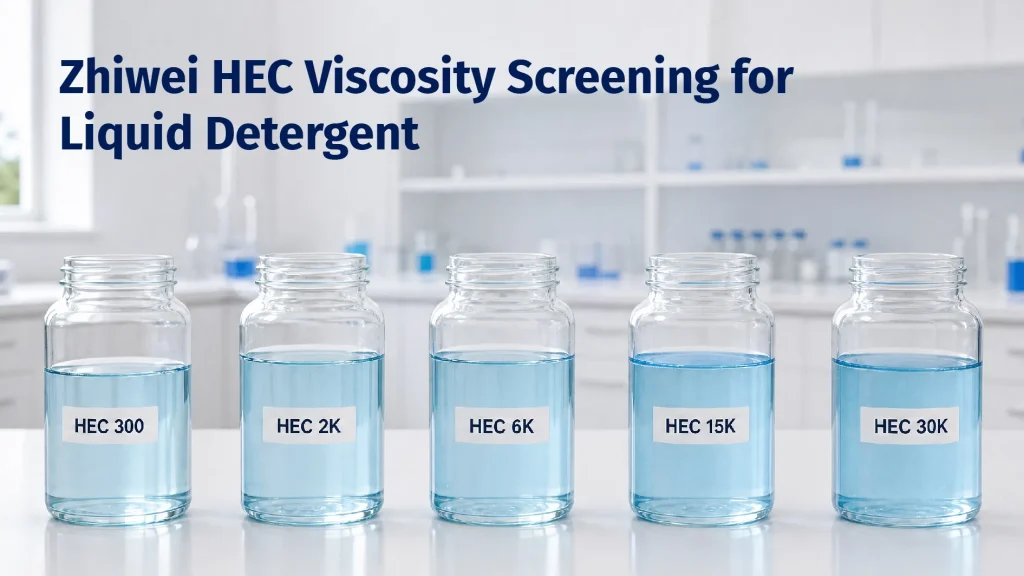
For liquid detergent development, our HEC 300, HEC 2K, HEC 6K, HEC 15K, and HEC 30K grades provide a practical progression for viscosity screening. A formulator can begin with a lower nominal viscosity grade for a light, readily pourable product and move toward higher-viscosity grades when stronger body or suspension is required.
The model number alone should not determine the final choice. Surfactant concentration, salt level, pH, perfume, solvent content, processing temperature, hydration method, and desired appearance can all change the result.
We therefore recommend testing the cellulose ether in the complete formula. The evaluation should include viscosity after preparation, viscosity after storage, pourability, dispersion, clarity or acceptable opacity, and performance at the intended use dilution.
HEC should not be presented as a replacement for the surfactant, builder, enzyme, bleach, or anti-redeposition package. Its primary value in this context is helping the liquid product achieve the required rheology and physical stability.
pH Regulators Support Cleaning and Formula Stability
Many laundry detergents operate under alkaline conditions because alkalinity can assist with oily-soil removal and support the action of selected surfactants and builders.
Sodium silicate and sodium carbonate are common pH-regulating materials in detergent formulation.
Sodium silicate, also known as water glass, can provide alkalinity and buffering. In alkaline powder systems, it may help maintain the wash solution near the desired pH, support suspension and emulsification, stabilize foam, and reduce soil redeposition.
Silicate can also contribute to corrosion protection for metals such as iron, aluminum, copper, and zinc under suitable formulation conditions.
A pH near 11 is associated with some conventional alkaline laundry systems, but it should not be treated as the correct target for every detergent. Liquid products, hand-washing detergents, fabric-care products, and cleaners for sensitive materials may require a different range.
The correct pH is the level that provides sufficient cleaning while maintaining ingredient stability, packaging compatibility, user safety, and material protection.
Bleaching Agents and Optical Brighteners Are Different
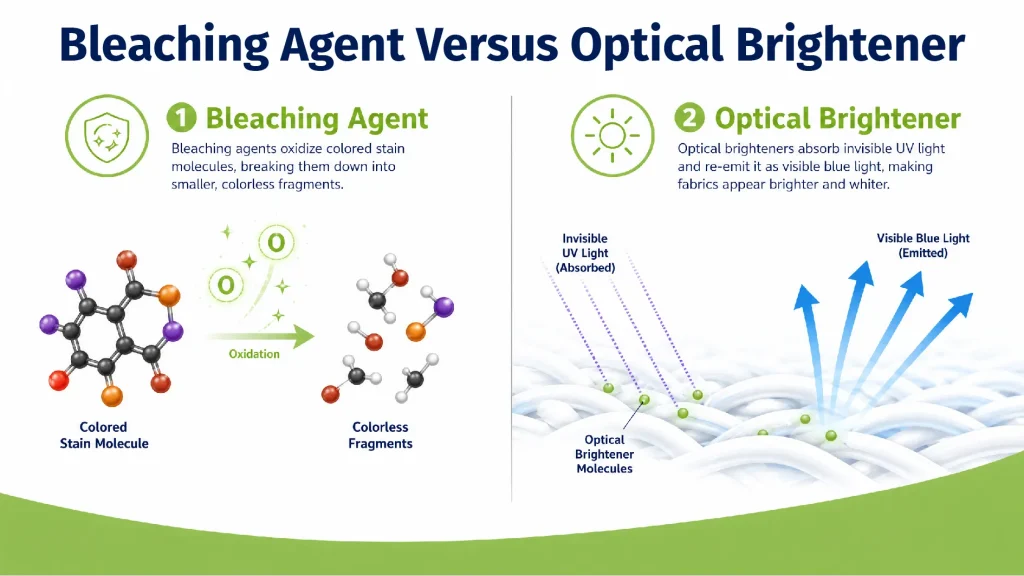
Bleaching agents and fluorescent whitening agents can both make fabrics appear cleaner, but they work through different mechanisms.
| Feature | Bleaching agent | Fluorescent whitening agent |
|---|---|---|
| Main action | Chemically oxidizes colored substances | Changes the way light is reflected and emitted |
| Common types | Chlorine bleach and oxygen bleach | Fluorescent dyes |
| Examples | Sodium hypochlorite, sodium percarbonate, sodium perborate | Stilbene and other fluorescent brightener types |
| Main concern | Stability and material compatibility | Uniform deposition and compatibility with bleach |
| Does it remove stains? | Can break down oxidizable stains | No, it improves visual whiteness |
Chlorine Bleach
Sodium hypochlorite is a strong oxidizing agent. It can provide effective bleaching but is sensitive to factors such as light, heat, heavy-metal contamination, and pH.
Its high oxidation strength also creates compatibility concerns. Fragrance, dye, surfactant, polymer, packaging, and the material being cleaned all require evaluation before sodium hypochlorite is used in a finished product.
Oxygen Bleach
Sodium percarbonate and sodium perborate are oxygen-based bleaching agents commonly associated with powder detergents. Traditional powder formulations may contain relatively high levels, sometimes within a broad 10%-30% reference range.
This range should not be transferred directly to every formula. The required amount depends on active oxygen content, washing temperature, storage conditions, target stain, package moisture barrier, and the rest of the detergent system.
Fluorescent Whitening Agents
Fluorescent whitening agents absorb ultraviolet light and emit visible blue or blue-violet light. This optical effect can counteract a yellow appearance and make white fabrics look brighter.
They do not replace surfactants, builders, or bleaching agents because they do not remove soil. Their success depends on fiber affinity, dispersion, solubility, uniform deposition, and stability in the presence of other ingredients.
Enzymes Target Specific Stain Components
Some stains contain proteins, fats, or starches that are difficult to remove using surfactants alone. Enzymes act as biological catalysts and break these materials into smaller, more water-compatible compounds.
An effective detergent enzyme system should retain useful activity under the intended washing conditions. Important requirements include:
- Activity across a practical washing temperature range, commonly considered between approximately 10°C and 60°C.
- Effective performance in the alkaline environment of the detergent.
- Compatibility with other enzymes and formulation ingredients.
- Tolerance to surfactants, particularly anionic surfactants.
- Sufficient stability during product storage and use.
A high initial enzyme activity does not guarantee a successful detergent. Activity can decline during storage if the enzyme is exposed to an unsuitable pH, water level, surfactant system, oxidizing agent, or temperature.
The enzyme package should match the expected soil. A formula targeting food starch, for example, has different requirements from one developed for fatty or protein-based stains.
Fillers, Hydrotropes, and Solubilizers Control Product Form
Sodium Sulfate in Powder Detergent
Sodium sulfate is commonly used as a filler in detergent powders. Traditional powder formulations may contain approximately 20%-40%, depending on product concentration and manufacturing requirements.
Calling it a filler does not mean it has no formulation effect. Sodium sulfate can influence powder flow, hygroscopicity, composition balance, surfactant behavior, dispersion stability, and product cost.
It may also lower the critical micelle concentration of a surfactant system. In this sentence, CMC means critical micelle concentration, not carboxymethyl cellulose.
Too much filler reduces the proportion of active ingredients. Too little may create processing, flow, or cost problems. The suitable amount depends on whether the detergent is conventional, concentrated, compact, or designed for a specific dosing system.
Hydrotropes in Liquid Detergent
Concentrated liquid detergents can contain more active material than the water phase can easily accommodate. Cloudiness, separation, crystallization, or incomplete dissolution may appear when surfactants, perfume, solvents, and salts compete within the same formula.
Hydrotropes and solubilizers help improve ingredient distribution and product clarity. Examples include ethanol, urea, polyethylene glycol, and toluenesulfonate salts.
These ingredients should support solubility without significantly reducing cleaning performance. Their concentration must also be balanced against viscosity, odor, flash point, packaging compatibility, and cost.
Sodium p-toluenesulfonate may additionally help control caking in selected detergent systems.
Softeners, Antistatic Agents, Bacteriostatic Agents, and Solvents
Synthetic fibers can develop static electricity and an undesirable hand feel after washing. Cationic or amphoteric surfactants may be introduced to provide antistatic and softening effects.
These materials must be integrated carefully because the formula already contains other charged ingredients. Compatibility should be checked through storage testing, dilution testing, fabric evaluation, and observation for precipitation or loss of performance.
Cold-water washing can create additional odor and hygiene concerns. Selected detergents therefore include a bacteriostatic system. The active ingredient and dosage should be chosen for the intended application and destination market, supported by safety assessment and verified product performance.
Solvents are particularly relevant in liquid and nonaqueous detergents. They can assist with oily stains, improve the distribution of ingredients, and help the formula wet the surface. Alcohols, ethers, esters, pine oil, and specialized solvents are examples of the broader solvent categories used in cleaning products.
Solvent selection affects far more than detergency. Odor, volatility, material compatibility, storage stability, worker handling, and packaging must all be considered.
Powder and Liquid Detergents Need Different Ingredient Structures
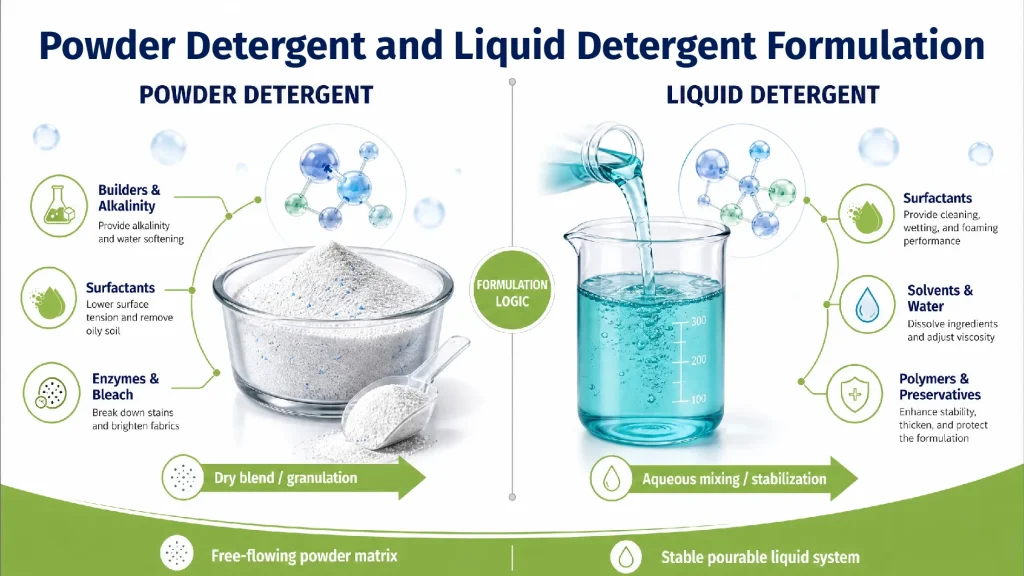
| Formulation area | Powder detergent | Liquid detergent |
|---|---|---|
| Surfactant system | Anionic and nonionic combinations are common | Anionic, nonionic, and amphoteric blends can be used |
| Hard-water control | STPP, zeolite, carbonate, silicate, and polymers | Soluble chelators and compatible polymers |
| Bleaching | Oxygen bleach is easier to incorporate | Bleach compatibility can be more difficult |
| Product structure | Filler, anti-caking control, powder flow | Rheology modifier, hydrotrope, and solvent balance |
| Enzyme challenge | Moisture and storage stability | Water exposure and surfactant compatibility |
| Main physical risk | Caking, poor flow, segregation | Separation, cloudiness, viscosity drift |
| Cellulose polymer role | Anti-redeposition and powder support | Anti-redeposition, suspension, and viscosity control |
A powder detergent has to remain dry, free-flowing, and compositionally uniform. A liquid detergent must remain pourable, homogeneous, and stable despite containing water, surfactants, salts, perfume, and other functional materials.
The same ingredient can behave differently in these two formats. A polymer that disperses easily in a powder premix may form lumps when added directly to a concentrated liquid. A builder that performs well in a powder may have insufficient solubility for a clear liquid detergent.
How the Ingredients Work Together During Washing
At the beginning of the wash cycle, the surfactant system lowers interfacial tension and wets the fabric. Oily soil becomes emulsified, while particulate dirt is loosened from the surface.
Builders and chelating agents control hardness ions so that the surfactants can continue working. Alkalinity supports the removal of selected soils, while enzymes begin breaking down protein, fat, or starch components.
Once the soil leaves the fabric, dispersants and anti-redeposition polymers help keep it suspended. This stage is essential because detached dirt can otherwise settle back onto the fibers.
Bleaching agents act on oxidizable stains where the formula and washing conditions permit. Fluorescent whitening agents can improve the final visual whiteness, while softening or antistatic components influence the feel of the textile after rinsing and drying.
The performance perceived by the user is therefore the result of several consecutive processes. Weakness in one stage can reduce the value of the entire detergent.
How to Build a Practical Detergent Formulation Brief
Before selecting raw materials, the formulator should define the product clearly.
1. Choose the Product Form
Decide whether the detergent will be a powder, standard liquid, concentrated liquid, nonaqueous liquid, or another format. This decision affects almost every later ingredient choice.
2. Define the Target Soil
A household laundry detergent, industrial degreaser, cold-water wash product, and fabric-care liquid do not require the same surfactant or enzyme package.
3. Establish the Water Conditions
Hard-water performance should be considered at the beginning rather than corrected after the surfactant system has already been fixed. Builder and chelator selection can change detergency, clarity, residue, and cost.
4. Select the Supporting Polymers
Choose anti-redeposition and rheology-control materials according to the fabric, product format, surfactant concentration, and desired flow. In liquid products, compare several viscosity grades rather than assuming that the highest-viscosity polymer will produce the best result.
5. Add Optional Performance Modules
Bleach, fluorescent whitening agents, enzymes, softeners, antistatic agents, bacteriostatic systems, and solvents should be added only when they support the intended product claim.
6. Test the Complete Formula
| Test area | What to evaluate |
|---|---|
| Cleaning performance | Removal of representative oil, protein, starch, and particulate soil |
| Hard-water behavior | Detergency, precipitation, residue, and clarity |
| Anti-redeposition | Whiteness retention and greying after repeated washing |
| Viscosity | Initial viscosity, storage change, pourability, and dilution behavior |
| Foam | Foam generation, persistence, rinse behavior, and machine suitability |
| Physical stability | Separation, sedimentation, caking, crystallization, and color change |
| Ingredient stability | Enzyme activity, bleach stability, fragrance, and polymer compatibility |
| Material compatibility | Fabric, metal, packaging, and equipment contact |
| Temperature stability | Low-temperature and elevated-temperature storage |
A formulation that looks stable immediately after mixing may still fail after temperature cycling or extended storage. Performance testing and stability testing should therefore proceed together.
Common Mistakes When Selecting Detergent Ingredients
One frequent mistake is using foam height as the main measure of cleaning. Foam can influence user perception, but grease removal, soil suspension, rinsing, and hard-water tolerance provide a more complete picture.
Another error is expecting one ingredient to solve unrelated problems. Adding more surfactant will not automatically prevent soil redeposition. Increasing polymer viscosity cannot replace a suitable builder. More bleach does not correct an unstable enzyme system.
Traditional reference percentages should also be treated carefully. A sodium sulfate, STPP, bleach, or CMC-Na level used in one powder detergent may be unsuitable for a concentrated liquid or a different washing process.
Confusing carboxymethyl cellulose with critical micelle concentration can create technical misunderstandings. The first is a polymeric detergent auxiliary; the second is a surfactant property.
Finally, selecting a cellulose ether only from its nominal viscosity overlooks the rest of the formula. Salt, surfactant, pH, solvent, temperature, and hydration procedure can change the viscosity observed in the finished product.
Frequently Asked Questions
What Is the Main Ingredient in Detergent?
Surfactants are the primary cleaning ingredients. Water, builders, fillers, or solvents may occupy a large part of the formula by weight, but surfactants provide the central wetting, emulsifying, and soil-removal action.
Why Does Detergent Need More Than One Surfactant?
Different surfactants have different strengths. A compatible blend can combine strong detergency, grease removal, hard-water tolerance, foam control, and improved product feel.
What Is the Function of CMC in Detergent?
CMC-Na helps prevent removed soil from redepositing on fabrics. It can also contribute to thickening, dispersion, suspension, and foam stability.
Is CMC in Detergent the Same as Critical Micelle Concentration?
No. CMC-Na is sodium carboxymethyl cellulose. Critical micelle concentration is the surfactant concentration at which micelles begin to form.
Why Are Builders Added to Laundry Detergent?
Builders control calcium and magnesium ions, support alkalinity, improve surfactant efficiency, and help manage soil dispersion. They are particularly important in hard water.
Are Phosphates Necessary in Detergent?
Phosphates such as STPP are effective builders, but they are not the only option. Citrate, gluconate, polyacrylates, chelating agents, and zeolite can be used in low-phosphate or phosphate-free systems.
What Is the Difference Between Bleach and Optical Brightener?
Bleach chemically oxidizes colored stains. An optical brightener absorbs ultraviolet light and emits visible blue light, making fabric appear whiter without directly removing soil.
Why Are Enzymes Added to Detergent?
Enzymes help break down difficult protein, fat, and starch stains into smaller compounds that can be removed more easily during washing.
What Does Sodium Sulfate Do in Detergent Powder?
Sodium sulfate acts as a filler and processing aid. It can influence powder flow, composition balance, surfactant behavior, dispersion, and product cost.
Which Zhiwei HEC Grade Can Be Used in Liquid Detergent?
The selection depends on the target viscosity and the complete formulation. At Zhiwei, we can screen HEC 300, HEC 2K, HEC 6K, HEC 15K, and HEC 30K as starting options. Final selection requires testing with the actual surfactant, salt, pH, perfume, and solvent system.
Conclusion
The main detergent ingredients are surfactants and detergent auxiliaries. Surfactants perform the central cleaning work, while builders, polymers, pH regulators, bleaching agents, optical brighteners, enzymes, fillers, solvents, and fabric-care additives make that cleaning process more reliable.
A successful formulation does not contain every available ingredient. It contains the right combination for the intended product form, washing conditions, target soil, and performance requirements.
At Zhiwei (Jinan) New Materials Co., Ltd., we support detergent manufacturers with cellulose ether selection for liquid-product viscosity and physical stability. By screening suitable HEC grades in the complete formula, we can help identify a practical balance between pourability, suspension, appearance, processing, and storage performance.