
Choosing HPMC for cement-based tile adhesive starts with the performance of the finished mortar. A suitable grade should help retain water, provide manageable troweling resistance, and support adequate tile wetting throughout the required open time. Its contribution must also fit the formulation’s slip resistance and adhesion requirements.
Viscosity is a useful specification, but it cannot answer all these questions. Two grades with similar solution-viscosity values can behave differently after mixing with cement, aggregate, polymer powder, and other additives.
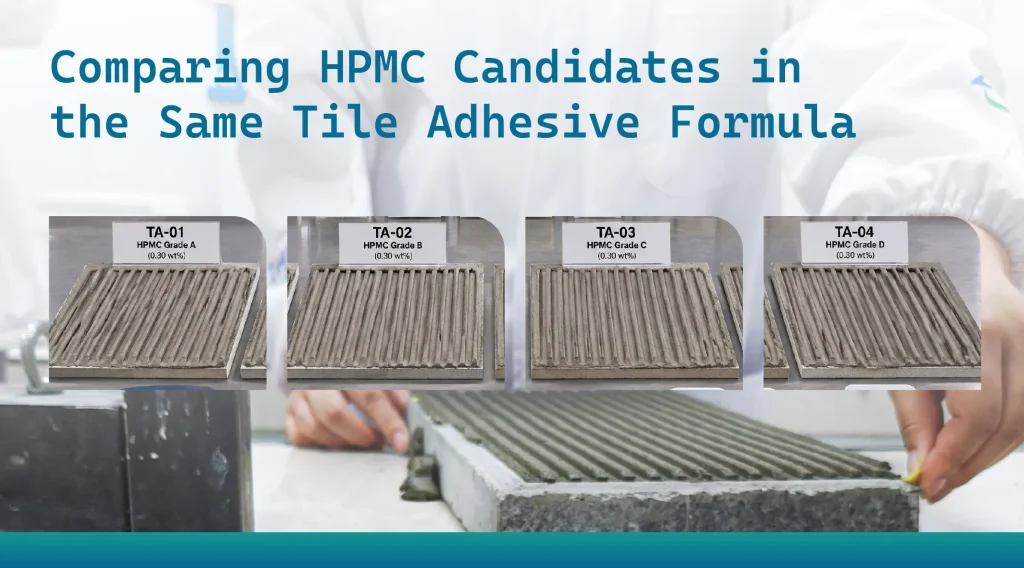
At Zhiwei, we recommend selecting HPMC through a controlled comparison in your actual formulation. Start with the required adhesive performance, identify the current limitation, and test candidates against that specific need.
What Does HPMC Do in Tile Adhesive?
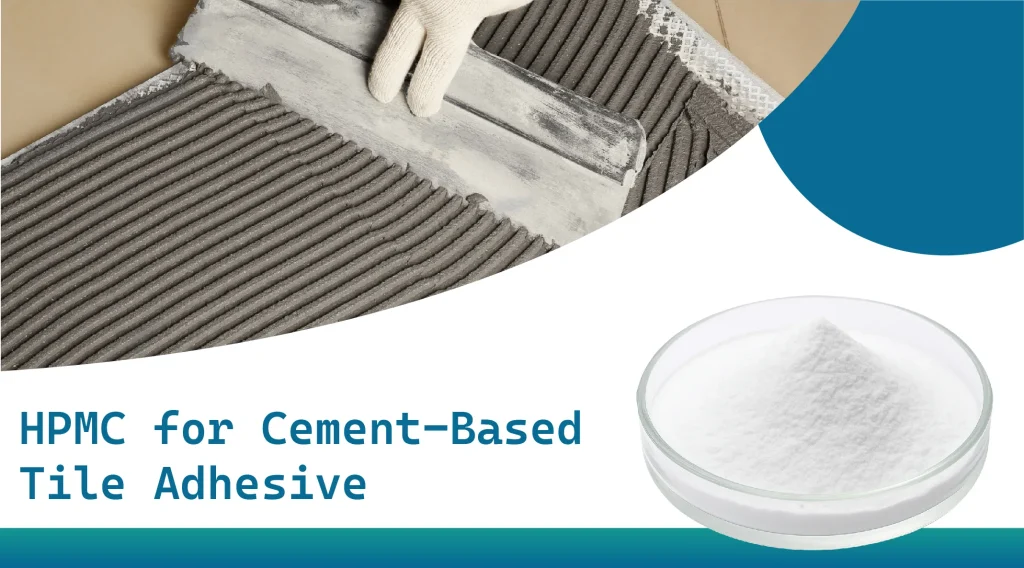
Hydroxypropyl methylcellulose, or HPMC, is a nonionic cellulose ether used in construction mixtures for water retention and consistency control. In tile adhesive, it influences how the fresh mortar mixes, spreads, holds its ridges, and remains workable before tile placement.
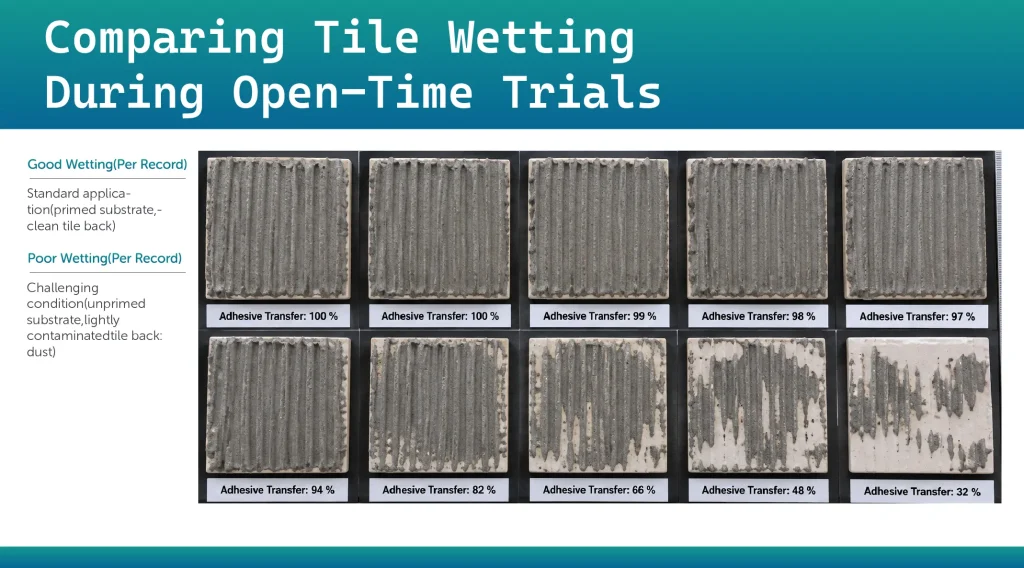
These functions are connected. Water loss into an absorbent substrate can change mortar consistency, while exposure to air can affect the surface that must wet the tile. The formulation needs enough body for application and sufficient mobility to establish contact when the tile is embedded.
Research on cementitious tile adhesives identifies cellulose ether as an additive contributing to thickening, water retention, and air entrainment. The same research shows that skin formation before tile placement can reduce wetting and final adhesive strength. This makes the exposed mortar surface an essential part of grade evaluation. Influence of Polymers on Microstructure and Adhesive Strength of Cementitious Tile Adhesive Mortars
Define the Adhesive Before Selecting the Grade
First establish what the adhesive needs to do. A floor adhesive, a vertical-wall adhesive, and a product intended for demanding environmental conditions may require different balances of fresh and hardened properties.
Record the substrate, tile type, application thickness, mixing-water range, and expected site conditions. Also define the required classification and associated test methods for the market where the product will be sold.
This information turns a broad request for “good HPMC” into a useful selection task. For example, an adhesive that spreads well but loses tile transfer after exposure needs a different investigation from one that retains transfer but allows excessive vertical movement.
Keep a sample of the existing formulation as the control. Without a reference, a new grade may feel better during mixing while creating a less obvious problem elsewhere.
Understand What the Viscosity Specification Means
An HPMC viscosity value describes the result of a defined measurement. It should include the solution concentration, temperature, instrument, and relevant instrument settings.
A value measured in a 2% aqueous solution cannot be directly compared with one measured at a different concentration. Likewise, different instruments or rotational speeds can produce results that do not represent the same measurement conditions.
Ask for the complete method before using viscosity to compare suppliers or grades. A model name containing a number is also insufficient unless the accompanying specification explains what that number represents.
The next step is testing in mortar. Solution viscosity helps organize candidate selection, but it does not directly measure trowel feel, tile transfer, slip, or adhesion. Those properties arise from the interaction of the whole formulation.
Why the Highest Viscosity Is Not Always the Best Choice
A higher-viscosity grade can increase the body of a mixture, but the adhesive still needs to spread and deform appropriately under the tile. Excessive application resistance can make it harder to produce consistent contact.
Grade and dosage also interact. A lower-viscosity product at one concentration can differ from a higher-viscosity product used at a lower concentration, even where one fresh-state measurement appears similar.
A study comparing hydroxyalkyl methylcelluloses at equivalent water-retention levels found notable differences in early skin formation. Under the conditions investigated, higher additions of lower-molecular-weight cellulose ether outperformed lower additions of higher-molecular-weight material in this respect. The finding supports evaluating the grade–dosage combination rather than ranking products by viscosity alone. The Influence of Hydroxyalkyl Methylcellulose on Early Skin Formation in Cement-Based Tile Adhesive
That result is a reason to test alternatives, not a universal instruction to select lower viscosity. The preferred combination must meet all the requirements of your adhesive.
Evaluate Water Retention and Open Time Separately
Water retention describes the mortar’s resistance to losing water under the specified test conditions. Open time concerns the period after spreading during which tile placement can still achieve the required performance.
A water-retention result is useful, but it does not establish open time by itself. The mortar surface can change during exposure even while material beneath it remains soft.
Test tile placement at defined exposure intervals. Keep the substrate, tile, adhesive thickness, embedding procedure, and environmental conditions consistent. Assess tile wetting and complete the adhesion tests required by the applicable procedure.
Also distinguish open time from pot life. A mortar can remain workable in the mixing container while its exposed ridges lose the ability to wet a tile adequately. Recording these as separate properties avoids a common selection error.
Balance Slip Resistance With Tile Embedding
For vertical applications, the adhesive must resist unacceptable tile movement after placement. HPMC contributes to the mortar’s consistency, but slip performance also depends on water content, aggregate grading, and the rest of the rheology package.
A mixture that holds sharp ridges is not automatically providing the best contact. Check how those ridges deform under the specified tile-placement procedure.
This is especially relevant when adjusting a formulation to improve slip. An increase in body may help one observation while making spreading or embedding more difficult. The correct balance should be demonstrated through both the slip test and practical application assessment.
Avoid selecting an HPMC grade solely because a freshly mixed sample looks firm. Compare it at the intended water addition and after the same conditioning period as the control.
Test Under Relevant Temperature and Drying Conditions
Environmental exposure belongs in the selection program when the adhesive will be used in hot, dry, or moving air. A comfortable laboratory condition may not reveal the same application limitation as an exposed job site.
Record air temperature, substrate temperature, relative humidity, and airflow where relevant. Then compare candidates under reproducible conditions that reflect the intended use.
Do not assume a universal temperature limit from the HPMC name alone. Thermal behavior depends on the grade, and a supplier’s solution test does not directly predict open time in a cementitious mixture.
A useful development program includes the required reference conditions and a separate application comparison for the expected environment. Keep those results clearly identified so that an internal stress test is not confused with a classification test.
Check Compatibility With the Complete Formulation
HPMC performs alongside cement, sand, mineral fillers, redispersible polymer powder, and any additional additives. A candidate should therefore be evaluated in the actual raw-material combination intended for production.
Changes in cement source or aggregate grading can affect the comparison. Keep these materials consistent during initial screening, then assess robustness against the variations your production process is likely to encounter.
Polymer powder and HPMC also serve different purposes. Improving fresh consistency does not establish that the hardened adhesive meets its adhesion or deformation requirements. Any adjustment to one ingredient should be checked against the functions supplied by the others.
Record fresh-mortar density or air content where appropriate to your test program. Cellulose ether can affect air entrainment, so a change in application feel deserves investigation alongside the hardened results.
Choose the Dosage Through a Defined Trial
Use a dosage basis that everyone can reproduce. For dry-mix production, state whether the percentage is calculated against the complete dry blend or another defined component.
For example, 3 kg added within 1,000 kg of finished dry mix represents 0.3% by mass. This is a calculation example, not a recommended dosage for every tile adhesive.
Begin with supplier-supported trial levels appropriate to the selected grade and formulation. Compare a small series around the initial level while keeping the other ingredients unchanged.
The mixing-water strategy should be explicit. An initial comparison at fixed water content shows how the grade changes consistency in an otherwise unchanged formula. A subsequent comparison at matched application consistency can help evaluate each candidate as part of an optimized formulation. Record the water adjustment in either case.
A Practical Comparison Plan
A compact trial matrix helps keep decisions tied to evidence. Use the same preparation and conditioning procedure for every candidate, then expand the testing for those that show promise.
| Selection area | What to compare | Why it matters |
|---|---|---|
| Preparation | Dispersion, mixing uniformity, and consistency development | Establishes a reproducible process |
| Workability | Spreading resistance, combing, and tool pickup | Reflects application quality |
| Water retention | Results under a defined method | Supports moisture-management assessment |
| Open time | Tile placement and adhesion after specified exposure | Checks performance after spreading |
| Slip | Tile movement under the required procedure | Evaluates vertical application |
| Fresh-mortar properties | Relevant rheology, density, or air measurements | Helps explain differences between candidates |
| Hardened performance | Required adhesion and other specified properties | Confirms fitness for the intended classification |
Do not approve a grade based only on the easiest result to obtain. A candidate that improves troweling still needs to pass the relevant performance tests.
Which Zhiwei Product Should You Evaluate?
Our HPMC range includes products for construction applications such as tile adhesives, mortars, and plasters. We recommend discussing candidates using your complete formulation and target properties.
The most useful starting information is your cement and aggregate composition, polymer package, current cellulose ether, mixing-water range, and the result you want to improve. Existing open-time, slip, and adhesion data make the recommendation more focused.
Our public HPMC overview does not establish one universal tile-adhesive grade. We would confirm the current technical specification and propose samples for comparison in your mortar before making a final selection.
Where a broader cellulose-ether comparison is justified, our HEMC range provides an additional product family to discuss. Any substitution should follow the same formulation tests rather than an assumption of equivalence.
Build a Repeatable Purchasing Specification
Once a candidate performs satisfactorily, document more than its commercial name. Agree on the viscosity test method, relevant powder specifications, preparation instructions, and batch documentation.
Retain the successful laboratory formula and define the acceptance checks used during production qualification. This provides a reference if later changes occur in mixing behavior or application performance.
At Zhiwei, we recommend choosing HPMC for cement-based tile adhesive through this combination of specification and mortar testing. Share your formulation and target performance with us so that sample selection can address the properties that matter to your product.