
Introduction
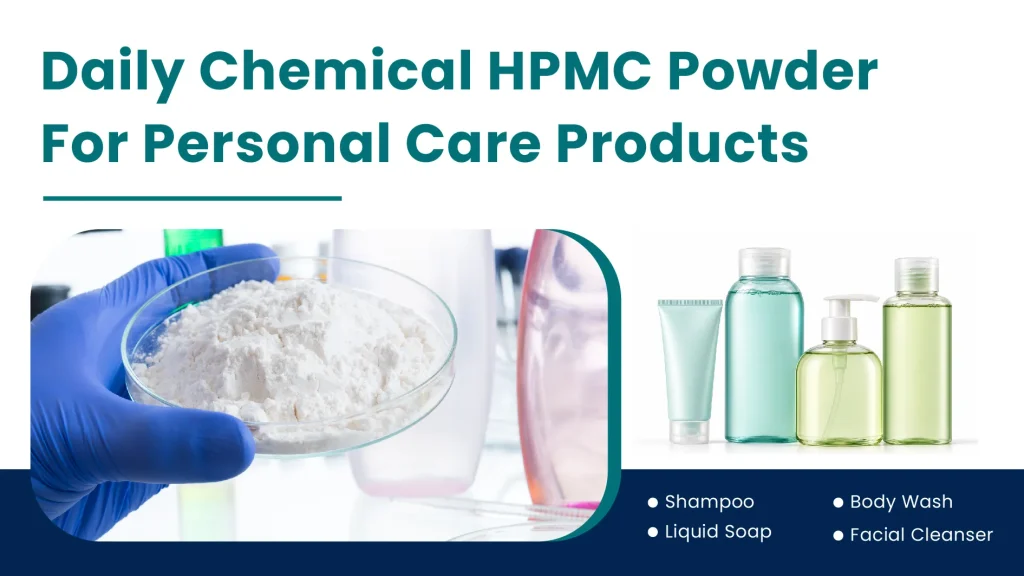
Daily chemical products need more than cleaning power. A shampoo must feel smooth in the hand. A body wash must produce stable foam and leave a pleasant skin feel. A facial cleanser must be mild and easy to rinse. A detergent must pour well, stay stable, and look consistent during storage.
This is why daily chemical HPMC is useful. HPMC, or hydroxypropyl methylcellulose, is a non-ionic cellulose ether made from natural cellulose. In daily chemical and washing products, it can work as a thickener, stabilizer, film-forming aid, foam-supporting agent, and water-retention aid.
For brands and manufacturers, HPMC can help improve product texture while keeping the formula simple. It can also help reduce cost in some formulas because a small amount can build useful viscosity and improve the system feel. In shampoo and body wash, HPMC can support thickening, freeze-thaw stability, water retention for hair and skin, and a soft film-forming effect.
Zhiwei supplies HPMC products for daily chemical and construction systems. For high-viscosity daily chemical formulas, Zhiwei HPMC 200K can be tested when the product needs stronger body, stable texture, and better handling. Other grades such as HPMC 100K and HPMC 150K can also be considered when the formula needs a different viscosity direction.
What Is Daily Chemical HPMC?
Daily chemical HPMC is hydroxypropyl methylcellulose used in personal care, cleaning, and washing products. It is made from natural cellulose through chemical modification. Cellulose is a natural high molecular compound. In its original form, cellulose has strong hydrogen bonds inside and between molecular chains. Because of this, it does not react easily.
During production, cellulose is treated so the molecular structure becomes more reactive. The hydroxyl groups are activated and then modified through etherification. This changes part of the cellulose structure and forms cellulose ether. HPMC is one type of cellulose ether.
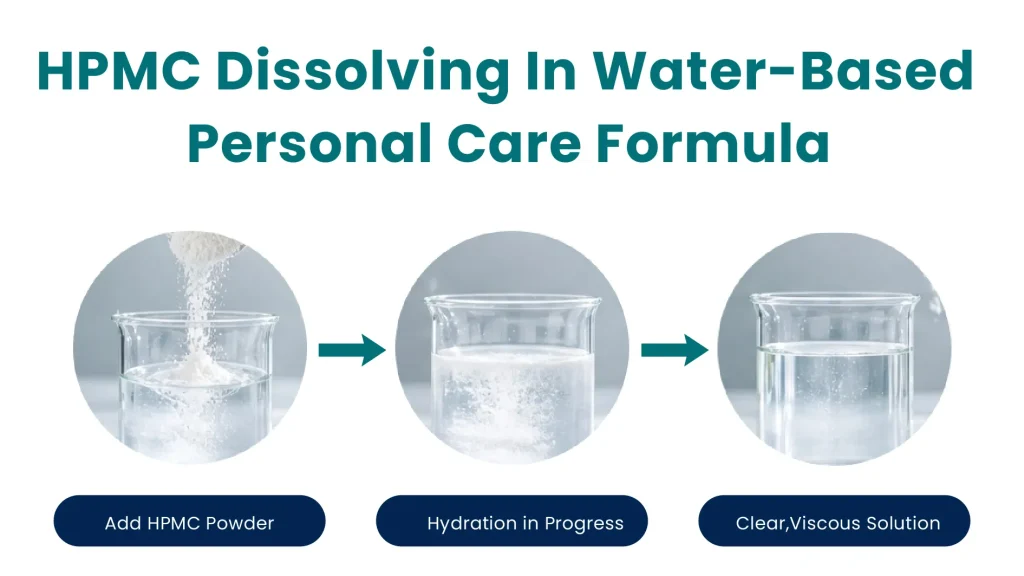
The final daily chemical HPMC product is usually a white or slightly yellowish powder. It has no clear odor, no strong taste, and is non-toxic under normal industrial use. It can dissolve in cold water and in some mixed solvent systems. After full hydration, it forms a transparent or slightly cloudy viscous solution.
HPMC is non-ionic. This gives it useful stability in many water-based formulas. It can work in a wide pH range and can be used with many surfactant systems after compatibility testing.
Why HPMC Is Used In Daily Chemical Formulas
HPMC is used because it can improve several formula properties at the same time.
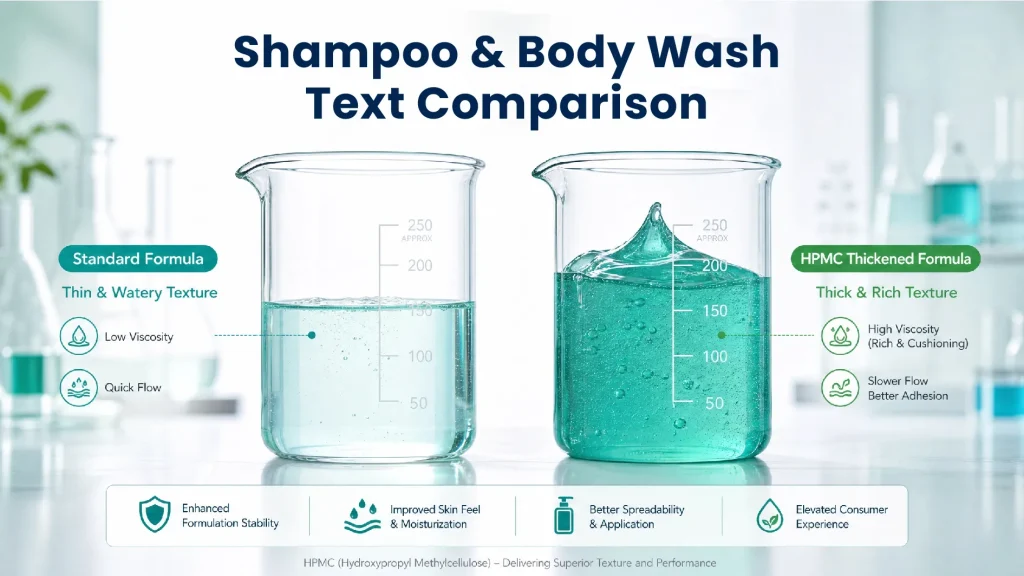
It can increase viscosity. This gives shampoo, body wash, facial cleanser, detergent, gel, or cream a better texture.
It can support foam quality. In some systems, it helps foam become more stable and more pleasant.
It can improve flow. A product should not be watery, but it also should not become hard to pour. HPMC can help create a smoother flow curve.
It can improve stability. It helps the formula keep a more uniform structure during storage.
It can form a light film. This can improve the skin or hair feel in selected formulas.
It can help reduce freeze-thaw problems. This is useful for products that may face low-temperature storage or transport.
These functions make HPMC useful in many daily chemical products, including shampoo, body wash, hand soap, facial cleanser, lotion, cream, gel, toner, hair conditioner, styling products, toothpaste, mouthwash, and bubble solutions.
Main Benefits Of HPMC In Daily Chemical Products
Low Irritation And Mild Formula Support
Daily chemical HPMC is valued because it supports mild formulas. It does not need to be used at a high level to affect texture. In personal care products, mildness matters because the formula touches skin, hair, scalp, or oral surfaces.
A good HPMC grade can help improve texture without making the formula feel harsh. It is useful in products that need a smooth and gentle experience, such as body wash, facial cleanser, shampoo, and cream.
Wide pH Stability
HPMC has good pH stability. In many systems, it can remain stable in the range of about pH 3-11. This is useful because daily chemical products can have different pH targets.
A shampoo may be weakly acidic or near neutral. A body wash may be designed for mild skin feel. A detergent may be more alkaline. A toothpaste or mouthwash formula may have its own pH control system.
HPMC does not solve all pH compatibility problems by itself. But its wide pH stability gives formulators more room to work.
Better Conditioning Feel
HPMC can improve the conditioning feel of some formulas. It can help the product feel smoother during use. In shampoo and body wash, this can improve the hand feel during spreading and rinsing.
For hair products, film formation and water retention can help improve the sense of softness. For skin products, it can support a smoother application feel.
Foam Support And Foam Stability
Foam is important in many daily chemical products. Consumers often connect foam with cleaning power, even when the real cleaning performance depends on the surfactant system.
HPMC can help improve foam feel and foam stability in some formulas. It can make bubbles feel more compact and stable. This is useful for shampoo, body wash, liquid soap, facial cleanser, and bubble water products.
Improved Flow And Pour Control
A good daily chemical product should pour smoothly. If the viscosity is too low, the product may look cheap or weak. If the viscosity is too high, it may be hard to pump, bottle, or rinse.
HPMC can improve the system flow and help the product feel more controlled. This is useful for bottle products, pump products, and gel-like products.
Thickening And Texture Building
High-viscosity HPMC is often used as a thickener. Low-viscosity HPMC may be used more for suspension, dispersion, and film formation.
In personal care and detergent formulas, viscosity control must be balanced with clarity, foam, salt tolerance, surfactant compatibility, fragrance compatibility, and packaging performance.
HPMC Applications In Daily Chemical Products
HPMC For Shampoo
In shampoo, HPMC can improve viscosity, foam stability, and use feel. It can help create a smooth paste-like or liquid gel texture. This makes the product easier to dose and apply to the hair.
HPMC can also help improve water retention and film-forming feel. For shampoo formulas, it should be tested with the surfactant system, salt level, fragrance, preservative, and pH system.
If the shampoo needs a strong body, Zhiwei HPMC 200K can be used as a high-viscosity screening option. If the formula needs lower viscosity or cleaner flow, a lower-viscosity grade may be better.
HPMC For Body Wash
Body wash needs a soft texture, stable foam, and good flow. HPMC can help build body and improve use feel. It can also help the formula look more stable in the bottle.
A good body wash should not separate during storage. It should not become too thin in warm conditions or too thick in cold conditions. HPMC can support texture control, but the final stability depends on the whole surfactant and thickening system.
HPMC For Facial Cleanser
Facial cleanser formulas often need mildness and smooth texture. HPMC can help improve viscosity and spreading. It can also help make the formula feel softer during use.
For facial cleanser, clarity and mild skin feel may be important. The HPMC grade should be tested at different dosages, because too much thickener can make the cleanser feel heavy.
HPMC For Lotion And Cream
In lotions and creams, HPMC can help improve viscosity, emulsion stability, and film formation. It can also support a smoother application feel.
HPMC can work with emulsifiers and other stabilizers. But it should be tested in the final emulsion system because oils, surfactants, electrolytes, fragrances, and preservatives may affect stability.
HPMC For Gels And Toners
HPMC can help build light gel texture. It can be used in clear or semi-clear systems where smooth flow and water retention matter.
For toners, the dosage should usually be lower because the product should remain light. For gels, higher viscosity grades can be tested when a stronger body is needed.
HPMC For Hair Conditioner And Styling Products
Hair conditioner and styling products need slip, texture, and sometimes film-forming behavior. HPMC can help with viscosity and film formation. This can support product handling and the final feel on hair.
It should be tested with cationic conditioning agents and other polymers because compatibility is important.
HPMC For Toothpaste And Mouthwash
In toothpaste, HPMC can support thickening, suspension, and paste texture. It can help keep abrasive particles evenly distributed and improve the body of the paste.
In mouthwash, the formula is usually lower viscosity. HPMC may be used only when slight body or film-forming support is needed. Clarity and taste must be tested carefully.
HPMC For Bubble Water
Bubble solutions need foam and film stability. HPMC can help support bubble film strength and improve solution body. This can make bubbles more stable and easier to form.
Recommended Dosage Direction
In many daily chemical formulas, HPMC can be tested at about 0.3-0.5%. The exact dosage depends on formula type, surfactant level, salt level, target viscosity, processing method, and product positioning.
A high-viscosity formula may need less HPMC than expected. A low-viscosity product may need a lower grade or a lower dosage. It is best to test several levels, such as 0.2%, 0.3%, 0.4%, and 0.5%, then compare viscosity, foam, clarity, storage stability, and sensory feel.
How To Dissolve HPMC In Daily Chemical Formulas
HPMC must be dispersed correctly. If it is dumped into water too fast, it can form lumps or fisheyes. These lumps may be hard to dissolve later.
A practical method is to add HPMC slowly into moving water under good agitation. The powder should be spread evenly across the vortex, not poured into one spot. After dispersion, allow enough time for hydration.
In some formulas, HPMC can be pre-wetted with a compatible solvent or mixed with other dry ingredients before water is added. This helps reduce lumping.
For high-viscosity grades such as HPMC 200K, dispersion control is very important. The higher the viscosity, the more carefully the powder should be added and hydrated.
How To Choose The Right HPMC Grade
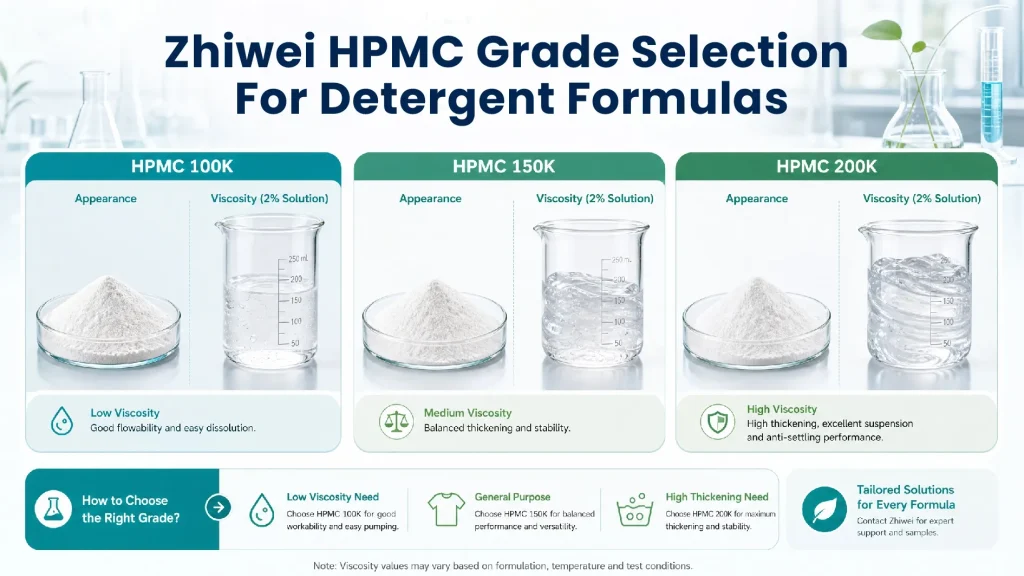
The right HPMC grade depends on the product type and target texture.
For a light shampoo or light body wash, a medium or lower-viscosity grade may be better. It can improve body without making the product too heavy.
For a rich body wash, thick shampoo, gel cleanser, or premium cream, a higher-viscosity grade can be tested.
For daily chemical formulas that need strong thickening, Zhiwei HPMC 200K is a useful screening grade because it has a high label viscosity direction. For formulas that need slightly lower body, Zhiwei HPMC 150K or HPMC 100K can be considered.
For very light rheology adjustment, lower grades such as HPMC 400 or HPMC 4K may be useful in selected water-based systems, but they will not build the same body as high-viscosity grades.
| Product Type | Main Formula Need | Suggested HPMC Direction |
|---|---|---|
| Shampoo | Thickening, foam feel, conditioning support | HPMC 100K, HPMC 150K, HPMC 200K |
| Body wash | Smooth texture, foam stability, pour control | HPMC 100K, HPMC 150K, HPMC 200K |
| Facial cleanser | Mild texture, smooth spreading | Test moderate to high viscosity grades |
| Lotion and cream | Emulsion body, stability, film feel | Test based on oil phase and emulsifier system |
| Gel | Stronger structure and smooth feel | Higher-viscosity HPMC |
| Toothpaste | Paste body and suspension | Higher-viscosity HPMC after abrasive compatibility test |
| Bubble water | Foam film support | Test low to moderate dosage |
HPMC Compared With Other Thickeners
Daily chemical formulas can use many thickening systems. Salt is common in surfactant formulas. Carbomer, acrylic polymers, xanthan gum, CMC, HEC, HEMC, and HPMC can also be used.
Salt is cheap, but too much salt can hurt clarity, stability, and skin feel.
Carbomer gives clear gels, but pH and neutralization must be controlled.
Xanthan gum gives strong suspension, but it may feel stringy in some products.
HEC is widely used in shampoos, body wash, detergents, and lotions.
HPMC gives a useful balance of thickening, film formation, water retention, and wide pH stability. It can be a practical choice when the formula needs texture, mildness, and stable body.
In some Zhiwei product systems, HEC and HEMC can also be tested for daily chemical applications. But when the formula target is high-viscosity HPMC texture, daily chemical HPMC should be tested first.
Quality Checks Before Production
Before using HPMC in bulk production, test the formula carefully.
Check dissolution. The formula should not have lumps, fisheyes, or undissolved powder.
Check viscosity. Measure viscosity after full hydration, after 24 hours, and after storage.
Check clarity. Some formulas need transparent appearance. HPMC grade, fragrance, surfactants, and salts can affect clarity.
Check foam. Compare foam volume, foam texture, and foam stability.
Check pH. Make sure the product stays in the target pH range.
Check freeze-thaw stability. This is useful for shampoo, body wash, detergent, and other products that may face cold transport.
Check skin or hair feel. A formula can pass lab viscosity tests but still feel heavy or sticky during use.
Check packaging. Pump bottles, squeeze bottles, and refill packs all need different flow behavior.
How Zhiwei Supports Daily Chemical HPMC Formulas
Zhiwei (Jinan) New Materials Co., Ltd. supplies cellulose ether products for water-based systems, including daily chemical and construction applications. Zhiwei HPMC can be used as a thickener, rheology modifier, and stabilizer in water-based systems.
For daily chemical formulas, Zhiwei can help customers screen suitable HPMC grades based on viscosity, clarity, foam feel, flow behavior, and storage stability. If the formula needs strong body, Zhiwei HPMC 200K can be tested. If the formula needs a softer or more moderate texture, HPMC 100K or HPMC 150K may be more suitable.
Zhiwei can also support comparison with other cellulose ether options when needed. For some detergent and personal care systems, HEC or HEMC may also be useful. The best choice depends on the formula, not only the product name.
Conclusion
Daily chemical HPMC is a useful cellulose ether for shampoo, body wash, facial cleanser, lotion, cream, gel, conditioner, toothpaste, mouthwash, and bubble water. It can provide thickening, foam support, emulsion stability, dispersion, film formation, water retention, and better flow control.
Its main advantages include low irritation, good pH stability, improved conditioning feel, better foam quality, and smoother product texture. A typical starting dosage can be around 0.3-0.5%, but the final amount should be confirmed by testing.
For brands and manufacturers developing daily chemical products, Zhiwei HPMC 200K is a strong option for high-viscosity formulas. Zhiwei HPMC 100K and HPMC 150K can also be tested when the formula needs a different texture balance.
Contact Zhiwei (Jinan) New Materials Co., Ltd. to request HPMC samples, technical information, and grade recommendations for your shampoo, body wash, detergent, or personal care formula.