
Quick Definition
Hydroxypropyl methylcellulose (HPMC) is a semi-synthetic, water-soluble cellulose ether derived from natural cellulose. It is produced by chemically modifying plant fiber (refined cotton or wood pulp) with methyl and hydroxypropyl groups. The result is a white to off-white powder that dissolves in cold water to form a clear, viscous solution.
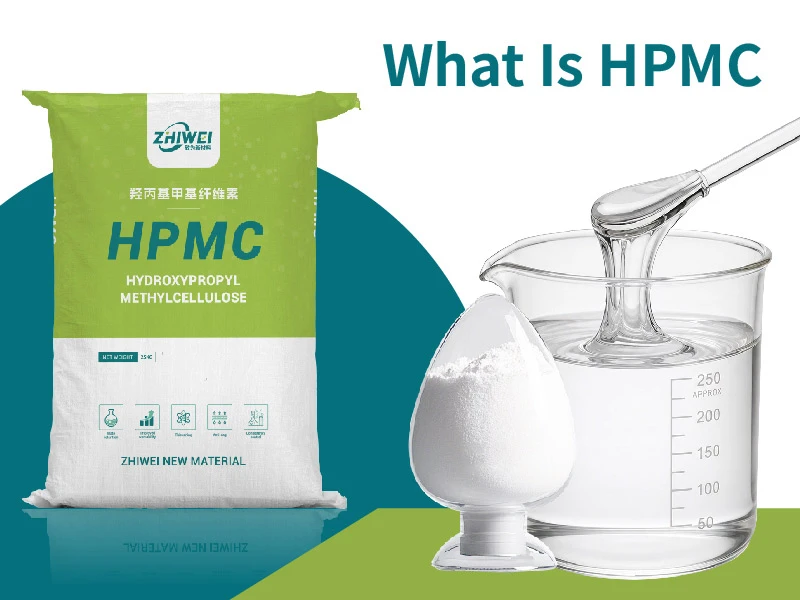
You will also see HPMC called by other names depending on the industry:
- Hypromellose: the pharmaceutical name used in the United States Pharmacopeia (USP), European Pharmacopoeia (EP), and Japanese Pharmacopoeia (JP)
- E464: the food additive code used in the European Union
- CAS number 9004-65-3: the Chemical Abstracts Service registry number
HPMC has four core functions: thickening, water retention, film formation, and adhesion. These functions make it one of the most widely used cellulose ethers in the world, with a global market valued at approximately USD 1.87 billion in 2021 and projected to grow at a CAGR of 4.8% through 2030 (Grand View Research).
How HPMC Is Made
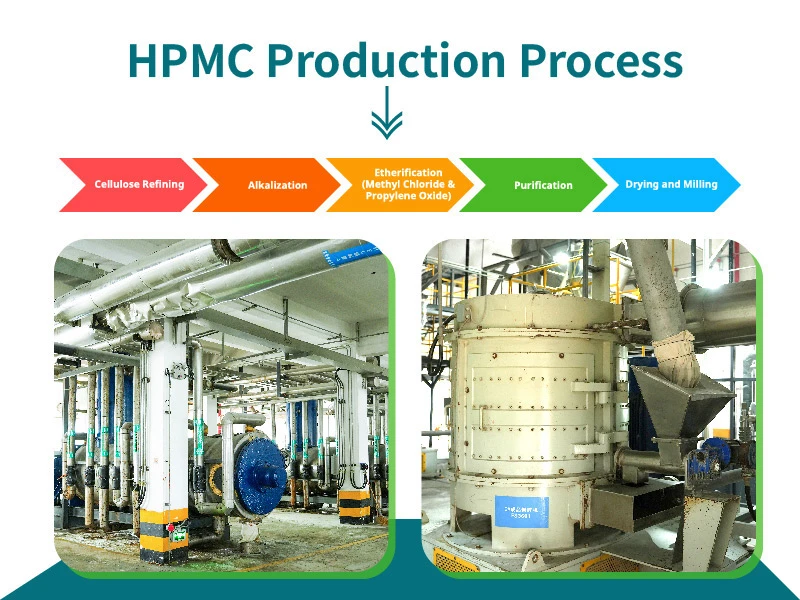
HPMC starts as natural cellulose, the main structural component of plant cell walls. The production process converts raw cellulose fiber into a functional polymer through a series of chemical reactions.
Step 1: Cellulose refining and grinding. Raw cotton linter or wood pulp is purified to remove lignin, hemicellulose, and other impurities. The purified cellulose is then ground into a fine powder to increase its surface area for the next step.
Step 2: Alkalization (mercerization). The cellulose powder is treated with a concentrated sodium hydroxide (NaOH) solution. This produces alkali cellulose, which swells the fiber structure and makes the hydroxyl groups on the cellulose chain more reactive.
Step 3: Etherification. This is the step where HPMC gets its name. Two reagents react with the alkali cellulose:
- Methyl chloride (CH₃Cl) introduces methyl groups (–CH₃) onto the cellulose backbone. This substitution produces the “methyl” part of hydroxypropyl methylcellulose.
- Propylene oxide (C₃H₆O) introduces hydroxypropyl groups (–OCH₂CH(OH)CH₃) onto the cellulose backbone. This substitution produces the “hydroxypropyl” part.
The ratio and extent of these substitutions determine the performance of the final product. Different combinations produce different HPMC grades.
Step 4: Neutralization and purification. The reaction mixture is neutralized with acid, then washed repeatedly with hot water to remove salts, by-products, and unreacted chemicals. This purification step is especially important for pharmaceutical-grade and food-grade HPMC, where residual solvent levels are strictly regulated.
Step 5: Drying, milling, and screening. The purified HPMC is dried, ground to a specified particle size, and passed through screens to ensure uniform particle distribution. The finished product is a free-flowing white or off-white powder.
The entire process takes place under controlled temperature and pressure conditions. The degree of substitution, viscosity, and particle size are all controlled at this stage.
Key Properties That Matter to Buyers
You do not need a chemistry degree to buy HPMC effectively. But you do need to understand the properties that affect how it performs in your application.
Water solubility. HPMC dissolves in cold water to form a clear or slightly hazy viscous solution. It does not dissolve in hot water. This is not a defect. It is a defining characteristic called thermal gelation, explained below.
Thermal gelation. When an HPMC solution is heated above a certain temperature (typically 60–90°C, depending on the grade), the polymer chains collapse and form a gel network. The solution becomes cloudy and viscosity increases sharply. When the solution cools back below the gel temperature, it returns to its original dissolved state. This reversible behavior matters in construction applications where ambient temperatures are high, and in pharmaceutical controlled-release formulations where gel formation controls drug release rates.
Viscosity. HPMC is available in a wide range of viscosity grades, from approximately 3 mPa·s to 200,000 mPa·s (measured as a 2% aqueous solution at 20°C). Higher viscosity means thicker solutions, better sag resistance, and better water retention. Lower viscosity means easier mixing, better flow, and better leveling. The viscosity you need depends on your application.
Non-ionic character. HPMC carries no electrical charge in solution. This means it does not react with ions in the system, such as calcium, sodium, or potassium salts. It is compatible with a wide range of electrolytes, surfactants, and other additives. Its pH stability range is approximately 3.0 to 11.0.
Film formation. When an HPMC solution dries, it forms a transparent, flexible film. This film resists oils and fats but is permeable to water vapor. In pharmaceutical coatings, this property allows controlled release. In construction, it contributes to adhesion and water retention at the substrate interface.
Surface activity. HPMC reduces the surface tension of water. This improves wetting and dispersion of powders and pigments in cement-based systems, paints, and personal care products.
HPMC Grades Explained: DS, MS, and Viscosity
When you look at an HPMC specification sheet, you will see numbers for DS, MS, and viscosity. Here is what they mean.
Degree of Substitution (DS) and Molar Substitution (MS)
DS (Degree of Substitution) refers to the average number of methyl groups (–OCH₃) attached to each anhydroglucose unit in the cellulose chain. The maximum possible DS is 3.0 (all three available hydroxyl positions are substituted). Typical HPMC DS values range from 0.6 to 1.8.
MS (Molar Substitution) refers to the average number of hydroxypropyl groups (–OCH₂CH(OH)CH₃) attached to each anhydroglucose unit. Unlike DS, MS can exceed 3.0 because hydroxypropyl groups can attach to each other in short side chains. Typical HPMC MS values range from 0.1 to 0.3.
The combination of DS and MS determines the fundamental behavior of HPMC. Higher methoxyl content (higher DS) increases hydrophobicity and lowers the gel temperature. Higher hydroxypropoxyl content (higher MS) increases hydrophilicity and raises the gel temperature. These two parameters work in opposition, and manufacturers adjust them to produce grades for different applications.
USP Substitution Types
The United States Pharmacopeia classifies HPMC into four substitution types based on their methoxyl and hydroxypropoxyl content ranges:
| USP Type | Methoxyl (%) | Hydroxypropoxyl (%) | Typical Use |
|---|---|---|---|
| 1828 | 16.5–20.0 | 23.0–32.0 | Film coating, sustained release |
| 2208 | 19.0–24.0 | 4.0–12.0 | Tablet binder, thickener |
| 2906 | 27.0–30.0 | 4.0–7.5 | Controlled release matrix |
| 2910 | 28.0–30.0 | 7.0–12.0 | General-purpose pharma, capsules |
The four-digit number encodes the substitution data. The first two digits represent the approximate methoxyl content, and the last two digits represent the approximate hydroxypropoxyl content. For example, Type 2910 has approximately 29% methoxyl and approximately 10% hydroxypropoxyl.
If you are sourcing HPMC for pharmaceutical applications, the USP type is a required specification. For construction and industrial applications, manufacturers often use different naming conventions.
Viscosity Grades and How to Read Them
Viscosity is the most commonly referenced specification for HPMC in construction and industrial applications. It is measured as the viscosity of a 2% aqueous solution at 20°C, reported in millipascal-seconds (mPa·s).
| Viscosity Grade | Viscosity Range (mPa·s, 2% solution) | Typical Application |
|---|---|---|
| 5 (or 5 cps) | 3–7 | Self-leveling compounds, low-viscosity film coating |
| 15 | 12–18 | Self-leveling, spray plaster |
| 50 | 40–60 | Tile adhesive (large format), joint filler |
| 100 | 80–120 | Tile adhesive, interior plaster |
| 400 | 300–500 | Tile adhesive, wall putty, exterior render |
| 4,000 | 3,000–5,000 | Wall putty, skim coat, thick film plaster |
| 15,000 | 12,000–18,000 | Wall putty, cement-based plaster |
| 40,000 | 35,000–45,000 | Thick-bed mortar, heavy render |
| 100,000 | 80,000–120,000 | Thick-bed tile adhesive, exterior insulation system |
Manufacturers use different naming conventions. For example, “HPMC 15M” or “HPMC 150,000” usually refers to a grade with approximately 15,000 mPa·s viscosity. Always confirm the test method and concentration when comparing grades from different suppliers, because a 1.5% solution and a 2% solution will give different viscosity readings for the same product.
What HPMC Is Used For
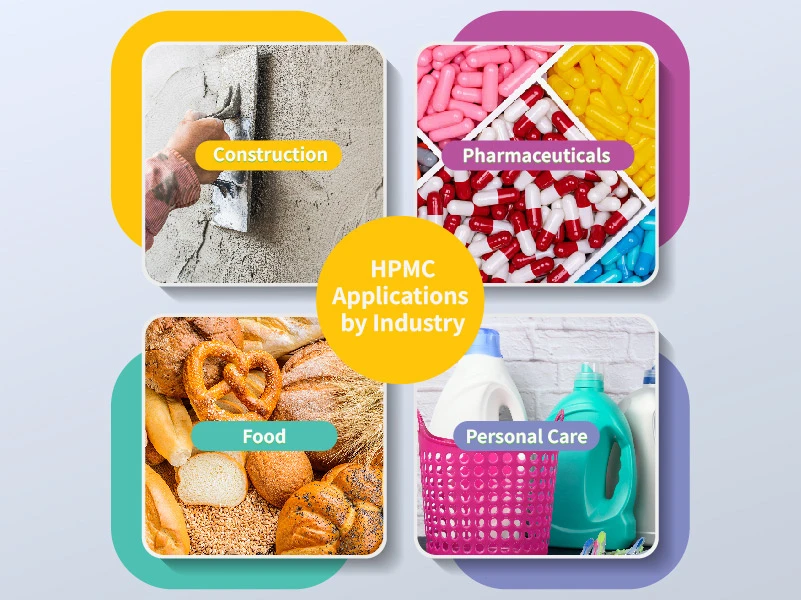
HPMC is used across multiple industries. The global market is dominated by construction, which accounts for the largest share of demand, but pharmaceuticals, food, and personal care are significant segments as well.
Construction and Building Materials
Construction is the largest end-use segment for HPMC, representing over 40% of global demand. In cement-based and gypsum-based building materials, HPMC is primarily used for thickening, water retention, and improving workability.
Common applications include:
- Tile adhesive and grout: HPMC improves open time (how long the adhesive stays workable), adjusts consistency, and prevents water from being absorbed too quickly by the substrate or tile. For C1 and C2 tile adhesives under EN 12004, HPMC is a standard ingredient at 0.2–0.5% by weight.
- Exterior render and plaster: HPMC retains water in the render long enough for proper cement hydration. This reduces cracking and improves bond strength. In hot climates, higher-viscosity grades are used to compensate for faster evaporation.
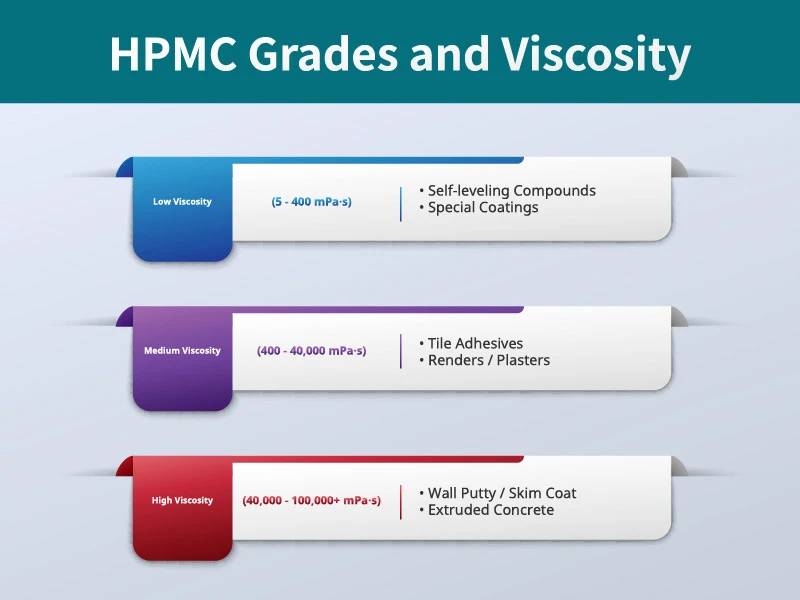
- Wall putty and skim coat: HPMC provides sag resistance, smooth application, and proper drying. Viscosity grades of 40,000–100,000 mPa·s are common.
- Self-leveling compounds: Low-viscosity HPMC (5–15 mPa·s) provides water retention without thickening the mix too much. The compound needs to flow freely.
- Cement mortar and masonry: HPMC improves workability, reduces water demand, and extends working time.
Pharmaceuticals and Supplements
In pharmaceutical manufacturing, HPMC is known by its pharmacopeial name hypromellose. It is one of the most widely used excipients in the industry.
- Tablet coating: HPMC forms transparent, flexible films that protect tablets from moisture and mask taste. Types 2910 and 2208 are commonly used.
- Sustained-release matrix tablets: HPMC hydrates and forms a gel layer that controls the rate at which the drug is released. Types 2208 and 2906 are preferred for this application because their higher molecular weight produces a stronger gel barrier.
- Hard capsules: Vegetarian capsules made from HPMC (instead of gelatin) are increasingly popular for consumers who avoid animal-derived products. HPMC capsules are also more stable in low-humidity environments.
- Eye drops and artificial tears: Low-viscosity hypromellose is used as a lubricant in ophthalmic solutions.
Pharmaceutical-grade HPMC must meet the monograph requirements of the relevant pharmacopoeia (USP, EP, JP). Purity, residual solvent levels, and microbial limits are strictly controlled.
Food Industry
HPMC is approved as a food additive in the European Union (E464) and the United States (FDA 21 CFR 172.874). In food, it is used as a thickener, emulsifier, stabilizer, and gelling agent.
- Gluten-free baking: HPMC mimics some of the viscoelastic properties of gluten in bread and pastry dough, improving volume and texture.
- Frozen foods: HPMC prevents ice crystal growth and syneresis (water separation) during freeze-thaw cycles.
- Sauces and dressings: HPMC provides viscosity and prevents phase separation in oil-in-water emulsions.
- Plant-based meat alternatives: HPMC helps bind water and fat, improving texture in products like veggie burgers and plant-based sausages.
Food-grade HPMC must meet specific purity standards for heavy metals, residual solvents, and microbial contamination.
Personal Care and Cosmetics
In cosmetics and personal care, HPMC functions as a thickener, film former, and stabilizer.
- Shampoo and body wash: HPMC adjusts viscosity and improves the feel of the product on skin and hair.
- Lotions and creams: HPMC stabilizes emulsions and provides a smooth, non-greasy feel.
- Toothpaste: HPMC contributes to texture and water binding, preventing the paste from drying out.
Cosmetic-grade HPMC does not have a formal pharmacopoeia standard, but it must comply with cosmetic ingredient regulations (EU Cosmetics Regulation, FDA OTC monograph) and is typically listed under the INCI name “Hydroxypropyl Methylcellulose.”
HPMC vs Other Cellulose Ethers
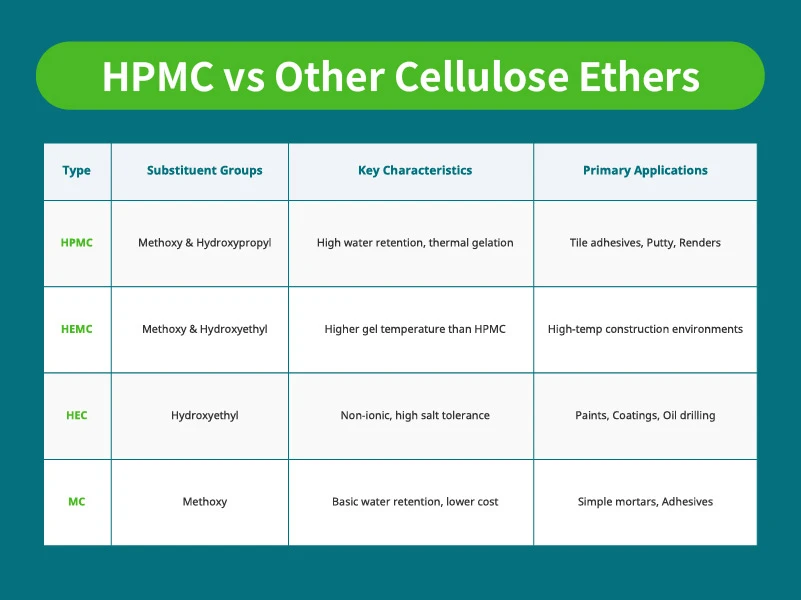
HPMC is not the only cellulose ether on the market. If you are new to this category, it helps to understand how HPMC compares to the other common types.
| Property | HPMC | HEMC (MHEC) | HEC | MC (Methylcellulose) |
|---|---|---|---|---|
| Full name | Hydroxypropyl methylcellulose | Hydroxyethyl methylcellulose | Hydroxyethyl cellulose | Methylcellulose |
| Substituent groups | Methyl + hydroxypropyl | Methyl + hydroxyethyl | Hydroxyethyl only | Methyl only |
| Viscosity range (mPa·s, 2%) | 3–200,000 | 3,500–100,000 | 200–15,000 | 3–200,000 |
| Gel temperature (°C) | 60–90 | 65–75 | Does not gel | 50–70 |
| Water retention | Good | Better | Moderate | Good |
| Salt tolerance | Good | Good | Poor | Good |
| Main applications | Construction, pharma, food | Construction (render, plaster) | Paint, cosmetics, oilfield | Construction, food, pharma |
HPMC vs HEMC: Both are methylcellulose derivatives with a second substituent. HPMC uses hydroxypropyl groups; HEMC uses hydroxyethyl groups. In construction, HEMC generally has higher water retention and a slightly higher gel temperature, making it preferred for hot-climate rendering. HPMC has a wider viscosity range and lower cost. Many formulators use both in the same product.
HPMC vs HEC: HEC does not contain methyl groups and does not exhibit thermal gelation. It is the preferred thickener in water-based paints and cosmetics because of its excellent clarity and compatibility with glycols and surfactants. HEC has poor salt tolerance, so it is rarely used in cement-based systems where calcium ions are present.
HPMC vs MC: Methylcellulose has only methyl substituents (no hydroxypropyl groups). MC has a lower gel temperature (50–70°C) compared to HPMC, which limits its use in hot environments. MC is less common in construction and more common in food and pharmaceutical applications.
How to Choose the Right HPMC Grade
If you are purchasing HPMC for the first time, the number of available grades can be overwhelming. Here is a simplified approach.
Step 1: Identify your industry. This determines the compliance requirements.
- Construction: industrial grade, no pharmacopoeia compliance needed
- Pharmaceuticals: must meet USP/EP/JP monograph for hypromellose
- Food: must meet E464 or FDA 21 CFR 172.874 specifications
- Cosmetics: must comply with cosmetic ingredient regulations
Step 2: Determine your viscosity requirement. This is based on the application.
- Low viscosity (3–60 mPa·s): self-leveling, spray application, film coating
- Medium viscosity (100–400 mPa·s): tile adhesive, interior plaster, grout
- High viscosity (4,000–100,000 mPa·s): wall putty, exterior render, thick-bed mortar
Step 3: Confirm the substitution type (for pharmaceutical applications). If you are sourcing HPMC for pharma, the USP type (1828, 2208, 2906, or 2910) is a required specification. If you are sourcing for construction, the manufacturer’s product code is sufficient.
Step 4: Check the supplier documentation. Ask for a Certificate of Analysis (COA) that includes viscosity, moisture content, ash content, and particle size. For pharma and food grades, also request residual solvent data and microbial test results.
| Application | Viscosity Grade | Substitution Type | Compliance |
|---|---|---|---|
| Tile adhesive (C1/C2) | 100–400 | Construction grade | Industrial |
| Exterior render | 15,000–40,000 | Construction grade | Industrial |
| Wall putty | 40,000–100,000 | Construction grade | Industrial |
| Self-leveling | 5–15 | Construction grade | Industrial |
| Tablet coating | 5–15 | USP 2910 or 2208 | USP/EP/JP |
| Sustained release | 4,000–15,000 | USP 2208 or 2906 | USP/EP/JP |
| HPMC capsules | 5–15 | USP 2910 | USP/EP/JP |
| Gluten-free baking | 100–4,000 | Food grade | E464 / FDA |
| Cosmetics | 100–4,000 | Cosmetic grade | EU Cosmetic Reg |
Common Questions About HPMC
Is HPMC natural or synthetic?
HPMC is semi-synthetic. It starts from natural cellulose (cotton or wood pulp), but the chemical modifications (etherification with methyl and hydroxypropyl groups) are synthetic processes. The final product is not found in nature, but the starting material is a natural polymer.
Is HPMC safe for food and pharmaceuticals?
Yes. HPMC is approved as a food additive (E464 in the EU, FDA 21 CFR 172.874 in the US) and as a pharmaceutical excipient (hypromellose, listed in USP, EP, and JP). It is non-toxic, non-irritating, and not metabolized by the human body. It passes through the digestive system unchanged.
Why does HPMC gel in hot water?
Thermal gelation occurs because the methyl and hydroxypropyl groups on the cellulose backbone become less soluble as temperature increases. Above a critical temperature (the gel point), the polymer chains collapse and aggregate, forming a three-dimensional gel network. This is a reversible process. When the temperature drops below the gel point, the gel dissolves and the solution returns to its original viscosity.
What is the difference between HPMC and hypromellose?
They are the same chemical substance. “HPMC” is the common name used in industrial and construction contexts. “Hypromellose” is the official pharmacopoeial name used in pharmaceutical and food applications. If you are sourcing HPMC for pharmaceutical use, your specification sheet will list “hypromellose” and will reference a pharmacopoeia monograph.
How should I store HPMC?
Store HPMC in a cool, dry place in sealed packaging. HPMC is hygroscopic, meaning it absorbs moisture from the air. Moisture absorption can cause clumping and change the measured viscosity. Under proper storage conditions (below 25°C, relative humidity below 60%), the typical shelf life is 24–36 months.
Conclusion
Hydroxypropyl methylcellulose (HPMC) is a versatile cellulose ether used across construction, pharmaceuticals, food, and personal care. Its value comes from a combination of thickening, water retention, film formation, and thermal gelation. The grade you choose depends on viscosity (determined by molecular weight), substitution type (determined by DS and MS), and what compliance standard your industry requires.
If you are new to HPMC sourcing, start by defining your application and viscosity requirement. Then confirm the compliance standard for your industry. A reliable supplier will provide COA documentation, technical data sheets, and formulation support.
Zhiwei New Materials produces construction-grade HPMC at its facility in Zhejiang, China. The factory has an annual capacity of 15,000 tons and uses Xinjiang refined cotton as its raw material. For product specifications, samples, or formulation questions, contact the team at info@zhiweichem.com or call +86 183 6616 3707.