
Introduction
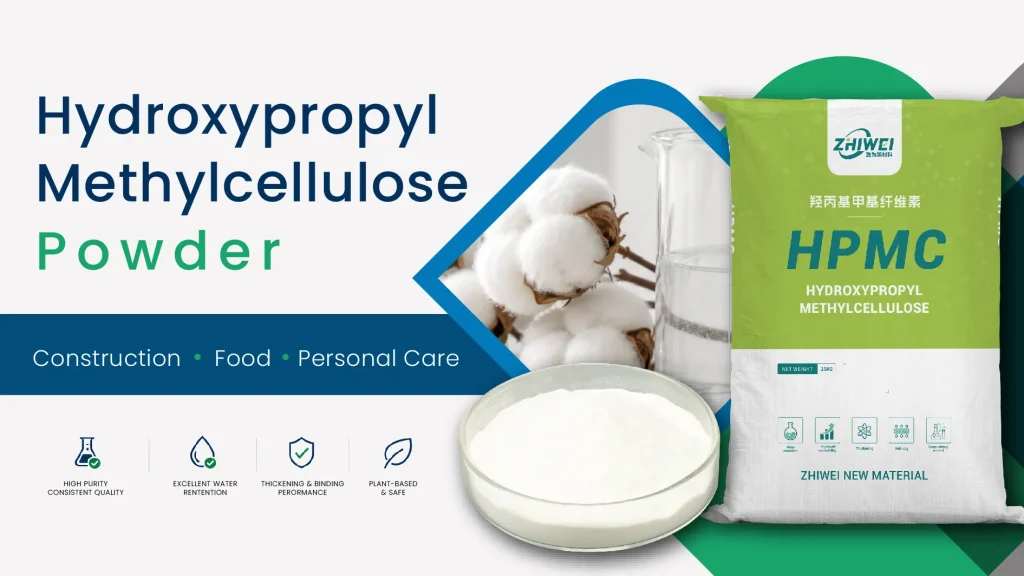
Hydroxypropyl methylcellulose, often called HPMC, is one of the most useful cellulose ether products in modern industry. It is a non-ionic, water-soluble polymer made from purified cellulose. It is widely used in construction materials, coatings, ceramics, PVC, inks, leather, paper, textiles, food-related systems, pharmaceuticals, and daily chemical products.
HPMC is valued because it can solve many formula problems at the same time. It can thicken water-based systems, improve water retention, support emulsification, protect colloids, form films, improve suspension, improve adhesion, and make products easier to process.
In construction, HPMC helps tile adhesive, wall putty, plaster, mortar, and EIFS systems keep water and stay workable. In PVC production, it can work as a dispersing aid in suspension polymerization. In coatings and inks, it can improve viscosity and stability. In pharmaceuticals, suitable grades can be used for coating, film formation, controlled release, and tablet binding.
For buyers, the main question is not only what HPMC is. The more practical question is how to choose a stable HPMC supplier and the right grade for the real formula. Zhiwei supplies HPMC grades for daily chemical and construction systems, including HPMC 400, HPMC 4K, HPMC 40K, HPMC 100K, HPMC 150K, and HPMC 200K.
What Is Hydroxypropyl Methylcellulose?
Hydroxypropyl methylcellulose is a modified cellulose ether made from natural cellulose. The raw cellulose is usually refined cotton or purified wood pulp. Through chemical treatment, part of the hydroxyl groups on cellulose are changed into methoxy and hydroxypropoxy groups.
This modification gives HPMC better solubility and better performance in water-based systems. The final product is usually a white or off-white powder. It has no strong odor, no strong taste, and it forms a clear or slightly cloudy viscous solution after proper hydration.
HPMC belongs to the non-ionic cellulose ether family. Other cellulose ether products include MC, HEC, HEMC, EC, CMC, CMHEC, and other modified grades. Compared with many other cellulose ethers, HPMC has a wide application range because it offers a strong balance of water retention, thickening, film formation, suspension, and stability.
Main Properties Of HPMC
Thickening
HPMC can increase viscosity in water-based systems. This is one of its most important functions. It helps improve the body, flow, and handling of a formula.
In mortar, it helps the paste stay on the wall. In coatings, it helps improve storage stability and application feel. In detergents and personal care products, it can improve product texture.
Water Retention
HPMC is an effective water retention agent. In cement and gypsum systems, it helps water stay in the mortar longer. This gives cement or gypsum more time to hydrate.
Good water retention can reduce cracking, powdering, poor bonding, and fast drying. It also extends working time and open time.
Emulsification And Colloid Protection
HPMC can support emulsification and colloid protection in selected systems. It helps keep particles or droplets more evenly distributed. This is useful in coatings, polymer systems, inks, and other water-based formulas.
Film Formation
HPMC can form a film after drying. This film-forming property is useful in coatings, paper products, pharmaceutical coating, ceramics, and binders. The film can improve surface quality, adhesion, and handling.
Suspension And Dispersion
HPMC helps suspend solid particles and reduce settling. This is important in coatings, ceramic slurries, pigment systems, dry-mix mortar, and polymer production.
In PVC suspension polymerization, HPMC can help improve particle control and resin quality when used as part of the dispersion system.
Adhesion And Binding
HPMC can improve adhesion in many formulas. It is used as a binder in ceramics, paper products, tablets, and some construction materials. It can also support better cohesion in mortar and putty.
Acid, Alkali, And Enzyme Resistance
HPMC has useful stability in many formula environments. Because it is non-ionic, it can remain stable in many systems where ionic polymers may be more sensitive. It also has useful resistance to acid, alkali, and enzymes, depending on the full formula condition.
How HPMC Is Made
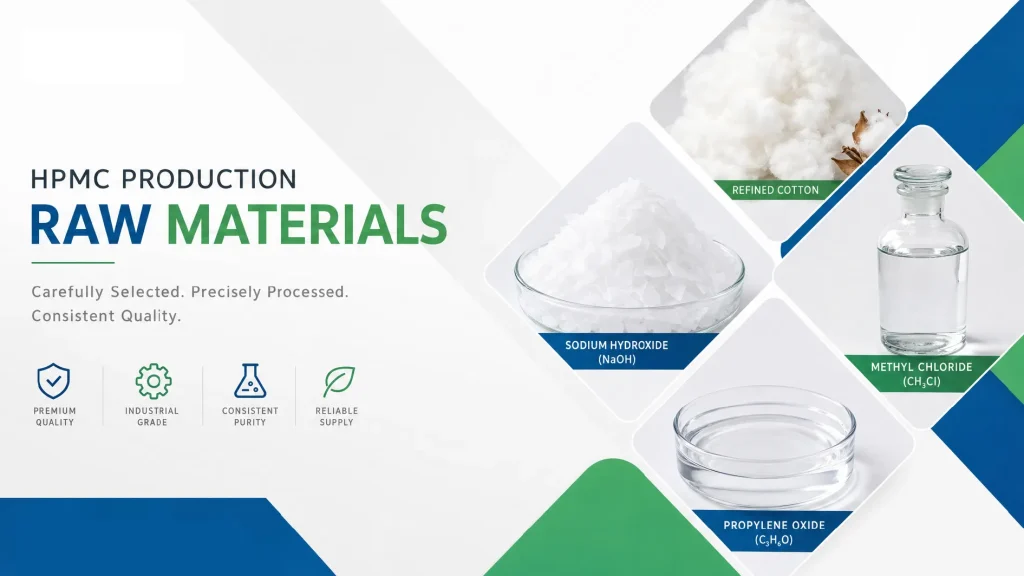
HPMC production starts with purified cellulose. The cellulose is first treated with alkali. This step breaks part of the strong hydrogen bonding inside the cellulose structure and makes the cellulose more reactive.
Then etherification is carried out. Common raw materials include refined cotton, sodium hydroxide, methyl chloride, and propylene oxide. Methyl chloride introduces methoxy groups. Propylene oxide introduces hydroxypropoxy groups.
After reaction, the material is neutralized, washed, dried, granulated, and pulverized. The final product is then tested for viscosity, moisture, ash, pH, particle size, substitution content, and appearance.
The main production equipment includes reactors, dryers, granulators, and pulverizers. In advanced production, automated control is important because reaction temperature, pressure, time, and raw material ratio can strongly affect final product quality.
Stable production is important. If the reaction is not well controlled, the viscosity, gel temperature, solubility, and application performance may change from batch to batch.
Why Production Technology Matters
HPMC is not only a simple powder. It is a performance material. The final grade depends on reaction control, raw material quality, washing, drying, particle design, and quality testing.
Good production technology can bring several advantages:
- More stable viscosity
- Better purity
- More controlled particle size
- Better solubility
- Lower batch variation
- More application-specific grades
- Better environmental control
- Better safety in production
For buyers, this means supplier selection matters. A low price is not enough if the product changes too much between batches. A stable HPMC supplier should provide clear specifications, sample support, technical data, SDS, COA, and practical grade recommendations.
Main Applications Of HPMC
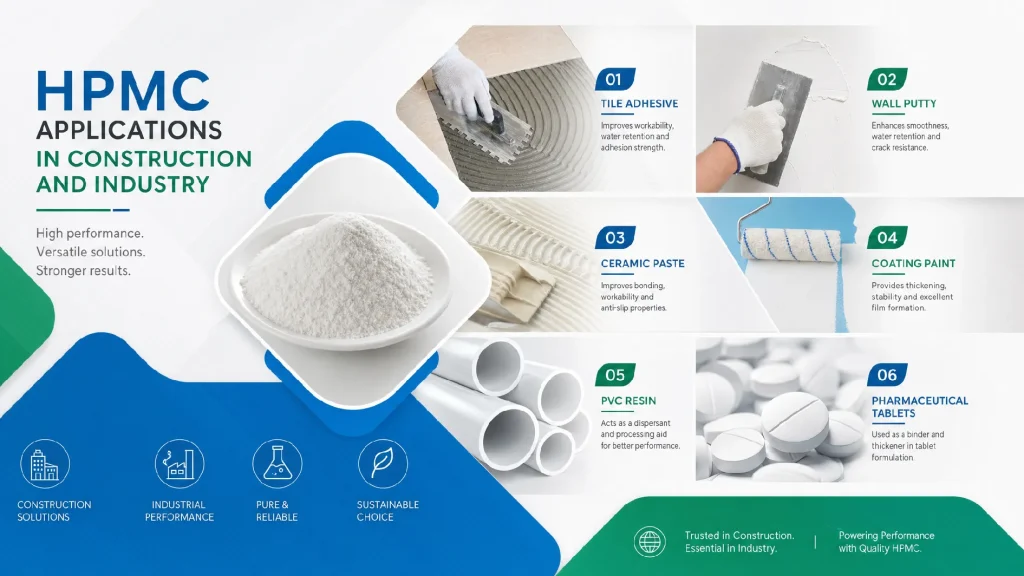
HPMC For Construction Materials
Construction is one of the largest and most important HPMC application areas. HPMC is used in tile adhesive, cement mortar, gypsum plaster, wall putty, skim coat, repair mortar, EIFS mortar, decoration mortar, self-leveling mortar, and waterproof mortar.
In these systems, HPMC improves water retention, workability, open time, anti-sag behavior, adhesion, and surface quality.
For tile adhesive, HPMC helps the adhesive stay workable for longer and reduces fast water loss. It also helps improve vertical stability, so tiles do not slide too easily.
For wall putty and plaster, HPMC improves smoothness, scraping feel, and surface finish. It also helps reduce cracking and powdering.
For mortar and EIFS systems, HPMC improves application body, water retention, and wet mortar stability.
HPMC For Ceramic Manufacturing
In ceramic manufacturing, HPMC can be used as a binder and processing aid. It helps improve green strength, shape retention, and lubrication. It can make ceramic pastes easier to form and process.
This is useful in extrusion, molding, and other ceramic production methods where the body must hold shape before firing.
HPMC For Coatings And Paint Removers
In coatings, HPMC can work as a thickener, dispersant, stabilizer, and film-forming aid. It helps control viscosity and supports pigment suspension. It can also improve application feel and reduce settling.
In paint removers, HPMC can increase viscosity. This helps the remover stay on a vertical or shaped surface instead of flowing away too fast.
HPMC For Ink Printing
In ink systems, HPMC can work as a thickener, dispersant, and stabilizer. It helps control flow, pigment distribution, and storage behavior. Good compatibility with water or selected solvent systems is important.
HPMC For Plastics
In plastics, HPMC can be used as a release agent, softening aid, lubricant, or processing aid in selected systems. Its exact use depends on the processing method and formulation.
HPMC For PVC Production
In PVC suspension polymerization, HPMC can work as a dispersing aid. It helps control the suspension system and supports resin particle formation.
For PVC producers, dispersant quality matters because it can affect particle size distribution, resin processing behavior, and final product quality.
HPMC For Leather, Paper, Textile, And Preservation
HPMC can also be used in leather, paper, fruit and vegetable preservation, and textile systems.
In paper products, it can improve binding, film formation, and surface treatment. In textiles, it can support sizing or finishing systems. In preservation systems, film-forming behavior can help control surface protection.
HPMC For Pharmaceutical Products
Suitable HPMC grades are widely used in pharmaceutical systems. They can be used as coating materials, film materials, controlled-release polymers, stabilizers, suspending agents, tablet binders, and viscosity modifiers.
This area requires special grades, strict quality control, and regulatory documents. Industrial construction-grade HPMC should not be used for pharmaceutical products unless it meets the correct standard.
Application Table
| Application Area | HPMC Function | Main Benefit |
|---|---|---|
| Tile adhesive | Water retention, open time, anti-sag | Better tile placement and stronger wet stability |
| Wall putty | Thickening, lubrication, water retention | Smoother scraping and better surface finish |
| Cement mortar | Water retention, workability | Longer working time and reduced cracking risk |
| Gypsum plaster | Water retention, smoothness | Better application and less fast drying |
| Coatings | Thickening, dispersion, stability | Better storage stability and application feel |
| PVC | Dispersing aid | Better suspension control and resin quality |
| Ceramics | Binding, lubrication | Better forming and green strength |
| Pharmaceuticals | Film forming, binding, controlled release | Better tablet and coating performance |
| Paper and textile | Film formation, binding | Better surface and processing performance |
How To Choose A Zhiwei HPMC Grade
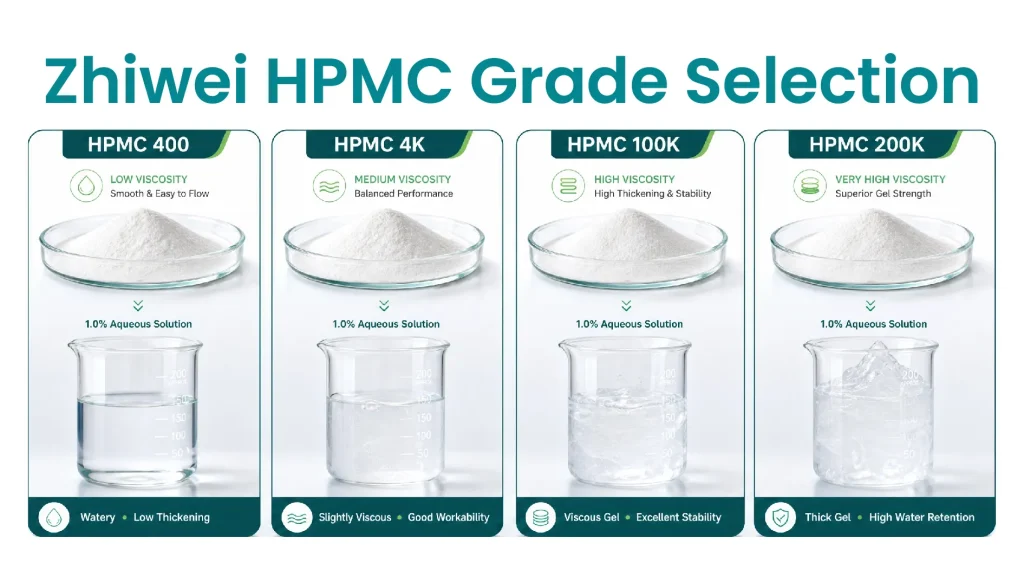
Different formulas need different HPMC grades. Viscosity is one of the most important selection points, but it is not the only one. Buyers should also check water retention, solubility, particle size, pH, ash, delayed solubility, and application behavior.
Zhiwei supplies HPMC grades for daily chemical and construction systems. The HPMC product page describes HPMC as a non-ionic, water-soluble cellulose ether used as a thickener, rheology modifier, and stabilizer in water-based systems. Zhiwei lists HPMC applications in shampoos, body washes, hand soaps, lotions, tile adhesives, cement mortars, plasters, putty, skim coat, render, and EIFS systems.
| Zhiwei HPMC Grade | General Direction | Possible Use |
|---|---|---|
| HPMC 400 | Low viscosity | Flowable systems and light rheology control |
| HPMC 4K | Low-to-mid viscosity | Light body construction and water-based formulas |
| HPMC 40K | Medium viscosity | General dry-mix mortar and putty screening |
| HPMC 100K | High viscosity | Tile adhesive, wall putty, plaster, EIFS mortar |
| HPMC 150K | High viscosity | Stronger body and water retention systems |
| HPMC 200K | Very high viscosity | High-body tile adhesive, putty, plaster, repair mortar |
Zhiwei HPMC 100K is designed for higher-viscosity construction systems that need stronger water retention, open time, and vertical stability. It is suitable for tile adhesive, wall putty, plaster, EIFS mortar, and other dry-mix systems.
Zhiwei HPMC 200K is a very-high-viscosity grade. It is useful when the formula needs stronger application body, water retention, open time, and anti-sag behavior.
Quality Points Buyers Should Check
Before buying HPMC in bulk, check more than the price.
Ask for these items:
- Product grade
- Viscosity test method
- Methoxy content
- Hydroxypropoxy content
- Appearance
- Particle size
- pH
- Ash
- Moisture
- SDS
- TDS
- COA
- Recommended application
- Sample availability
Viscosity must be compared under the same test method. A label value is useful, but the real formula test is more important. A grade that looks correct on paper may still behave differently in your cement, coating, detergent, or PVC system.
How To Test HPMC Before Bulk Purchase
Start with a sample. Test it in your real formula.
For tile adhesive, check water retention, open time, anti-slip behavior, wet mortar feel, and final bonding strength.
For wall putty, check scraping feel, smoothness, water retention, surface finish, and cracking behavior.
For mortar, check workability, pumpability, sag resistance, and strength.
For coatings, check viscosity, storage stability, pigment suspension, leveling, and compatibility.
For PVC, check suspension behavior, particle control, and resin quality.
For pharmaceutical use, check the correct regulatory and quality standard first.
Why Work With Zhiwei
Zhiwei (Jinan) New Materials Co., Ltd. supports customers with cellulose ether products, including HPMC, HEMC, and HEC. For HPMC, Zhiwei provides grade options for construction and daily chemical systems.
Zhiwei can help customers choose a starting grade based on the real application. If the formula needs stronger water retention and vertical stability, HPMC 100K or HPMC 200K can be tested. If the system needs lighter viscosity control, lower-viscosity HPMC grades may be more suitable.
The main goal is repeatable performance. A good HPMC grade should help the customer make stable products with fewer production adjustments.
Conclusion
Hydroxypropyl methylcellulose is a versatile non-ionic cellulose ether. It is used because it can thicken, retain water, emulsify, protect colloids, form films, suspend particles, improve adhesion, and support stable processing.
It is used in construction, ceramics, coatings, ink, PVC, plastics, leather, paper, textiles, preservation systems, pharmaceuticals, and daily chemical products. In construction, it is especially useful in tile adhesive, wall putty, plaster, mortar, EIFS, and repair systems.
For buyers, grade selection should be based on real application testing. Zhiwei HPMC 100K and HPMC 200K are useful high-viscosity options for dry-mix construction systems that need strong water retention, open time, and vertical stability. Other Zhiwei HPMC grades can be tested when the formula needs lighter viscosity or different flow behavior.
Contact Zhiwei (Jinan) New Materials Co., Ltd. to request HPMC samples, technical data, and grade recommendations for your construction, coating, detergent, or industrial formula.