
Introduction
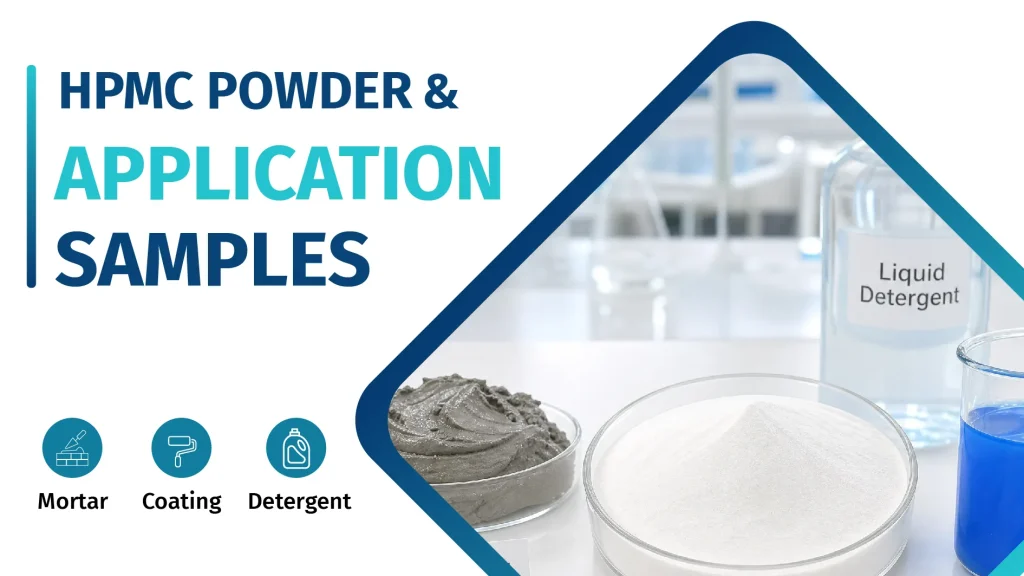
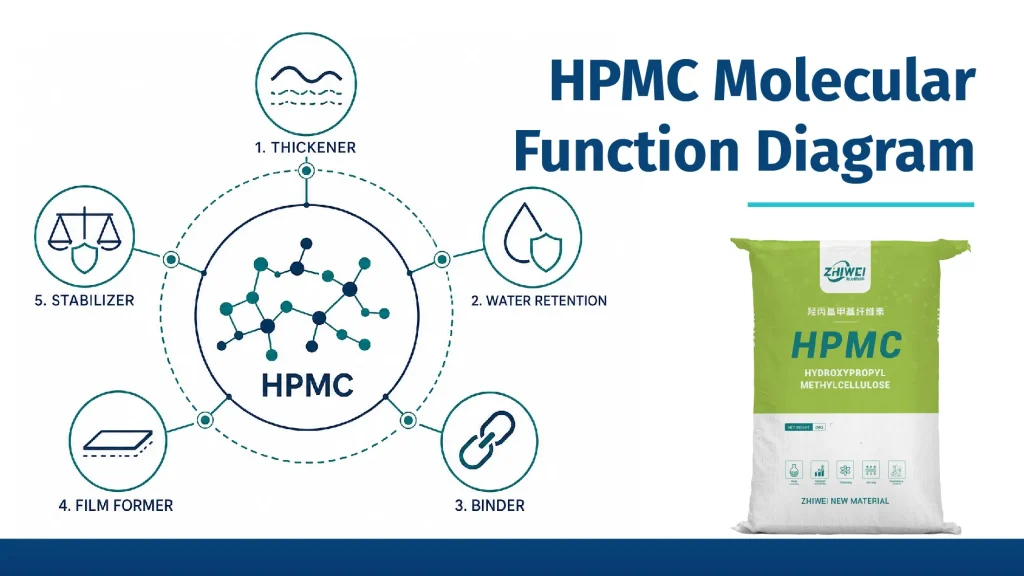
Hydroxypropyl methylcellulose, usually called HPMC, is a non-ionic cellulose ether. It is made from natural cellulose through chemical modification. It is used in many water-based systems because it can thicken, retain water, improve workability, form films, stabilize particles, and support bonding.
HPMC is widely used in construction materials, coatings, PVC suspension polymerization, ceramics, oilfield fluids, paper, textile sizing, daily chemical products, food systems, and pharmaceutical formulations. In dry-mix mortar, a very small dosage can change the whole handling behavior of the material. In tile adhesive, HPMC helps the mortar keep water, stay workable, and hold stable ridges. In self-leveling mortar, low-viscosity HPMC helps control bleeding while keeping flow.
Zhiwei (Jinan) New Materials Co., Ltd. supplies HPMC grades for construction and water-based systems. Zhiwei HPMC 400 and HPMC 4K are useful for flowable systems and light rheology control. Zhiwei HPMC 100K and HPMC 200K are designed for higher-viscosity dry-mix systems such as tile adhesive, wall putty, plaster, EIFS mortar, and repair mortar.
What Is HPMC?
HPMC is a mixed ether of cellulose. Its full name is hydroxypropyl methylcellulose. It is produced from cellulose by alkalization, etherification, neutralization, washing, drying, and grinding.
The cellulose source is usually refined cotton or wood pulp. Cellulose is a renewable polymer made from glucose units. Each glucose unit has hydroxyl groups. These groups allow cellulose to react and become cellulose ether. After modification, HPMC becomes soluble in cold water and gains useful industrial properties.
HPMC is usually a white or off-white powder. It has little or no odor. It can be fibrous or granular depending on the production process and particle treatment.
Main Properties Of HPMC
HPMC has several properties that make it valuable in formulations.
| Property | Practical Meaning |
|---|---|
| Water solubility | HPMC dissolves in cold water and forms a clear or slightly cloudy colloidal solution. |
| Thickening | HPMC builds viscosity in water-based systems. |
| Water retention | HPMC holds water in cement, gypsum, mortar, and other porous systems. |
| Film formation | HPMC can form colorless, transparent, and tough films. |
| Surface activity | HPMC can help emulsification, dispersion, and particle protection. |
| pH stability | HPMC solution stays relatively stable across a broad pH range, often around pH 3-11. |
| Salt tolerance | HPMC is non-ionic, so it has better stability than many ionic polymers in electrolyte systems. |
| Thermal gelation | HPMC dissolves in cold water but can gel or become cloudy when heated. |
| Enzyme resistance | HPMC has better resistance to enzyme attack than many natural starch or sugar systems. |
| Thixotropy | HPMC can help materials become easier to apply under shear and more stable after application. |
These properties explain why HPMC is sometimes called a small-dosage, high-impact additive. In many construction formulas, the dosage is only about 0.1% to 1.0%, but the effect is important.
HPMC Solubility And Dissolution Methods
HPMC is soluble in cold water. It is almost insoluble in absolute ethanol, ether, and acetone. It can also dissolve in some mixed water-organic solvent systems.
The dissolution process matters. If HPMC is added directly into cold water too quickly, it may form lumps. Two common methods can help.
The first method is the hot water dispersion method. The formulator adds about two-thirds of the required water as hot water above 80°C. HPMC does not dissolve immediately in hot water, so it can disperse evenly. Then cold water or ice water is added. The solution is stirred until viscosity develops.
The second method is the organic wetting method. HPMC is first wetted with ethanol, ethylene glycol, oil, or another suitable medium. Then water is added. This helps the powder disperse before hydration starts.
In dry-mix mortar, many commercial HPMC grades have delayed solubility. This helps powder disperse during mixing and reduces lump formation.
How Substitution Affects HPMC Performance
HPMC performance is related to methoxy content, hydroxypropoxy content, degree of substitution, molar substitution, and viscosity.
A higher methoxy content with lower hydroxypropoxy content usually gives better water solubility and surface activity. It also tends to give a lower gel temperature. A proper increase in hydroxypropoxy content can raise the gel temperature, but too much hydroxypropoxy content may lower it again.
This is why HPMC grades are not interchangeable only by name. Two products can both be called HPMC, but they may behave differently in mortar, coatings, PVC, or daily chemical systems. Viscosity, substitution type, gel temperature, particle size, and surface treatment all affect the final result.
HPMC In Construction Materials
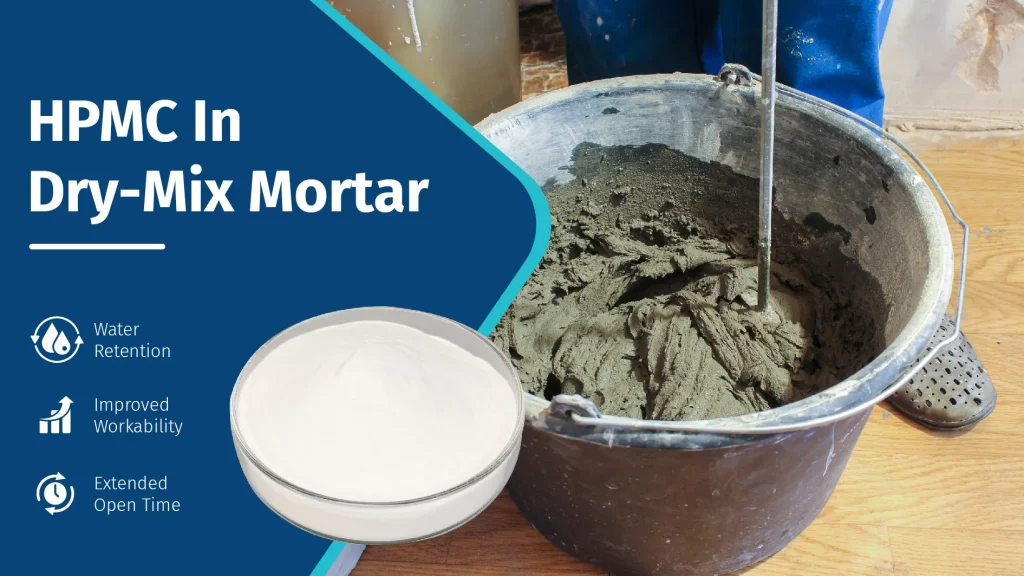
Construction is one of the most important application areas for HPMC. HPMC can be used in cement mortar, tile adhesive, wall putty, plaster, EIFS mortar, gypsum products, self-leveling mortar, repair mortar, and decorative mortar.
In construction materials, HPMC mainly works as:
| Function | Effect In Mortar |
|---|---|
| Water retention | It keeps water available for cement or gypsum hydration. |
| Thickening | It gives mortar body and improves handling. |
| Workability improvement | It makes spreading, troweling, and leveling easier. |
| Open time control | It gives workers more time to apply and adjust materials. |
| Anti-sag support | It helps vertical mortar stay in place. |
| Adhesion support | It improves contact between mortar and substrate. |
| Crack reduction | It helps reduce fast water loss and uneven drying. |
Zhiwei HPMC 100K and HPMC 200K are suitable test options for high-body construction systems. They support stronger water retention, longer open time, and better vertical stability. These grades are practical for tile adhesive, wall putty, plaster, EIFS mortar, and repair mortar.
HPMC For Self-Leveling Mortar
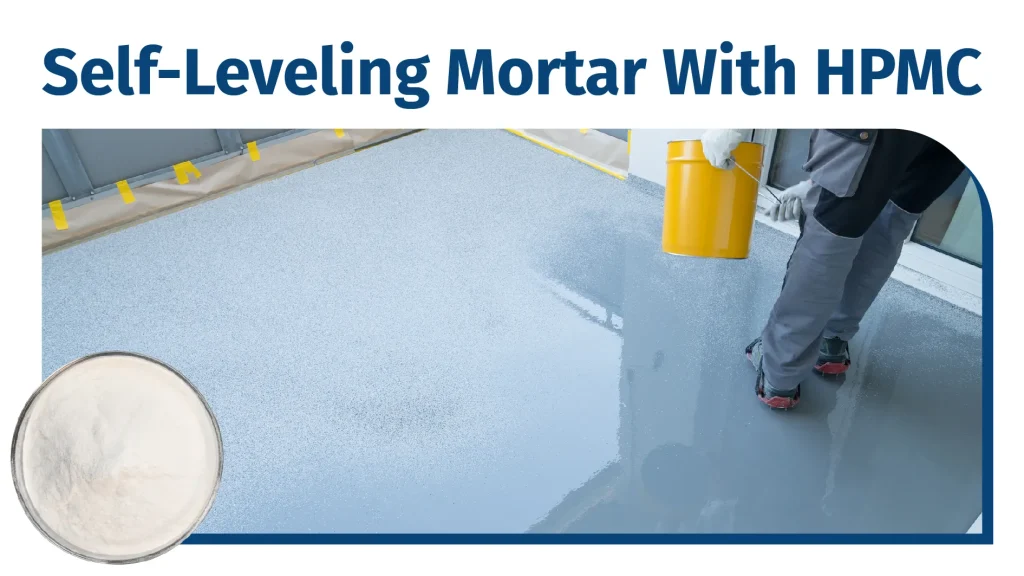
Self-leveling mortar needs flow. It must spread across the floor with limited manual leveling. At the same time, it must not show serious bleeding, segregation, or surface weakness.
Low-viscosity HPMC is useful in this system. It helps retain water without making the mortar too heavy or sticky. It also helps reduce settlement and improves pumpability.
Zhiwei HPMC 400 and HPMC 4K can be tested in self-leveling mortar and other flowable construction systems. These grades provide light rheology control and controlled water retention. They help the formula keep spread while reducing surface water loss.
HPMC For Tile Adhesive
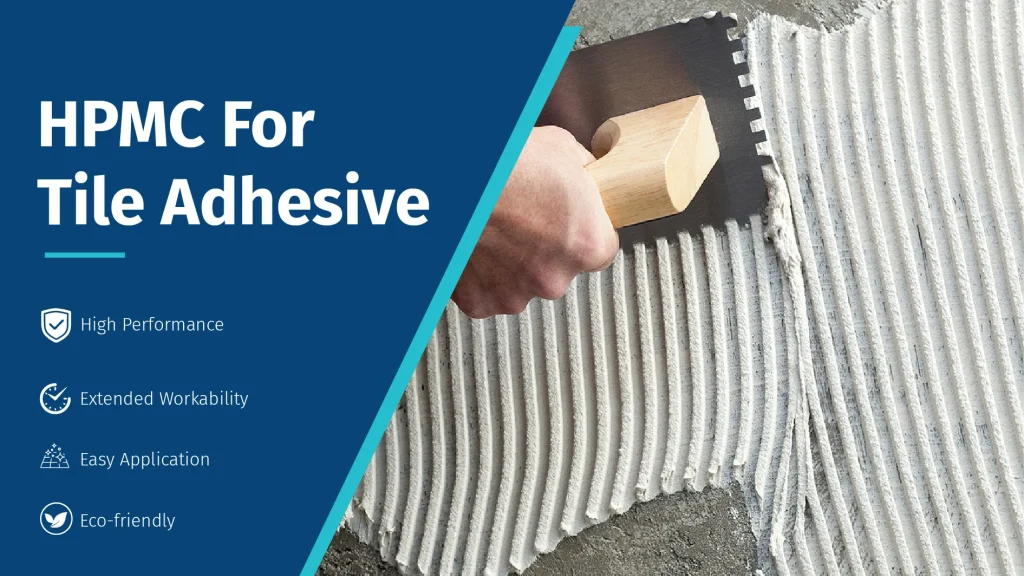
Tile adhesive needs stable water retention and good open time. The adhesive must keep enough wet contact before the tile is placed. It also needs good troweling feel and ridge stability.
HPMC helps tile adhesive in several ways. It keeps water in the adhesive layer. It improves workability during spreading. It supports open time for tile adjustment. It helps reduce sagging on vertical surfaces. It also helps the adhesive form a better structure during curing.
For standard tile adhesive, Zhiwei HPMC 100K can be used as a starting test grade. For stronger body and higher water retention, Zhiwei HPMC 150K or HPMC 200K can be tested. If the formula also needs higher temperature stability or different rheology, Zhiwei HEMC 100H or HEMC 150H can also be compared.
HPMC For Wall Putty, Plaster, And EIFS
Wall putty and skim coat need smooth application and good water retention. The material should spread evenly, fill small defects, and dry without easy cracking.
Plaster and EIFS mortar need adhesion, workability, and anti-crack support. HPMC improves mortar consistency and reduces fast surface drying. It also helps the mortar maintain strength by allowing hydration to continue.
For these systems, Zhiwei HPMC 100K and HPMC 200K are useful when stronger body and longer open time are required. Zhiwei HPMC 40K can be tested when the formula needs moderate viscosity and easier application.
HPMC For Cement Plaster And Spray Mortar
HPMC improves the uniformity of cement plaster. It makes plaster easier to spread and improves anti-sag performance. It can also improve pumpability and workability.
Because HPMC retains water, it extends working time. It helps cement mortar develop better mechanical strength during curing. It also helps reduce coating cracks and improve surface smoothness.
For spray mortar, the grade must balance pumpability and anti-sag. A formula that is too thin may slide. A formula that is too thick may block equipment or become hard to spray. Grade testing is necessary.
HPMC In Underwater Anti-Washout Concrete
Normal concrete can lose cement paste when placed underwater. Cellulose ether can help reduce washout. It increases viscosity and improves the cohesion of the mixture.
In underwater construction such as docks, bridges, or water-contact repair, HPMC or other cellulose ethers can help concrete keep shape and reduce material loss. The dosage is small, but the effect can be important. The full formula must still be tested for flow, strength, setting time, and anti-washout performance.
HPMC In PVC Suspension Polymerization
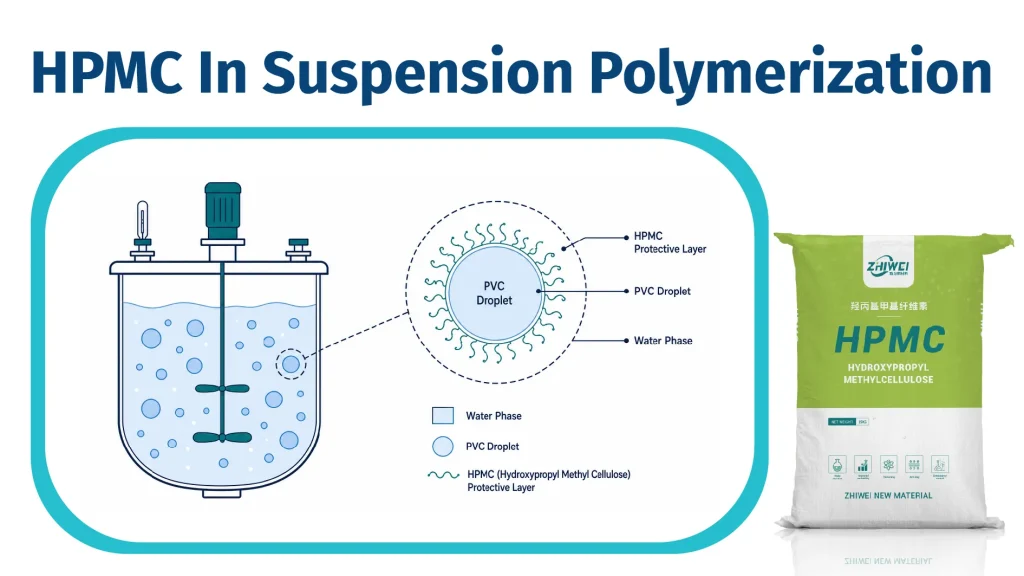
HPMC is also used in synthetic resin production, especially PVC suspension polymerization. In this system, HPMC acts as a protective colloid and dispersant. It helps prevent monomer droplets and polymer particles from coalescing.
HPMC affects PVC particle size, particle distribution, porosity, bulk density, flowability, thermal stability, and processing performance. It can also help improve residual monomer removal and plasticizer absorption.
In many PVC systems, HPMC is used together with PVA. A PVA and HPMC-E50 type composite dispersant system can be used as a starting point. A total dispersant level around 0.05%-0.06% of VCM, with HPMC-E50 making up about 40%-60% of the composite dispersant, can be tested. The final ratio depends on reactor design, agitation, conversion rate, polymerization temperature, and water-to-monomer ratio.
Key factors that affect PVC particle morphology include:
| Factor | Effect |
|---|---|
| Agitation | It affects droplet size, particle size, distribution, and porosity. |
| Dispersant system | It controls protection strength, particle compactness, and particle coalescence. |
| Conversion rate | It affects particle structure and shrinkage behavior. |
| Polymerization temperature | It affects particle porosity and fusion degree. |
| Water-to-monomer ratio | It affects viscosity, heat transfer, and final particle morphology. |
HPMC In Coatings And Paints
HPMC can be used in water-based coatings as a thickener, film-forming aid, dispersant, and emulsion stabilizer. It helps control storage viscosity and application viscosity. It can reduce dripping and sagging during use.
HPMC can also improve surface tension control, alkali and acid stability, and pigment compatibility in some systems. Since cellulose ether absorbs water strongly, the formulator should avoid excessive dosage when water resistance is important. A higher-viscosity grade at a lower dosage may help reach the required viscosity with less impact on water resistance.
HPMC In Ceramics
Water-soluble cellulose ethers can be used as green binders in ceramic production. Non-ionic cellulose ethers have low ash residue. HPMC and related cellulose ethers can support forming strength and help ceramic bodies keep shape before firing.
HPMC can also improve plasticity and processing behavior in ceramic forming systems. The selected grade should match the forming method, water content, drying behavior, and residue requirement.
HPMC In Oilfield Applications
HPMC and other cellulose ethers can be used in drilling fluids, cementing fluids, and fracturing fluids. They can work as thickeners, suspending agents, fluid-loss reducers, and rheology modifiers.
A good oilfield cellulose ether must tolerate salt, maintain viscosity, and reduce fluid loss. HPMC has non-ionic character, so it can remain stable in many electrolyte-containing systems. However, excessive electrolyte can still cause gelation or precipitation. Field testing is required.
HPMC In Pharmaceutical And Food Systems
HPMC is used in many pharmaceutical systems as a binder, thickener, suspending agent, stabilizer, film coating material, controlled-release material, and disintegrant support. Low-viscosity HPMC can be used in film systems. High-viscosity HPMC can be used for sustained-release and controlled-release systems.
HPMC can form transparent and tough films. It can also improve tablet stability and reduce color change in sensitive materials. HPMC ester derivatives, such as HPMCP, are used in enteric coating systems where release behavior depends on pH.
In food systems, HPMC can act as a thickener, stabilizer, emulsifier, and gel-forming agent. Its thermal gelation can help form a protective layer in some heated foods. Food and pharmaceutical applications require the correct grade, documentation, and regulatory approval. Construction-grade HPMC should not be used in food or medicine.
HPMC Grade Selection Guide
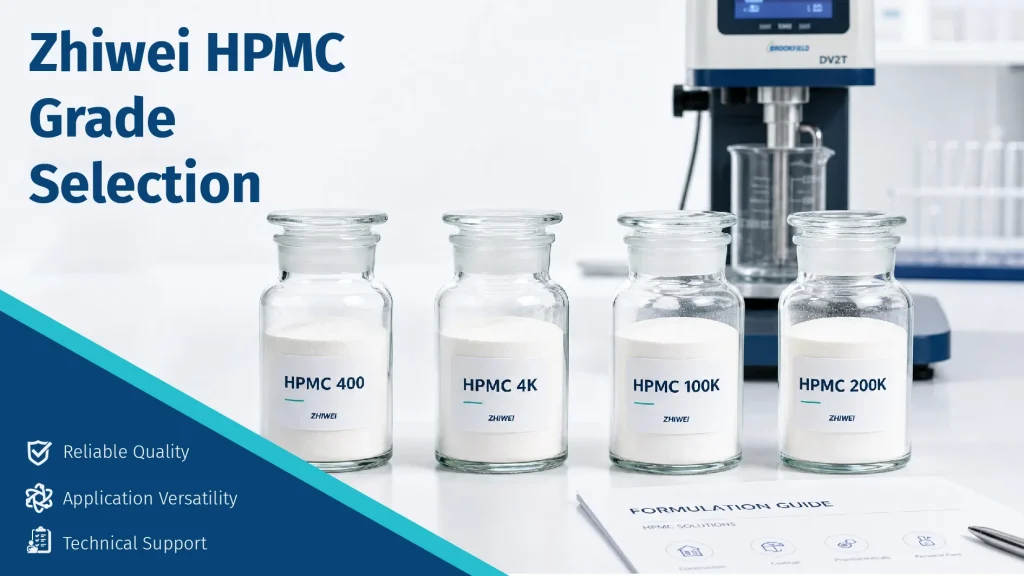
| Application | Main Need | Zhiwei Grade To Test |
|---|---|---|
| Self-leveling mortar | Flow, light viscosity, water retention | HPMC 400, HPMC 4K |
| Tile adhesive | Water retention, open time, vertical stability | HPMC 100K, HPMC 150K, HPMC 200K |
| Wall putty and skim coat | Smooth application, body, water retention | HPMC 40K, HPMC 100K |
| EIFS and repair mortar | Anti-sag, adhesion support, workability | HPMC 100K, HPMC 200K |
| Gypsum products | Smooth mixing and controlled consistency | HPMC 400, HPMC 4K, HPMC 40K |
| Coatings | Thickening and storage stability | HPMC 40K, HPMC 100K, or compare with HEC/HEMC |
| Daily chemical systems | Texture, stability, thickening | HPMC 100K, HPMC 150K, HPMC 200K |
The best grade should be confirmed by a small lab test. Cement type, sand grading, filler, polymer powder, water ratio, temperature, and mixing order can all change the final effect.
Conclusion
HPMC is a versatile cellulose ether with strong value in water-based industrial systems. It can thicken, retain water, stabilize particles, form films, improve workability, and support bonding. These functions make it useful in construction materials, PVC suspension polymerization, coatings, ceramics, oilfield fluids, paper, textiles, daily chemicals, food, and pharmaceutical systems.
For construction materials, HPMC is especially important. It improves dry-mix mortar performance at low dosage. It helps tile adhesive keep open time and vertical stability. It helps self-leveling mortar keep flow while reducing bleeding. It helps plaster, putty, EIFS, and repair mortar achieve better handling and curing behavior.
Zhiwei (Jinan) New Materials Co., Ltd. offers practical HPMC grades for different viscosity needs. Zhiwei HPMC 400 and HPMC 4K are suitable for flowable systems. Zhiwei HPMC 100K and HPMC 200K are suitable for high-body dry-mix systems that need stronger water retention, open time, and anti-sag support. For manufacturers, the right HPMC grade can make the formula more stable, easier to apply, and more repeatable in production.