
At Zhiwei (Jinan) New Materials Co., Ltd., we supply HEMC for dry mix mortar customers who need stable water retention, smooth workability, longer open time, and repeatable construction performance. Dry mix mortar is not judged only by how it looks in the bag. The real test starts after water is added. The mortar must wet out properly, spread smoothly, stay workable, hold water long enough, and support the final performance of the cement-based system.
That is why HEMC is such an important additive in dry mix mortar. A small dosage can change the handling of the whole formula. It helps the mortar keep the right body during mixing and application. It improves water retention, supports better troweling, reduces rapid water loss, and helps the material stay usable for a longer working window. For customers producing tile adhesive, wall putty, plaster, render, EIFS, repair mortar, waterproof mortar, or masonry mortar, choosing the right HEMC grade can directly affect product quality.
As an HEMC for dry mix mortar supplier, our role is not only to send powder. We help customers choose the right grade, test it in their own formula, and keep performance stable from sample to repeat order.
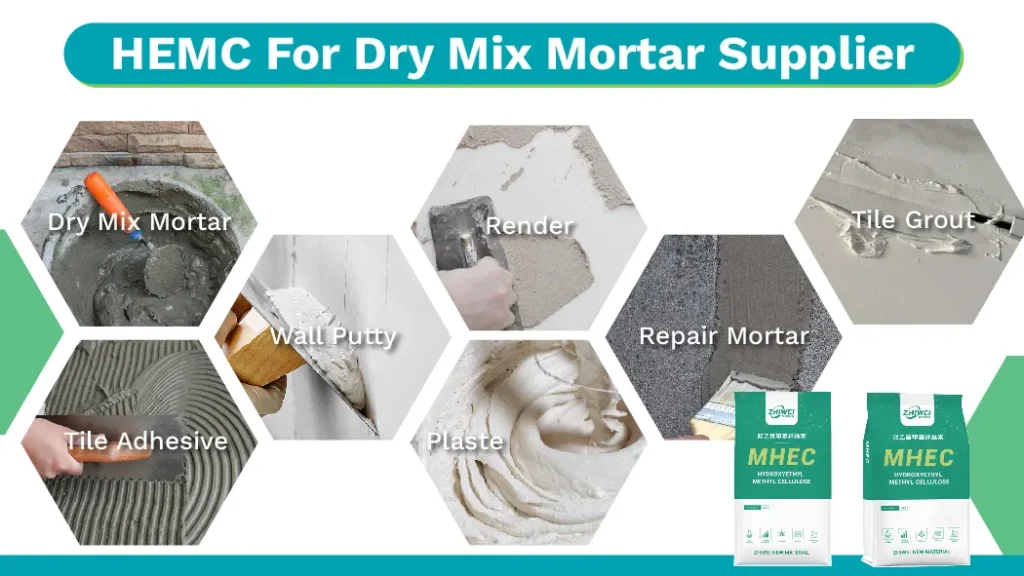
What Is HEMC In Dry Mix Mortar?
HEMC stands for Hydroxyethyl Methyl Cellulose. In some markets, it is also called MHEC, or Methyl Hydroxyethyl Cellulose. It is a non-ionic cellulose ether used in water-based and cement-based systems where viscosity, water retention, and handling matter.
In dry mix mortar, HEMC works mainly after water is added. It hydrates in the wet mix and helps control how the mortar behaves before the cement fully sets. It helps the material stay workable, improves the feel under the trowel, and supports water retention during early curing. This is especially important when the mortar is applied on absorbent substrates, vertical surfaces, or under hot and dry jobsite conditions.
For a dry mix mortar factory, HEMC is not just a thickener. It is a performance-control additive. It affects fresh mortar behavior, application comfort, open time, sag resistance, and the final user experience.
Why Dry Mix Mortar Needs HEMC
Dry mix mortar usually contains cement or gypsum, fillers, sand, mineral powders, polymers, and other functional additives. Before use, the powder is mixed with water. The wet mortar must then stay stable long enough for application.
Without proper cellulose ether support, several problems may appear. The mortar may lose water too quickly. The mix may feel rough or dry. The open time may be too short. Tile adhesive may slip on the wall. Wall putty may drag during scraping. Plaster may become difficult to spread. Repair mortar may lose workability too fast.
HEMC helps reduce these problems by improving fresh-state control. It helps the mortar hold water, build a stable wet structure, and maintain a smoother application feel. That is why HEMC is widely used in modern dry mix mortar formulations.
Main Functions Of HEMC In Dry Mix Mortar
Water Retention
Water retention is one of the most important functions of HEMC. Cement-based systems need enough water for hydration and workable application. If water is absorbed too quickly by the substrate or lost too fast during application, the mortar may become difficult to use and the final performance may suffer.
HEMC helps keep water inside the mortar for a longer period. This supports better working time and improves the stability of the wet mix. For tile adhesive, plaster, render, and wall putty, this function is especially important.
Workability
Workability is what the applicator feels during use. A good mortar should not feel too dry, too sticky, too heavy, or too loose. It should spread smoothly and keep a stable body on the tool and surface.
HEMC helps improve that balance. It gives the mortar a smoother and more controlled feel. This makes application easier and helps reduce complaints from installers.
Open Time
Open time is the period during which the mortar remains usable after application. In tile adhesive, open time is critical because tiles must be placed and adjusted before the adhesive surface dries too much. HEMC helps extend the usable working window by supporting water retention and surface stability.
For customers making tile adhesive or EIFS adhesive, open time is often one of the first performance points to test.
Sag Resistance
For vertical applications, the mortar must stay in place. Tile adhesive, wall putty, render, plaster, and EIFS base coat all need controlled sag resistance. If the mortar is too weak, it may slide or slump. If it is too stiff, it may become hard to apply.
HEMC helps build the right wet structure so the material can stay on the wall while remaining workable.
Consistency And Batch Stability
A dry mix mortar factory needs repeatable results. If the HEMC performance changes from batch to batch, the mortar formula may also change. Stable viscosity, moisture, fineness, and batch control are important for long-term production.
At Zhiwei, we treat HEMC supply as a long-term quality job, not only a single shipment.
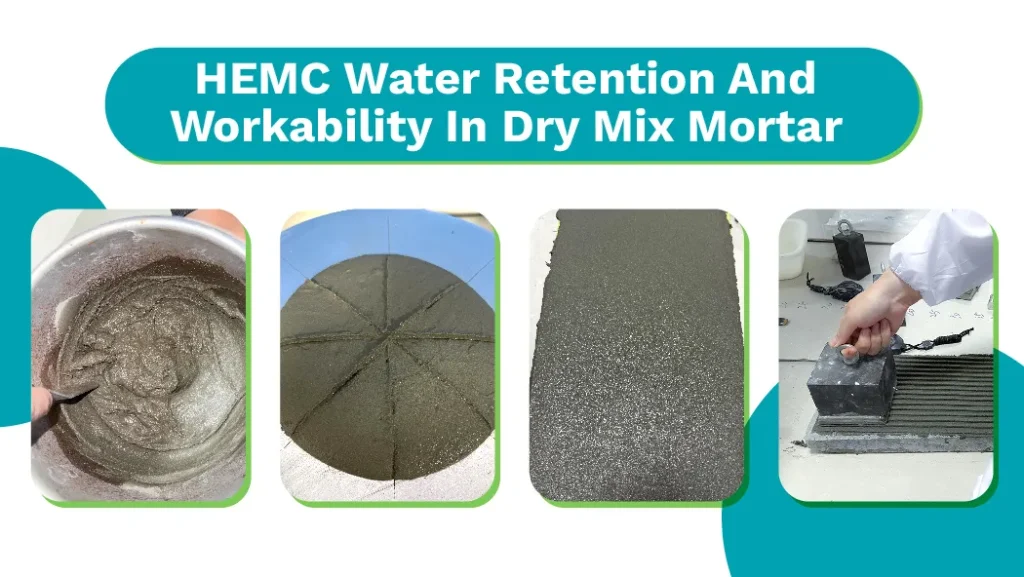
HEMC For Tile Adhesive
Tile adhesive is one of the most important applications for HEMC in dry mix mortar. In cement-based tile adhesive, HEMC helps improve water retention, open time, troweling feel, slip resistance, and application stability.
A good tile adhesive must spread smoothly, form clean ridges, hold the tile in place, and provide enough time for adjustment. If the adhesive dries too quickly, bonding performance may be affected. If the adhesive is too weak, tiles may slip on vertical surfaces. If the mix is too sticky, installers may feel poor workability.
When we recommend HEMC for tile adhesive, we usually ask for the cement type, sand grading, filler system, redispersible polymer level, target open time, slip resistance target, and the customer’s main problem. This helps us choose a more useful grade direction instead of sending a random sample.
HEMC For Wall Putty And Skim Coat
Wall putty and skim coat need smooth scraping, good water retention, stable consistency, and fine surface finish. HEMC helps improve the wet feel and makes the material easier to apply in thin layers.
In wall putty, the customer may care about smoothness, anti-cracking support, drying behavior, sanding performance, and final appearance. HEMC mainly supports the fresh-state side of the formula. It helps the putty spread more evenly, reduces rapid water loss, and supports a stable working feel.
For wall putty customers, grade selection should consider viscosity target, filler system, binder type, local temperature, water ratio, and application thickness.
HEMC For Plaster, Render, And Stucco Mortar
Lightweight cement plaster, render, and stucco mortar require stable workability and strong water retention. The material must spread across the surface without drying too quickly or losing body. In many jobsite conditions, the substrate can absorb water fast. HEMC helps slow that water loss and keeps the mortar usable for longer.
For plaster and render, we focus on spreading feel, anti-sag behavior, working time, water retention, and surface finishing. A suitable HEMC grade can make the mortar smoother and more comfortable to apply, especially in manual application.
HEMC For EIFS Adhesive And Base Coat
EIFS systems need adhesive and base coat materials with strong application stability. HEMC helps improve water retention, workability, and consistency in these systems. It supports smoother spreading and helps the material stay workable during installation.
For EIFS customers, grade selection should consider adhesive strength target, polymer level, cement system, application thickness, climate, and jobsite requirements. HEMC is not the only additive in EIFS, but it plays an important role in fresh mortar behavior.
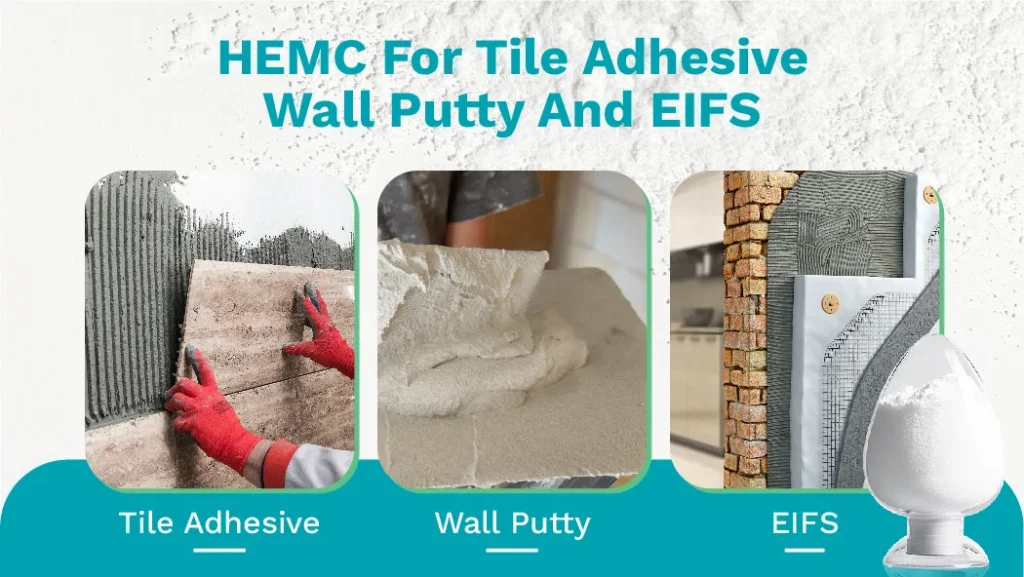
HEMC For Repair Mortar, Tile Grout, And Waterproof Mortar
HEMC is also used in repair mortar, tile grout, and cementitious waterproof mortar. These products have different requirements, but they all need controlled water behavior and stable workability.
Repair mortar needs body, adhesion support, and enough working time for proper placement. Tile grout needs smooth filling, stable consistency, and good workability between tile joints. Waterproof mortar needs a balanced wet structure that can be applied evenly without losing water too fast.
For these applications, we usually ask for the binder system, filler system, application thickness, target consistency, and final performance target before recommending a grade.
How To Choose HEMC For Dry Mix Mortar
Choosing HEMC for dry mix mortar should start from the application, not from the model name alone. A tile adhesive and a wall putty may both use HEMC, but they do not need the same performance balance. A repair mortar and a lightweight plaster may both need water retention, but the required workability can be different.
When customers contact us, we usually ask for:
Application type: tile adhesive, putty, plaster, EIFS, repair mortar, grout, waterproof mortar, or masonry mortar.
Binder system: cement type, gypsum type, lime, or mixed binder.
Filler and sand system: particle size, grading, and powder structure.
Target performance: water retention, open time, sag resistance, troweling feel, adhesion, or smooth scraping.
Formula conditions: polymer level, starch ether, air entrainer, water ratio, and other additives.
Jobsite conditions: temperature, humidity, substrate absorption, and application thickness.
These details help us recommend a more accurate HEMC grade and a simple sample test plan.
HEMC Models And Grade Direction
At Zhiwei, our HEMC product range includes different viscosity levels and grade directions for different applications. Common models include HEMC 400, HEMC 4K, HEMC 30K, HEMC 60K, HEMC 100H, HEMC 150H, and HEMC 200H. These model names help customers start the selection process, but real performance still depends on formula testing.
A higher viscosity grade is not always better. Some formulas need stronger water retention. Some need smoother workability. Some need better anti-sag behavior. Some need faster hydration or a cleaner working feel. The best grade is the one that matches the formula target.
As an HEMC for dry mix mortar supplier, we help customers avoid blind selection. We prefer to understand the formula first, then recommend a suitable testing direction.
Why Factory Backing Matters
Factory backing matters because dry mix mortar customers need stable long-term performance. A sample may work well once, but the real question is whether the same performance can be repeated in later batches.
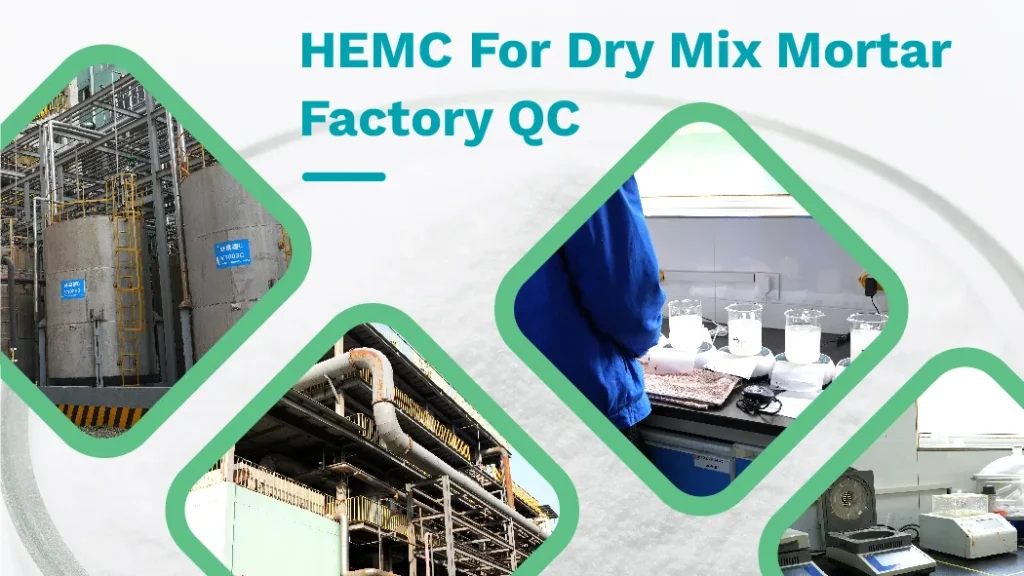
Our production and quality control focus on stable viscosity, fineness control, moisture control, appearance checks, ash control, and batch traceability. COA can be provided by batch on request. For B2B customers, this matters because unstable cellulose ether can create unstable mortar.
A dry mix mortar factory cannot keep changing its formula because the HEMC changes. Tile adhesive producers need repeatable open time and troweling feel. Wall putty producers need stable scraping and water retention. Plaster producers need consistent workability. Factory-backed supply helps reduce these risks.
How We Support Dry Mix Mortar Customers
At Zhiwei, we support customers from inquiry to sample testing and repeat order. We first confirm the application and formula direction. Then we recommend grade options for evaluation. After the customer tests the sample, we discuss the result and adjust the grade direction if needed.
For tile adhesive, we may focus on open time, slip resistance, troweling feel, and adhesion. For wall putty, we may focus on smooth scraping, water retention, and surface finish. For plaster and render, we may focus on spreading, anti-sag behavior, and workability after rest. For repair mortar and waterproof mortar, we may focus on consistency, placement, and water control.
We also support TDS, SDS, and COA by batch. For export customers, documents and communication are part of the supply service. We want customers to test clearly, order confidently, and use the product with stable expectations.
Why Choose Zhiwei As Your HEMC For Dry Mix Mortar Supplier
Customers choose Zhiwei because we combine factory-backed supply with application-focused support. We do not recommend HEMC only by name. We ask what the mortar needs to do. We care about water retention, workability, open time, sag resistance, adhesion, and final user experience.
Our goal is to help customers make performance repeatable. That means selecting the right grade, testing it in the right formula, and keeping batch quality stable over time. For dry mix mortar manufacturers, this is more valuable than a one-time low price.
Conclusion
HEMC is one of the key additives used in dry mix mortar. It improves water retention, workability, open time, sag resistance, and stable handling in cement-based and gypsum-based systems. It is widely used in tile adhesive, wall putty, plaster, render, EIFS, repair mortar, tile grout, waterproof mortar, and masonry mortar.
At Zhiwei (Jinan) New Materials Co., Ltd., we supply HEMC for dry mix mortar customers who need factory-backed quality, practical grade selection, sample support, and repeatable performance. As an HEMC for dry mix mortar supplier, our work is simple: help customers choose the right Hydroxyethyl Methyl Cellulose grade, test it in the real formula, and keep performance stable from sample to long-term supply.