
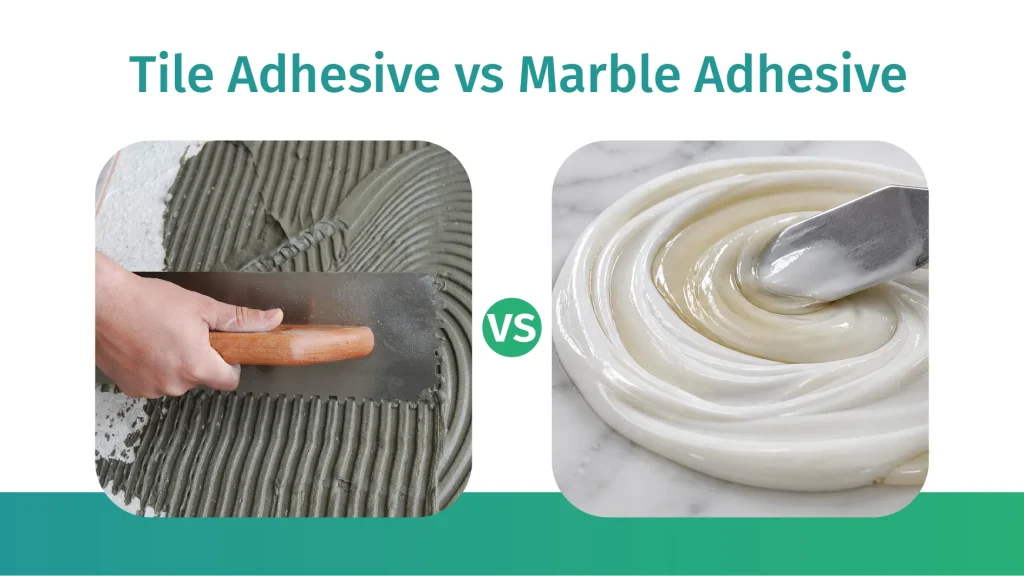
Tile adhesive and marble adhesive are not interchangeable products.
Most dry-powder tile adhesives are cement-based materials designed for installing ceramic tiles, porcelain tiles, mosaics, and some natural stones over a relatively large surface. Marble adhesive usually refers to a resin-based product used for stone bonding, seam filling, edge repair, or small-area fixing.
However, the term “marble adhesive” can be confusing. It may describe a white cement-based natural stone adhesive, a two-part epoxy stone adhesive, or a polyester marble glue. These products have different properties and should not be used for the same job.
The correct choice depends on the tile or stone type, unit size, substrate, installation location, moisture exposure, and required bond performance.
Tile Adhesive vs Marble Adhesive at a Glance
| Comparison | Cement-Based Tile Adhesive | Epoxy Stone Adhesive | Polyester Marble Glue |
|---|---|---|---|
| Main binder | Cement | Epoxy resin and hardener | Unsaturated polyester resin and catalyst |
| Typical form | One-component dry powder | Two-component paste or liquid | Two-component paste |
| Mixing method | Mix with measured water | Mix Part A and Part B | Mix resin with the specified catalyst |
| Main use | Large-area tile and stone installation | Dense surfaces, moisture-sensitive stone, structural repair when approved | Stone seams, chips, edges, and small repairs |
| Application method | Notched-trowel thin-bed application | Full spread, beads, dots, or structural bonding | Small dots, joints, seams, and repair areas |
| Working time | Controlled by open time after spreading | Limited by pot life after mixing | Usually short after catalyst is added |
| Bonding mechanism | Cement hydration and polymer film formation | Chemical reaction | Chemical reaction |
| Flexibility | Depends on polymer modification and product class | Usually strong and tough, depending on formulation | Often hard and relatively rigid |
| Vapor permeability | Generally higher than dense resin systems | Low | Low |
| Water and chemical resistance | Depends on formulation and installation system | Often high when correctly formulated | Product-specific and usually below structural epoxy |
| Suitable layer thickness | Defined by adhesive grade and trowel size | Product-specific | Usually intended for small bonding areas |
| Main limitation | Requires suitable curing conditions and substrate preparation | Mixing ratio and pot life must be controlled | Not normally suitable for full-area tile installation or structural anchoring |
This table provides a general comparison. The technical data sheet of the selected product must always take priority.
What Is Tile Adhesive?

Tile adhesive is a bonding material developed for fixing tiles or stone to walls and floors.
The term covers several adhesive technologies. Classifies ceramic tile adhesives into three main families:
- C: Cementitious adhesive
- D: Dispersion adhesive
- R: Reaction resin adhesive
In the dry-mix mortar industry, tile adhesive usually means a cementitious adhesive supplied as a dry powder. The installer adds water before application.
A typical cement-based tile adhesive may contain:
- Portland cement or another hydraulic binder
- Graded quartz sand or mineral aggregate
- Mineral fillers
- Redispersible polymer powder
- Hydroxypropyl methylcellulose, or HPMC
- Hydroxyethyl methylcellulose, or HEMC
- Starch ether or another anti-sag additive
- Setting-control and performance additives
Cement provides the basic strength. The polymer powder improves adhesion and deformation performance. Cellulose ether controls water retention, consistency, open time, and application behavior.
The balanced interaction between these materials allows the adhesive to be combed with a notched trowel while maintaining contact with the tile and substrate.
Where Is Tile Adhesive Used?
Depending on its grade, tile adhesive can be used for:
- Ceramic wall and floor tiles
- Porcelain and vitrified tiles
- Glass or ceramic mosaics
- Cement-based artificial stone
- Some natural stone materials
- Large-format tiles
- Tile-over-tile renovation
- Interior and exterior installation
- Wet areas, balconies, and swimming pools when the complete system is approved
Tile adhesive can be applied over concrete, cement render, cement screed, masonry, cement board, and other approved substrates.
Low-absorption porcelain tiles and large-format units usually need an improved adhesive. The required classification may include C2 for improved adhesion, E for extended open time, T for reduced slip, F for fast setting, or S1/S2 for deformation performance.
These codes describe different properties. They are not a simple quality ranking. The correct combination depends on the project design.
What Is Marble Adhesive?
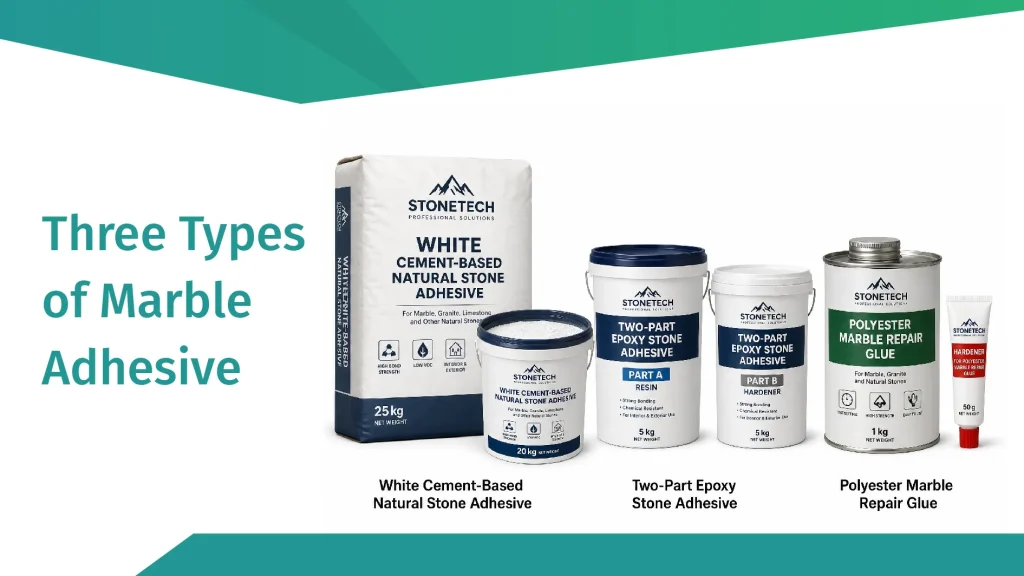
“Marble adhesive” is a broad commercial term rather than one precise product category. Buyers should identify the binder chemistry and intended use before ordering.
Three types are commonly sold for marble and other natural stones.
1. White Cement-Based Natural Stone Adhesive
This is a cementitious tile adhesive formulated specifically for natural stone installation.
It may use white cement and carefully selected fillers to reduce the risk of visible discoloration. Rapid-setting versions help limit the time during which moisture can move through a sensitive stone.
A product in this category can be suitable for:
- Marble wall and floor installation
- Granite tiles
- Light-colored natural stone
- Dimensionally stable stone slabs
- Interior and exterior surfaces
- Full-area bedding with a notched trowel
For example, SikaCeram-275 Marble & Stone is an example of a white, rapid-setting cementitious adhesive developed for tiles and natural stone.
This type is technically still a tile adhesive, even though it is marketed for marble.
2. Two-Part Epoxy Stone Adhesive
Epoxy stone adhesive contains a resin component and a hardener component. The two parts react chemically after mixing.
An epoxy system may be selected when the project requires:
- Bonding to a dense or non-absorbent surface
- High water or chemical resistance
- Installation of certain moisture-sensitive stones
- Stone-to-metal bonding
- Stone repair
- High bond strength
- Structural bonding when the product is specifically tested and approved
Epoxy products can bond materials such as natural stone, ceramic, concrete, metal, and existing tile. However, every product has its own approved substrates and applications.
For example, Sika RonaBond EPA 711 is a two-part epoxy adhesive intended for tiles and moisture-sensitive stone on several substrate types.
Epoxy adhesives are not all structural products. Structural work requires an adhesive with the appropriate test results, technical approval, and engineering specification.
3. Polyester Marble Glue
Polyester marble glue, sometimes called marble mastic, is widely used in stone processing workshops.
Common applications include:
- Filling small holes and cracks
- Repairing chipped stone edges
- Joining countertop sections
- Filling marble or granite seams
- Attaching small decorative pieces
- Color-matched cosmetic repairs
- Temporary stone positioning during fabrication
Polyester marble glue normally cures quickly after a catalyst is added. It can be sanded and polished, which makes it useful for visible stone repairs.
However, it is often rigid and is not automatically suitable for large-area tile installation, exterior weather exposure, submerged applications, or structural anchoring. Some polyester products may also discolor or lose performance under prolonged ultraviolet exposure.
Mapei’s technical discussion of epoxy grout application notes that marble glue is commonly used for filling cavities in marble and granite, but it should not be assumed to provide the same properties as a tested reaction-resin grout or adhesive.
What Is the Main Difference Between Tile Adhesive and Marble Adhesive?
The main difference is the intended bonding system.
Cement-based tile adhesive is designed to create a continuous bedding layer between a tile and a mineral substrate. It supports controlled troweling, sufficient open time, water retention, and coverage over a large area.
Resin-based marble adhesive is commonly designed for stone seams, repairs, dense materials, spot fixing, or special bonding conditions. It cures through a chemical reaction and usually has a shorter working time after the components are mixed.
The difference is not simply “weak cement versus strong resin.” Adhesive strength has several dimensions:
- Tensile adhesion
- Shear strength
- Deformation capacity
- Slip resistance
- Impact resistance
- Water resistance
- Chemical resistance
- Heat resistance
- Compatibility with the substrate
- Compatibility with the tile or stone
A high-strength but rigid adhesive may fail when movement occurs. A flexible tile adhesive may perform better in a wall or floor system exposed to thermal movement.
Can Tile Adhesive Be Used for Marble?
Yes, but it must be a tile adhesive approved for the selected natural stone.
A white cement-based, rapid-setting natural stone adhesive is often suitable for dimensionally stable marble. White materials are generally preferred for light-colored or translucent stone because grey cement may affect the finished appearance.
Before installation, consider the following stone properties:
- Water absorption
- Moisture sensitivity
- Risk of staining
- Translucency
- Resin backing
- Dimensional stability
- Unit size and weight
- Surface finish
- Exposure to heat, water, or chemicals
Some marble can bend, stain, or change color after absorbing moisture from a cement-based mortar. A reaction-resin adhesive may be more suitable for these materials, but only when it is approved for the stone and substrate.
A sample installation is advisable when stone sensitivity is uncertain.
Can Marble Adhesive Be Used for Ceramic or Porcelain Tile?
A tested epoxy tile adhesive can be used for ceramic or porcelain tile when its technical data sheet allows it.
Polyester marble glue should not be treated as a general replacement for tile adhesive.
Using small dots of marble glue behind a large tile creates unsupported spaces. These spaces can increase the risk of cracking under impact or load. Spot bonding also reduces the effective contact area and can allow moisture to accumulate behind the tile.
For normal wall and floor installation, use a tile adhesive designed for continuous bedding. Select the trowel size and back-buttering method needed to achieve the specified adhesive coverage.
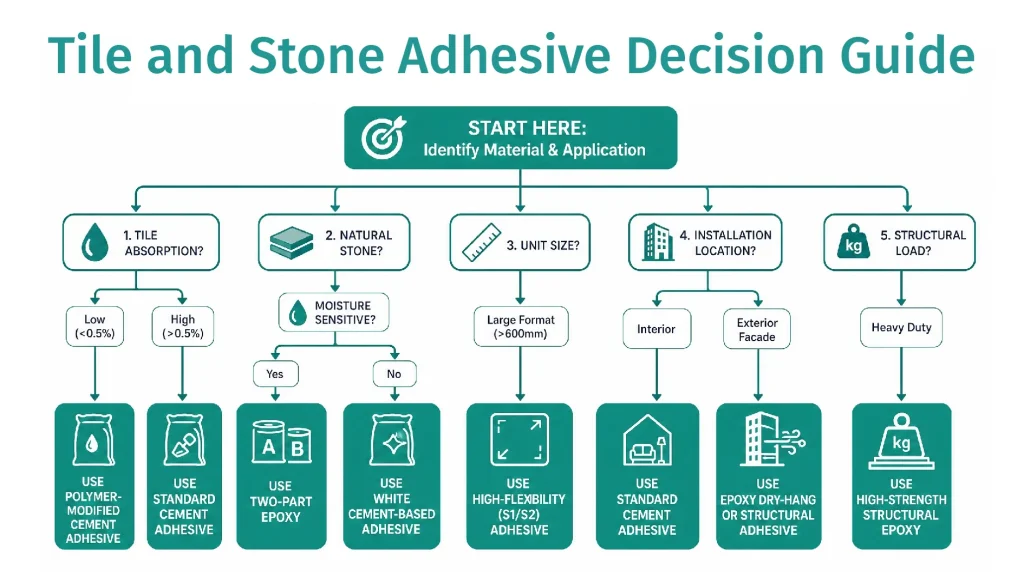
Which Adhesive Should You Use?
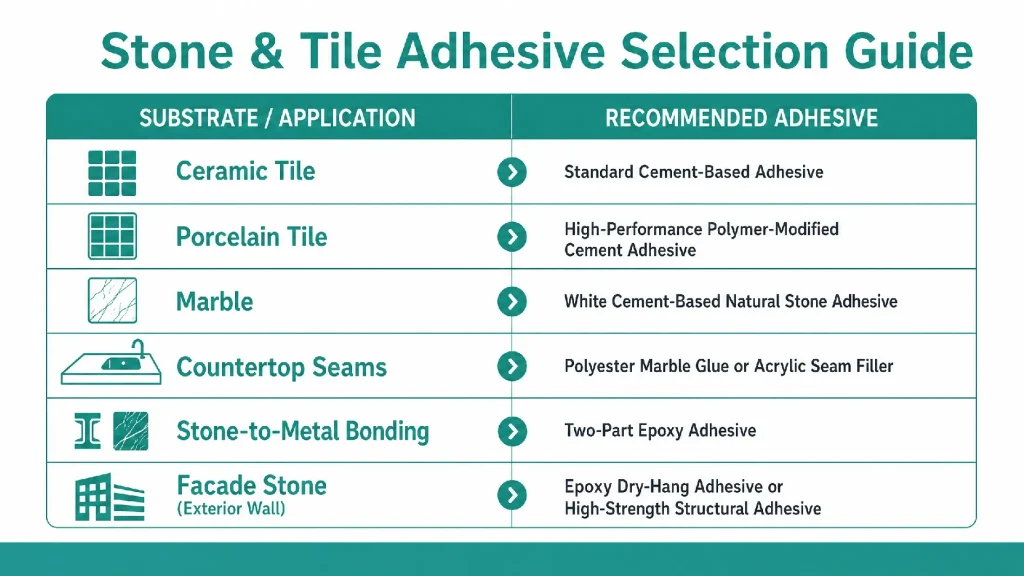
| Installation Situation | Recommended Direction |
|---|---|
| Standard ceramic tile on a cement wall | Suitable cementitious tile adhesive |
| Porcelain tile with low water absorption | Improved cementitious adhesive with the required adhesion class |
| Large-format wall tile | Adhesive with suitable slip resistance, open time, and deformation performance |
| Marble floor tile | White natural-stone-rated cementitious adhesive, subject to compatibility testing |
| Light or translucent marble | White adhesive and a sample test before full installation |
| Moisture-sensitive natural stone | Approved rapid-setting cementitious or reaction-resin adhesive |
| Resin-backed stone | Adhesive specifically approved for the backing material |
| Marble countertop seam | Color-matched polyester or epoxy stone adhesive |
| Stone chip or edge repair | Repair-grade marble adhesive |
| Stone bonded to metal | Approved epoxy adhesive |
| Heavy stone facade | Engineered mechanical fixing, with approved adhesive only as part of the specified system |
| Swimming pool or chemical area | Complete adhesive, waterproofing, grout, and sealant system rated for the exposure |
Heavy stone panels should not depend only on a general marble glue. Exterior facades and overhead installations may require mechanical anchors, brackets, or dry-hanging systems designed by a qualified engineer.
Application Differences
How to Apply Cement-Based Tile Adhesive
- Remove dust, oil, loose material, curing compounds, and other contaminants.
- Confirm that the substrate is sound, level, and suitable for tiling.
- Measure clean water according to the product instructions.
- Add the dry powder and mix mechanically at a controlled speed.
- Allow the mortar to rest for the specified maturation time.
- Remix briefly without adding extra water.
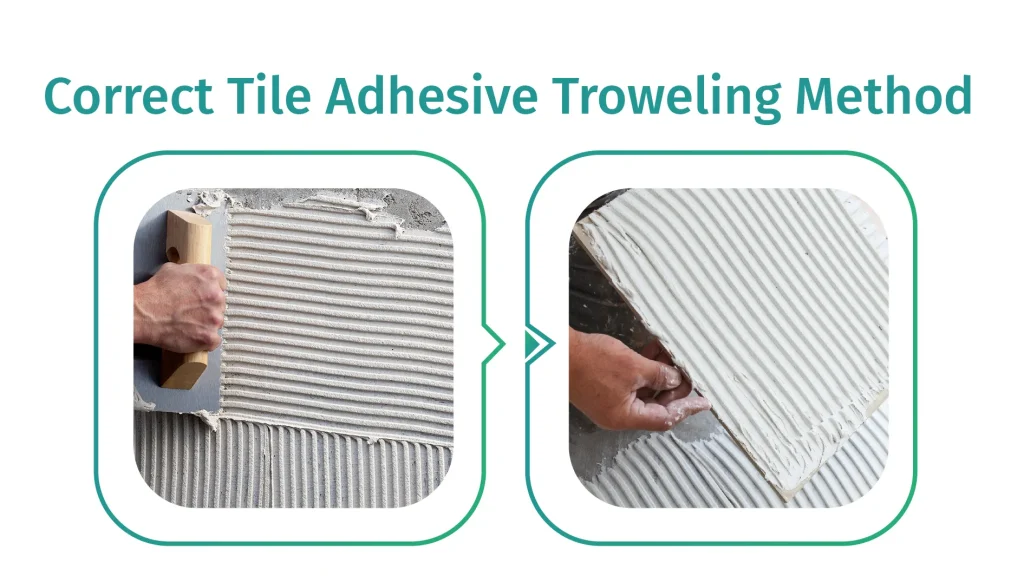
- Spread the adhesive with the flat side of the trowel.
- Comb it in one direction with the correct notched edge.
- Press the tile into the fresh ridges with a sliding movement.
- Use back-buttering for large tiles or when higher coverage is required.
- Check coverage by removing a tile during installation.
- Protect the installation from rain, washing, freezing, and rapid drying.
The installer must work within the adhesive’s open time. If a dry skin forms on the surface, pressing a tile into it will not restore full bonding.
Adding water after the mortar has started to set can damage its performance.
How to Apply Two-Part Marble or Epoxy Adhesive
- Clean and dry the bonding surfaces.
- Confirm that the stone, substrate, and backing are compatible with the adhesive.
- Measure Part A and Part B at the specified ratio.
- Mix until the material is uniform in color and consistency.
- Prepare only the amount that can be used within the stated pot life.
- Apply using the method required by the product and project.
- Position the stone before the adhesive begins to thicken.
- Remove excess material before it fully hardens.
- Keep the bonded area stable during curing.
- Wait for full cure before loading, polishing, or exposing the joint to water.
The pot life becomes shorter at higher temperatures. Mixing a large batch can also increase heat generation and shorten the usable time.
The specified ratio should never be changed to speed up or slow down curing.
Common Selection and Installation Mistakes
Using Plain Cement Mortar for Low-Absorption Tiles
Modern porcelain tiles absorb very little water. Plain cement and sand mortar may not provide reliable adhesion to their dense backs.
A polymer-modified tile adhesive is usually the better choice.
Using Polyester Marble Glue Over a Full Wall or Floor
Polyester marble glue is useful for fabrication and repair, but it is generally not a full-area bedding mortar. It can be too rigid, cure too quickly, and create poor coverage when used as isolated dots.
Assuming Every Epoxy Is Structural
Some epoxy products are designed for tile setting or cosmetic repair. Others are tested for structural bonding.
For example, Mapei Adesilex PG1 is specifically presented as a structural epoxy adhesive. This does not mean every two-part stone adhesive has the same function.
Believing a Thicker Adhesive Layer Is Always Stronger
Tile adhesive should be applied within its specified thickness.
An excessively thick layer can shrink, cure unevenly, reduce stability, and make tile alignment difficult. A layer that is too thin may not provide sufficient contact or compensate for normal surface variation.
Uneven substrates should be repaired or levelled before installation.
Ignoring Movement Joints
Neither tile adhesive nor marble glue replaces a movement-joint sealant.
Existing structural and movement joints must be carried through the tile or stone finish. Additional joints may be required around perimeters, changes of plane, large floor areas, and locations exposed to temperature changes.
Treating Adhesive as Waterproofing
A water-resistant adhesive is not automatically a waterproof membrane.
Bathrooms, balconies, pools, and other wet areas may require a complete waterproofing system beneath the adhesive.
How Cellulose Ether Improves Cement-Based Tile Adhesive

Cellulose ether is an important functional additive in cement-based tile and natural stone adhesives.
It is not normally used as the main thickener in epoxy or polyester marble glue. These resin products require additives designed for their own chemical systems.
In cement-based adhesive, HPMC or HEMC can support:
- Water retention
- Open time
- Wetting of the tile and substrate
- Smooth trowel application
- Consistency control
- Vertical stability
- Reduced tile slip
- Improved mortar cohesion
- More reliable performance under warm or dry conditions
Water retention is especially important. If the substrate or environment removes water too quickly, the cement may not hydrate properly. The adhesive can lose workability before the tile is installed.
However, more cellulose ether is not always better. Excessive viscosity or dosage may make the mortar sticky, reduce wetting, increase air entrainment, or slow strength development.
The grade must be balanced with the cement, sand grading, filler, polymer powder, water demand, and climate.
Zhiwei Cellulose Ether Options for Tile Adhesive
Zhiwei (Jinan) New Materials Co., Ltd. supplies HEMC and HPMC grades for cement-based dry-mix applications.
The appropriate model should be selected through laboratory trials and application testing.
| Formulation Requirement | Suggested Zhiwei Screening Direction | Main Selection Focus |
|---|---|---|
| Standard cement-based tile adhesive | HEMC 100H | Water retention, open time, and workable consistency |
| Improved or premium tile adhesive | HEMC 150H | Body, vertical stability, and extended handling |
| High-viscosity wall tile adhesive | HPMC 100K | Water retention, open time, and anti-sag support |
| Large-format tile adhesive | HEMC 150H or HPMC 100K | Stable ridges, workable spread, and sufficient wetting |
| White cement-based stone adhesive | Suitable HEMC or HPMC grade after color and setting tests | Moisture control, open time, and compatibility with white cement |
| Epoxy or polyester marble glue | No standard cellulose ether recommendation | Use resin-compatible rheology additives |
Zhiwei HPMC 100K is a high-viscosity cellulose ether developed for applications requiring water retention, open time, and vertical stability. Its published NDJ viscosity range is 90,000-120,000 mPa.s for a 2% solution at 20 C.
Zhiwei also offers an HEMC product range that includes HEMC 100H and HEMC 150H. These grades can be evaluated for different tile adhesive consistency and water-retention targets.
Model selection should not be based on viscosity alone. Important test items include:
- Water demand
- Mixing behavior
- Trowelability
- Ridge stability
- Tile wetting
- Open time
- Slip resistance
- Tensile adhesion
- Strength development
- Air content
- Performance after heat, water, and freeze-thaw exposure when relevant
Zhiwei can support formulation trials by matching cellulose ether characteristics to the cement, aggregate, polymer powder, application method, and target market.
Safety and Handling
Cement-based tile adhesive contains fine powder and alkaline materials. Avoid breathing dust and prevent prolonged skin or eye contact. Use suitable gloves, eye protection, and respiratory protection during mixing.
Epoxy resin and hardener can irritate or sensitize the skin. Polyester marble glue may release strong odors and volatile compounds during mixing and curing.
Use resin adhesives in a ventilated area. Wear the personal protective equipment specified in the safety data sheet. Do not clean uncured resin from skin with aggressive solvents.
Questions to Ask Before Buying an Adhesive
Before choosing between tile adhesive and marble adhesive, confirm:
- What material is being installed?
- Is it ceramic, porcelain, marble, granite, or resin-backed stone?
- What are the tile or stone dimensions and weight?
- Is the installation on a wall, floor, facade, ceiling, or countertop?
- Is the substrate absorbent or non-absorbent?
- Will the area be exposed to water, chemicals, heat, or freezing?
- Is the natural stone sensitive to moisture or staining?
- Is full-area bedding, seam filling, repair, or structural bonding required?
- What adhesive classification does the project specify?
- Are mechanical fixings required?
- What open time or pot life is practical for the installer?
- Has a compatibility test been completed?
These questions are more useful than selecting a product only by the words “tile adhesive” or “marble adhesive” on the package.
Frequently Asked Questions
Is Marble Adhesive Stronger Than Tile Adhesive?
Not in every situation.
An epoxy stone adhesive may have very high shear and tensile strength, but a cementitious tile adhesive may provide better deformation compatibility and large-area application performance. The best product is the one designed for the actual materials, loads, movement, and exposure conditions.
Can I Use Tile Adhesive to Repair a Marble Countertop?
Tile adhesive is generally not the best choice for a narrow countertop seam or cosmetic edge repair.
A color-matched epoxy or polyester marble repair adhesive can provide a finer joint that can be sanded and polished. Confirm food-contact, stain-resistance, and heat-resistance requirements when applicable.
Can Marble Glue Be Used for Large Porcelain Tiles?
Polyester marble glue is generally unsuitable as the primary full-area adhesive for large porcelain tiles.
Use a tile adhesive rated for the tile size, substrate, and service conditions. Large-format installation may also require back-buttering and a suitable deformation class.
Is White Tile Adhesive Suitable for Marble?
It may be suitable if it is specifically approved for natural stone.
White color alone does not prove compatibility. Check setting speed, water content, stone sensitivity, adhesion classification, and the manufacturer’s application limits.
Does Marble Adhesive Make the Surface Waterproof?
No. An adhesive does not automatically form a complete waterproofing system.
Wet areas may need a membrane, compatible adhesive, grout, movement-joint sealant, drainage design, and correct detailing.
Can HPMC or HEMC Be Added to Marble Glue?
HPMC and HEMC are mainly used in water-based and cement-based formulations. They are important additives in dry-mix tile adhesive but are not normally added to reactive epoxy or polyester marble glue.
Resin adhesives require rheology modifiers compatible with their resin chemistry.
Conclusion
The difference between tile adhesive and marble adhesive begins with the binder, application method, and intended use.
Cement-based tile adhesive is normally the practical choice for full-area installation of ceramic, porcelain, and compatible natural stone. A white natural-stone-rated cementitious adhesive may be suitable for marble when moisture sensitivity and staining have been evaluated.
Epoxy stone adhesive is useful for demanding substrates, moisture-sensitive materials, chemical exposure, and approved structural repairs. Polyester marble glue is better suited to seams, chips, edges, and small fabrication work.
Product names alone are not enough. Always check the binder chemistry, technical classification, substrate compatibility, coverage requirement, and project conditions.
For manufacturers developing cement-based tile or natural stone adhesives, Zhiwei HEMC and HPMC products can support water retention, open time, consistency, and vertical stability. The final grade and dosage should be confirmed through formulation testing.