
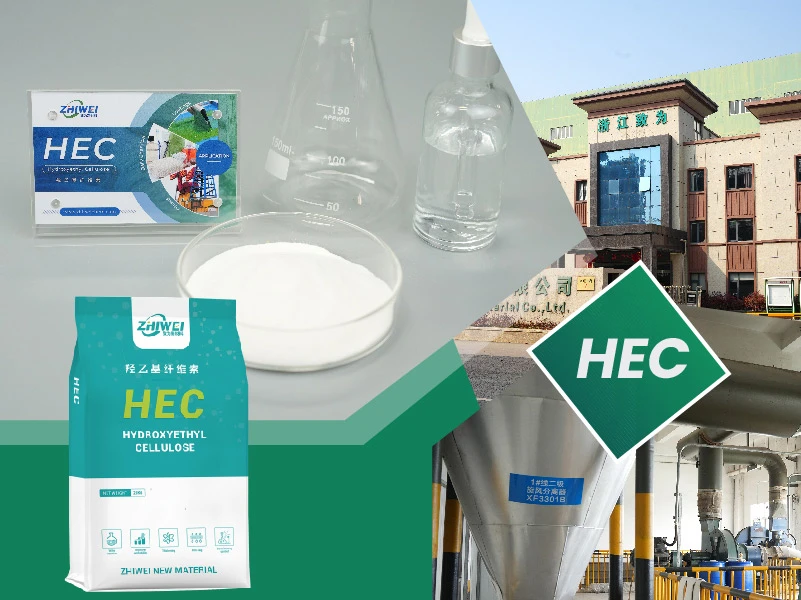
The global hydroxyethyl cellulose (HEC) market
reached 1.8 billion in 2024 and is projected to grow to 1.8 billion in 2024 and is projected to grow to 2.8 billion by 2033 at a CAGR of 5.2%, according to Verified Market Reports. Two industries account for the bulk of that volume: paint and coatings manufacturing, and personal care product formulation. If you are a procurement manager sourcing HEC for either of those sectors, this guide is for you.
The challenge is not finding a supplier. There are hundreds of HEC manufacturers and traders, mostly in China. The challenge is finding one whose grade, quality system, and documentation match what your formulators actually need. A paint thickener grade and a cosmetic-grade HEC are not the same product, even if they share the same CAS number. Getting that wrong costs you returns, reformulation time, and credibility with your customers.
This guide cuts through the noise. It covers what HEC is, how paint and personal care grades differ, how to evaluate suppliers on the criteria that matter for your industry, and what documentation you should demand before the first shipment arrives.
What Is Hydroxyethyl Cellulose (HEC)?

Hydroxyethyl cellulose is a non-ionic, water-soluble cellulose ether. Manufacturers produce it by reacting cellulose — typically from refined cotton linter or wood pulp — with sodium hydroxide and ethylene oxide. The result is a white to off-white powder that dissolves in cold or hot water to produce viscous solutions.
HEC functions primarily as a thickener, rheology modifier, stabilizer, and water-retention agent. Its non-ionic nature means it does not react with ionic salts or surfactants in a formulation, which is why it works across such a wide range of products.
| Property | Typical Value | Why It Matters |
|---|---|---|
| Appearance | White to off-white powder | Visual quality indicator |
| Viscosity (2% solution) | 3,000–100,000 mPa·s | Determines thickening power; varies by grade |
| Moisture content | ≤5% | Shelf life and dosing accuracy |
| pH (1% solution) | 6.0–8.5 | Formulation compatibility |
| Ash content | ≤1% | Purity; higher in cosmetic grades |
| Gelation temperature | 60–70°C | Affects high-temperature processing |
| Degree of substitution (MS) | 1.8–2.5 | Water solubility and viscosity behavior |
| Heavy metals | Varies by grade | Regulated for cosmetics and pharma |
The degree of substitution (DS for methyl/hydroxypropyl, MS for hydroxyethyl) is a key parameter. Higher MS values mean better water solubility and clearer solutions — which is why cosmetic-grade HEC typically has an MS above 2.0.
HEC for Paint and Coatings: What Procurement Teams Need to Know
In architectural paints, HEC does more than just thicken. It controls rheology across the entire production and application cycle. Spray atomization, brush drag, roller splatter, and storage stability all depend on getting the HEC grade right.
Key Performance Parameters for Paint-Grade HEC
Viscosity grade: The viscosity of the HEC you buy does not equal the viscosity of your final paint. Suppliers typically specify viscosity at 2% concentration in water. Paint formulators target different final viscosities depending on the paint type:
| Viscosity Range | Typical Use | Notes |
|---|---|---|
| 3,000–15,000 mPa·s | Flat/matte wall paints | Good spatter resistance |
| 15,000–40,000 mPa·s | Eggshell and satin paints | Balance of flow and leveling |
| 40,000–100,000 mPa·s | High-build coatings, textured paints | Thick application, anti-sag |
Pseudoplastic behavior: HEC solutions are shear-thinning — viscosity drops under high shear (spraying, brushing) and recovers at rest. This is what makes paint brush smoothly without running. Ask your supplier for rheological data if you are comparing grades.
BIODUR or bio-stable grades: Standard HEC is susceptible to microbial attack in the paint can, which breaks down viscosity over time. Bio-stable HEC (sometimes sold as BIODUR or enzyme-resistant grades) includes a protective treatment. If your paint has no in-can preservative or is sold in warm climates, demand a bio-stable grade.
Dispersion behavior: Some HEC powders disperse easily in cold water; others require high-shear mixing or predispersion in glycerin. Your supplier’s technical data sheet should specify the recommended addition method. If your factory runs a cold-batch process, check this before ordering.
What Paint Buyers Should Ask Suppliers
- What is the viscosity range for your standard paint-grade HEC?
- Do you offer bio-stable or enzyme-resistant grades?
- What is the recommended addition procedure for your grade?
- Can you provide rheological curves (viscosity vs. shear rate)?
- Do you have Technical Data Sheets (TDS) and SDS in our required languages?
- Can you supply pilot batches for in-house testing before full orders?
HEC for Personal Care and Cosmetics: What Procurement Teams Need to Know
HEC is one of the most widely used thickeners in personal care formulations. Shampoo, body wash, lotion, cream, facial cleanser, and toothpaste all use it. The grade requirements are substantially different from paint — and so are the compliance obligations.
Key Performance Parameters for Cosmetic-Grade HEC
Clarity and transparency: Cosmetic formulations, especially clear products like shampoos and gels, require HEC that produces crystal-clear solutions. This depends on both the MS value and the manufacturing process. Cloudy solutions usually indicate either a high-ash grade or incomplete dissolution.
Viscosity grade: Cosmetic HEC typically uses lower viscosity grades than paint:
| Viscosity Range | Typical Application | Notes |
|---|---|---|
| 300–6,000 mPa·s | Shampoos, body washes, facial cleansers | Low viscosity for pourable products |
| 6,000–15,000 mPa·s | Thick lotions, hand creams | Medium viscosity |
| 15,000–40,000 mPa·s | Hair gels, thick creams | High viscosity for gel-like textures |
INCI compliance: The International Nomenclature of Cosmetic Ingredients (INCI) name for HEC is simply Hydroxyethylcellulose. Your supplier must provide a grade that is listed under this INCI name, not a trade name or mixture. If you are selling in the EU, USA, or other regulated markets, the INCI name is required on your product label.
Microbial purity: Cosmetic-grade HEC must meet microbial limits set by the relevant regulatory body (USP for the USA, EP for the EU). Standard limits: total aerobic microbial count (TAMC) ≤100 CFU/g, absence of specified pathogens. Ask for a Certificate of Analysis that includes microbial test results, not just physicochemical parameters.
Preservative compatibility: HEC itself is not a food for microorganisms, but a contaminated grade can introduce microbes into your formulation. Many personal care manufacturers add preservatives as a belt-and-suspenders approach. Confirm your supplier’s microbial testing protocol and ask whether they offer preservative-treated grades.
What Personal Care Buyers Should Ask Suppliers
- Is your cosmetic-grade HEC listed under INCI name Hydroxyethylcellulose?
- Can you provide a Certificate of Conformance or COA with microbial test results?
- What is the transparency level of your HEC solutions at 1% concentration?
- Do you have EU REACH registration or US FDA documentation for cosmetic use?
- Can you supply samples with full regulatory documentation for your target markets?
- Is the grade free from animal-derived materials (vegan/cruelty-free requirements)?
Global HEC Supplier Landscape
Most HEC worldwide comes from three types of producers: multinational chemical companies, Chinese manufacturers, and regional distributors. Understanding who makes what helps you choose the right tier for your procurement strategy.
Multinational Producers
Companies like Dow (now Dow Inc., CELLOSIZE brand), Ashland (Natrosol brand), and Shin-Etsu produce high-purity, technically consistent HEC grades. Their products are fully REACH- and TSCA-registered, with complete regulatory documentation and warehouse coverage in major markets.
The trade-off is price. Multinational brands typically cost 50–100% more than equivalent Chinese grades. For large buyers with complex regulatory requirements or multi-market product launches, that premium is often justified. For buyers sourcing for a single formulation in one region, it may not be.
Chinese Manufacturers
China produces the majority of global HEC volume. The industry is concentrated in Shandong, Hebei, and Jiangsu provinces. Most factories produce HEC from Xinjiang refined cotton, which is among the highest-purity cotton linter available.
Chinese HEC suppliers compete primarily on price and availability. Quality varies more than among multinational brands — some factories run ISO-certified quality systems, while others do not. Batch consistency is the main variable. Before committing to a Chinese supplier, verify their quality system and test samples across at least three production batches.
The gap between Chinese and Western-brand HEC has narrowed significantly in recent years. Several Chinese factories now produce HEC that meets or exceeds the performance of Western equivalents for specific applications. Finding those factories requires due diligence.
Regional Distributors
Distributors repackage and resell HEC sourced from manufacturers. They add value through smaller MOQs, local stock, and technical support in local languages. The downside is margin on top of the manufacturer’s price and potential supply chain opacity — you may not know the actual manufacturing origin.
For buyers in North America, Europe, or Southeast Asia who need small volumes quickly, distributors are often the most practical first contact. As volumes grow, it is worth going direct to the manufacturer for better pricing and traceability.
How to Evaluate HEC Suppliers: A Dual-Industry Framework
The evaluation criteria differ depending on whether you are buying for paint or personal care. Use the framework that matches your industry.
For Paint and Coatings Buyers
| Evaluation Area | What to Check | Red Flags |
|---|---|---|
| Grade range | Standard vs. bio-stable grades available | No bio-stable option available |
| Quality system | ISO 9001 minimum; ISO 14001 preferred | No third-party certification |
| Documentation | TDS, SDS, COA per batch | COA not available per shipment |
| Sample testing | Pilot batch for in-house viscosity test | Supplier refuses sample requests |
| Viscosity consistency | Compare COAs across 3 batches; ±10% max drift | Large viscosity variation between batches |
| Moisture control | ≤5% moisture stated on COA | No moisture specification on COA |
| Lead time | 7–21 days production + shipping | Lead times exceed 6 weeks with no explanation |
| Technical support | In-house lab or application engineer available | No technical contact provided |
For Personal Care Buyers
| Evaluation Area | What to Check | Red Flags |
|---|---|---|
| Regulatory compliance | INCI listing, REACH (EU), TSCA (USA) | INCI name not confirmed or not provided |
| Microbial testing | COA includes TAMC and pathogen testing | Microbial results absent from COA |
| Transparency test | Request 1% solution photo or turbidity data | Supplier cannot provide transparency data |
| Vegan/cruelty-free | Declaration of animal-free raw materials | Supplier cannot confirm sourcing of cellulose |
| Documentation package | INCI, COA, SDS, Allergen Declaration | Incomplete regulatory documentation |
| Grade availability | Cosmetic-grade viscosity ranges in 300–40,000 mPa·s | Only industrial/technical grades available |
| Formulation support | Can supplier provide dissolution guidance or compatibility data? | No technical support after sale |
HEC Grade Comparison: Paint vs. Personal Care
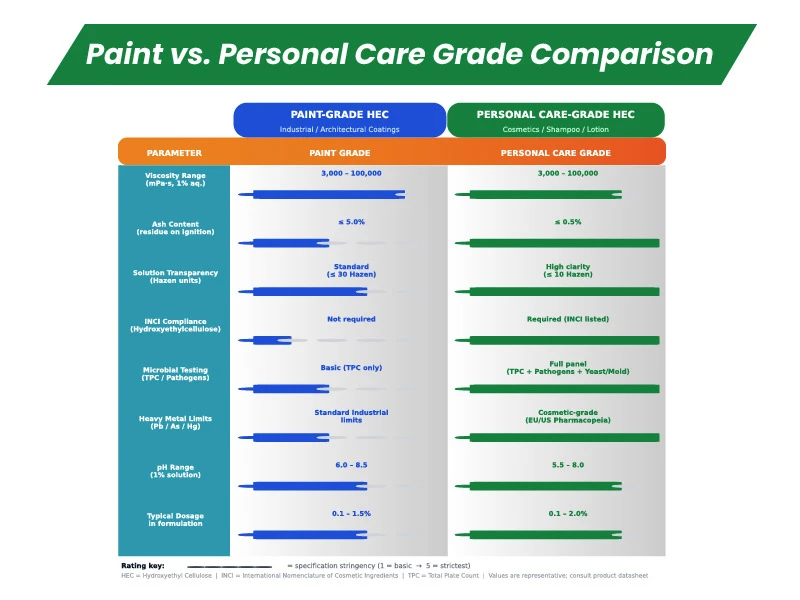
Many HEC suppliers offer grades that work for both industries, but the specifications and pricing expectations differ. Here is a practical side-by-side comparison.
| Parameter | Paint-Grade HEC | Personal Care-Grade HEC |
|---|---|---|
| Typical viscosity | 3,000–100,000 mPa·s | 300–40,000 mPa·s |
| Ash content | Up to 5% acceptable | ≤1% preferred for clarity |
| Transparency | Not critical | High transparency required for clear products |
| Bio-stability | Often required (BIODUR) | Not usually required; preservatives handle this |
| INCI listing | Not required | Required for EU/USA compliance |
| Microbial testing | Not typically specified | Required per USP/EP pharmacopeia |
| Price level | Lower | Higher (due to purity and documentation) |
| Typical MOQ | 1 metric ton | 500 kg – 1 metric ton |
| Shelf life | 12–24 months | 24 months with proper storage |
The critical takeaway: do not buy a paint grade for a personal care application, even if the supplier quotes the same CAS number and a lower price. The ash content and microbial purity of cosmetic HEC require a dedicated manufacturing and testing process that paint grades skip.
Sourcing HEC from China: What Experienced Buyers Do Differently
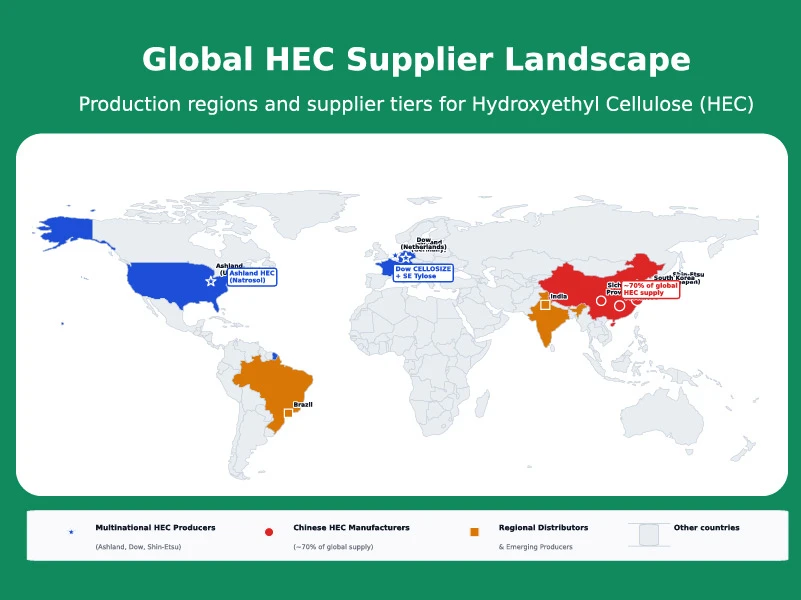
Most competitive HEC procurement involves sourcing from China. Here is what buyers who have done this before wish they had known earlier.
Start with Samples, Not Containers
Order 1–5 kg samples before placing any commercial order. Test the sample in your actual formulation under your standard conditions. Do not rely solely on the supplier’s TDS — formulations and processing conditions vary. A grade that looks perfect on paper may perform poorly in your specific process.
Demand Three Batch COAs
Ask the supplier to provide COAs from three separate production lots — ideally from three different months if possible. Compare the viscosity, moisture, and ash values across all three. Significant variation between batches is a warning sign. The best suppliers will share these proactively.
Verify Viscosity Independently
Suppliers sometimes label HEC at a viscosity grade that is higher than what the batch actually measures. Run your own viscosity test using a rotational viscometer (Brookfield or equivalent) at the same concentration and temperature stated on the COA. Compare your result to the COA value before accepting the batch.
Understand the Difference Between MS and Viscosity
The degree of substitution (MS) affects solubility and solution clarity. Viscosity is a separate parameter that depends on molecular weight. A supplier can offer the same viscosity grade at different MS values. For cosmetic applications, clarify the MS along with the viscosity.
Negotiate Documentation Packages
For personal care buyers, request a complete documentation package before commercial orders: COA, SDS, INCI confirmation letter, REACH or TSCA statement, allergen declaration, and a heavy metals report. The cost of assembling this package is minimal for the supplier but saves significant regulatory risk for you.
Plan for Lead Time Variability
Standard production lead time from Chinese HEC factories is 7–21 days. Ocean freight adds 14–35 days depending on destination. Build in a 4–6 week buffer for your first orders. Once you have validated the supplier and established a reliable cadence, you can reduce buffer stock, but do not run lean on the first few orders until you have seen the product perform.
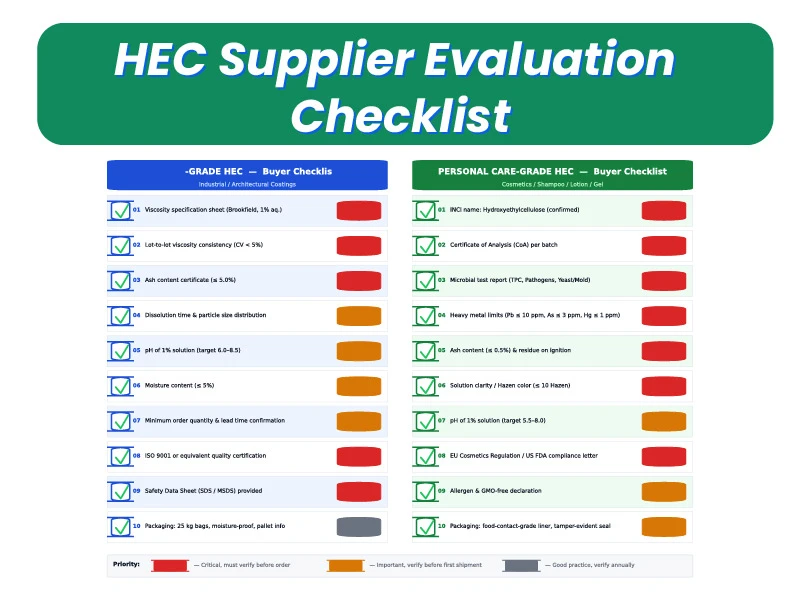
HEC Supplier Evaluation Checklist
Use this checklist to assess any hydroxyethyl cellulose supplier before committing to a commercial order.
Paint Industry Buyers
- [ ] Bio-stable or enzyme-resistant grade available (if needed)
- [ ] ISO 9001 quality system verified
- [ ] TDS and SDS available in required languages
- [ ] COA provided with every shipment
- [ ] Three-batch COA comparison completed without significant viscosity drift
- [ ] In-house viscosity test completed on sample
- [ ] Moisture specification confirmed (≤5%)
- [ ] Lead time confirmed and documented
- [ ] Technical contact assigned for formulation support
Personal Care Industry Buyers
- [ ] INCI name Hydroxyethylcellulose confirmed in writing
- [ ] EU REACH compliance statement provided (for EU market)
- [ ] TSCA compliance statement provided (for USA market)
- [ ] COA includes microbial test results (TAMC and pathogens)
- [ ] Transparency test completed (1% solution, photo or turbidity data)
- [ ] Vegan/animal-free declaration provided (if required)
- [ ] Allergen declaration and heavy metals report included
- [ ] Full documentation package assembled before first order
- [ ] Sample tested in your formulation without reformulation needed
- [ ] Shelf life confirmed (24 months typical)
FAQ
What is the INCI name for HEC?
The INCI name is Hydroxyethylcellulose. It is listed in the Personal Care Product Council’s INCI dictionary and is accepted in all major regulatory markets including the EU, USA, Japan, and China.
Can I use paint-grade HEC in personal care formulations?
Technically yes in some cases, but it is not recommended. Paint-grade HEC typically has higher ash content, may lack microbial testing, and is not produced to cosmetic-grade purity standards. Using it creates regulatory risk and may affect product clarity or skin feel. Always source a grade specifically produced for cosmetic use.
What viscosity of HEC should I use for shampoo?
For shampoos, viscosity grades in the 3,000–6,000 mPa·s range are most common. Adjust based on your target final viscosity and surfactant system. HEC in shampoo also helps stabilize the formula and improve foam texture.
How does bio-stable HEC work in paint?
Bio-stable HEC (sometimes called BIODUR) includes a treatment that makes it resistant to enzymatic breakdown by microorganisms. This is important for paint stored in warm, humid conditions where microbial contamination can degrade viscosity and cause odor. If your paint does not contain a strong in-can preservative, use a bio-stable grade.
What certifications does HEC need for EU import?
For import into the EU, HEC must be REACH-registered (or covered by an Only Representative for non-EU manufacturers). The REACH registration dossier includes toxicological data, environmental safety assessment, and exposure scenarios. Request the supplier’s REACH registration number and verify it against the ECHA database.
What is the shelf life of HEC?
HEC powder has a typical shelf life of 24 months when stored in sealed, original packaging in a cool, dry location. After opening, the powder absorbs moisture from the air, which can affect its thickening performance. Once a bag is opened, use it within 3–6 months or reseal tightly between uses.
How do I test HEC viscosity on arrival?
Dissolve the HEC at the concentration specified on the COA (typically 2% weight/volume in deionized water) using the supplier’s recommended dispersion method. Measure viscosity with a rotational viscometer (Brookfield LV or equivalent) at 25°C, using spindle #4 at 30 rpm. Compare your measured value to the COA. A difference of more than ±10% warrants a conversation with the supplier.
Conclusion
Sourcing hydroxyethyl cellulose for paint and personal care formulations is not the same job. The grades differ, the compliance requirements differ, and the supplier qualities you should prioritize differ. Paint buyers should focus on viscosity consistency and bio-stability — technical support rounds out the list. Personal care buyers must verify INCI compliance, microbial purity, and regulatory documentation.
What both industries share is the need for batch consistency. Viscosity drift between deliveries forces reformulation, which no buyer wants to deal with. The single best predictor of a reliable HEC supplier is their track record across multiple production batches — not their price list, not their website, and not a single sample.
For buyers ready to evaluate HEC suppliers for either industry, the process is straightforward: review documentation, test samples in your formulation, compare three-batch COAs, and verify compliance for your target market. That framework works whether you are sourcing from a multinational brand or going direct to a Chinese manufacturer.
Zhiwei (Jinan) New Material Co., Ltd. produces HEC from Xinjiang refined cotton at its Zhejiang facility with 15,000 tons annual capacity. The company supplies both paint-grade and personal care-grade HEC, with full technical documentation including COA, SDS, INCI confirmation, and REACH statements. Request samples and a three-batch COA comparison at zhiweichem.com.