
Ethyl cellulose (EC) is a widely used cellulose ether. Buyers around the world source it from China. But finding the right manufacturer takes some work. This article covers the main EC producers in China, what grades they offer, and how to choose a supplier that fits your needs.
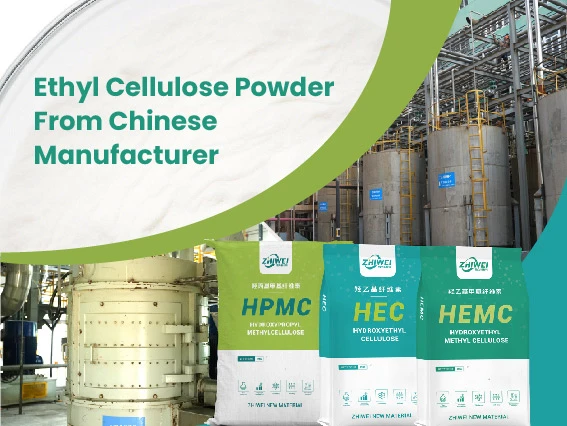
What Is Ethyl Cellulose?
Ethyl cellulose is a derivative of natural cellulose. Its CAS number is 9004-57-3. It is a white to off-white powder. It dissolves in organic solvents but not in water. This property makes it useful in many industries.
EC is known for its film-forming ability, thermal stability, and chemical resistance. It is non-toxic and safe for food and pharmaceutical products. These traits explain why so many industries buy EC from Chinese manufacturers.
Manufacturers produce EC by reacting cellulose with ethyl chloride. The level of ethoxy substitution determines the grade and viscosity. A higher ethoxyl content means better solubility in organic solvents.
How Ethyl Cellulose Grades Work
Understanding EC grades is important before you place an order. The grade tells you the viscosity range and the ethoxyl content. Both factors affect how the material performs in your application.
N Series Grades
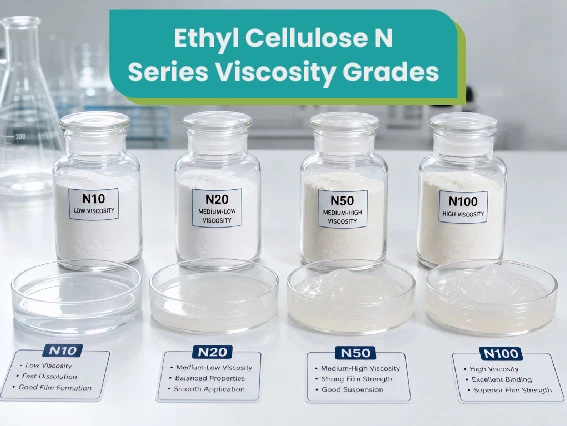
The N series is the most common grade in the market. The number after N shows the viscosity level. N7 is a low-viscosity grade and N100 is a high-viscosity grade.
Common N series grades include N4, N7, N10, N20, N50, N100, and N200. Buyers in the pharmaceutical industry often use N10 and N20 for tablet coatings. N50 and N100 work well in printing inks because they provide better film strength.
Some Chinese suppliers offer N series grades that match international brands like Ethocel by Dow. If your current formulation uses a specific Ethocel grade, you can ask the Chinese supplier for an equivalent product.
K Series Grades
The K series grades are less common but still available from some Chinese suppliers. K70 and K100 are two examples. These grades are sometimes used as alternatives to well-known international brands.
Some manufacturers also offer custom viscosity grades. If you need a specific viscosity that does not match a standard grade, you can ask the supplier for a custom product. This is useful for niche applications where standard grades do not give the right performance.
What Industries Use Ethyl Cellulose From China?
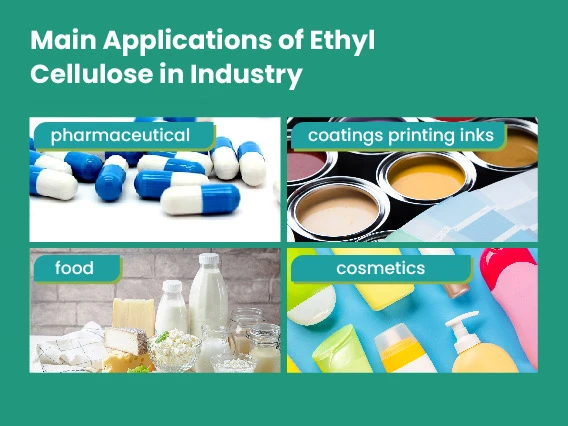
Chinese EC manufacturers supply material to several industries. Here are the main application areas.
Pharmaceutical Coatings
Ethyl cellulose is widely used as a coating polymer for tablets and capsules. It controls the release rate of active ingredients in sustained-release formulations. Many pharmaceutical companies buy EC from China because the price is competitive and the quality meets USP and EP standards.
EC N10 and N20 are the most popular grades for pharmaceutical use. The coating must be uniform and free of defects, so consistent quality from the supplier matters a lot. Buyers should always ask for a Certificate of Analysis (COA) before purchasing.
Printing Inks
EC acts as a binder in printing inks. It provides good adhesion to paper and plastic surfaces. The ink dries fast and resists water after curing. Low-ash EC grades are preferred for electronic-grade inks used in circuit board manufacturing.
Grades like N100 and N200 work best for ink formulations that need higher viscosity. The material must dissolve well in solvents like ethanol and toluene. Chinese manufacturers offer EC with low ash content specifically for this purpose.
Food and Cosmetics
Food-grade ethyl cellulose works as a thickener, stabilizer, and emulsifier in food products. It is also used in cosmetic formulations as a film-forming agent. Chinese suppliers offer EC that meets food safety standards.
Buyers in this segment need to check the supplier’s certifications carefully. Food-grade and cosmetic-grade EC must pass purity tests and heavy metal limits. Always ask for test reports that confirm the product meets the relevant food safety regulations in your country.
Adhesives and Coatings
EC is a useful binder in adhesives and protective coatings. It improves the flexibility and water resistance of the final product. Some Chinese EC manufacturers also produce bio-based EC for customers who want renewable raw materials. This is a growing trend in the coatings industry.
Where Are Ethyl Cellulose Manufacturers Located in China?
Most EC manufacturers in China are concentrated in a few provinces. Shandong has the largest number of suppliers. Cities like Jinan and Qingdao host many trading companies and some factories. Hebei, especially Shijiazhuang, is another major production hub for cellulose ethers, including EC.
Shanghai has several suppliers that focus on pharmaceutical and electronic grades. Shaanxi (Xi’an) and Jiangsu (Nanjing, Suzhou) also have active EC suppliers.
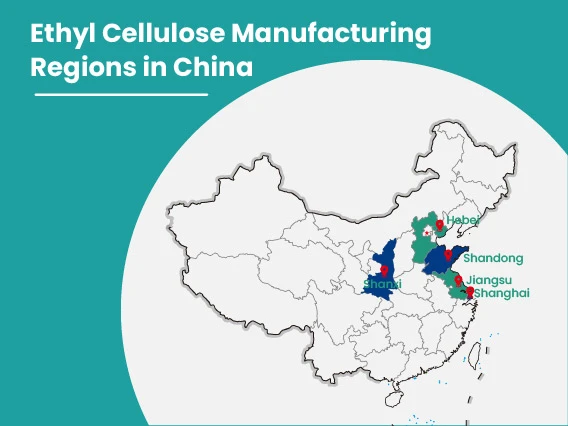
The table below shows the main production areas and what they are known for.
| Province | Known For | Typical Grades |
| Shandong | Wide range of EC grades, trading companies | N series, standard EC |
| Hebei | Cellulose ether manufacturing | N series, EHEC |
| Shanghai | Pharma-grade EC, electronics | N10, N20, N100 |
| Shaanxi | Industrial EC, electronic pastes | N100, K100 |
| Jiangsu | Multi-purpose EC, trading | Standard EC, HEC |
Some suppliers on B2B platforms are trading companies, not actual factories. If you want to buy directly from a manufacturer, ask for factory photos, production line details, and quality inspection reports.
How Much Does Ethyl Cellulose Cost From Chinese Suppliers?
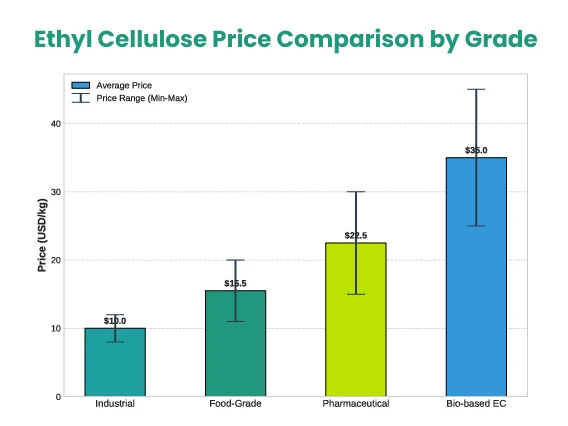
EC prices from Chinese suppliers vary a lot. The price depends on the grade, order quantity, and whether you buy from a factory or a trading company.
Based on current market data, here is a rough price range:
| Grade / Type | Price Range (per kg) | Typical MOQ |
| Standard industrial EC | $2 – $12 | 1 kg – 1,000 kg |
| Pharmaceutical-grade EC (USP/EP) | $17 – $25 | 100 – 500 kg |
| Food-grade EC | $6 – $12 | 1 – 5,000 kg |
| Bio-based EC | $17 – $18 | 1 kg |
These are reference prices from B2B platforms like Made-in-China.com and Alibaba. The actual price you negotiate may be different. Large orders usually get better per-kilogram rates.
Keep in mind that the cheapest option is not always the best. Low-priced EC may have inconsistent viscosity, high ash content, or poor solubility. Always request a sample before placing a large order. Test the sample in your own lab to make sure it works in your formulation.
How to Pick a Reliable Ethyl Cellulose Supplier
Choosing the right supplier takes more than comparing prices. Here are the factors that matter.
Check the grade range. Not every Chinese EC supplier carries all viscosity grades. Make sure the supplier can provide the exact grade you need. If your application requires USP or EP standard EC, confirm that the supplier has the relevant documentation.
Ask for test reports. A reliable supplier should provide a Certificate of Analysis (COA) with every batch. The COA shows the viscosity, ethoxyl content, moisture, and ash content. Compare these numbers with the specification sheet you agreed on.
Verify production capability. Some companies on B2B platforms are traders, not manufacturers. If you need factory-direct pricing, ask for factory audit reports, production line photos, or a video call tour of the facility. This step helps you avoid paying extra to middlemen.
Look at export experience. Does the supplier have a track record of shipping to your country? Experienced exporters handle customs documents, logistics, and quality complaints more smoothly. Check their delivery history and on-time delivery rate if available.
Request samples. Never skip the sample step. Test the EC in your own formulation before committing to a large order. This is the only way to know if the product actually works for your process. Most Chinese suppliers offer free samples. You only pay for the shipping cost.
About Zhiwei (Jinan) New Materials Co., Ltd.
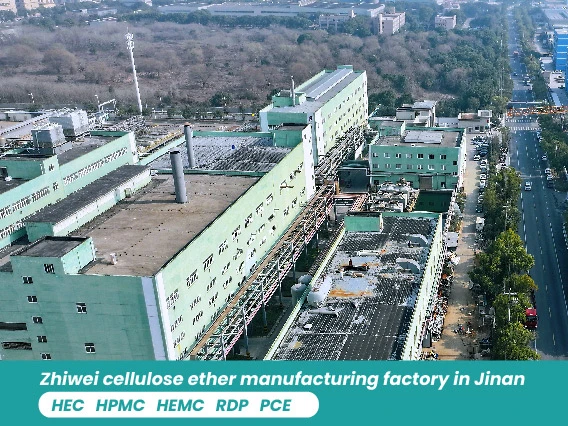
Zhiwei (Jinan) New Materials Co., Ltd. is a China-based manufacturer of cellulose ethers. The company was founded in 2017 and has an annual production capacity of 15,000 tons. The factory uses refined cotton from Xinjiang as raw material.
Zhiwei’s main product line covers hydroxyethyl cellulose (HEC), hydroxyethyl methyl cellulose (HEMC), hydroxypropyl methyl cellulose (HPMC), redispersible polymer powder (RDP), and polycarboxylate ether superplasticizer (PCE). These products serve the construction, paint, and building material industries in markets around the world.
While Zhiwei does not currently produce ethyl cellulose, the company is a trusted name in the broader cellulose ether market. If your business needs HEC, HPMC, HEMC, or related construction chemicals, Zhiwei offers competitive pricing and consistent quality. The company holds several patents and provincial-level science and technology awards.
For more information, visit zhiweichem.com or contact the team at info@zhiweichem.com. You can also reach them by phone at +86 183 6616 3707.
Frequently Asked Questions
What Is the CAS Number of Ethyl Cellulose?
The CAS number is 9004-57-3. You can use this number to search for the exact product on chemical databases and supplier catalogs.
What Is the Difference Between N10 and N100 Grades?
The difference is viscosity. N10 has a lower viscosity and dissolves faster. N100 has a higher viscosity and forms stronger films. Your choice depends on the application. Pharmaceutical coatings often use lower viscosity grades, while inks and adhesives benefit from higher viscosity.
Can I Buy Ethyl Cellulose in Small Quantities From China?
Yes. Many Chinese suppliers accept small orders, sometimes as low as 1 kg. But the per-kilogram price is usually higher for small orders. Trading companies are more likely to accept small MOQs than factories.
What Certifications Should an EC Supplier Have?
For industrial use, ISO 9001 is a basic requirement. For pharmaceutical-grade EC, the supplier should meet USP or EP pharmacopeia standards. For food-grade EC, look for FDA registration or relevant food safety certifications in your target market.
How Long Does Shipping Take From China?
Shipping time depends on the destination and the shipping method. Sea freight to Southeast Asia takes about 7 to 14 days. To Europe or South America, it can take 30 to 45 days. Air freight is faster but much more expensive. Talk to your supplier about the best shipping option for your order size and deadline.
Conclusion
China is one of the main sources of ethyl cellulose in the global market. Shandong, Hebei, and Shanghai are the top production regions. Buyers can find EC in a wide range of grades, from standard industrial to pharmaceutical-grade. The key is to verify the supplier’s quality, request samples, and compare prices across multiple sources.
If you are also sourcing other cellulose ethers like HEC, HPMC, or HEMC, Zhiwei (Jinan) New Materials Co., Ltd. is a manufacturer worth considering. Contact the team at info@zhiweichem.com or visit zhiweichem.com for more details.