
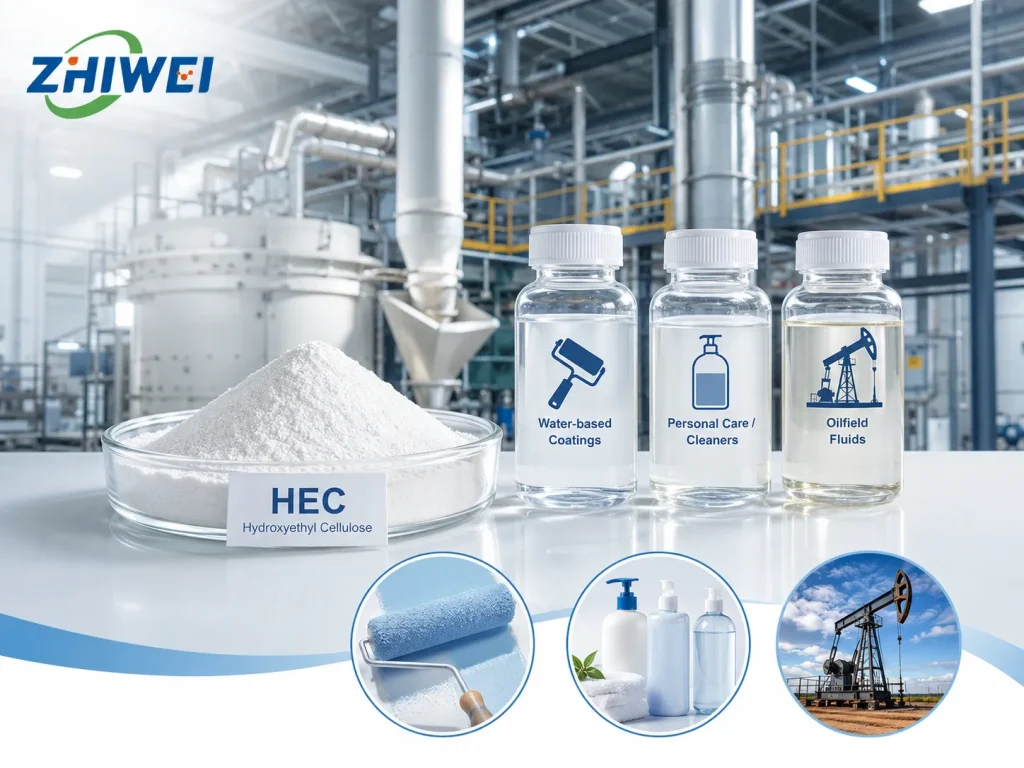
At Zhiwei, HEC material means Hydroxyethyl Cellulose, a nonionic, water-soluble cellulose ether used to build viscosity, adjust flow, support suspension, and improve stability in water-based systems. It is a functional polymer, not a simple filler. When it is added to a formula, it changes how that formula feels, flows, stores, and performs during use. This is why HEC is widely used in coatings, daily chemical products, and oilfield fluids. Our own product structure places HEC and HEMC as the two core cellulose ether families we supply to global customers, with production and shipment running from our Zhejiang manufacturing base.
The short answer is simple: HEC material is a thickening and rheology-control material made from cellulose. Ashland describes hydroxyethylcellulose as a nonionic, water-soluble polymer made by reacting ethylene oxide with alkali-cellulose under controlled conditions. Dow’s CELLOSIZE hydroxyethyl cellulose products are also positioned as thickeners and rheology modifiers for water-based systems such as coatings, cleaners, and personal care products. That is the basic technical identity of HEC. It starts from cellulose, but it is modified so it can perform in modern formulations.
HEC Is A Cellulose Ether Material
HEC belongs to the cellulose ether family. Cellulose is the base structure. Chemical modification gives the material its water-soluble and thickening behavior. In HEC, hydroxyethyl groups are introduced onto the cellulose chain. This change allows the material to dissolve in water and form a useful viscosity profile. The result is a polymer that can help control the behavior of liquid and semi-liquid formulas.
This is the main difference between raw cellulose and HEC material. Raw cellulose does not behave like a ready-to-use thickener in water-based formulas. HEC is modified so it can hydrate, build viscosity, and help the formula stay more stable. That is why customers in coatings, personal care, household cleaning, and oilfield fluid systems use it as a functional additive. It is a material designed to solve formulation problems.
For B2B buyers, this point matters. HEC is not purchased only because the label says “hydroxyethyl cellulose.” It is purchased because the customer needs a certain result. That result may be higher viscosity, smoother texture, better suspension, more stable flow, or a more controlled process. The value of HEC comes from what it does inside the customer’s system.
What HEC Material Looks Like
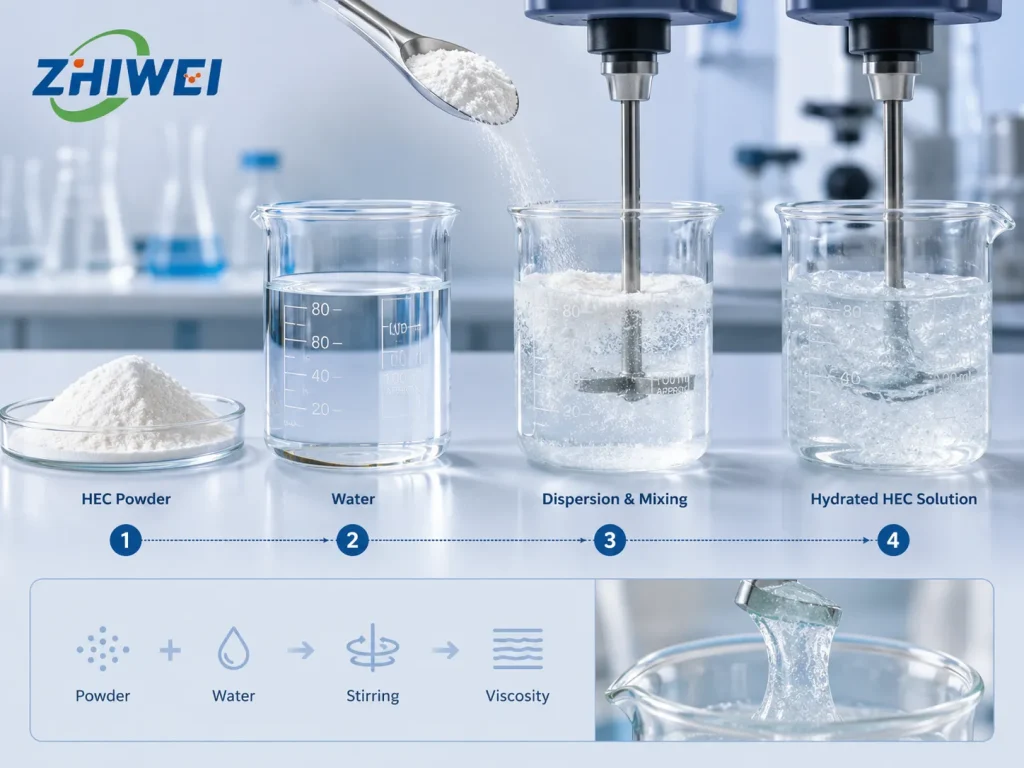
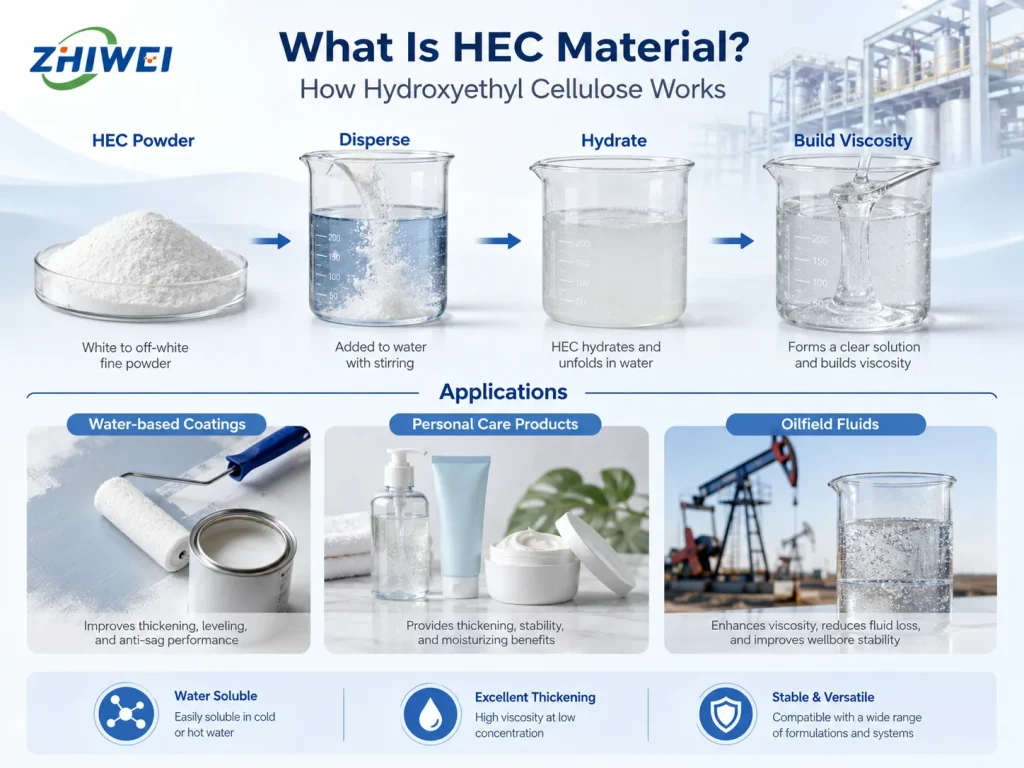
HEC material is usually supplied as a fine white to off-white powder. In normal industrial handling, the powder is added to water or a water-based system and then allowed to hydrate. Once it hydrates correctly, it builds viscosity and changes the flow behavior of the formulation. In personal care systems, it may help create a smooth body. In coatings, it may support better flow and leveling. In oilfield fluids, it may help adjust viscosity under specific fluid conditions.
The way HEC is added matters. A good HEC material still needs proper dispersion and hydration. If the powder is dumped too quickly, fisheyes or lumps can form. That is why our application guidance focuses on controlled addition, steady agitation, full hydration time, and final viscosity confirmation. On our HEC shampoo and body wash page, we recommend slow addition into moving water, steady agitation, hydration time before final adjustment, and viscosity checking after rest.
What HEC Material Does In A Formula
The most important job of HEC material is viscosity control. It helps a water-based system become thicker and more stable. But viscosity is only part of the story. HEC also affects flow behavior, texture, suspension, application feel, and storage consistency. In surfactant systems, it can help create richer body and smoother slip. In coatings, it can support flow and leveling. In oilfield systems, it can help build fluid viscosity and support controlled handling.
Dow describes hydroxyethyl cellulose as an ideal thickener for premium latex paints, with good flow and leveling characteristics and tolerance for dissolved electrolytes. This explains why HEC is so common in water-based paint systems. A paint must not be too thin in storage or too heavy during application. It must flow from the brush or roller, level on the surface, and still hold enough body to avoid problems such as sagging or poor coverage. HEC helps the formulator manage that balance.
In personal care, Dow positions certain hydroxyethyl cellulose grades as water-soluble rheology modifiers for hair care, skin care, and color cosmetics. These grades can support thickening, emulsion stability, salt tolerance, foam stability, and sensory performance depending on the formula. This shows why HEC material is useful in daily chemical products. It can help the product feel better and behave more consistently.
HEC Material In Coatings
Coatings are one of the main use areas for HEC material. At Zhiwei, we support HEC use in architectural latex paint, high-PVC latex paint, waterborne industrial coatings, texture and high-build coatings, water-based inks, and general thickening for waterborne systems. These applications all need flow control, viscosity stability, and predictable handling. Our current product structure lists these HEC coating applications directly under the HEC category.
In a water-based paint, HEC material can help control how the paint behaves from production to application. During production, it helps the system reach the right viscosity. During storage, it helps maintain a more stable texture. During application, it can improve brush feel, roller feel, leveling, and general handling. In high-PVC systems, the formulation may need extra support for suspension and body. In texture coatings, the product may need stronger structure and stable build.
A coating customer should not choose HEC only by one viscosity number. The binder system, pigment volume concentration, dispersant package, pH, electrolyte level, target application method, and local climate can all influence the final result. This is why grade matching and sample testing matter. A good HEC material should be evaluated in the real coating system, not only in water.
HEC Material In Daily Chemical Products
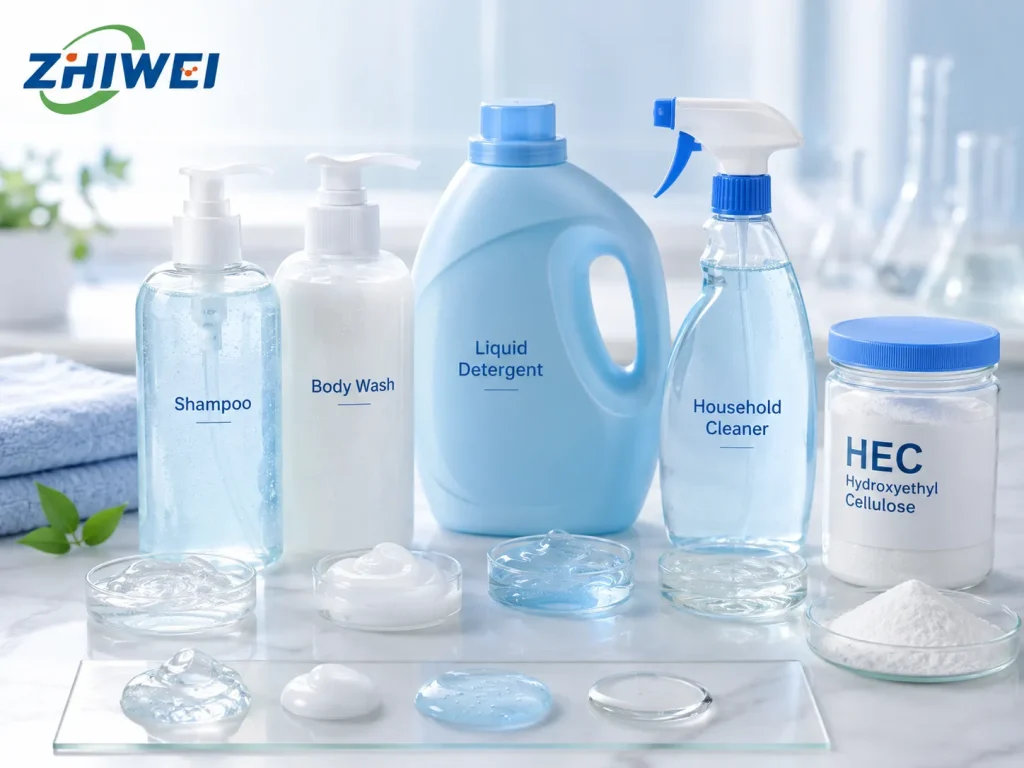
Daily chemical products are another important field for HEC. In shampoo and body wash, HEC material can build viscosity, support clear texture in many systems, improve product feel, and help create smoother spreading. Our application guidance for shampoo and body wash focuses on surfactant type, target viscosity, clarity target, salt level, pH range, other thickeners, mixing equipment, and packaging type. These details matter because HEC performance depends strongly on the full formulation.
In household cleaners, laundry detergents, and dish detergents, HEC material can help control thickness and improve product body. The formula may need to stay pourable, stable, and easy to use. It may also need to tolerate surfactants, salts, fragrance, preservatives, and pH changes. HEC can work well in many of these systems, but it must be tested under the customer’s actual conditions.
In lotions and sun care products, HEC may support viscosity, emulsion stability, and smooth sensory feel. Here the customer may care less about lather and more about spreadability, slip, and stable texture. This is why we treat daily chemical HEC selection as application-specific. A shampoo system and a lotion system do not need the same testing logic.

HEC Material In Oilfield Fluids
HEC material is also used in oilfield fluid systems. At Zhiwei, our HEC application structure includes oilfield drilling fluids, workover fluids, completion fluids, and oil production fluids. These applications need a different technical discussion from coatings or personal care. The fluid may contain brine, salts, and other additives. The product may also need to perform under changing temperature and shear conditions.
In oilfield use, HEC is mainly valued for viscosity and fluid-behavior control. The customer may need a fluid that can carry solids, maintain a certain flow profile, or support a specific field operation. The grade selection should consider salinity, target viscosity, mixing equipment, temperature range, and operating conditions. This is why oilfield HEC should be tested in the actual fluid system.
For us, oilfield HEC is a good example of why “HEC material” cannot be explained by one generic sentence. The material family is the same, but the use environment is completely different. A grade that works well in a shampoo base may not be the right starting point for a brine-based oilfield fluid. Application matching is essential.
Why HEC Grade Selection Matters
HEC is a material family, not one single performance point. Different grades can vary in viscosity level, hydration behavior, particle treatment, and application suitability. Some systems need faster hydration. Some need cleaner dispersion. Some need salt tolerance. Some need higher viscosity. Some need better clarity. The correct choice depends on what the customer wants the HEC to do.
At Zhiwei, we ask for formula details before recommending HEC. For shampoo and body wash, we ask for surfactant system, target viscosity, clarity target, salt level, pH range, other thickeners, mixing equipment, and packaging type. For coatings, we ask about the coating type, binder system, target viscosity, application method, and performance issue. For oilfield fluids, we ask about fluid type, salinity, temperature range, and target viscosity behavior.
This process helps customers avoid blind testing. A customer who only asks for “HEC material” may receive a product, but not necessarily the right one. A customer who shares the application and performance target can get a better sample direction from the beginning.
How HEC Material Is Different From HEMC And HPMC
HEC, HEMC, and HPMC all belong to the cellulose ether family, but they are not the same material. HEC is hydroxyethyl cellulose. HEMC is hydroxyethyl methyl cellulose. HPMC is hydroxypropyl methylcellulose. Each one has a different substitution pattern and a different application balance.
At Zhiwei, we focus on HEC and HEMC as core product lines. HEC is used to build viscosity and adjust flow in water-based formulas, especially coatings, daily chemical products, and oilfield fluids. HEMC supports viscosity build and stable handling in water-based systems, with strong use in coatings, daily chemical products, and construction mixes. Our current site presents HEC and HEMC as two core cellulose ether families for water-based systems.
This distinction matters for buyers. If the application is shampoo, paint, or drilling fluid, HEC may be the better starting point. If the application is tile adhesive, mortar, wall putty, or another cement-based dry-mix system, HEMC may be more suitable. The right choice depends on the system.
Why Zhiwei Supplies HEC Material
At Zhiwei, we supply HEC material because customers need repeatable performance in real formulations. We do not want HEC to be seen as a generic powder. We want it to be used as a practical formulation tool. That means we support customers with grade selection, sample follow-up, technical feedback, TDS, SDS, and COA by batch on request. Our current manufacturing message focuses on consistent output, verified QC, routine checks for viscosity and fineness, moisture management, and batch traceability.
This factory-backed approach matters in long-term supply. A successful sample is only the beginning. Customers need the same performance in repeat orders. They need stable viscosity, stable appearance, stable hydration behavior, and clear communication when a formula needs adjustment. That is the real standard for HEC material supply.
Conclusion
HEC material is Hydroxyethyl Cellulose, a nonionic, water-soluble cellulose ether used to thicken, stabilize, and control the flow of water-based systems. It is used in coatings, daily chemical products, personal care formulas, household cleaners, and oilfield fluids. It can build viscosity, improve texture, support suspension, help control flow, and make a formula more stable during production, storage, and use.
At Zhiwei, we supply HEC material as a factory-backed product for real formulation work. Our HEC focus covers coatings, daily chemical products, and oilfield fluids. We help customers choose grades by application, test in their own systems, and move from sample to repeat order with clearer technical support. That is the most practical answer to the question, “What is HEC material?” It is not just a chemical name. It is a performance material for water-based formulas.