
At Zhiwei (Jinan) New Materials Co., Ltd., we often receive questions from dry-mix mortar and tile adhesive customers about product codes such as C1, C2, C2TE, C2TES1, and C2TES2. These codes are not random marketing labels. They are technical language used to describe the adhesive type, performance level, and special application properties.
Zhiwei find out that many buyers know they need “tile adhesive,” but they are not always clear about what C1, C2, T, E, or S means. This can create problems during product selection. A standard indoor ceramic tile adhesive does not need the same performance as a large-format porcelain tile adhesive. A bathroom wall, exterior façade, swimming pool, heated floor, balcony, or large slab installation may also require a different adhesive grade.
For us, understanding these codes is important because HEMC plays a direct role in the fresh-state performance of cement-based tile adhesive. HEMC can support water retention, open time, workability, smoother troweling, and slip resistance. However, HEMC alone does not decide the final adhesive classification. The full formula, cement type, filler system, redispersible polymer powder, cellulose ether, starch ether, additives, and test results all work together.
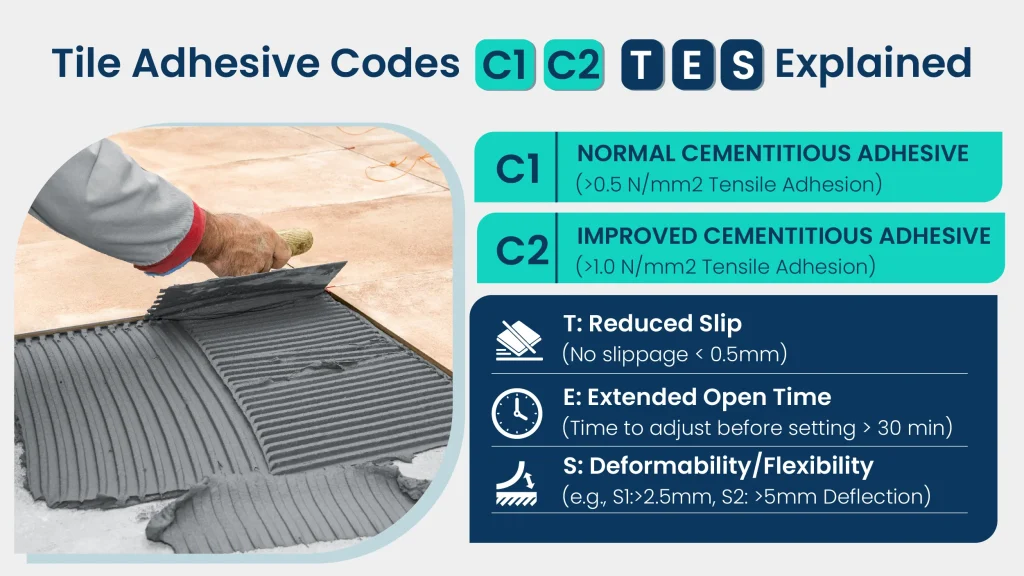
What Tile Adhesive Codes Mean
Tile adhesive code systems usually combine letters and numbers. Each part gives technical information about the product.
The first letter tells the adhesive type. The number tells the performance level. The following letters show special properties such as fast setting, reduced slip, extended open time, or deformability.
For example, C2TE can be read as:
C = cementitious adhesive
2 = improved performance grade
T = reduced slip
E = extended open time
A product marked C2TES1 adds one more property:
S1 = deformable adhesive with flexibility
This code structure helps manufacturers, distributors, contractors, and project owners quickly understand what the adhesive is designed to do.
The First Letter: Adhesive Type
C: Cementitious Adhesive
The letter C means cementitious adhesive. This is the most common tile adhesive type in dry-mix mortar markets. Cementitious adhesive uses cement as the main binder, combined with graded fillers, cellulose ether, polymer modifiers, and other functional additives.
Cementitious tile adhesive is widely used because it is practical, cost-effective, easy to transport as a dry powder, and suitable for many ceramic tile and porcelain tile applications. Most customers who ask Zhiwei for HEMC in tile adhesive are working with C-type adhesive systems.
D: Dispersion Adhesive
The letter D means dispersion adhesive. This type is usually supplied as a ready-to-use paste. It is based on polymer dispersion rather than cement hydration. It can be useful in some indoor applications, but it is not the main focus for most dry-mix mortar factories.
R: Reaction Resin Adhesive
The letter R means reaction resin adhesive. This type usually uses reactive resin systems such as epoxy or polyurethane. It can provide high chemical resistance and special bonding performance, but the cost is higher and the application field is more specialized.
For dry-mix mortar producers, the most important category is usually C, because cementitious tile adhesive is the main product family used in large-scale construction material production.
C1 And C2: The Performance Level
C1: Normal Cementitious Tile Adhesive
C1 means normal cementitious tile adhesive. This grade is usually used for common indoor ceramic tile applications where the tile size, substrate, and environment are not very demanding.
C1 products can be suitable for traditional ceramic tiles with higher water absorption, especially in dry indoor areas. These products are usually more economical and easier to formulate. They can meet the needs of common residential decoration when the tile type and application environment are simple.
However, C1 is not always enough. If the tile has low water absorption, if the tile size is large, if the installation is outdoors, or if the area has frequent moisture and temperature changes, a higher grade may be needed.
C2: Improved Cementitious Tile Adhesive
C2 means improved cementitious tile adhesive. Compared with C1, C2 adhesive has higher bonding performance and better durability. It is normally selected for more demanding tile installation conditions.
C2 adhesive is often used for porcelain tiles, vitrified tiles, large-format tiles, exterior walls, wet areas, and other applications that need stronger bonding and more reliable long-term performance.
From a formulation point of view, C2 usually requires stronger polymer modification and a more carefully balanced additive system. HEMC helps support the fresh mortar side, but the final C2 performance also depends heavily on the polymer system, cement quality, filler design, curing condition, and test standard.
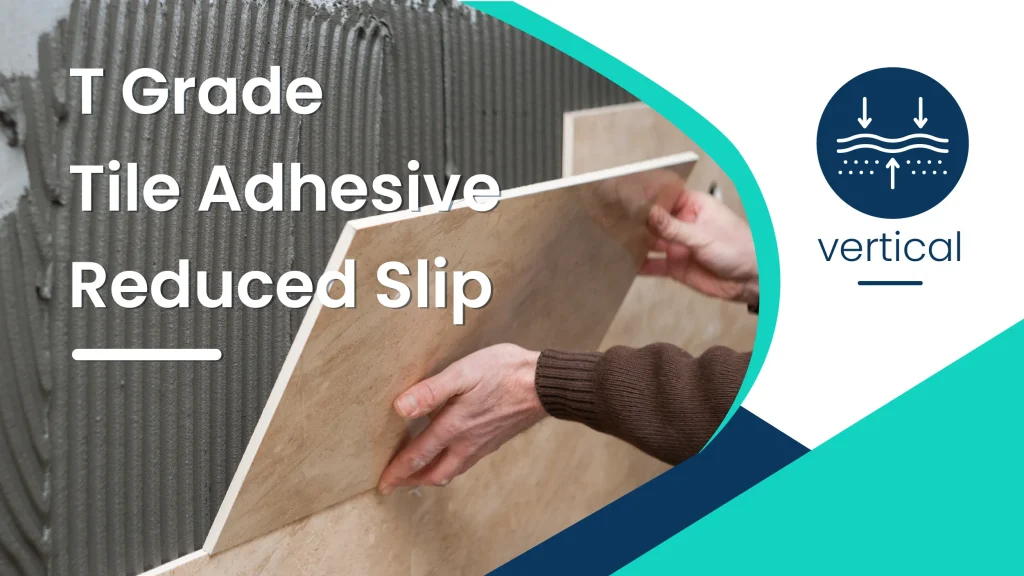
T: Reduced Slip
The letter T means reduced slip. This property is especially important for wall tile adhesive and large-format tile installation.
When tile adhesive is applied on a vertical wall, the tile may slide down before the adhesive sets. This is more likely when the tile is heavy, the adhesive is too weak in fresh structure, or the formula has poor anti-slip behavior.
A T-grade adhesive is designed to reduce this problem. It should hold the tile better during installation and give the contractor more control.
HEMC can help support reduced slip by improving the fresh-state structure of the mortar. It helps the adhesive build body, improve troweling consistency, and stay more stable after spreading. Still, the T property depends on the full formula. Starch ether, polymer powder, mineral filler design, water ratio, and mixing process can all affect slip resistance.
E: Extended Open Time
The letter E means extended open time. Open time is the period after the adhesive is spread during which the tile can still be placed and bonded properly.
This property is very important on large projects. If open time is too short, the adhesive surface can dry too quickly before the tile is placed. This can reduce bonding performance and increase the risk of hollowing or failure.
An E-grade adhesive gives workers more time for tile placement and adjustment. This is useful for hot weather, large-format tile installation, complex layout work, and projects where installation speed may be slower.
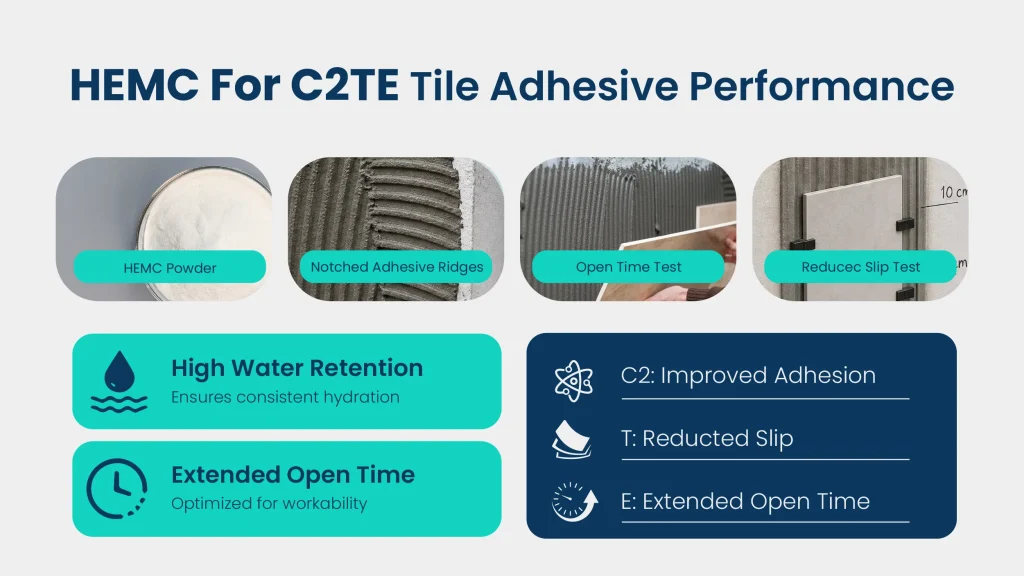
HEMC plays an important role here. Good water retention helps slow rapid moisture loss from the adhesive surface. It also helps the adhesive remain workable for a longer period. This is why many tile adhesive customers test HEMC carefully when they want better open time.
For Zhiwei, open time is one of the first questions we ask when customers develop tile adhesive. If a customer says the adhesive dries too quickly, loses surface activity, or has poor placement time, HEMC selection and dosage should be reviewed together with cement type, filler system, polymer powder, and water ratio.
F: Fast Setting
The letter F means fast setting. This type of adhesive is designed for projects that need quick return to service. It can be useful in repair work, commercial areas, cold weather projects, or installations where the next construction step must begin quickly.
Fast-setting adhesive has a shorter working window, so formula balance becomes more sensitive. The product must set quickly, but it should still give enough time for spreading and tile placement. If the formula sets too fast, construction becomes difficult. If it sets too slowly, the fast-setting value is lost.
For fast-setting systems, the cellulose ether selection must be handled carefully. HEMC can support water retention and workability, but the setting system, cement chemistry, accelerator, temperature, and dosage must be considered together.
S1 And S2: Deformability
S1: Deformable Adhesive
S1 means deformable adhesive. This type can absorb a certain level of substrate movement, temperature stress, or structural vibration. S1 products are often used where the substrate may move slightly or where thermal expansion and contraction are expected.
Common examples include balconies, exterior walls, heated floors, lightweight partition walls, and some insulation systems.
S2: Highly Deformable Adhesive
S2 means highly deformable adhesive. It has stronger deformation capacity than S1 and is used for more demanding applications. Large slabs, exterior façade systems, high-stress substrates, and areas with higher movement risk may require S2-level products.
S1 and S2 performance usually depends strongly on the polymer system. Redispersible polymer powder and other flexible modifiers are central to this property. HEMC supports the fresh-state handling of the adhesive, but the deformability grade is not achieved by HEMC alone.
This distinction is important. A customer cannot simply add HEMC and claim S1 or S2. The adhesive must be designed and tested as a complete system.

A Simple Reading Table For Tile Adhesive Codes
| Code | Meaning | Main Application Direction |
|---|---|---|
| C | Cementitious adhesive | Common dry-mix tile adhesive |
| C1 | Normal cementitious adhesive | Standard indoor ceramic tile installation |
| C2 | Improved cementitious adhesive | Porcelain tile, large tile, wet area, exterior use |
| F | Fast setting | Fast repair or quick return-to-service projects |
| T | Reduced slip | Wall tiles, heavy tiles, vertical installation |
| E | Extended open time | Large-format tiles, hot weather, slower installation |
| S1 | Deformable adhesive | Substrates with slight movement or thermal stress |
| S2 | Highly deformable adhesive | Large slabs, façade systems, demanding movement conditions |
C1, C2, C2TE, And C2TES1: How To Choose
Zhiwei find out that many tile adhesive problems start from choosing a grade that is too low for the tile or the environment. A product may work for a small ceramic tile indoors, but fail with a large porcelain tile on an exterior wall.
For standard indoor ceramic tiles, a C1 product may be enough. For low-absorption porcelain tiles, a stronger grade is usually needed. For large-format tiles, C2TE is often a more practical direction because the adhesive needs stronger bonding, reduced slip, and longer open time. For slabs, exterior façades, heated floors, and substrates with movement risk, C2TES1 or C2TES2 may be needed.
The tile absorption rate is one of the first things to check. Traditional ceramic tiles with higher absorption are easier to bond. Low-absorption porcelain tiles and vitrified tiles need stronger adhesive performance. Fully dense slabs or sintered stone require even more careful system design.
The environment is the second point to check. Dry indoor walls are less demanding. Bathrooms, kitchens, balconies, exterior façades, swimming pools, and heated floors need higher durability and better formula design.
The substrate is the third point to check. Concrete, cement render, old tile, gypsum board, lightweight wall panels, insulation boards, and waterproof layers all behave differently. A weak or moving substrate can create stress that the adhesive must handle.
Why Standards Matter
Tile adhesive selection should not rely only on product names. Standards provide measurable requirements for bonding strength, water resistance, heat aging, freeze-thaw durability, open time, slip resistance, and deformation.
Zhiwei find out that different standards may use different test periods and different durability requirements. Some basic mortar standards focus mainly on standard tensile adhesion and water immersion performance. More specific ceramic tile adhesive standards include wider durability testing, including heat aging and freeze-thaw cycles.
For important projects, exterior applications, wet areas, large-format tile installation, or complex substrates, customers should pay more attention to the ceramic tile adhesive standard system rather than selecting only by price.
A better adhesive code gives the customer a clearer performance direction, but the final product still needs testing. A bag label does not replace laboratory confirmation or jobsite quality control.
How HEMC Helps Tile Adhesive Performance
HEMC is one of the key additives in cement-based tile adhesive. It does not replace cement or polymer powder, but it strongly affects the fresh-state behavior of the mortar.
Water Retention
HEMC helps keep moisture in the adhesive. This is important for cement hydration, open time, and stable application. If the adhesive loses water too quickly, the surface can dry and bonding may suffer.
Open Time
Better water retention can support longer open time. This gives installers more time to place and adjust tiles, especially in hot weather or large-format tile work.
Workability
HEMC improves troweling feel and helps the adhesive spread more smoothly. A good adhesive should form stable ridges and feel controlled under the notched trowel.
Reduced Slip
HEMC can help build a stronger wet structure in the adhesive. This supports reduced slip in vertical applications, especially when combined with a suitable formula system.
Stable Handling
A well-selected HEMC grade helps the adhesive stay stable during mixing, resting, and application. It can reduce rough handling and improve the working experience.
At Zhiwei, we ask customers to share adhesive type, cement type, filler system, sand grading, polymer level, target open time, slip resistance target, adjustment time target, mixing method, and main issue. These details help us recommend a practical HEMC test direction.
What HEMC Cannot Do Alone
It is also important to be clear about the limits of HEMC.
HEMC can improve fresh mortar performance, but it cannot alone turn a weak formula into a C2 adhesive. It cannot alone create S1 or S2 flexibility. It cannot solve poor cement quality, wrong sand grading, weak polymer dosage, bad substrate preparation, or poor jobsite application.
For example, C2 bonding strength usually depends heavily on cement, polymer powder, filler structure, curing condition, and full formulation design. S1 or S2 deformability depends strongly on polymer modification and flexible system design. HEMC supports the application window, but the complete adhesive formula must be engineered properly.
This is why we always recommend testing the full tile adhesive formula. The HEMC grade should be selected together with the adhesive performance target.
Construction Points That Affect Final Performance
Even a good tile adhesive can fail if the construction process is poor. Zhiwei find out that several construction details are especially important.
First, the substrate must be clean, strong, and stable. Loose dust, oil, weak plaster, hollow areas, and unstable substrates can reduce bonding. New concrete should be fully cured before tile installation.
Second, the correct water ratio must be used. Too much water can weaken the adhesive and increase slip. Too little water can reduce workability and wetting.
Third, the adhesive should be mixed evenly and allowed to mature if the formula requires it. This helps the cellulose ether and other additives hydrate properly.
Fourth, a suitable notched trowel should be used. The adhesive layer must be uniform, and large-format tiles often need back-buttering to improve contact.
Fifth, tiles must be placed within the open time. If the adhesive surface has already skinned over, bonding can be affected.
Sixth, the installed tile should be checked for flatness, contact area, and adjustment while the adhesive is still workable.
How Zhiwei Supports Tile Adhesive Manufacturers
At Zhiwei (Jinan) New Materials Co., Ltd., we supply HEMC for cement-based tile adhesive, dry-mix mortar, wall putty, plaster, render, EIFS, tile grout, waterproof mortar, and masonry mortar. For tile adhesive customers, our support begins with understanding the target code and application.
If the customer wants a C1 product, the formula focus may be cost balance, basic bonding, and easy workability. If the customer wants C2TE, the focus shifts to higher bonding strength, longer open time, reduced slip, and better application stability. If the customer wants C2TES1 or C2TES2, the formula must also include flexibility and deformation performance.
We help customers by reviewing application type, target grade, cement system, filler package, polymer level, water ratio, mixing process, and main performance issue. Then we recommend HEMC grade options for testing.
Our goal is simple: help customers make performance repeatable.

Conclusion
Tile adhesive codes such as C1, C2, T, E, S1, and S2 are technical performance labels. They help customers understand whether a tile adhesive is normal grade, improved grade, reduced-slip grade, extended-open-time grade, or deformable grade.
Zhiwei find out that correct code understanding can prevent many selection mistakes. C1 may work for common indoor ceramic tiles, but larger tiles, low-absorption porcelain tiles, exterior areas, wet zones, heated floors, and moving substrates often require higher-performance adhesive systems such as C2TE, C2TES1, or C2TES2.
For Zhiwei, HEMC is an important part of this discussion because it helps improve water retention, open time, workability, troweling feel, and fresh-state stability in cement-based tile adhesive. But the final code depends on the full formula and test results. A reliable tile adhesive is not built by one additive alone. It is built by a balanced system.
At Zhiwei (Jinan) New Materials Co., Ltd., we support tile adhesive manufacturers with HEMC grade selection, sample testing, technical communication, and factory-backed supply. Our work is to help customers choose the right cellulose ether direction, test it in the real formula, and keep performance stable from sample to long-term production.