
CMC and HEC are two water-soluble cellulose ethers widely used in personal care and home care formulations. Both can build viscosity, control flow, bind water, and help keep a formula uniform.
However, they are not interchangeable.
Sodium carboxymethyl cellulose, commonly called CMC-Na, CMC, or cellulose gum, is an anionic polymer. Hydroxyethyl cellulose, or HEC, is nonionic. This difference in electrical charge affects how each thickener behaves with salts, surfactants, cationic ingredients, abrasives, active ingredients, and preservatives.
CMC is often a practical and economical choice for conventional toothpaste, masks, and water-based products that need binding and syneresis control. HEC is often preferred in formulas that contain higher electrolyte levels, cationic ingredients, complex surfactant blends, or demanding clarity and texture targets.
The best choice depends on the complete formulation, not only on the viscosity shown on a product label.
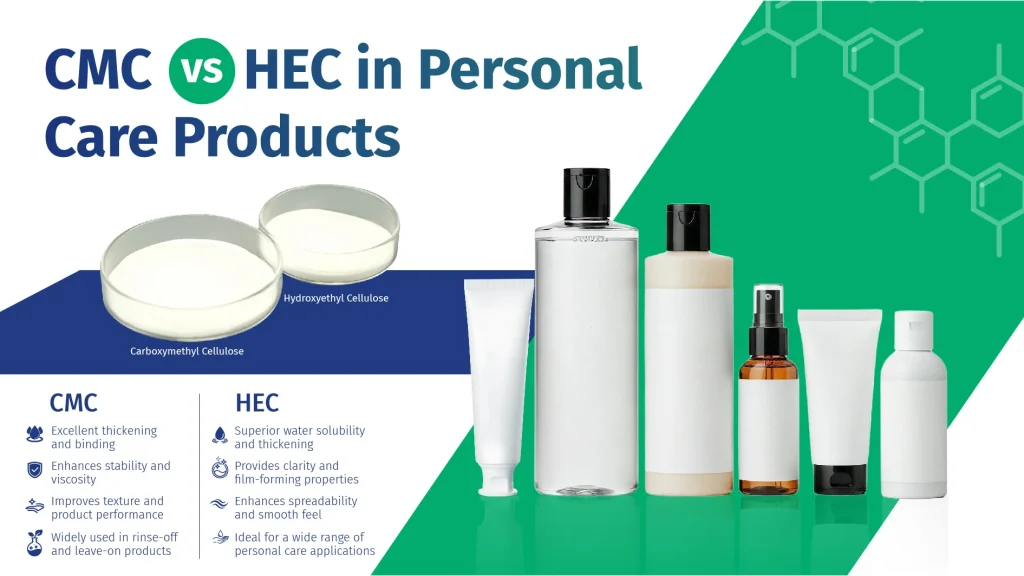
CMC vs HEC at a Glance
| Property | Sodium Carboxymethyl Cellulose | Hydroxyethyl Cellulose |
|---|---|---|
| Common abbreviation | CMC, CMC-Na, NaCMC | HEC |
| Common INCI name | Cellulose Gum | Hydroxyethylcellulose |
| Ionic character | Anionic | Nonionic |
| Main functional roles | Thickening, binding, water retention, syneresis control, suspension | Thickening, flow control, suspension support, film formation, texture stabilization |
| Salt tolerance | Depends strongly on salt type, concentration, DS, and grade | Usually better across many electrolyte systems |
| Cationic compatibility | May interact with cationic surfactants or active ingredients | Generally more compatible because it is nonionic |
| Clear formulation potential | Possible, but grade and formulation dependent | Often a strong option for clear gels and surfactant systems |
| Common personal care uses | Toothpaste, masks, creams, gels | Shampoo, body wash, hand wash, lotions, sun care, toothpaste |
| Common home care uses | Detergents, polishes, suspension systems | Laundry liquid, dishwashing liquid, household cleaners, gel cleaners |
| Main formulation risk | Viscosity loss or incompatibility in high-salt and cationic systems | Lumps during hydration, over-thickening, and grade-dependent clarity |
| Can they be combined? | Yes | Yes |
There is no universal winner in the CMC vs HEC comparison. Each polymer solves a different group of formulation problems.
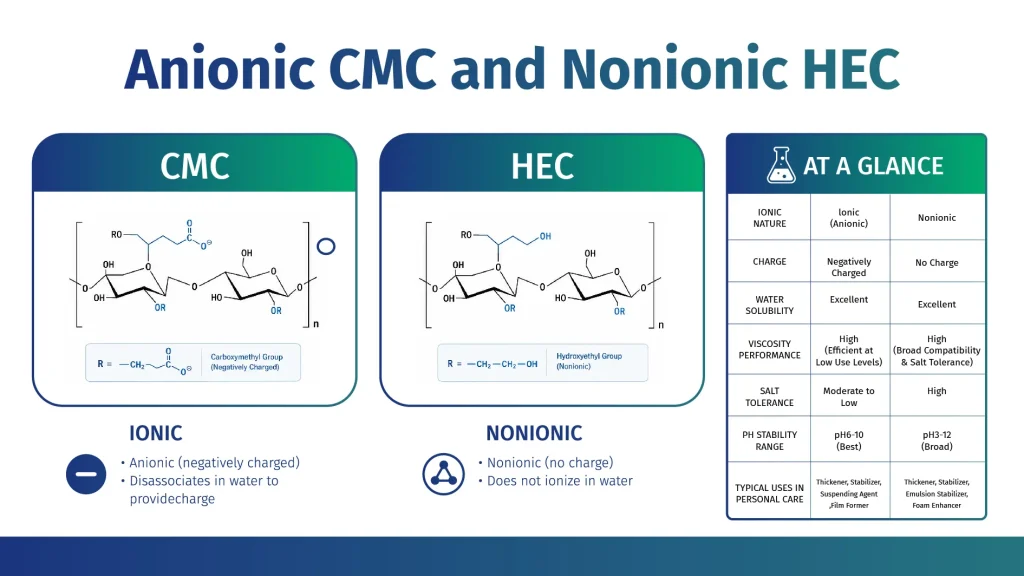
What Is Sodium Carboxymethyl Cellulose?
Sodium carboxymethyl cellulose is produced by introducing carboxymethyl groups into a cellulose backbone. It is normally supplied as the sodium salt.
These carboxymethyl groups give CMC an anionic charge when it dissolves in water. The charge helps the polymer hydrate and interact with the aqueous phase, but it also makes CMC more sensitive to certain ions and positively charged ingredients.
Commercial CMC grades vary in degree of substitution, molecular weight, purity, particle size, and substitution uniformity.
The degree of substitution, or DS, describes the average number of carboxymethyl groups attached to each anhydroglucose unit in the cellulose chain. Changes in DS can affect water solubility, electrolyte response, rheology, and compatibility.
CMC used in personal care or oral care should not be selected from viscosity alone. Purity, sodium chloride content, sodium glycolate, microbial limits, heavy metals, odor, taste, and regulatory status may also be important.
In oral care, CMC is valued as a binder and rheology modifier. It can hold liquid and solid ingredients together, reduce water separation, and give toothpaste a smooth ribbon when it is squeezed from the tube. Ashland describes oral-care CMC as an anionic, water-soluble cellulose ether that modifies rheology, binds water, and helps prevent syneresis in toothpaste. Its oral care technical guide also shows that CMC grades differ in DS, viscosity, and particle size.
What Is Hydroxyethyl Cellulose?
Hydroxyethyl cellulose is produced by introducing hydroxyethyl groups into cellulose. It is a nonionic, water-soluble polymer.
Because HEC does not carry the same negative charge as CMC, it is generally less likely to form unwanted interactions with cationic surfactants, quaternary ammonium compounds, and positively charged active ingredients.
HEC can build viscosity, control flow, support suspension, improve spreading, and stabilize the texture of water-based formulations. It is used in shampoos, body washes, hand washes, lotions, creams, gels, liquid detergents, dishwashing liquids, and household cleaners.
HEC can also produce shear-thinning behavior. A shear-thinning product becomes easier to pump, pour, spread, or squeeze when force is applied. It then rebuilds part of its structure after the force is removed. This behavior can improve dispensing and help a product stay on a vertical surface.
Zhiwei describes HEC as a water-soluble polymer used to build viscosity and control flow in daily care products and other water-based systems. Its current range includes HEC 40, HEC 300, HEC 2K, HEC 6K, HEC 15K, HEC 30K, HEC 50K, HEC 100K, and HEC 150K. The complete range is presented on the Zhiwei HEC product page.
The Most Important Difference: Anionic vs Nonionic
The difference in ionic character is the main reason why CMC and HEC behave differently.
CMC contains negatively charged carboxymethyl groups. These groups can interact with dissolved salts and positively charged materials. The interaction may reduce polymer expansion, lower viscosity, form haze, or cause precipitation.
The result depends on the type and concentration of ions. Monovalent salts such as sodium chloride may reduce viscosity at higher concentrations. Multivalent ions such as calcium, magnesium, aluminum, or iron can have a stronger effect.
HEC is nonionic. Its hydration and thickening do not depend on an anionic charge in the same way. It therefore offers broader compatibility in many systems containing electrolytes or cationic ingredients.
This does not mean that HEC is unaffected by formulation chemistry. Very high salt concentrations, extreme pH, high solvent levels, surfactants, fragrance oils, temperature, and preservatives can still change its viscosity and clarity.
HEC should be described as more tolerant in many complex systems, not completely immune to compatibility problems.
CMC and HEC in Toothpaste
Toothpaste contains a combination of water, humectants, abrasives, surfactants, flavors, sweeteners, active ingredients, and preservatives. The thickener must hold this system together while allowing the paste to be pumped, filled, squeezed, and spread on a toothbrush.
The American Dental Association explains that toothpaste may contain cellulose-based thickeners or binders to stabilize the product. Toothpaste can also contain calcium carbonate, hydrated silica, phosphate salts, fluoride compounds, humectants, and detergents. These ingredients create different compatibility conditions for the thickener. See the ADA toothpaste ingredient overview.
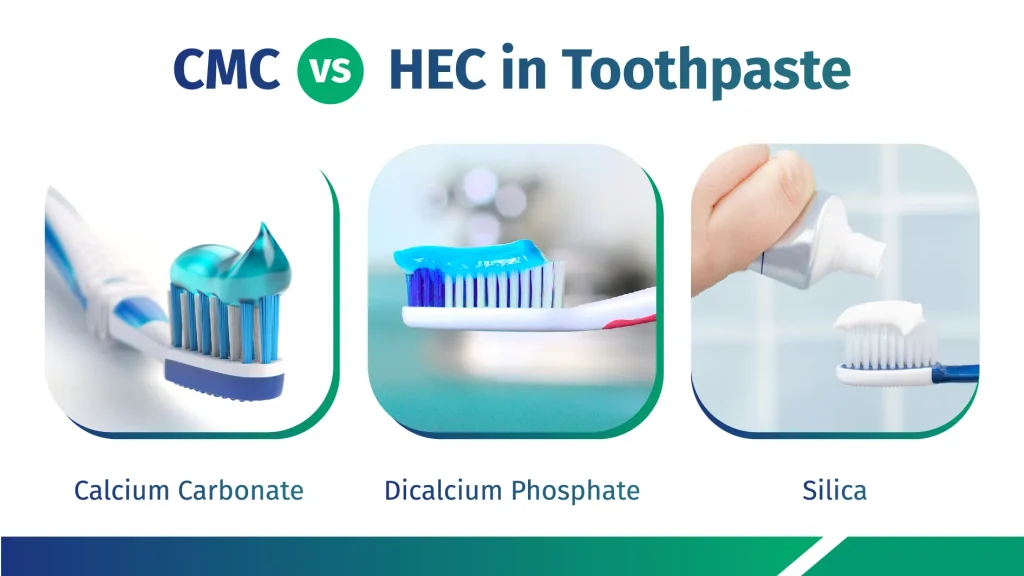
When CMC Is a Good Choice
CMC has a long history of use in conventional toothpaste. It provides binding, water retention, body, and syneresis control. It is often cost-effective and can produce a smooth paste with good extrusion properties.
CMC can work well when the electrolyte level is moderate and the active ingredients are compatible with an anionic polymer.
When HEC Is a Better Choice
HEC becomes attractive when the formula contains a high concentration of salts, multivalent ions, or cationic active ingredients.
Its nonionic character can improve compatibility and storage stability. It can also contribute to a smooth, glossy toothpaste ribbon and shear-thinning flow.
Ashland’s HEC oral care guide describes HEC as compatible with a wide range of actives and tolerant of mono-, di-, and trivalent cations. This makes HEC a practical candidate for mineral-rich toothpaste and other electrolyte-heavy oral care systems.
Can CMC and HEC Be Used Together?
Yes. A CMC and HEC combination can balance cost, binding strength, salt tolerance, texture, and storage stability.
CMC may provide economical water binding and initial body. HEC may improve compatibility and help protect viscosity when the formula contains more challenging ions.
The ratio should be tested rather than copied directly from another toothpaste. Abrasive type, fluoride source, humectant level, surfactant system, temperature, and processing order all influence the result.
The following ranges are reasonable laboratory screening references, not finished commercial formulas.
| Toothpaste Type | CMC Screening Range | HEC Screening Range | Main Test |
|---|---|---|---|
| Calcium carbonate toothpaste | 0.8%-1.0% | 0.3%-0.6% | Calcium tolerance, ribbon shape, water separation |
| Dicalcium phosphate toothpaste | 0.1%-0.6% | 0.3%-0.5% | Electrolyte compatibility and storage viscosity |
| Hydrated silica toothpaste | 0.1%-0.5% | 0.1%-0.5% | Clarity, smoothness, extrusion, and syneresis |
The total thickener level should be optimized around the selected grades. A high-molecular-weight polymer may require a lower dosage than a lower-viscosity grade.
Oral-care production also requires an appropriate purity grade. A general industrial HEC or CMC grade should not be used in toothpaste unless the supplier confirms that it meets the required oral-care specifications and local regulations.
HEC in Shampoo and Body Wash
Modern shampoos and body washes may contain anionic, amphoteric, nonionic, and cationic ingredients. They can also contain sodium chloride, fragrance, botanical extracts, conditioning polymers, preservatives, pearlizing agents, and suspended particles.
HEC is often selected because its nonionic character provides broad compatibility with many of these materials.
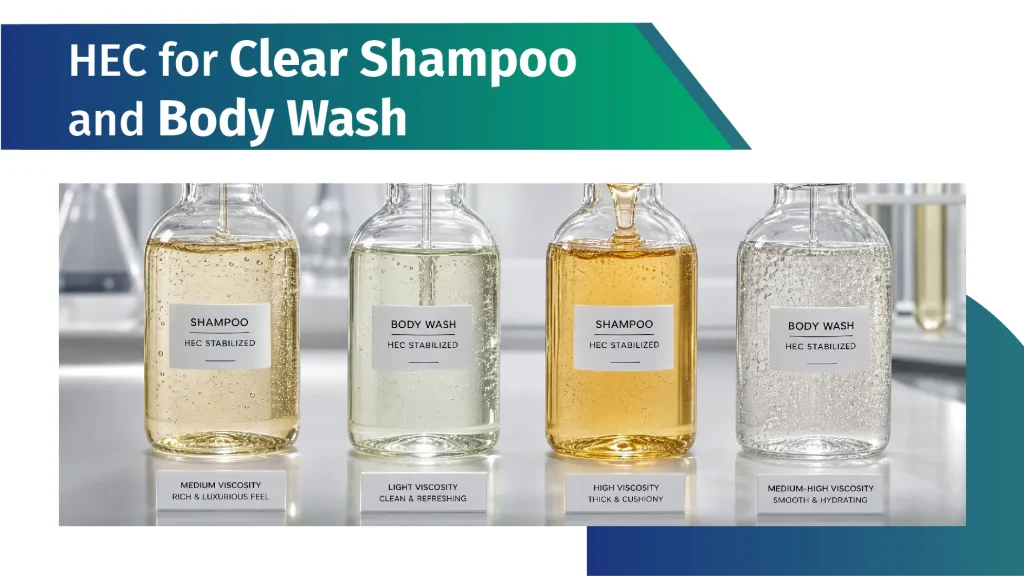
It can increase body, improve pouring control, support a smooth texture, and help keep the product consistent during storage. Clear gels may also be possible when the HEC grade is properly hydrated and compatible with the surfactant and fragrance system.
Zhiwei identifies HEC as a thickener for shampoo and body wash that can support clear texture, salt tolerance, smooth spreading, and stable product feel. The company also emphasizes that actual results depend on the surfactants, salt level, pH, fragrance, temperature, and mixing method. More application details are available on the Zhiwei HEC for Shampoo and Body Wash page.
A soap-based body wash can use HEC as a viscosity and texture modifier. A screening level around 0.2%-0.4% may provide an initial laboratory direction, but the final dosage must reflect the HEC grade and soap concentration.
HEC should not be described as a complete emulsifier. It can help stabilize a dispersed system by increasing viscosity and slowing movement, but a formula containing a meaningful oil phase normally still needs a suitable emulsifier.
HEC should also not automatically be described as a foam booster. Changing viscosity can affect foam formation, drainage, and stability, but the result depends on the surfactant system. Foam volume, foam texture, and rinse behavior should be measured during development.
HEC in Hand Wash and Liquid Soap
Hand washes may contain anionic surfactants, amphoteric surfactants, nonionic surfactants, disinfecting ingredients, salts, solvents, moisturizers, fragrances, and preservatives.
If the formula contains a cationic antimicrobial ingredient, an anionic thickener such as CMC may interact with it. This can reduce thickening efficiency, create haze, or affect active availability.
HEC is often a safer starting direction for cationic or mixed-surfactant systems because it is nonionic. However, compatibility must still be confirmed with the exact active ingredient and use level.
The formulation team should monitor appearance, viscosity, pH, active stability, foam, rinse feel, and microbial preservation. Testing only the initial viscosity is not sufficient.
Hydroalcoholic products require additional attention. Some HEC grades can work in water-alcohol systems, but tolerance depends on polymer grade, alcohol type, alcohol concentration, hydration method, and other ingredients. A thickener that works in a normal hand wash may not work in a high-alcohol sanitizer.
HEC in Lotions, Creams, and Sun Care
In an oil-in-water lotion, HEC thickens the continuous water phase. This can slow droplet movement, improve texture, and support emulsion stability.
HEC may also improve slip during application and reduce a watery or unstable feel. Typical screening levels in lotions and creams may begin around 0.1%-0.5%, depending on the required texture and the viscosity grade.
It is important to distinguish between thickening and emulsification. HEC can support an emulsion, but it is not normally the primary emulsifier. The formula still needs an emulsifier system suited to the oil phase and intended product.
Sun care products are more demanding because they may contain mineral particles, organic UV filters, electrolytes, oils, and film-forming ingredients. HEC can support texture and suspension, but sunscreen performance cannot be predicted from viscosity alone. Any change to the thickener may affect spreading, film formation, water resistance, and measured sun protection.
Zhiwei’s HEC for Lotions and Sun Care guide recommends confirming emulsion type, oil-phase level, pH, electrolyte content, UV-filter type, processing method, and packaging before selecting a grade.
CMC and HEC in Facial Masks
CMC is used in peel-off and rinse-off mask systems as a thickener, binder, and film-texture modifier.
In a peel-off mask containing polyvinyl alcohol, CMC can reduce an excessively strong or brittle film and modify the way the dried layer separates from the skin. It may also work with alginate, glycerin, propylene glycol, and other water-binding ingredients.
In a rinse-off mask, CMC can build body and support the suspension of powders or other dispersed materials.
HEC can be used when the formulator needs a smoother gel, better compatibility with cationic ingredients, or a less ionic thickening system. It may also improve spreadability and produce a different sensory profile.
Neither polymer should be selected only from its viscosity in water. Film flexibility, drying time, tack, wash-off, skin feel, preservation, and package dispensing must be tested in the complete product.
CMC and HEC in Laundry and Dishwashing Products
CMC has an established role in laundry formulations, including soil anti-redeposition. It can help reduce the return of suspended soil to fabric during washing.
HEC is more often used to adjust the viscosity and flow of liquid laundry detergent, dishwashing liquid, and gel cleaners. It can improve dosing control and help a cleaner remain on a vertical surface.
Zhiwei describes HEC as a nonionic thickener for laundry and dish detergents. It supports viscosity, pour control, texture stability, and clarity in suitable formulations. The final result still depends on surfactant type, salt concentration, enzymes, fragrance, solvents, and pH. See the Zhiwei detergent application guide.
An important formulation distinction is that thickening and soil anti-redeposition are separate functions. HEC may improve the texture of a detergent, but it should not automatically be treated as a direct replacement for CMC when fabric anti-redeposition is the main target.
A formulation may therefore use one polymer for rheology and another material for fabric-care performance.
How to Compare CMC and HEC Viscosity Correctly
A product name such as “30K” or “100K” is not enough to compare two cellulose ethers.
Viscosity depends on several test conditions:
| Test Variable | Why It Matters |
|---|---|
| Polymer concentration | A 1% solution cannot be compared directly with a 2% solution |
| Test temperature | Cellulose ether viscosity changes with temperature |
| Instrument | Brookfield, NDJ, and other viscometers may give different results |
| Spindle and speed | Different spindle and rotational speed settings change the reading |
| Hydration time | An incompletely hydrated sample gives an artificially low result |
| Water quality | Minerals and dissolved salts can change viscosity |
| pH | pH affects hydration and long-term polymer stability |
| Sample preparation | Lumps or trapped air make the result unreliable |
A CMC measured at 2% and 25°C should not be compared directly with an HEC measured at 1% and 25°C.
Formulators should request the complete test method from the supplier. The same method should then be used for incoming quality control and competitive comparisons.
How to Add CMC or HEC Without Lumps
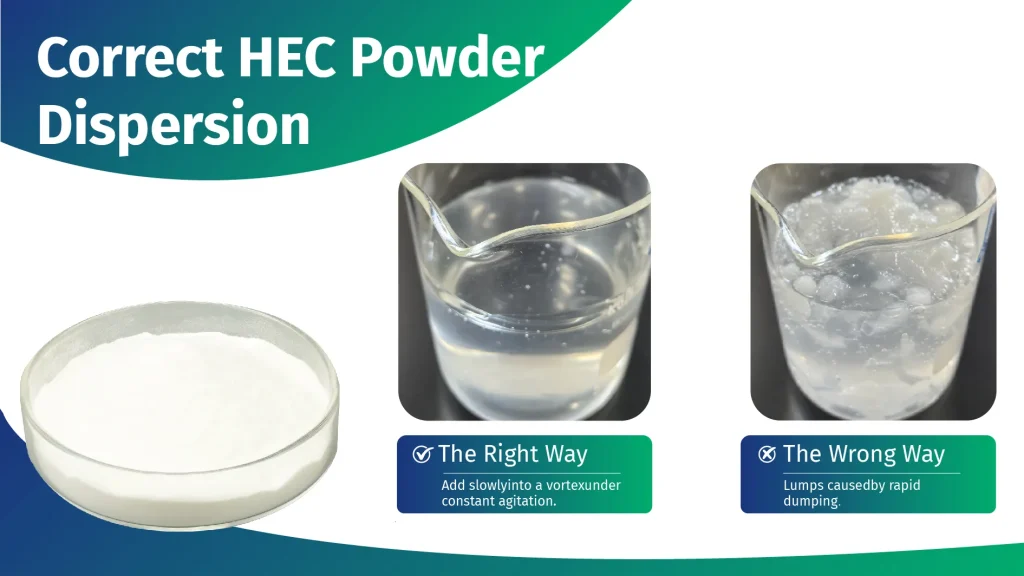
Both CMC and HEC can form fisheyes when dry powder contacts water too quickly. The outside of a powder cluster hydrates first and creates a gel layer. This layer prevents water from reaching the dry material inside.
A controlled mixing procedure reduces this problem.
- Start with clean water and establish a steady vortex without pulling excessive air into the batch.
- Add the cellulose ether slowly across the moving surface. Do not dump an entire bag into one location.
- Allow the powder to disperse before accelerating hydration.
- Where appropriate, pre-disperse the polymer in glycerin, sorbitol, glycol, or another compatible non-solvent phase.
- For delayed-hydration HEC, follow the supplier’s recommended pH and timing procedure.
- Add high levels of salt after the polymer has hydrated when the formula and process permit.
- Measure viscosity only after the batch has completed its expected hydration and rest period.
- Confirm the result again after 24 hours because final viscosity may continue to develop.
Some Zhiwei HEC grades use delayed-hydration treatment to improve dispersion and reduce lump formation. The correct procedure should be confirmed from the grade-specific TDS.
Heating is not automatically the best solution. HEC can dissolve in hot or cold water, but high temperature can accelerate surface hydration and make poor dispersion worse. Temperature should be selected as part of the complete mixing process.
Which Zhiwei HEC Grade Should You Test?
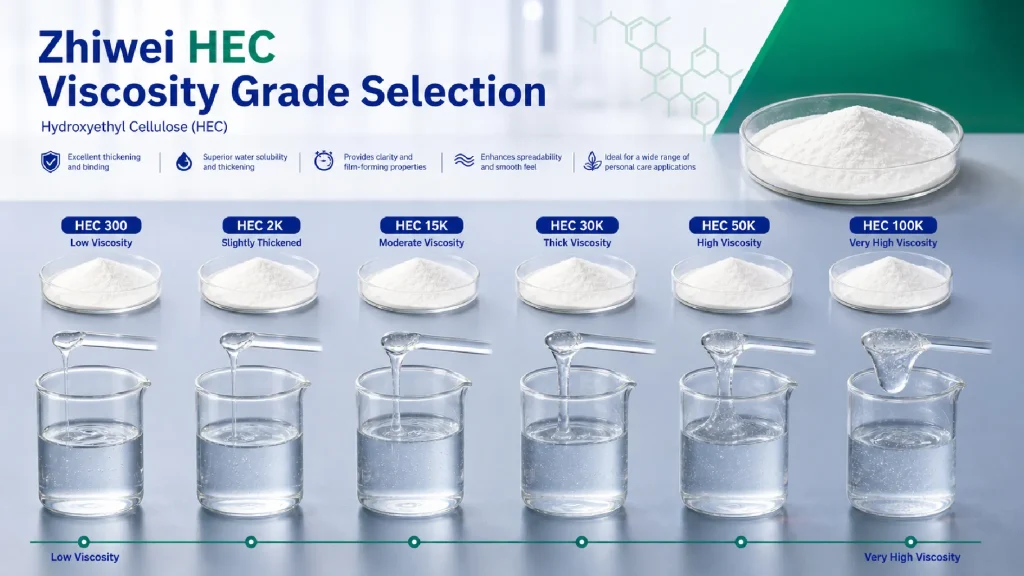
Zhiwei supplies HEC models from low to high label values. Grade selection should begin with the required product texture and test method.
| Formulation Target | Zhiwei HEC Screening Direction | Main Verification |
|---|---|---|
| Light liquid, serum, or low-body system | HEC 300 or HEC 2K | Clarity, flow, sprayability, and residue |
| Moderate shampoo or body wash viscosity | HEC 6K, HEC 15K, or HEC 30K | Foam, salt response, fragrance compatibility, and rinse feel |
| Rich body wash or liquid cleaner | HEC 30K or HEC 50K | Pouring, pumpability, texture, and storage stability |
| Cleaner requiring stronger vertical cling | HEC 50K or HEC 100K | Cling, stringiness, surface rinsing, and package dispensing |
| High-body water gel | HEC 100K | Hydration time, air release, clarity, and sensory feel |
| Toothpaste or oral care | Application-specific compliant grade | Purity, microbial limits, taste, ions, abrasives, and oral-care documentation |
These models are screening directions rather than final recommendations.
For example, Zhiwei HEC 30K is a nonionic grade positioned for cleaners and stable waterborne formulas. Its published specification uses a 1% solution at 25°C and gives a Brookfield LV viscosity of 1,501-2,600 mPa.s. Zhiwei HEC 50K is positioned for stronger viscosity and body, while Zhiwei HEC 100K is intended for high-body systems and stronger suspension support.
The model label should never replace the measured specification. Buyers should compare concentration, temperature, instrument, spindle, speed, ionic character, particle size, moisture, ash, and pH.
Personal care and oral care also require additional quality controls. The buyer should confirm whether the proposed grade meets the purity, microbial, residual chemical, and regulatory requirements of the intended market.
A Practical CMC vs HEC Selection Method
Start with the formula rather than starting with a polymer name.
If the product is a conventional toothpaste with a moderate electrolyte load and cost is important, CMC may be the first candidate.
If the toothpaste contains high mineral content, multivalent ions, or cationic ingredients, HEC or a CMC-HEC combination may provide better stability.
If the product is a clear shampoo or body wash with a complex surfactant system, HEC is often the more practical starting point.
If the product contains a cationic antimicrobial or conditioning ingredient, nonionic HEC is generally easier to evaluate than anionic CMC.
If the main goal in a laundry powder or liquid is soil anti-redeposition, CMC may offer a function that cannot be judged from viscosity alone.
If the product is a lotion, cream, or sun care emulsion, HEC can support continuous-phase viscosity and texture, but the emulsifier and complete stability system remain essential.
The final selection should be based on comparative laboratory batches. Each batch should be tested at initial preparation, after complete hydration, and after storage.
What Should Be Included in a Stability Test?
A useful CMC vs HEC comparison should measure more than initial viscosity.
| Test | What It Reveals |
|---|---|
| Initial and 24-hour viscosity | Hydration rate and final viscosity development |
| Viscosity at different temperatures | Temperature sensitivity and consumer-use behavior |
| Centrifuge test | Early indication of separation or sedimentation |
| Freeze-thaw cycles | Resistance to temperature changes during transport and storage |
| High-temperature storage | Accelerated viscosity and appearance changes |
| pH monitoring | Polymer and formulation stability |
| Clarity or haze | Compatibility with surfactants, salts, fragrance, and actives |
| Foam testing | Effect on foam generation and drainage |
| Package testing | Pumping, squeezing, spraying, or pouring performance |
| Microbial challenge testing | Adequacy of the preservation system |
| Sensory testing | Slip, drag, tack, residue, and rinse feel |
A formula that has the correct Brookfield viscosity can still fail because it becomes stringy, traps air, reduces foam, blocks a pump, or separates during storage.
What Should Buyers Ask an HEC Supplier?
A professional inquiry should include the product type, surfactant system, salt level, pH, target viscosity, clarity target, mixing method, use temperature, and packaging.
The supplier should provide a current TDS, SDS, and batch COA. For personal care and oral care, the buyer should also request information about purity, microbial limits, residual substances, heavy metals, and intended-use compliance.
Zhiwei (Jinan) New Materials Co., Ltd. provides HEC grade selection, samples, TDS, SDS, and batch documentation. Its HEC range covers low-, medium-, and high-viscosity directions for water-based formulations.
Providing the actual base formulation allows the supplier to recommend a realistic screening grade instead of selecting a model only from its label value.
Frequently Asked Questions
Is HEC better than CMC?
HEC is not universally better. It is often better in high-electrolyte, cationic, clear, or complex surfactant systems. CMC can be more economical and effective for binding, water retention, toothpaste texture, and laundry anti-redeposition.
Can HEC replace CMC at the same dosage?
Usually not. The two polymers have different charge, molecular weight, hydration, rheology, and compatibility. A replacement should begin with a dosage ladder and complete stability testing.
Which thickener is better for toothpaste?
CMC is suitable for many conventional toothpaste formulas. HEC can be advantageous in high-salt or high-mineral systems and formulas containing cationic actives. A CMC-HEC blend can provide a useful balance.
Which thickener is better for shampoo?
HEC is often the better starting point because it is nonionic and compatible with many surfactant combinations. Clarity, foam, salt response, and rinse feel must still be tested.
Can CMC and HEC be mixed?
Yes. Combining them can balance cost, rheology, binding, electrolyte tolerance, and storage stability. The mixing order and ratio require laboratory testing.
Does HEC keep insoluble particles suspended?
HEC can slow sedimentation by increasing viscosity and changing rheology. Effective suspension depends on particle size, density difference, yield stress, viscosity profile, and storage conditions.
Is HEC an emulsifier?
HEC is mainly a thickener and rheology modifier. It can support emulsion stability by thickening the water phase, but it normally does not replace a suitable emulsifier.
Does HEC reduce foam?
It may change foam generation, drainage, and texture because it changes the viscosity of the continuous phase. The result depends on the surfactant blend and HEC dosage, so foam must be measured in the finished formula.
Conclusion
The CMC vs HEC decision begins with one fundamental difference: CMC is anionic, while HEC is nonionic.
CMC is a proven binder, water-retention agent, and rheology modifier for toothpaste, masks, detergents, and other water-based products. It can provide strong performance at a practical cost when the ionic environment is suitable.
HEC offers broader compatibility in many high-salt, cationic, surfactant-rich, and clear formulations. It is especially useful in shampoo, body wash, hand wash, lotions, cleaners, and high-body water gels.
Neither polymer should be selected from a model name or viscosity number alone. The formulation team must consider ionic character, salt concentration, surfactants, active ingredients, pH, clarity, sensory properties, preservation, processing, and packaging.
Zhiwei supplies HEC models from HEC 40 through HEC 150K for different viscosity and flow targets. For an effective grade recommendation, buyers should provide their complete application conditions and compare samples in the actual formulation.