
At Zhiwei, our practical answer is clear: Hydroxyethyl Cellulose is generally considered safe for skin when it is cosmetic-grade, properly formulated, and used at suitable levels in finished personal care products. It is widely used as a nonionic thickener, rheology modifier, and texture-support ingredient in skin care, hair care, body wash, lotion, sun care, and related personal care systems. Dow’s personal care grade CELLOSIZE™ Hydroxyethyl Cellulose is positioned for hair care, skin care, color cosmetics, and personal care formulations across pH 3 to 10, with benefits such as thickening, emulsion stability, high solution clarity, surfactant compatibility, and salt tolerance.
This does not mean every product containing HEC is automatically suitable for every person. Skin safety depends on the full formula, the grade used, the purity standard, the preservative system, the final pH, the use level, and the user’s own skin condition. FDA also makes this general regulatory point clear for cosmetics: cosmetic products and ingredients, except color additives, do not need FDA premarket approval, but the ingredient and finished cosmetic must be safe under labeled or customary conditions of use.
What Hydroxyethyl Cellulose Does In Skin Care
Hydroxyethyl Cellulose, or HEC, is a nonionic, water-soluble cellulose ether. In personal care formulas, it is not used as a strong active ingredient like a retinoid, acid, sunscreen filter, or preservative. It is mainly used to control texture. It helps build viscosity, improve flow, support suspension, and make a formula feel smoother during application. Ashland describes Natrosol™ hydroxyethyl cellulose as a nonionic, water-soluble polymer made by reacting ethylene oxide with alkali-cellulose under controlled conditions, and notes that purified HEC for personal care and cosmetic applications is typically sold at 95.0% minimum purity on a dry basis.
This is why HEC appears in many skin-contact products. It can help a lotion feel more stable. It can help a gel spread smoothly. It can help body wash feel richer in the hand. It can also help a formula keep a more uniform texture during storage. On Zhiwei’s lotion and sun care application page, HEC is used in skincare emulsions to build viscosity, support stability, and improve slip during rubbing.
Why HEC Is Usually Skin-Friendly
HEC is generally skin-friendly because it is nonionic, water-soluble, and mainly used as a physical texture modifier. It does not work by exfoliating the skin, changing skin pigment, killing microbes, or strongly interacting with the skin barrier. Its main job is to hold water, build body, and improve how the finished product feels. Dow’s personal care HEC page describes the material as a nonionic, bio-based, biodegradable, water-soluble rheology modifier used to thicken, improve emulsion stability, and enhance sensory experience in hair and skin care applications.
From a formulation point of view, that makes HEC different from many ingredients that are more likely to create skin questions. Acids, strong surfactants, fragrance allergens, preservatives, and high levels of alcohol often deserve closer irritation review. HEC is usually there to improve product body and stability. Still, it must be cosmetic-grade and used correctly. A raw industrial grade, a contaminated material, or a poorly preserved finished formula should not be treated the same as a qualified personal care ingredient.
HEC In Lotions And Sun Care
In lotions and sun care systems, HEC can help build a stable texture and improve application feel. Zhiwei uses HEC in this area for viscosity control, flow behavior, emulsion stability, smoother rubbing feel, and process flexibility across many pH conditions. The performance still depends on the emulsion type, oil phase level, emulsifier system, pH range, electrolyte content, UV filter type, and process shear.
This is important for skin comfort. A lotion that is too thin may feel weak or unstable. A lotion that is too sticky may feel unpleasant. A sun care formula may need enough body to apply evenly while still spreading smoothly. HEC helps formulators adjust that balance. It is not the ingredient that gives SPF. It is not the ingredient that repairs skin. Its value is in the base structure and sensory profile of the formula.
HEC In Shampoo And Body Wash
HEC is also used in rinse-off skin-contact products such as shampoo and body wash. In these systems, it helps build viscosity, support clear texture in many surfactant bases, improve smooth spreading, support salt tolerance, and help lather feel more stable. Zhiwei’s shampoo and body wash application page describes HEC as a nonionic polymer used to build viscosity in surfactant systems, and highlights clear texture, stable feel, smooth spreading, lather stability, and smoother slip.
For skin safety, the whole body wash formula matters more than HEC alone. The surfactant system, fragrance, preservative, pH, salt level, and rinse-off behavior all affect mildness. HEC can help the product feel softer and richer, but it does not automatically make a harsh surfactant base mild. This is why we ask customers to share surfactant type, target viscosity, clarity target, salt level, pH range, and mixing conditions before choosing an HEC grade.
Can Hydroxyethyl Cellulose Irritate Skin?
For most users, HEC is not expected to be a common skin irritant when it is used correctly in a finished cosmetic formula. It is widely used in skin care and personal care products because it is generally compatible with water-based systems and has a mild functional role. Dow lists personal care uses including skin care, hair care, and color cosmetics, and identifies the INCI name as Hydroxyethylcellulose.
However, no ingredient is impossible to react to. A small number of users may be sensitive to a finished product that contains HEC, but the cause may not be HEC itself. It could be fragrance, preservative, surfactant, botanical extract, pH, contamination, or the total formula design. For sensitive-skin products, formulators should run stability testing, microbial testing, preservative challenge testing, compatibility testing, and skin-use safety evaluation according to the target market’s requirements.
Cosmetic Grade Matters
The grade matters. Personal care HEC should be selected for cosmetic use, not pulled from an industrial-use stream without review. Ashland notes that purified HEC for personal care and cosmetic applications is typically sold at 95.0% minimum purity on a dry basis. Dow’s personal care grade HEC page also gives personal care-specific positioning, including skin care, hair care, color cosmetics, pH 3 to 10 use, and regulatory-related statements such as not meeting the EU cosmetic nanomaterial definition and no intentionally added animal-origin ingredients to the best of its knowledge.
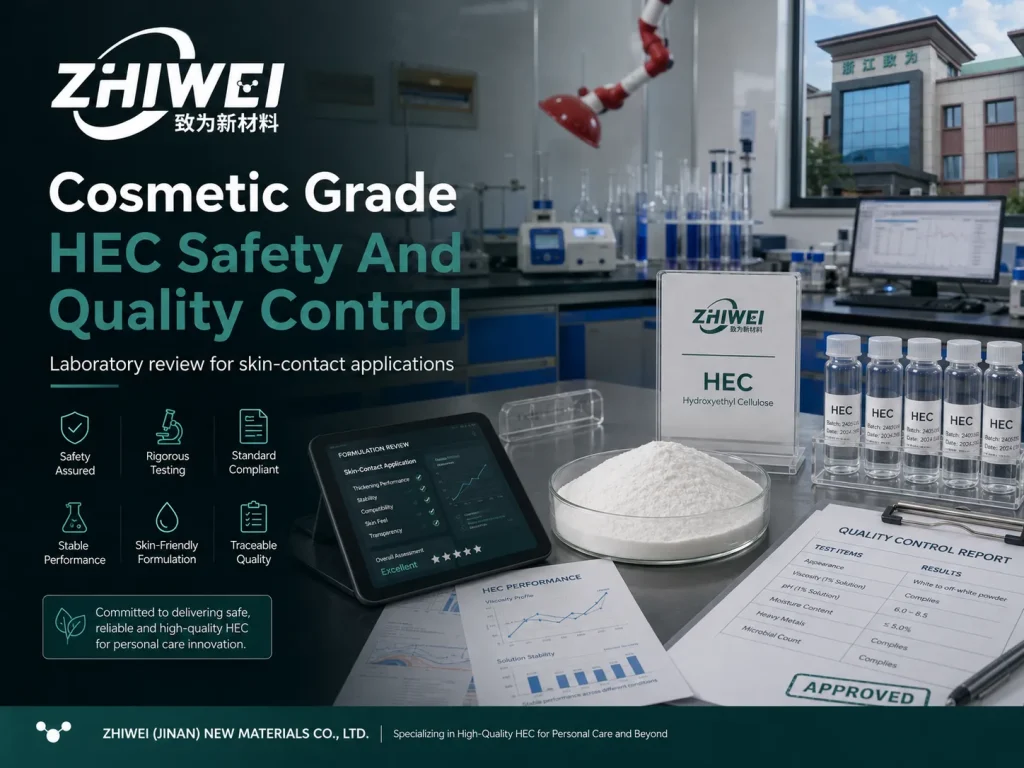
At Zhiwei, this is how we prefer to discuss skin-contact use. The question is not only, “Is HEC safe?” The better question is, “Is this the right HEC grade for this finished formula and this target market?” Skin care, body wash, lotion, and sun care products need suitable grade selection, suitable documents, and suitable testing. TDS and SDS help the technical review, and COA by batch supports traceability. Zhiwei’s HEC personal care pages also note that TDS and SDS are available and COA is available by batch on request.
Finished Formula Safety Is The Real Standard
A safe ingredient can still be used in a poor formula. A mild formula can still fail if it is contaminated, unstable, or incorrectly preserved. FDA explains that cosmetic products and ingredients generally do not need premarket approval, but manufacturers may use cosmetic ingredients only when the ingredient and finished cosmetic are safe under labeled or customary conditions, the product is properly labeled, and the product is not adulterated or misbranded. FDA also states that companies who manufacture or market cosmetics are legally responsible for ensuring product safety.
This is why HEC should be evaluated as part of the whole product. For a lotion, the formula should be checked for pH, emulsion stability, microbial protection, texture stability, and skin feel. For a body wash, the formula should be checked for surfactant mildness, pH, fragrance level, preservative system, clarity, viscosity stability, and rinse feel. For sun care, the formula must also meet the regulatory and performance requirements for the UV filter system in the target market.
How We Recommend Testing HEC For Skin-Contact Products
For skin-contact formulas, we usually start with application details. For shampoo and body wash, we ask for surfactant system, target viscosity, clarity target, salt level, pH range, other thickeners, mixing equipment, and packaging type. For lotions and sun care, we ask for emulsion type, oil phase level, emulsifier system, target viscosity, pH, electrolytes, UV filter type if relevant, mixing method, and packaging type. These details help us recommend a practical sample direction instead of sending a random grade.
After that, the customer should confirm hydration, final viscosity after rest, clarity or appearance, stability under storage, and sensory feel. For sensitive-skin positioning, the finished product should go through the customer’s own safety and regulatory testing route. HEC can support texture and stability, but it is not a substitute for finished product safety review.
What We Tell Customers
Our answer to customers is straightforward. HEC is widely used in skin-contact products and is generally suitable for cosmetic formulations when the grade is correct and the finished product is properly tested. It can help improve viscosity, slip, texture stability, emulsion support, and product feel. It works especially well in water-based systems where formulators need clean thickening and stable flow behavior.
At the same time, customers should not treat all HEC grades as identical. Cosmetic use requires the right grade, the right documents, and the right formula testing. If the customer is making a body wash, shampoo, lotion, or sun care product, the HEC grade should be selected against that base system. That is how we help customers reduce risk and make performance repeatable.
Conclusion
Hydroxyethyl Cellulose is generally safe for skin when it is cosmetic-grade, properly formulated, and used under suitable conditions in the finished product. It is widely used in skin care, hair care, body wash, lotion, sun care, and color cosmetic systems as a nonionic, water-soluble rheology modifier and thickener. Its main role is to improve viscosity, texture, emulsion stability, spreadability, and product feel, not to act as a strong skin-active ingredient.
At Zhiwei, we treat HEC for skin-contact applications as a formulation material that must be matched to the customer’s system. We support customers by reviewing the application, target viscosity, pH, surfactant or emulsion system, process conditions, and document needs. The best answer to “Is Hydroxyethyl Cellulose safe for skin?” is therefore practical: yes, it is generally considered suitable for skin-contact cosmetic products when the right grade is used in a well-designed, properly tested formula.