
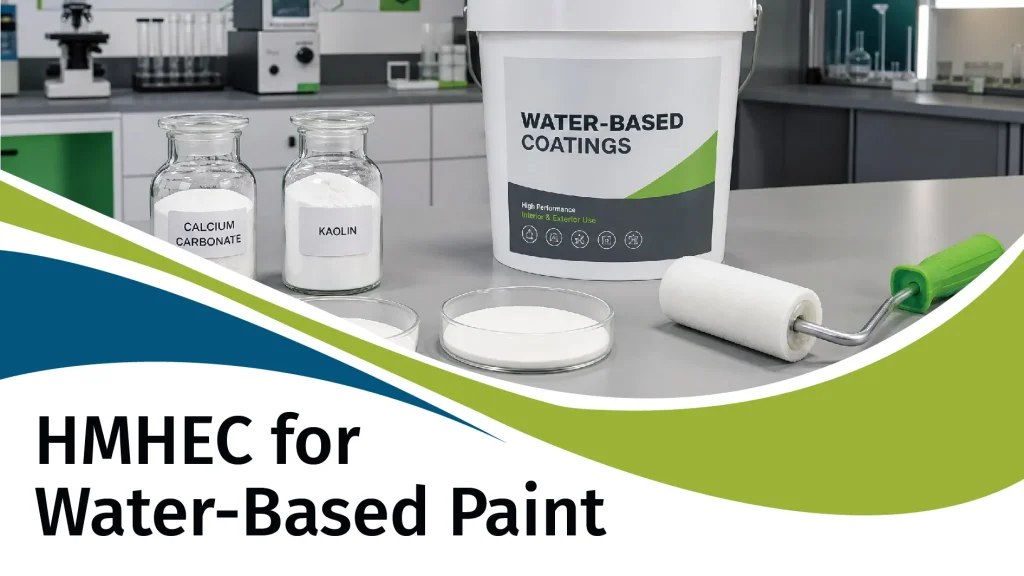
Hydrophobically modified hydroxyethyl cellulose thickens water-based paint through two connected mechanisms.
Its water-soluble cellulose backbone hydrates and increases the viscosity of the water phase. Its hydrophobic side groups also associate with each other and with hydrophobic surfaces in the coating. These interactions create a temporary three-dimensional network.
The network can include polymer chains, latex particles, calcium carbonate, kaolin, surfactants, and other formulation components. It provides high viscosity at rest, but it can separate under shear and rebuild after the shear force decreases.
This reversible structure explains why hydrophobically modified hydroxyethyl cellulose can support pigment suspension, storage stability, sag resistance, brush feel, and controlled application flow.
However, HMHEC performance depends strongly on polymer concentration, pigment type, particle size, temperature, electrolyte level, dispersant package, and shear history. A grade that performs well in one paint may behave differently in another.
What Is Hydrophobically Modified Hydroxyethyl Cellulose?
Hydrophobically modified hydroxyethyl cellulose is usually abbreviated as HMHEC.
HMHEC starts with a hydroxyethyl cellulose backbone. A manufacturer then introduces a small quantity of hydrophobic groups onto that backbone.
The resulting polymer has an amphiphilic structure:
- The hydroxyethyl cellulose backbone interacts with water.
- The hydrophobic groups avoid direct contact with water.
- Hydrophobic groups from different polymer chains associate with each other.
- Some hydrophobic groups can interact with latex particles and other hydrophobic formulation components.
These temporary connections increase the effective size of the polymer structure in solution. They also create physical crosslinks between polymer chains.
The links are not permanent chemical bonds. Shear can disrupt them, and they can form again after shear decreases.
HMHEC Versus Conventional HEC
Conventional hydroxyethyl cellulose and HMHEC are related, but they do not thicken through exactly the same mechanism.
| Property | Conventional HEC | HMHEC |
|---|---|---|
| Polymer structure | Hydrophilic cellulose ether | Hydrophilic cellulose ether with hydrophobic groups |
| Main thickening mechanism | Hydration, chain expansion, and entanglement | Hydration, entanglement, and hydrophobic association |
| Interaction with latex | Limited associative effect | Can associate with hydrophobic latex surfaces |
| Interaction with pigments | Adsorption and hydrogen bonding | Adsorption, hydrogen bonding, and hydrophobic association |
| Low-shear viscosity | Depends mainly on molecular weight and concentration | Can receive additional support from an associative network |
| Shear response | Shear-thinning | Often stronger shear-thinning at low shear |
| Recovery | Polymer chains gradually reorganize | Hydrophobic junctions can reform after shear |
| Formula sensitivity | Affected by water, pH, salts, and solids | Also sensitive to surfactants, latex type, and hydrophobic components |
A conventional high-viscosity HEC can produce more viscosity than a low-viscosity HMHEC in a simple water solution. This result does not mean that the conventional HEC provides the same associative behavior in a finished coating.
The complete rheology curve matters more than one viscosity number.
How Does the HMHEC Associative Network Form?
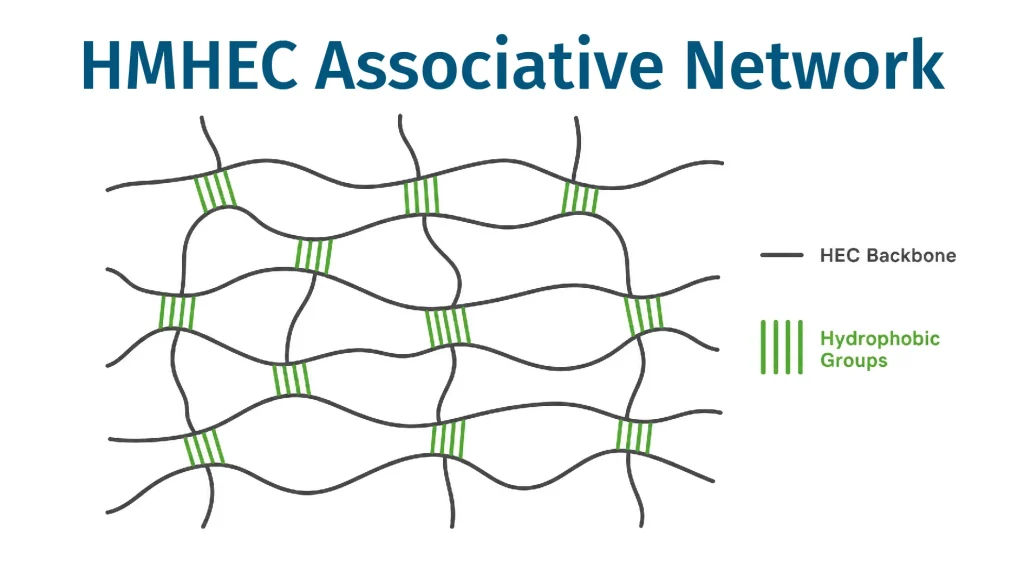
The thickening process can be divided into five stages.
1. The Cellulose Backbone Hydrates
Water surrounds the hydroxyethyl groups and expands the polymer chains.
The expanded chains occupy more hydrodynamic volume. This action increases water-phase viscosity even before strong hydrophobic association develops.
2. Hydrophobic Groups Move Together
The hydrophobic groups have low affinity for water. They tend to move into small hydrophobic domains.
Several groups from different polymer chains can join the same domain. Each domain acts as a temporary junction point.
3. Intermolecular Association Builds a Network
When the polymer concentration becomes high enough, hydrophobic groups on separate chains form a connected network.
The network can hold water and slow the movement of pigment and filler particles. It can also increase low-shear viscosity.
The formulation may show a stronger thickening response after the polymer concentration passes a critical association range.
4. HMHEC Adsorbs on Formulation Particles
Hydroxyl groups on the cellulose backbone can interact with mineral surfaces through hydrogen bonding and other physical forces.
The hydrophobic groups can also interact with suitable surface regions or with adsorbed organic materials.
One HMHEC chain may contact more than one particle. This structure creates polymer bridges between particles.
5. The Structure Responds to Shear
Low shear allows more hydrophobic connections to remain in place. The coating therefore maintains storage body and suspension.
Higher shear breaks some temporary junctions and aligns polymer chains with the direction of flow. The viscosity falls, and the coating becomes easier to pump, brush, roll, or spray.
When shear decreases, some hydrophobic junctions form again. The viscosity then recovers, although the recovery may not be immediate or complete.
What Forces Hold HMHEC and Pigments Together?
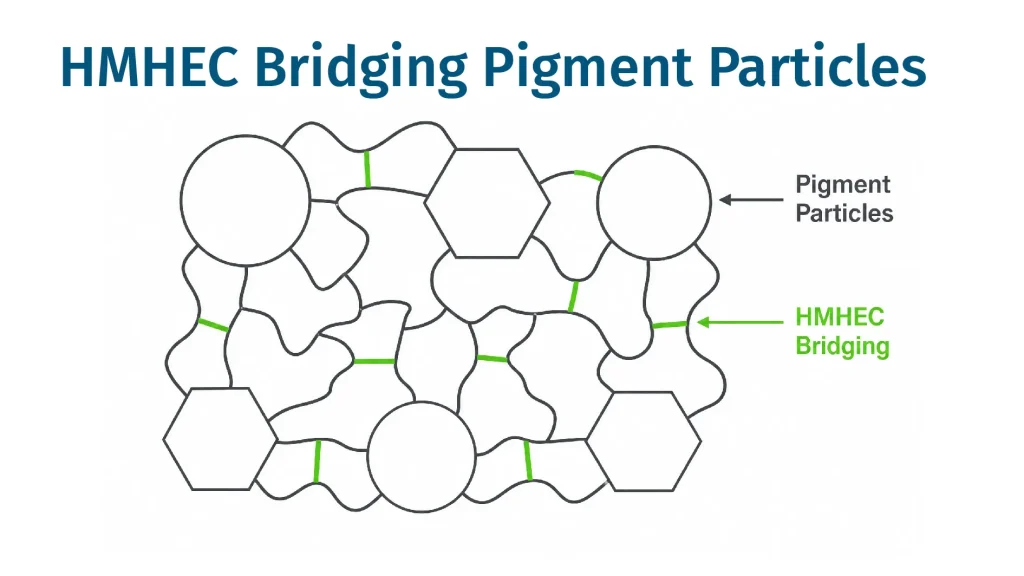
No single force explains HMHEC adsorption on pigment particles.
Several interactions can operate at the same time:
- Hydrogen bonding
- Van der Waals attraction
- Electrostatic attraction or repulsion
- Hydrophobic association
- Polymer entanglement
- Physical bridging
- Interaction with dispersants or adsorbed surfactants
The relative importance of each force depends on pigment chemistry, pH, ionic strength, particle size, surface treatment, and polymer structure.
This complexity explains why calcium carbonate and kaolin do not respond in the same way.
Effect of HMHEC Concentration
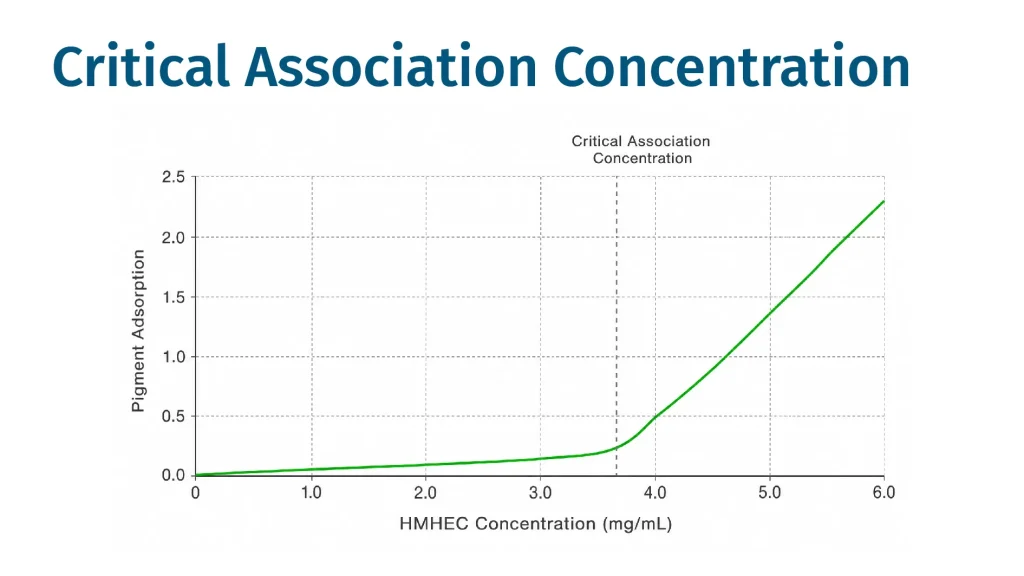
A laboratory pigment suspension showed that HMHEC adsorption increased as the HMHEC concentration increased.
The adsorption initially rose slowly. It then increased sharply when the HMHEC concentration reached approximately 0.35-0.40 g per 100 mL, which is equivalent to 3.5-4.0 mg/mL.
This transition suggests that the system had reached a critical association region.
Below this concentration, isolated polymer chains and small associative groups dominated the solution. Above it, intermolecular association became much stronger.
Hydrophobic groups on free HMHEC chains could connect with groups on chains that had already adsorbed onto the pigment surface. This behavior supported multilayer adsorption and larger polymer-pigment structures.
The exact transition concentration is not a universal HMHEC specification. It depends on:
- Hydrophobic group type
- Hydrophobic substitution level
- HEC molecular weight
- Polymer concentration
- Pigment surface area
- Electrolyte concentration
- Temperature
- Test method
A commercial coating may reach an associative transition at a different dosage.
Effect of Temperature
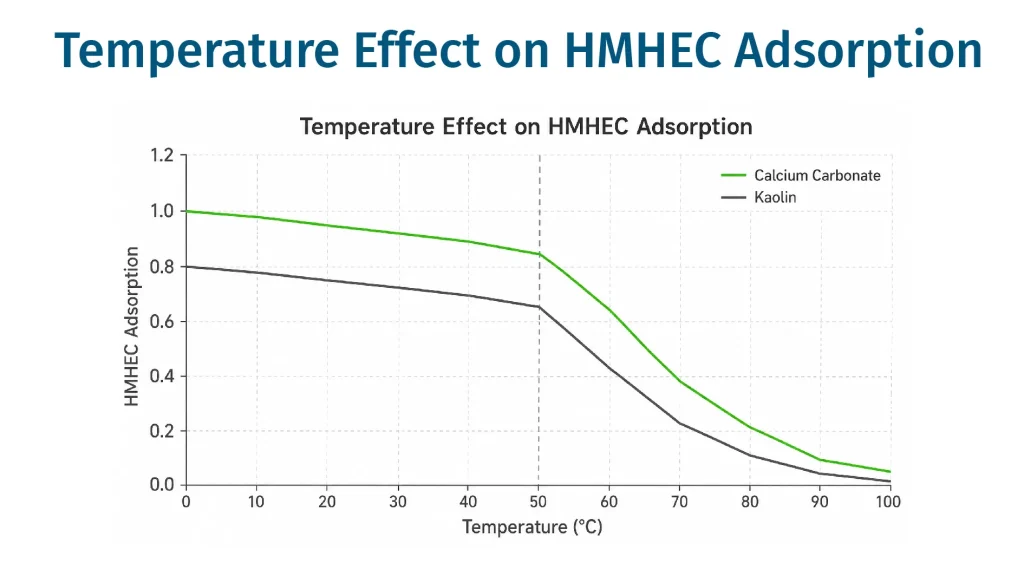
HMHEC adsorption on calcium carbonate and kaolin decreased as temperature increased in the model suspension.
Several processes occurred at the same time.
Higher temperature increased molecular motion and could expose more particle surface area. These effects might support adsorption.
However, higher temperature also disturbed hydrogen bonds and hydrophobic microdomains. Water molecules competed more strongly with the adsorbed polymer layer. The temporary associative structure became easier to disrupt.
The negative effects dominated the tested system.
The adsorption decline became more pronounced when the temperature exceeded approximately 50°C.
Coating formulators should therefore evaluate HMHEC at both production and storage temperatures. A thickener that provides strong body at 25°C may show a different rheology profile after a hot manufacturing step or warm warehouse storage.
Effect of Pigment Concentration
The amount of HMHEC adsorbed per unit of pigment decreased when the pigment concentration increased.
A higher pigment concentration can increase particle contact and aggregation. The effective specific surface area may then decrease.
The available HMHEC also has to spread across more particles. Each unit of pigment therefore receives less polymer.
This result has an important practical meaning. The same HMHEC dosage may perform differently in a low-PVC and a high-PVC paint.
A formulator should not transfer an HMHEC dosage directly between:
- Primer and topcoat
- Flat paint and semi-gloss paint
- Calcium carbonate-rich and kaolin-rich paint
- Low-solids and high-solids coating
- Different filler particle-size distributions
The pigment volume concentration and extender package must be included in the thickener selection process.
Effect on Pigment Particle Size
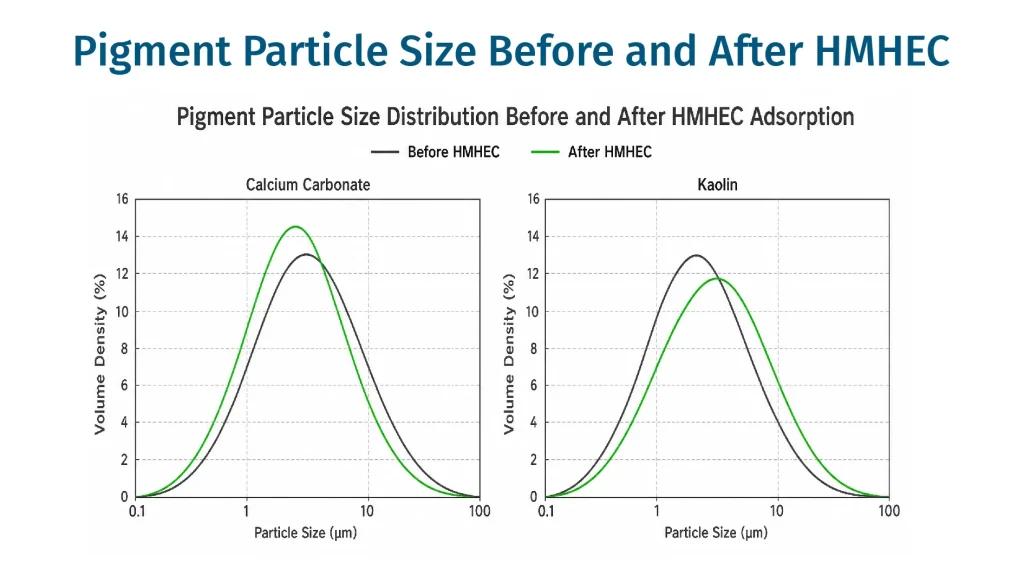
HMHEC adsorption changed the measured particle size of both calcium carbonate and kaolin suspensions.
At an HMHEC-to-pigment mass ratio of 1:10, the reported average particle radius changed as follows:
| Pigment | Before HMHEC Adsorption | After HMHEC Adsorption | Main Interpretation |
|---|---|---|---|
| Calcium carbonate | 83.12 nm | 196.40 nm | Strong polymer adsorption and bridging |
| Kaolin | 244.40 nm | 319.50 nm | Adsorption occurred, but the increase was smaller |
The particle-size increase does not mean that HMHEC simply caused uncontrolled pigment flocculation.
A laser particle-size instrument detects the hydrodynamic structure moving through the liquid. Adsorbed polymer layers, polymer bridges, and reversible pigment-polymer clusters can all increase the apparent size.
A controlled network may support suspension stability. Excessive bridging can produce harmful flocculation, poor color development, lower gloss, or higher yield stress.
The formulator must distinguish between useful structural association and uncontrolled pigment aggregation.
Why Does HMHEC Interact More Strongly With Calcium Carbonate?
The laboratory system showed stronger HMHEC adsorption on calcium carbonate than on kaolin.
Several factors contributed to the difference.
Smaller Particle Size
The tested calcium carbonate had a smaller initial particle size. It therefore provided more surface area for polymer adsorption.
Surface Chemistry
Calcium carbonate and kaolin have different surface groups and charge behavior. These differences affect hydrogen bonding and electrostatic interactions.
Calcium Ions
Calcium ions can change the electrical environment near the particle surface. They can compress the electrical double layer and reduce some electrostatic repulsion.
Hydrophobic association can then make a larger contribution to the total interaction.
Kaolin Structure
Kaolin normally has a plate-like structure. Its faces and edges can show different charge behavior.
At around pH 9, electrostatic repulsion between parts of the kaolin surface and the polymer can limit adsorption. The exact result depends on the kaolin source, particle size, surface treatment, and pH.
The conclusion should not be simplified to “HMHEC always works better with calcium carbonate.” Every commercial pigment package requires testing.
What Does Zeta Potential Show?
Zeta potential helps describe the electrical condition near dispersed particle surfaces.
The calcium carbonate and kaolin systems showed different trends after HMHEC addition:
- The absolute zeta potential of calcium carbonate generally increased.
- The absolute zeta potential of kaolin generally decreased.
The different trends support the conclusion that HMHEC interacts with the two pigments through different combinations of forces.
A zeta potential result cannot by itself prove good or poor coating stability. Associative polymers can provide steric stabilization, bridging, network formation, and yield stress that a simple electrical measurement does not fully describe.
The formulator should combine zeta potential with:
- Particle-size analysis
- Sedimentation testing
- Rheology
- Drawdowns
- Gloss
- Color strength
- Storage stability
- Microscopy
How Does HMHEC Respond to Shear?
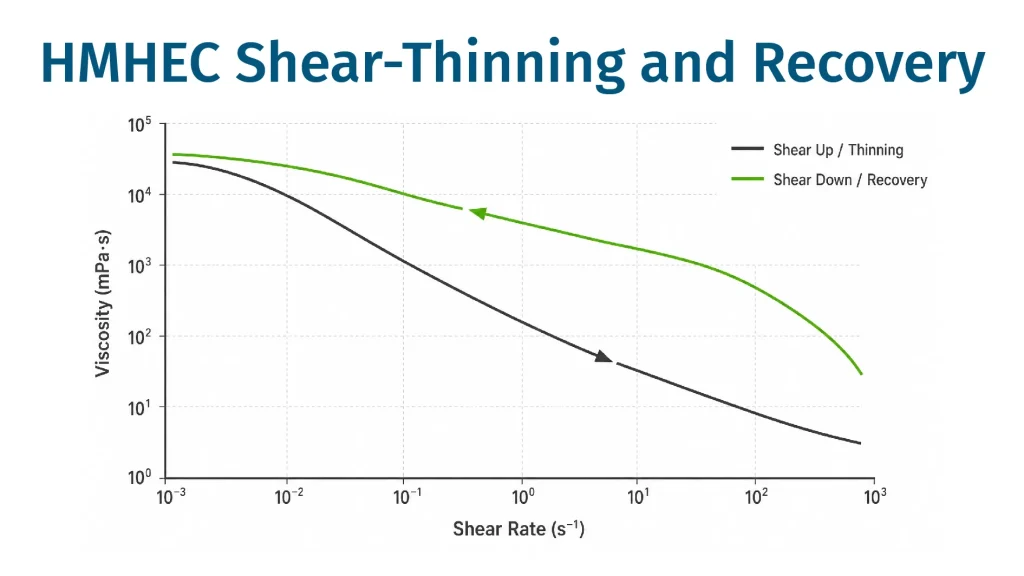
Both HEC and HMHEC show shear-thinning behavior.
At low shear, conventional HEC forms an entangled polymer structure. Increasing shear disrupts part of that structure and aligns the polymer chains with the direction of flow.
HMHEC contains an additional associative network. Low shear allows the hydrophobic junctions to connect several chains.
When shear increases, these weak physical junctions separate. HMHEC viscosity can therefore decline more rapidly during the initial increase in shear rate.
At higher shear, the viscosity curve becomes flatter because much of the temporary network has already been disrupted.
This behavior can provide:
- High viscosity during storage
- Easier pumping during production
- Controlled brush and roller flow
- Lower resistance during high-shear application
- Viscosity recovery after application
The tested HMHEC solution used a concentration of approximately 0.4 g per 100 mL, or 0.4% w/v.
When the shear rate decreased, the viscosity rose again. The return curve did not exactly follow the original curve. The difference showed that network rebuilding required time.
This hysteresis is important in coatings. A system that recovers too quickly may show poor leveling. A system that recovers too slowly may sag.
How HMHEC Affects Coating Performance
| Coating Stage | Required Rheology | Possible HMHEC Contribution |
|---|---|---|
| Storage | High low-shear viscosity | Pigment suspension and syneresis control |
| Mixing | Reduced viscosity under shear | Easier dispersion and pumping |
| Filling | Stable, repeatable flow | More consistent package filling |
| Brushing | Controlled mid-shear viscosity | Better brush drag and film build |
| Rolling | Balanced flow and body | Improved roller feel and spatter control |
| Spraying | Lower viscosity at high shear | Better atomization when correctly balanced |
| After application | Controlled recovery | Sag resistance without excessive leveling loss |
No single thickener normally optimizes every shear range.
A coating may use HMHEC with conventional HEC, HEUR, alkali-swellable polymers, clays, or other rheology modifiers. The combination can shape low-, medium-, and high-shear viscosity more precisely.
Variables That Control HMHEC Performance
Hydrophobic Modification Level
A low modification level may provide weak association. A high level may reduce water solubility or produce excessive interaction with latex and surfactants.
Polymer Molecular Weight
Higher molecular weight normally increases hydrodynamic volume and entanglement. However, it can also increase stringiness and reduce leveling.
Binder Type
Different acrylic, styrene-acrylic, vinyl acetate, and other latex particles provide different hydrophobic surfaces.
Pigment and Extender Package
Calcium carbonate, kaolin, titanium dioxide, talc, and silica have different surface chemistries and particle sizes.
Surfactants and Dispersants
Surfactants can occupy hydrophobic sites and change the associative network. Dispersants can compete with HMHEC for pigment surfaces.
Electrolytes
Salts change the electrical double layer and polymer conformation. Divalent ions can produce a different response from sodium salts.
Temperature
Higher temperature can weaken adsorption and alter solution viscosity.
Shear History
High-speed dispersion can temporarily break the network. The measured viscosity depends on the recovery time before testing.
Addition Order
HMHEC can behave differently when added before pigment dispersion, after letdown, or as a prehydrated solution.
HMHEC Laboratory Evaluation Plan
A coating laboratory should compare HMHEC and conventional HEC under the same conditions.
Step 1: Prepare a Thickener-Free Control
The control shows the original pigment settling, flow, and viscosity.
Step 2: Use Equal Polymer Solids
The laboratory should compare products at equal active polymer content before optimizing cost.
Step 3: Measure Several Shear Ranges
The test should include:
- Low-shear Brookfield viscosity
- Stormer or KU viscosity
- High-shear ICI viscosity
- Flow curve
- Yield stress
- Thixotropic recovery
Step 4: Check Application Performance
The laboratory should test:
- Sag resistance
- Leveling
- Brush drag
- Roller feel
- Spatter
- Spray behavior
- Film build
Step 5: Check Pigment Stability
The test program should include:
- Sedimentation
- Syneresis
- Particle size
- Color development
- Gloss
- Rub-up
- Storage stability
Step 6: Repeat at Different Temperatures
Testing at 25°C and an elevated temperature can reveal temperature sensitivity.
Step 7: Repeat After Tinting
Universal colorants contain surfactants and glycols that can change associative thickening. The tinted paint may need a different thickener balance from the white base.
Can Zhiwei HEC Replace HMHEC?
Conventional HEC cannot automatically replace HMHEC on a one-to-one basis.
Zhiwei currently lists a broad range of conventional HEC models for coatings, including HEC 15K, HEC 30K, HEC 50K, HEC 100K, and HEC 150K. The company describes HEC as a non-ionic thickener that supports viscosity, pigment suspension, application flow, and storage stability in water-based coatings. Zhiwei HEC for Architectural Latex Paint
These grades can provide useful baseline products during an associative thickener study.
| Formulation Goal | Zhiwei Starting Grade | Role in the Test |
|---|---|---|
| Medium-to-high body | HEC 30K | Conventional HEC baseline |
| Stronger viscosity and suspension | HEC 50K | Higher conventional HEC baseline |
| High-PVC paint screening | HEC 30K or HEC 50K | Compare pigment suspension and roller feel |
| True hydrophobic association | Confirmed HMHEC grade | Requires explicit hydrophobic modification data |
Zhiwei HEC 30K has a listed Brookfield LV viscosity of 1,501-2,600 mPa.s in a 1% solution at 25°C.
Zhiwei HEC 50K has a listed Brookfield LV viscosity of 2,601-3,400 mPa.s under the same stated conditions.
These values cannot be compared directly with specifications measured at 2% concentration or with another viscometer method.
The public Zhiwei product range identifies these products as HEC, not HMHEC. A buyer who specifically needs hydrophobically modified hydroxyethyl cellulose should request written confirmation of:
- Hydrophobic modification
- Hydrophobe type
- Modification level
- Solution viscosity method
- Low-shear viscosity
- KU viscosity
- ICI viscosity
- Associative response with latex
- Response to surfactants
- Pigment compatibility
- Temperature sensitivity
- Recommended addition order
- TDS, SDS, and batch COA
This distinction increases technical credibility. It also prevents an ordinary high-viscosity HEC from being selected for an application that requires true associative behavior.
Common Selection Mistakes
Treating Every HEC as HMHEC
A high-viscosity HEC is not automatically hydrophobically modified. The supplier must confirm the chemistry.
Selecting by One Viscosity Number
A single water-solution value does not describe coating rheology. The formulator needs low-, medium-, and high-shear measurements.
Ignoring Pigment Type
Calcium carbonate and kaolin can show different adsorption behavior. A change in extender package may require a new thickener balance.
Testing Only in Water
Water testing describes hydration and basic viscosity. It does not show interactions with latex, dispersant, pigment, surfactant, defoamer, and colorant.
Ignoring Temperature
HMHEC adsorption and viscosity can fall at higher temperatures. The formulator should test realistic production and storage conditions.
Assuming Larger Particle Size Means Failure
A larger hydrodynamic particle size may come from an adsorbed polymer layer or a useful reversible network. The result must be checked with stability, color, and film tests.
Adding Too Much HMHEC
Excessive polymer bridging can increase flocculation, yield stress, brush drag, and poor leveling. More thickener does not always produce better stability.
Measuring Immediately After High Shear
The associative structure needs time to rebuild. The test method should specify a fixed recovery period.
Frequently Asked Questions
What is HMHEC?
HMHEC is hydroxyethyl cellulose that contains a small quantity of hydrophobic groups. These groups create temporary associations between polymer chains and coating components.
How does HMHEC thicken water-based paint?
The HEC backbone hydrates and entangles in water. Hydrophobic groups also form reversible junctions between polymer chains, pigments, and latex particles.
Is HMHEC an associative thickener?
Yes. Its hydrophobic groups create intermolecular associations that contribute to the coating’s rheology.
What is the difference between HEC and HMHEC?
HEC mainly thickens through hydration and chain entanglement. HMHEC also creates a hydrophobic associative network.
Does HMHEC work with calcium carbonate?
HMHEC can adsorb strongly on calcium carbonate. The result depends on particle size, surface treatment, pH, salt, dispersant, and polymer chemistry.
Does HMHEC work with kaolin?
HMHEC can adsorb on kaolin, but the interaction may differ from calcium carbonate because kaolin has a plate-like structure and different surface-charge behavior.
Is HMHEC shear-thinning?
Yes. Shear disrupts part of its temporary network and lowers viscosity. Some viscosity returns when the shear rate decreases.
Does HMHEC recover immediately after shear?
Not always. Network rebuilding takes time, so the decreasing-shear curve may differ from the increasing-shear curve.
Which Zhiwei model should be tested?
Zhiwei HEC 30K and HEC 50K are useful conventional HEC reference grades for coating trials. A project that requires HMHEC should request a specifically confirmed hydrophobically modified grade.
Conclusion
Hydrophobically modified hydroxyethyl cellulose provides more than conventional water-phase thickening.
Its hydrophilic backbone hydrates in water, while its hydrophobic groups form temporary links between polymer chains and coating components. HMHEC can also adsorb onto calcium carbonate and kaolin and contribute to a reversible pigment-polymer network.
This mechanism supports pigment suspension, storage body, controlled application flow, and viscosity recovery. It also makes HMHEC sensitive to pigment type, particle size, temperature, surfactants, dispersants, and shear history.
Zhiwei (Jinan) New Materials Co., Ltd. offers conventional HEC grades such as HEC 30K and HEC 50K for coating viscosity and suspension trials. These models provide credible comparison grades when a formulator evaluates whether conventional HEC or a true associative HMHEC is more suitable.
Customers can share their binder type, pigment volume concentration, calcium carbonate and kaolin levels, target KU and ICI viscosity, application method, storage temperature, and existing thickener package. The Zhiwei technical team can then prepare a focused grade and testing plan.