
What Is HEMC and Why Your Choice of Manufacturer Matters
Hydroxyethyl methyl cellulose — HEMC or MHEC — is a non-ionic, water-soluble cellulose ether made from natural cotton fiber (CAS 9032-42-2). It comes as a white to off-white powder that dissolves in cold water and provides thickening, water retention, workability, and film-forming properties.
You already know the chemistry. What you need is a reliable HEMC manufacturer — and the gap between suppliers is wider than most buyers expect.
Two companies can both sell “HEMC” and deliver very different products. One holds consistent viscosity from drum to drum. The other drifts 20% between shipments. One dissolves clean. The other leaves gel lumps. One ships on time. The other stalls your production line.
Same chemical name on the label. Very different results on the job site. The difference comes down to who made it — their raw materials, their process control, their testing rigor.
Below is a practical framework for evaluating an HEMC manufacturer, covering applications, selection criteria, product specs, and what to look for before placing your first order.
Where HEMC Is Used: Key Industrial Applications
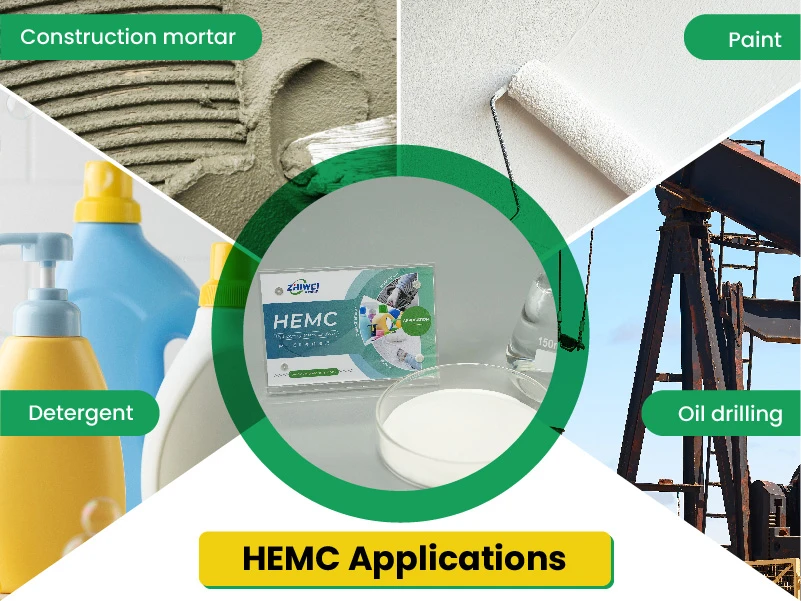
Different industries need different viscosity grades, purity levels, and performance from their HEMC. Make sure the manufacturer you choose actually covers yours.
Construction & Building Materials
The biggest market for HEMC. In cement-based mortars, tile adhesives, self-leveling compounds, and EIFS, HEMC for construction does several things at once: it holds water in the mix for proper cement hydration, makes mortar easier to spread, extends open time so tiles can be adjusted before setting, and cuts down on vertical sag.
Tile adhesives rely on HEMC for water retention and slip resistance — especially with today’s large-format tiles. Self-leveling compounds need it for flow control and segregation prevention. EIFS base coats depend on the balance between workability and anti-sag performance.
Switch to inconsistent HEMC and the problems show up fast: cracking, poor bond strength, premature drying. The manufacturer behind the product makes a real difference here.
Water-Based Paints & Coatings
In coatings, HEMC for coatings works as a thickener, rheology modifier, and stabilizer all in one. It sets the viscosity for brush and roller application, keeps pigments from settling in the can, controls spatter, and helps maintain even film thickness on walls.
The feel of a water-based paint — how it spreads, how it levels — depends heavily on the cellulose ether in the formula. Too thin and it runs. Too thick and it drags. HEMC lets formulators hit the right rheological window.
Batch consistency matters enormously in this segment. If thickening power shifts from lot to lot, viscosity drifts. That means reformulation, production holdups, and unhappy customers.
Detergent & Personal Care
Liquid laundry detergents use HEMC for detergent as an anti-redeposition agent — it keeps suspended soil from settling back onto clothes. It also thickens the formulation and stabilizes it on the shelf.
In shampoos and body washes, HEMC adds viscosity and a smooth texture. Formulators like it because it plays well with a wide range of surfactants and salts.
One practical requirement: HEMC for detergent must dissolve fast and clean. Gel particles or incomplete dissolution cause visible defects in clear liquid products.
Oil Drilling Fluids
HEMC for oil drilling modifies viscosity and controls fluid loss in water-based drilling muds. It suspends cuttings, stabilizes the borehole wall, and reduces filtration into the formation.
Downhole conditions demand thermal stability. HEMC that breaks down too early leads to lost circulation — and that gets expensive fast. Raw material quality and process control directly affect field performance in this application.
Drilling fluid companies buy HEMC in bulk and need large volumes, consistent quality, and on-schedule delivery. Rig time does not wait.
5 Critical Factors for Evaluating an HEMC Manufacturer
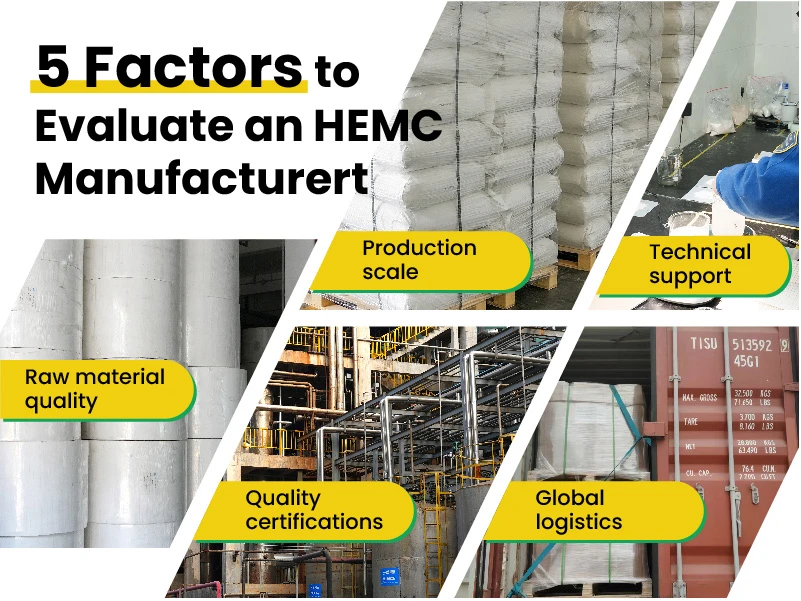
How do you tell a dependable HEMC supplier from a risky one? These five factors form a practical evaluation checklist — whether you are a distributor comparing sources or a procurement manager qualifying vendors.
1. Raw Material Quality & Traceability
HEMC starts with cellulose, usually refined cotton. The quality of that starting material directly affects color, purity, and batch-to-batch consistency. Low-grade cotton with high impurity levels produces darker HEMC with higher ash content and less predictable performance.
A manufacturer who controls their raw material source has a real edge. Zhiwei sources refined cotton from Xinjiang — one of China’s top cotton-producing regions — which gives them traceability from field to finished product. When you know where the cotton came from, quality issues are easier to track down.
Ask any supplier: where does your cotton come from? Can you provide a raw material traceability report? A vague answer is a red flag.
2. Production Capacity & Scale
Capacity matters more than most buyers expect. A small workshop might produce decent HEMC in small runs. But can they deliver 50 tons next month? Can they keep consistency across a 500-ton order? Can they take a rush order without displacing other customers?
Zhiwei (Jinan) New Materials Co., Ltd. runs a factory in Zhejiang Province with 15,000 tons of annual cellulose ether capacity. The site covers 50 mu (about 8.2 acres) with 28,000 m² of building area. That is manufacturing scale — not a trading desk reselling someone else’s output.
Scale also brings price stability. Large manufacturers buffer raw material swings through inventory and long-term supply contracts. Small producers pass every cost change straight to the buyer.
3. Quality Control & Certifications
Any credible HEMC manufacturer in China should have documented quality systems. ISO 9001 is the baseline. Ask about batch-level testing: do they provide a Certificate of Analysis with every shipment? Will they share third-party test results?
Zhiwei holds multiple production patents and has earned provincial-level scientific and technology recognition. Patents mean real R&D investment. Government-recognized achievements mean independent experts have vetted the technology.
When you evaluate a supplier, ask for a current ISO certificate, a sample COA, and any regulatory registrations your market requires. A supplier who cannot produce these quickly is one to question.
4. Technical Support & Custom Formulation
Selling HEMC is one thing. Helping customers use it well is another. Distributors often get caught in the middle when end users need formulation guidance — “Which viscosity grade works for tile adhesive in hot climates?” or “How do I adjust dosage switching from HPMC to HEMC?” A manufacturer who can answer these adds genuine value.
Some applications also need custom viscosity grades or modified performance. A manufacturer with real R&D capability can develop tailored solutions instead of making you pick from a fixed catalog.
Ask your supplier: do you have a technical team? Can you support my end users with application guidance? Can you customize a grade if nothing off the shelf fits?
5. Supply Chain Reliability & Global Logistics
For international buyers, on-time delivery ranks alongside product quality. An HEMC factory in China might make great product but still fall short on export logistics, customs paperwork, or packaging.
Ask directly: what is your typical lead time? Have you shipped to my region before? Can you supply the documentation my market requires? What packaging options do you offer?
Zhiwei has exported since 2017. The company runs a factory in Zhejiang paired with a trading office in Jinan, so production and international sales coordinate directly. That structure cuts out the communication gap you get when manufacturers rely on outside export agents.
Zhiwei HEMC Product Portfolio
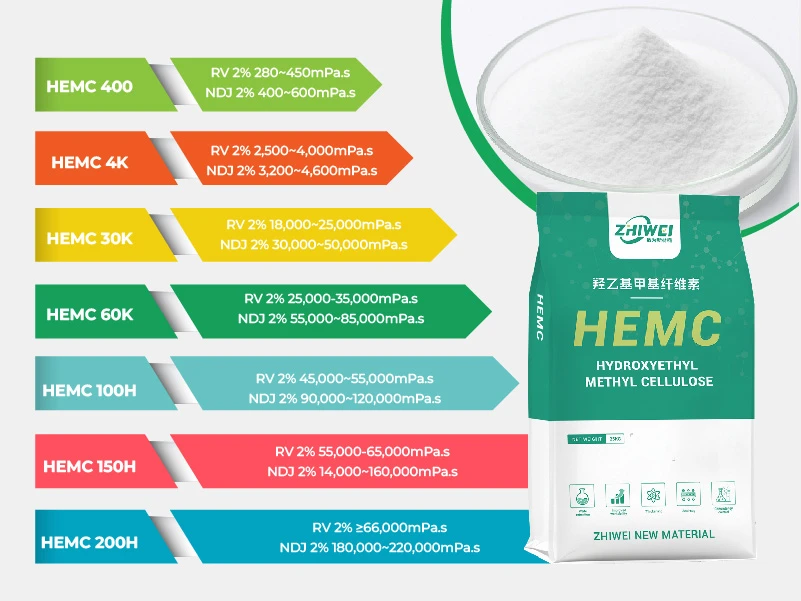
Specifications and packaging details below. Use these tables to find the right grade for your application.
Viscosity Grades & Applications Matrix
| Grade | Viscosity Range (mPa·s, 2% solution, 20°C) | Primary Application | Recommended Industry |
|---|---|---|---|
| ZW-HEMC-L | 400 – 800 | Self-leveling compounds, thin-film coatings | Construction, Coatings |
| ZW-HEMC-ML | 1,000 – 4,000 | Tile adhesives, EIFS base coats, joint fillers | Construction |
| ZW-HEMC-M | 4,000 – 15,000 | Cement plaster, wall putty, water-based paint | Construction, Coatings |
| ZW-HEMC-MH | 15,000 – 40,000 | Thick-film coatings, detergent gels | Coatings, Detergent |
| ZW-HEMC-H | 40,000 – 75,000 | Drilling fluids, specialty adhesives | Oil & Gas, Construction |
| ZW-HEMC-EH | 75,000 – 200,000 | High-thixosity systems, specialty applications | Oil & Gas, Industrial |
Note: Grade names and exact ranges may vary. Contact Zhiwei for the latest product specification sheet.
Technical Data Sheet Highlights
| Parameter | Typical Specification | Test Method |
|---|---|---|
| Appearance | White to off-white powder | Visual |
| Moisture content | ≤ 5.0% | Oven drying |
| Ash content (sulfated) | ≤ 5.0% | Muffle furnace |
| pH (1% solution) | 5.0 – 8.0 | pH meter |
| Gel temperature | ≥ 65°C | Visual method |
| Particle size | 80 – 100 mesh (typical) | Sieve analysis |
Values represent typical ranges. Specific batch data is provided on the Certificate of Analysis. Contact the manufacturer for guaranteed specifications.
Packaging, MOQ & Lead Time
| Item | Details |
|---|---|
| Standard packaging | 25 kg woven bag with PE inner liner |
| Alternative packaging | Jumbo bag (1,000 kg) available on request |
| MOQ | 1 metric ton (negotiable for trial orders) |
| Typical lead time | 7 – 15 working days after order confirmation |
| Sample availability | Free samples available; freight collect |
Why Zhiwei Stands Out as a Global HEMC Supplier
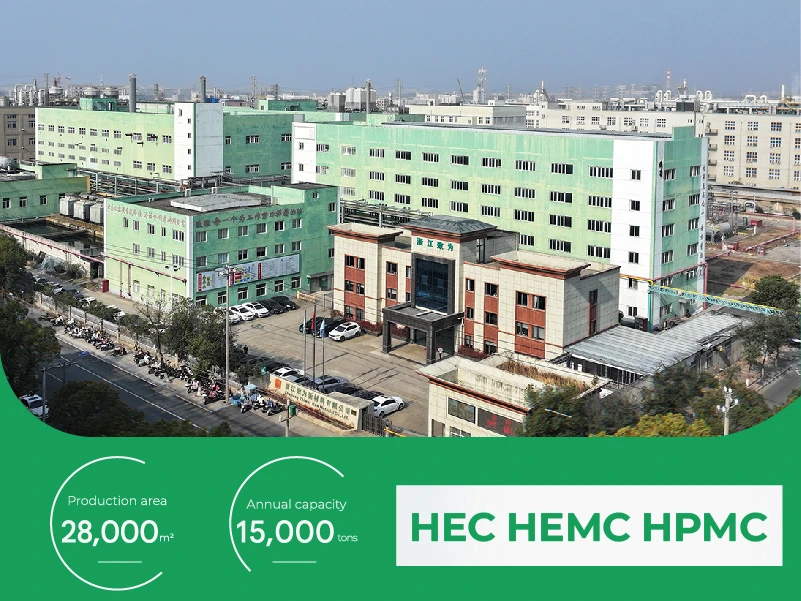
There are dozens of HEMC manufacturers in China. Here is what separates Zhiwei from the pack.
Focus on cellulose ethers. Zhiwei specializes in HEC, HEMC, and HPMC — not a broad catalog of unrelated chemicals. That focus means deeper product knowledge, tighter process control, and faster answers to application-specific questions.
Real factory, not a relabeler. The Zhejiang plant produces 15,000 tons of cellulose ethers per year under one roof. Orders come from their own line, with their own quality control and batch records. If something goes wrong, you talk to the people who made it — not a middleman calling someone else.
Xinjiang cotton advantage. Refined cotton from Xinjiang gives Zhiwei’s products higher whiteness, lower impurity levels, and better batch consistency than producers using lower-grade feedstock. In coatings and detergents where color and clarity matter, this shows up in the final product.
R&D that has been independently recognized. Multiple production patents and provincial-level scientific awards are not window dressing. They reflect real investment in process improvement and validation by outside experts.
Export track record. Zhiwei has shipped to global markets since 2017. The Jinan office handles English-language communication, export documentation, and logistics coordination. Customers get standard trade terms and reliable container loading.
Flexible order volumes. A trial pallet or a full container — the production scale handles both. The team works with new customers on smaller initial orders to get the relationship started.
How to Request a Sample or Get a Quote
1. Define your needs. Know your target viscosity range, estimated monthly volume, destination country, and packaging preference. The more detail you provide upfront, the faster you get a precise answer.
2. Request a sample. Email or submit an inquiry through the Zhiwei website. Sample preparation typically takes 2–3 working days. Shipping time depends on your location. Samples are free; freight is collect.
3. Test and confirm. Run the sample against your current material. If the results need adjustment, Zhiwei’s technical team can recommend alternative grades or dosages.
4. Place your order. Once you confirm the grade, request a formal quote covering pricing, lead time, and shipping terms. Zhiwei supports standard international payment methods and trade terms (FOB, CIF, etc.).
Contact:
- Email: Available on zhiweichem.com
- Website: zhiweichem.com
- WhatsApp: +86 183 6616 3707
FAQ
Is HEMC the same as MHEC?
Yes — they are the same compound. “HEMC” stands for hydroxyethyl methyl cellulose and “MHEC” stands for methyl hydroxyethyl cellulose. The names just reverse the substituent order. Some regions and industries prefer one name, but the product is identical. For a broader look at cellulose ether types, see our HPMC vs HEMC comparison guide.
What viscosity grades of HEMC does Zhiwei offer?
Zhiwei covers a wide range — roughly 400 to 200,000 mPa·s (2% aqueous solution, 20°C). That spans applications from self-leveling compounds to drilling fluids. See the product portfolio section above for the grade matrix, or contact Zhiwei directly for a detailed spec sheet.
Is Zhiwei HEMC REACH registered?
Contact Zhiwei for the current registration status in your market. Compliance can vary by grade and target region. The team can provide documentation and certification details on request.
What is the minimum order quantity for HEMC?
Standard MOQ is 1 metric ton. For trial or first-time orders, Zhiwei may accommodate smaller quantities — reach out to discuss.
How does HEMC compare to HPMC for construction mortars?
Both work in construction, but with differences. HEMC generally holds water better at elevated temperatures and has a higher gel point, which suits hot-climate applications. HPMC can offer slightly longer open time in some mixes. The right choice depends on your formulation and conditions. See our full comparison article for details.
Conclusion
Choosing an HEMC manufacturer comes down to more than price on a spreadsheet. You need a partner with consistent quality, technical support, and reliable delivery — batch after batch.
Zhiwei (Jinan) New Materials Co., Ltd. brings focused cellulose ether expertise, 15,000 tons of annual capacity, and years of global export experience. For construction, coatings, detergent, or oilfield applications, Zhiwei is worth a close look.
Request a sample. Test it against what you are using now. The product will make the case.