
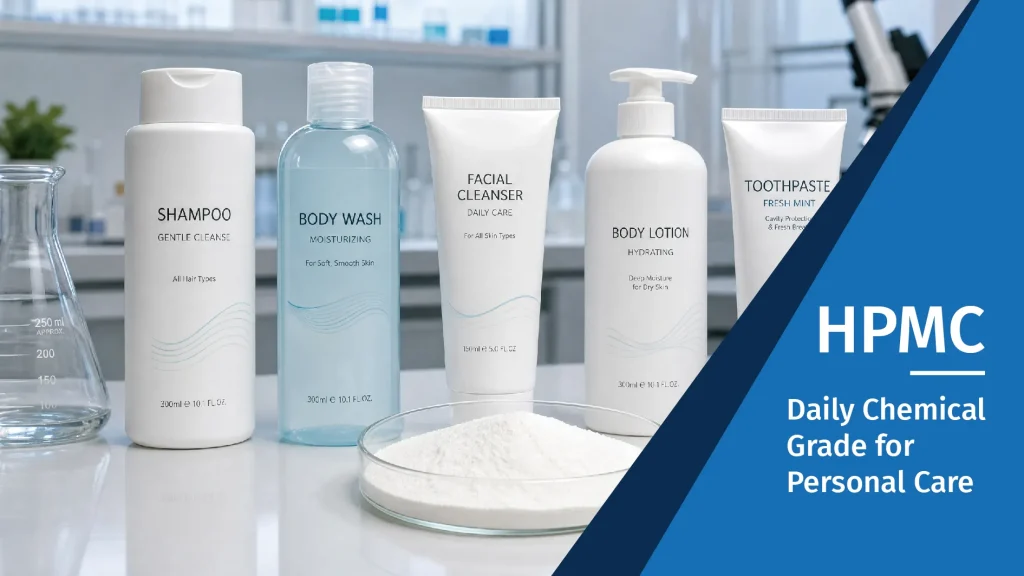
What Is Daily Chemical Grade HPMC?
Daily chemical grade HPMC is a non-ionic, water-soluble cellulose ether designed for personal care and household product formulations. It can work as a thickener, rheology modifier, stabilizer, suspending aid, protective colloid, and film-forming polymer.
Manufacturers use HPMC in shampoo, body wash, liquid hand soap, facial cleanser, creams, lotions, facial masks, scrubs, toothpaste, and other water-based products.
Daily chemical grade HPMC must provide more than viscosity. The material should have controlled color, odor, purity, particle size, solution clarity, hydration behavior, and batch consistency. The supplier should also provide a specification that matches the intended personal care or home care application.
The best HPMC grade depends on the target viscosity, surfactant system, electrolyte level, pH, processing method, product clarity, and desired sensory feel.
What Does “Daily Chemical Grade” Mean?
“Daily chemical grade” is a term commonly used in the Chinese chemical industry. International buyers may use terms such as personal care grade, home care grade, detergent grade, or cosmetic grade HPMC.
These terms describe the intended application, but the words alone do not prove regulatory suitability. The buyer must review the specification, manufacturing controls, supporting documents, and local compliance requirements.
Daily chemical grade HPMC normally needs tighter control over the following properties than general industrial material:
- Color and appearance
- Odor
- Visible impurities
- Solution transparency
- Particle size
- Viscosity consistency
- Hydration speed
- Heavy metals
- Microbial limits
- Residual processing materials
- Sensory feel
- Compatibility with surfactants and preservatives
A construction-grade HPMC should not automatically be used in shampoo, skin care, toothpaste, or another consumer product. The product name may be similar, but the purity controls, production process, documentation, and quality limits can be different.
What Is HPMC Made From?
Hydroxypropyl methylcellulose is produced by chemically modifying purified cellulose. The cellulose normally comes from plant-based raw materials such as refined cotton or wood pulp.
The production process introduces two main substituent groups:
- Methoxy groups
- Hydroxypropoxy groups
These groups change the natural cellulose structure and make the finished polymer soluble or dispersible in water.
The methoxy and hydroxypropoxy contents influence:
- Water solubility
- Hydration rate
- Thermal gelation
- Viscosity
- Surface behavior
- Electrolyte response
- Compatibility with other ingredients
Daily chemical grade HPMC is normally a white to off-white powder. A suitable personal care grade should have little or no noticeable odor and should not contain visible foreign material.
Typical Technical Specifications
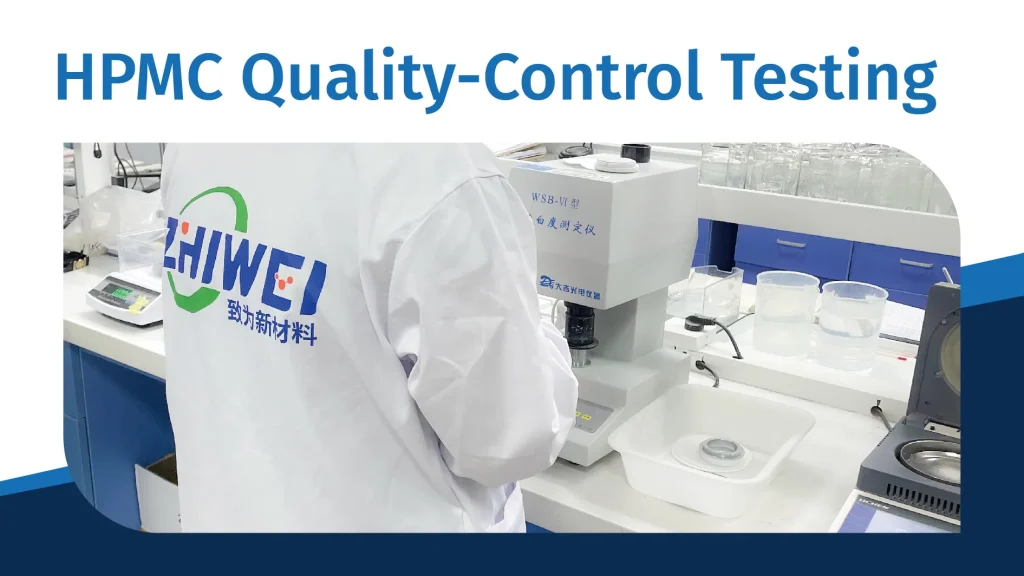
The following values provide a practical reference for medium-viscosity daily chemical grade HPMC. A supplier’s confirmed specification and test methods must take priority.
| Test Item | Unit | Typical Reference Range | Common Test Method |
|---|---|---|---|
| Appearance | — | White to off-white powder | Visual inspection |
| Viscosity at 2%, 20°C | mPa·s | 4,000–20,000 | Rotational viscometer |
| Methoxy content | % | 19.0–24.0 | Instrumental chemical analysis |
| Hydroxypropoxy content | % | 4.0–12.0 | Instrumental chemical analysis |
| Loss on drying | % | ≤5.0 | Drying to constant weight |
| Residue on ignition | % | ≤1.5 | High-temperature ignition |
| Transmittance of 1% solution | % | ≥95 | Spectrophotometer |
| Gel temperature | °C | 60–75 | Controlled water-bath method |
| Fine-particle passing rate | — | Supplier-specific | Sieve analysis |
| Heavy metals | ppm | Application-specific limit | Validated instrumental method |
| pH of aqueous solution | — | Supplier-specific | Calibrated pH meter |
| Microbial limits | CFU/g | Application-specific limit | Microbial testing |
These values should not be compared without checking the test method. A viscosity result depends on polymer concentration, water quality, temperature, spindle, rotational speed, hydration time, and instrument type.
A value measured with a Brookfield viscometer may not match a value measured with an NDJ or another rotational instrument. Buyers should compare products under the same conditions.
Daily Chemical Grade HPMC Versus Industrial Grade HPMC
| Property | Daily Chemical Grade | General Industrial Grade |
|---|---|---|
| Appearance | White or controlled off-white powder | Wider color variation may be accepted |
| Visible impurities | Strict control | Limits may be less strict |
| Odor | Low or neutral odor expected | Application-dependent |
| Particle size | Often finer or specially treated | Selected for industrial processing |
| Solution clarity | Important for clear and translucent products | May not be a major requirement |
| Viscosity tolerance | Controlled for repeatable texture | Controlled for industrial application targets |
| Heavy metals | Buyer and market-specific limits | Different limits may apply |
| Microbial limits | Important for consumer formulations | May not be routinely specified |
| Sensory feel | Smoothness and tack require evaluation | Normally not a selection priority |
| Documentation | Personal care or home care support required | Industrial TDS and SDS may be sufficient |
The final product manufacturer remains responsible for checking the raw material and finished formulation against the laws of the target market.
The European Commission also explains that the appearance of an ingredient name in CosIng does not by itself mean that every grade is approved for every cosmetic use. A finished cosmetic product still requires a suitable safety assessment and compliance review. European Commission Cosmetic Ingredient Database
Why Is Viscosity Important?
Viscosity is the first property that many buyers examine, but the highest viscosity does not always create the best product.
A light facial cleanser needs a different flow profile from toothpaste. A pump shampoo needs enough body to look rich, but it must still move through the pump. A facial mask may need stronger structure to keep particles suspended.
Medium-viscosity HPMC grades in the 4,000–20,000 mPa·s range often provide a practical starting point for liquid personal care products.
Higher-viscosity grades in the 20,000–40,000 mPa·s range can be considered for:
- Toothpaste
- Facial masks
- Dense gels
- Scrubs
- High-body creams
- Products with suspended particles
The apparent viscosity of the finished product does not depend only on the HPMC grade. It also depends on the HPMC dosage, surfactants, salts, oils, humectants, pH, temperature, and other polymers.
How Does HPMC Change Product Rheology?
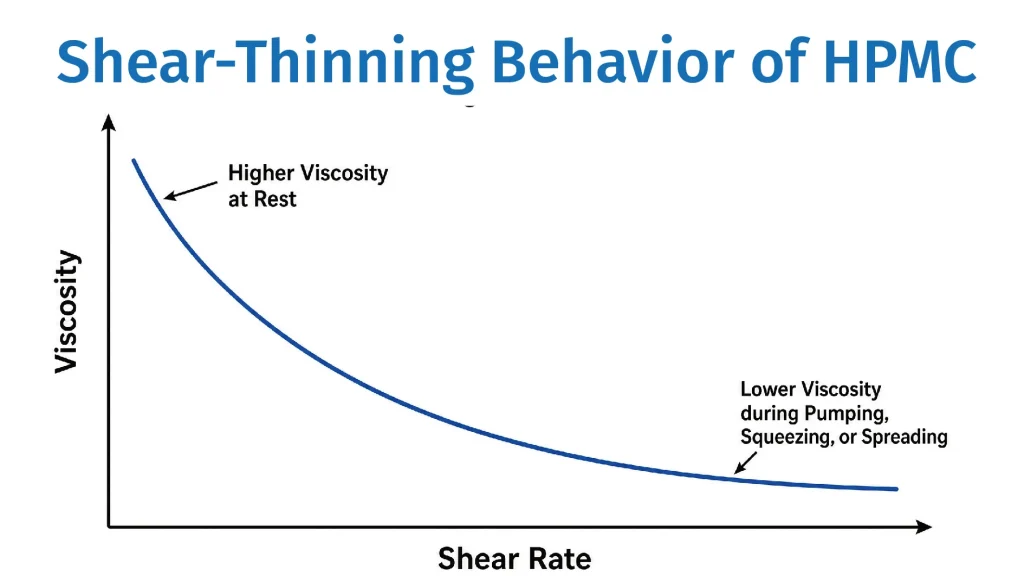
HPMC solutions normally show non-Newtonian and shear-thinning behavior.
The product maintains more structure while it remains at rest. The viscosity then decreases when the product experiences pumping, squeezing, shaking, or spreading.
This behavior provides several practical advantages:
- Shampoo remains stable in the bottle.
- Body wash can move through a pump.
- Cream spreads more easily on the skin.
- Toothpaste can leave the tube without becoming runny.
- Suspended particles settle more slowly.
- The product can recover part of its structure after use.
The recovery speed and final texture depend on the complete formulation. The formulator should measure the flow curve and thixotropic recovery when these properties are important.
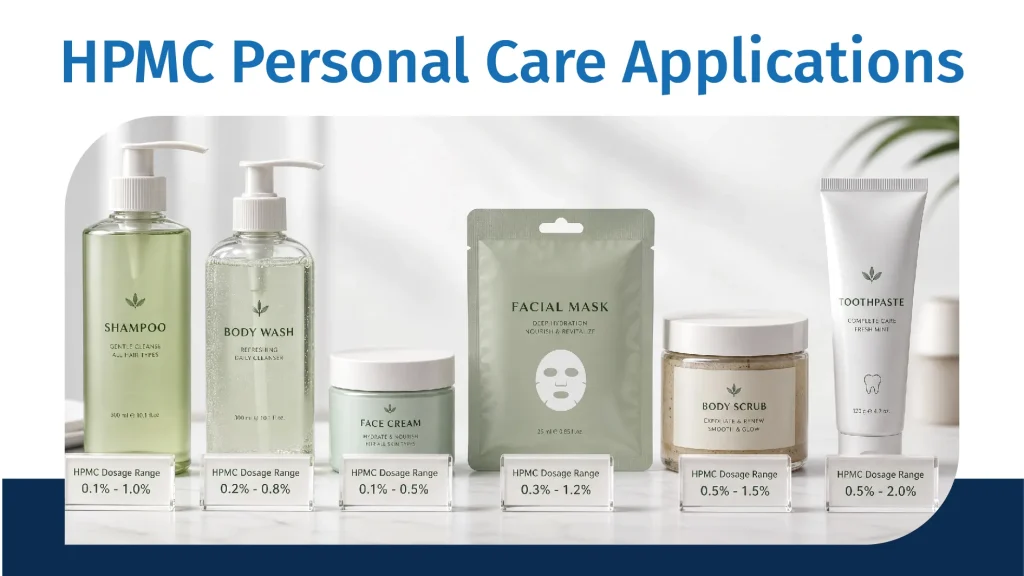
HPMC in Shampoo
HPMC can increase viscosity and support a smooth, shear-thinning texture in shampoo.
A typical laboratory screening range is approximately 0.3%–0.5%. This range can be adjusted after measuring the finished product.
A medium-viscosity HPMC can help provide:
- Better product body
- Smoother dispensing
- More consistent flow
- Reduced watery appearance
- Support for foam texture
- Improved stability in some surfactant systems
A 0.3%–0.5% dosage may increase shampoo viscosity by several thousand mPa·s in a compatible system. However, the exact increase cannot be predicted without a formula test.
SLES, SLS, betaine, glucosides, salt, fragrance, oils, and conditioning polymers can all change the result. The formulator should not evaluate HPMC only in pure water.
HPMC in Body Wash and Shower Gel
A typical HPMC screening range for body wash is approximately 0.2%–0.4%.
HPMC can increase the liquid-phase viscosity around foam bubbles. This effect may help the foam remain stable for longer in some formulations.
The polymer can also improve:
- Product body
- Pumping behavior
- Spreading
- Rinsing feel
- Texture consistency
- Stability during storage
HPMC does not guarantee a fixed increase in foam life. Surfactant type, active surfactant matter, oil, fragrance, salt, water hardness, and mixing air have a strong influence.
The formulator should measure foam volume, foam decay, density, and rinsing feel in the final system.
HPMC in Creams and Lotions
HPMC can work as a water-phase rheology modifier and suspension aid in creams and lotions.
A typical screening range is approximately 0.4%–0.6%.
The hydrated polymer can help slow the movement of:
- Mineral sunscreen particles
- Pigments
- Scrub particles
- Powders
- Capsules
- Other dispersed solids
HPMC may also support emulsion stability by increasing continuous-phase viscosity and forming a protective colloid around dispersed materials.
However, HPMC does not replace a complete emulsifier system. The formulation still needs a suitable oil-phase structure, emulsifier package, homogenization process, preservative, and stability program.
The laboratory should check particle settling, creaming, separation, and viscosity after storage at several temperatures.
HPMC in Toothpaste
Toothpaste needs body, extrusion control, shape retention, and adhesion to the toothbrush.
A common HPMC screening range is approximately 0.5%–1.0%.
A suitable grade can help the toothpaste:
- Remain stable in the tube
- Extrude with controlled pressure
- Hold its shape on the brush
- Spread during brushing
- Keep abrasive particles suspended
- Recover structure after shear
Toothpaste contains high levels of abrasives, humectants, salts, surfactants, flavors, and active ingredients. These materials can change HPMC hydration and viscosity.
The manufacturer should use oral care grade raw materials and confirm all applicable purity and safety requirements. A general daily chemical grade should not automatically be used for oral care.
HPMC in Facial Masks, Serums, and Scrubs
Facial masks and particle-containing products often need stronger suspension than a conventional shampoo.
A grade in the 20,000–40,000 mPa·s viscosity direction may provide a useful starting point. Products with inorganic particles may also benefit from a grade with a suitable hydroxypropoxy substitution level.
The formulator should evaluate:
- Particle suspension
- Drip control
- Spreadability
- Tack
- Dry-down feel
- Film formation
- Pilling
- Rinse behavior
- Packaging compatibility
A very high-viscosity HPMC may create a sticky or stringy texture. The best result may come from combining a lower HPMC dosage with another rheology modifier.
Recommended Starting Points
| Product Type | HPMC Viscosity Direction | Typical Screening Dosage | Main Evaluation |
|---|---|---|---|
| Light facial cleanser | Low to medium | 0.2%–0.4% | Clarity, flow, foam |
| Shampoo | 7,500–15,000 mPa·s | 0.3%–0.5% | Viscosity, combing feel, foam |
| Body wash | 7,500–15,000 mPa·s | 0.2%–0.4% | Pumping, foam, rinse |
| Cream or lotion | Medium to high | 0.4%–0.6% | Emulsion stability, sensory feel |
| Facial mask | 20,000–40,000 mPa·s | Formula-dependent | Suspension, spreading, tack |
| Scrub or particle cleanser | Medium to high | Formula-dependent | Particle settling, rinse |
| Toothpaste | 20,000–40,000 mPa·s | 0.5%–1.0% | Extrusion, shape recovery |
| Household gel cleaner | Medium to high | Formula-dependent | Surface cling, pour, stability |
These ranges are laboratory starting points. The final dosage must be optimized in the complete formula.
How to Dissolve HPMC Without Lumps

HPMC can form fisheyes when dry powder contacts water too quickly. The outside of each powder cluster hydrates first and forms a gel barrier. Dry powder then remains trapped inside.
The correct process depends on whether the HPMC is a regular grade, delayed-solubility grade, or specially treated instant grade.
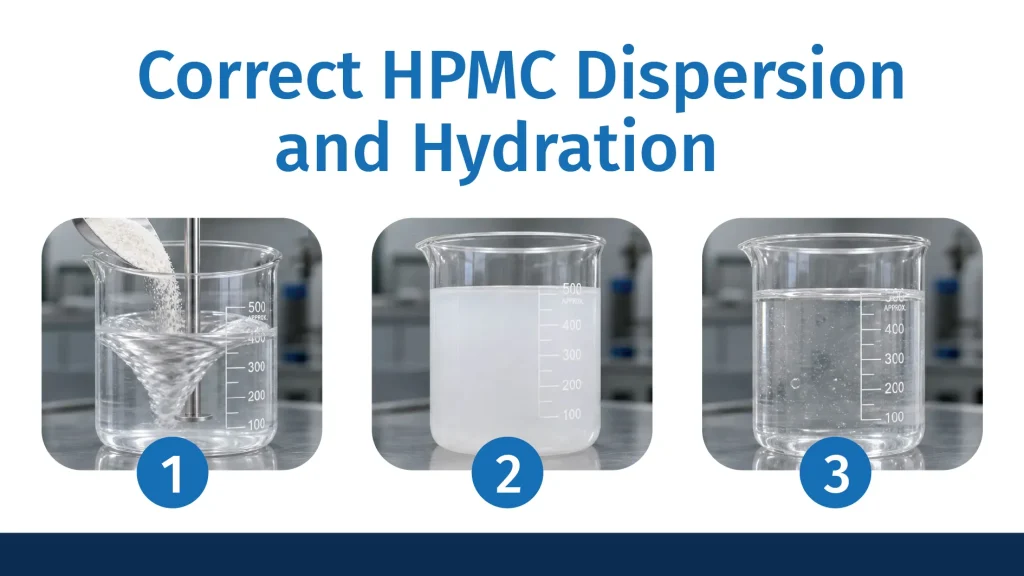
Method 1: Direct Cold-Water Dispersion
This method is suitable for an HPMC grade designed for cold-water dispersion.
- Add deionized or softened water to the mixing vessel.
- Start moderate agitation and create a stable circulation pattern.
- Add HPMC slowly across the moving water surface.
- Do not dump the complete quantity into one location.
- Allow the particles to wet uniformly.
- Increase the mixing speed when the powder is fully dispersed.
- Continue mixing until hydration is complete.
- Allow the solution to rest before measuring the final viscosity.
An industrial high-shear process may use approximately 800–1,200 rpm, but the correct speed depends on tank size, impeller type, batch volume, and air entrainment.
A high-viscosity product may need 60–90 minutes to reach full and stable hydration. Some instant grades hydrate much faster.
Method 2: Dry Premixing
A laboratory can premix HPMC with a compatible dry powder before water addition.
Possible carriers include:
- Sugar
- Selected salts
- Other water-soluble powders
- A large quantity of another dry formulation ingredient
The carrier separates the HPMC particles and reduces direct particle-to-particle contact.
The formulator should not assume that every salt is suitable. A high electrolyte concentration can reduce viscosity or change hydration.
Method 3: Slurry or Hot-Cold Method
The formulator can first disperse HPMC in a suitable non-solvent or in hot water under controlled conditions. Cold water can then be added to complete hydration.
HPMC shows reversible thermal gelation. As a solution approaches its gel temperature, it can become cloudy and form a thermal gel. Cooling normally restores the hydrated solution.
The formulator should not describe this change as a simple loss of thickening. Heating can change flow, clarity, mixing behavior, and air release. Every hot process requires validation in the complete formula.
Why Water Quality Matters
Hard water can slow hydration, reduce clarity, and affect viscosity.
Deionized or softened water provides a more controlled starting point. A calcium and magnesium level below approximately 50 ppm can be used as a practical development target when high clarity is important.
The water should also meet the microbiological requirements of the finished product process.
When a solution remains cloudy, the formulator should check:
- Water hardness
- HPMC purity
- Hydration time
- Mixing speed
- Electrolyte level
- Solution temperature
- Incomplete powder wetting
- Air bubbles
- Insoluble formulation ingredients
Centrifugation can help distinguish suspended particles from true solution haze. However, the laboratory should use additional analytical tests before deciding that one cause is responsible.
HPMC Compatibility
HPMC is non-ionic and can work in many anionic and non-ionic systems. However, broad compatibility does not mean universal compatibility.
Surfactants
HPMC can work with SLS, SLES, betaine, and other common surfactants. The final viscosity depends on the surfactant ratio and active matter.
The laboratory should hydrate HPMC before adding a large amount of surfactant unless the selected grade supports another process.
Electrolytes
High salt levels can reduce HPMC viscosity or change the texture. A sodium chloride concentration above approximately 5% deserves careful testing.
The formulator should add salt after HPMC hydration when the process allows it. Salt should then be increased in small steps.
Cationic Ingredients
Some cationic conditioning agents may change clarity or produce instability in a complex formulation. The laboratory should check HPMC with polyquaterniums, quaternary ammonium compounds, and cationic surfactants before scale-up.
Oxidizing Agents
Strong oxidizing agents can break polymer chains and reduce viscosity. Products containing bleach or strong oxidizers need a dedicated compatibility study.
pH
Many HPMC grades remain useful across a broad pH range, often around pH 3–11. The formulation team should still measure viscosity and clarity at the final pH.
Temperature
HPMC solution viscosity normally falls as the measurement temperature rises. A change of 10°C may cause a noticeable viscosity difference.
Production and quality-control tests should therefore use a fixed temperature, such as 20°C or 25°C.
How to Prevent Microbial Contamination
Dry HPMC has low water activity, but an HPMC solution can support microbial growth after preparation.
The manufacturer should:
- Use microbiologically controlled water.
- Clean and sanitize the mixing system.
- Use the prepared solution promptly.
- Avoid storing unpreserved stock solution.
- Select a preservative for the complete formulation.
- Run preservative efficacy or challenge testing.
- Protect open tanks from contamination.
- Monitor total microbial count and specified organisms.
A stock solution should not automatically be stored for 72 hours. The acceptable storage time must be established through sanitation controls, preservative design, and microbial testing.
The preservative system must match the product type, pH, packaging, target market, and complete ingredient list.
How to Improve the Sensory Feel
High-viscosity HPMC can produce tack, drag, stringiness, or a heavy after-feel in some products.
The formulator can improve the sensory profile by:
- Reducing the HPMC dosage
- Selecting a lower-viscosity grade
- Combining HPMC with carbomer
- Combining HPMC with xanthan gum
- Using an acrylate rheology modifier
- Adjusting humectant levels
- Optimizing oils and emollients
- Reducing polymer overlap
- Allowing full hydration before sensory testing
A polymer blend can produce stronger suspension or cleaner flow than one thickener alone. However, the blend may also create incompatibility, excessive yield stress, pilling, or poor rinse behavior.
The laboratory must confirm the result through stability and sensory tests.
Common Problems and Solutions
| Problem | Likely Cause | Practical Correction |
|---|---|---|
| White lumps or fisheyes | Powder added too quickly | Add slowly, increase dispersion, or use dry premixing |
| Cloudy solution | Hard water, incomplete hydration, impurities, or air | Use treated water, extend hydration, and deaerate |
| Low viscosity | Wrong grade, incomplete hydration, high temperature, or high salt | Check the test method and formulation conditions |
| Batch-to-batch viscosity changes | Temperature or substitution variation | Fix test conditions and tighten supplier specifications |
| Stringy texture | HPMC viscosity or dosage is too high | Use a lower grade or reduce the dosage |
| Sticky skin feel | Excess polymer or unsuitable blend | Reduce HPMC and optimize the rheology system |
| Particle settling | Low yield stress or insufficient structure | Increase structure carefully or add a compatible co-thickener |
| Poor foam | Formula interaction or excessive air control | Rebalance surfactants and polymer dosage |
| Flocculation | Ingredient incompatibility | Change addition order or select another grade |
| Microbial growth | Poor sanitation or preservation | Improve water, cleaning, preservation, and challenge testing |
Which Zhiwei HPMC Grade Should Be Tested?
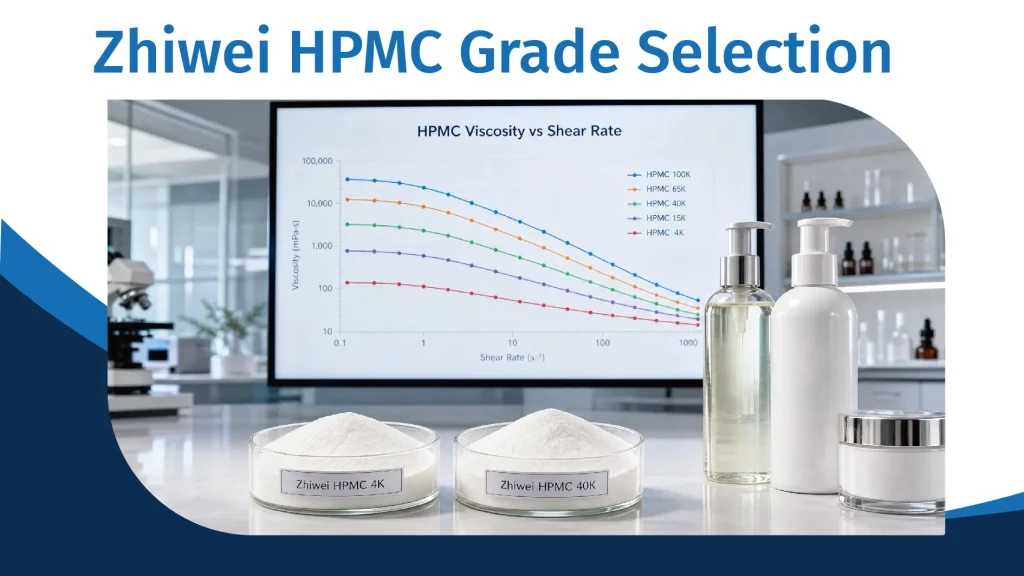
Zhiwei describes HPMC as a non-ionic, water-soluble cellulose ether for daily chemical and construction systems. The company lists shampoo, body wash, liquid hand soap, lotion, emulsion, and skin care gel among its HPMC use cases. Zhiwei HPMC Product Overview
The current Zhiwei catalog includes HPMC 400, HPMC 4K, HPMC 40K, HPMC 100K, HPMC 150K, and HPMC 200K. The model number indicates a viscosity direction. It does not automatically confirm that every version is suitable for personal care.
| Development Requirement | Zhiwei Model Direction | Required Verification |
|---|---|---|
| Light thickening or co-thickening | HPMC 4K | Request daily chemical purity, clarity, odor, heavy-metal, and microbial specifications |
| Shampoo or body wash with moderate body | HPMC 4K plus dosage optimization, or a custom intermediate grade | Test the complete surfactant and salt system |
| Facial mask or dense gel | HPMC 40K | Check tack, stringiness, clarity, and suspension |
| Toothpaste development | HPMC 40K viscosity direction | Use only a version supported for oral care |
| Very high body | Higher-viscosity HPMC | Confirm pumping, hydration, sensory feel, and stability |
Zhiwei HPMC 4K has a listed NDJ viscosity of 3,200–4,600 mPa·s for a 2% solution at 20°C. This model provides a useful low-to-medium viscosity reference.
Zhiwei HPMC 40K has a listed NDJ viscosity of 30,000–50,000 mPa·s under the stated test conditions. This viscosity direction is more suitable for higher-body screening.
The public model pages currently describe construction applications. Personal care customers should therefore request a dedicated daily chemical specification before testing. Zhiwei should confirm:
- Intended application grade
- Viscosity method and range
- Methoxy and hydroxypropoxy content
- Solution clarity
- Particle size
- Loss on drying
- Residue or ash
- Heavy-metal limits
- Microbial limits
- Odor and color
- Surface treatment
- Residual processing materials
- TDS, SDS, and batch COA
- Regulatory and traceability documents
This verification protects both product quality and brand credibility.
Quality-Control Tests for a Finished Formula
A formulation should not be approved after one room-temperature viscosity test.
A useful evaluation program includes:
- Initial appearance and odor
- pH
- Viscosity at a fixed temperature
- Flow curve
- Thixotropic recovery
- Solution or product clarity
- Centrifuge stability
- High-temperature storage
- Low-temperature storage
- Freeze-thaw cycling
- Packaging compatibility
- Foam testing for cleansers
- Particle suspension
- Preservative efficacy testing
- Consumer sensory evaluation
- Viscosity after one, seven, and 28 days
The laboratory should also monitor the product after scale-up. Industrial mixing can introduce more air and shear than a small laboratory mixer.
Frequently Asked Questions
What is daily chemical grade HPMC used for?
Manufacturers use it to control viscosity, flow, suspension, stability, and sensory properties in shampoo, body wash, creams, masks, cleansers, toothpaste, and home care products.
Is HPMC suitable for clear shampoo?
A high-purity, high-transmittance grade can support clear or translucent formulations. The result depends on surfactants, fragrance, salt, pH, water quality, and complete hydration.
How much HPMC should be used in shampoo?
A practical starting range is 0.3%–0.5%. The final dosage must be determined in the complete formula.
Why does HPMC form lumps?
The outer surface of a powder cluster hydrates first and traps dry powder inside. Controlled addition, strong circulation, dry premixing, or a dispersible grade can reduce this problem.
Does HPMC work with SLES?
HPMC can work in many SLES systems. The formulator must test the surfactant ratio, salt level, pH, fragrance, and addition order.
Can HPMC improve foam?
HPMC may support foam texture or foam stability in some formulations. It does not guarantee a fixed foam increase in every surfactant system.
Is HPMC compatible with salt?
Moderate salt levels may be acceptable, but high electrolyte levels can reduce viscosity or change hydration. Salt should be added gradually after HPMC hydration when possible.
Which Zhiwei HPMC model is suitable for personal care?
Zhiwei HPMC 4K provides a low-to-medium viscosity direction, while HPMC 40K provides a higher-viscosity direction. The buyer must request a daily chemical specification rather than automatically using a standard construction version.
Is cosmetic grade HPMC the same as construction grade HPMC?
No. The chemistry may share the same name, but purity, clarity, odor, microbial control, residual materials, documentation, and quality limits can differ.
Conclusion
Daily chemical grade HPMC gives formulators a flexible way to control viscosity, flow, suspension, and product stability.
The best grade must match the finished product. Shampoo and body wash often need medium viscosity and clean flow. Creams and masks may need stronger suspension. Toothpaste needs body, extrusion control, and structural recovery.
The formulator must also control the hydration process. HPMC should be dispersed evenly, allowed to hydrate fully, and tested in the final surfactant, electrolyte, pH, and preservative system.
Zhiwei (Jinan) New Materials Co., Ltd. offers several HPMC viscosity directions. Zhiwei HPMC 4K can serve as a low-to-medium viscosity reference, while HPMC 40K can support higher-body formulation screening. Personal care customers should request versions with suitable purity, transmittance, microbial, heavy-metal, odor, and traceability controls.
Customers can provide their product type, surfactant system, target viscosity, pH, salt level, clarity target, processing method, and market requirements. The Zhiwei technical team can then recommend an appropriate daily chemical HPMC screening plan.