
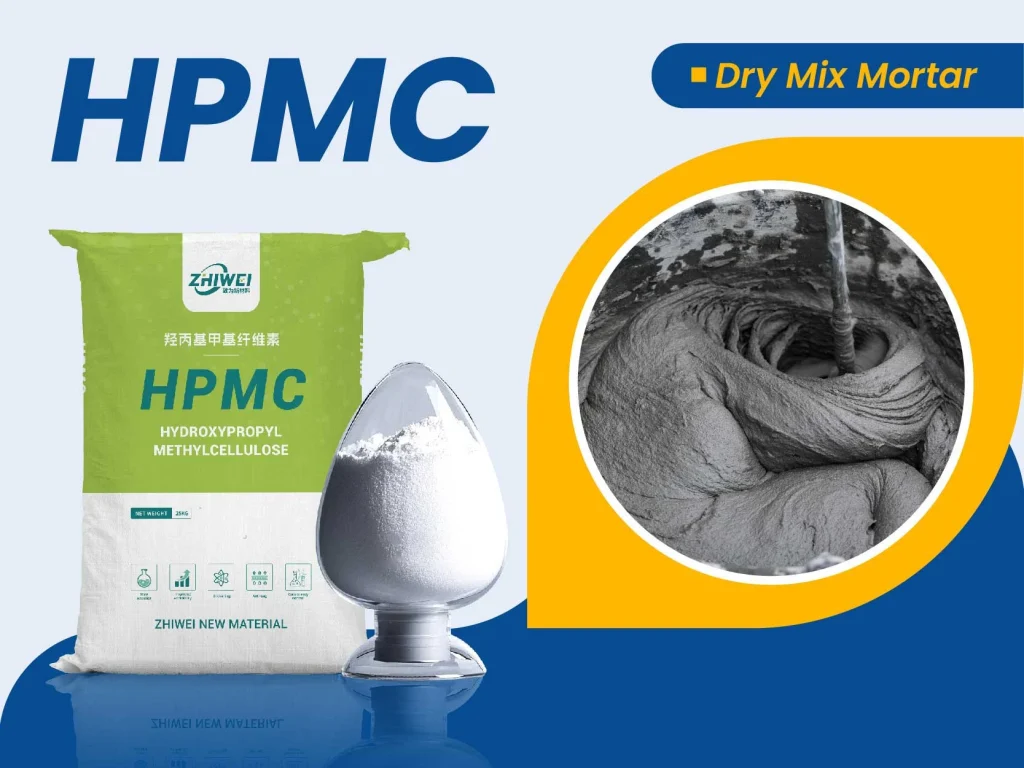
What to Look for in an HPMC Manufacturer
This article is not a chemistry lesson. If you are a distributor or importer sourcing hydroxypropyl methyl cellulose (HPMC) from China, you need a framework for evaluating manufacturers, not a textbook definition.
The global HPMC market was valued at approximately USD 2.11 billion in 2024 and is projected to reach USD 2.99 billion by 2034, growing at a CAGR of 3.57%. Construction applications account for the largest share of that demand. That growth means more buyers are entering the market, and more manufacturers are competing for their orders.
Not all HPMC suppliers are equal. When you evaluate an HPMC manufacturer, focus on five areas:
Does the factory have enough production capacity to deliver on time, every time? Stock-outs damage your credibility with customers.
Does the manufacturer provide consistent quality from batch to batch? Viscosity, moisture content, and fineness should not swing between shipments.
Does the supplier hold the certifications your target market requires? ISO 9001 is the baseline. REACH compliance matters for Europe. Your customers will ask for documentation.
Can the manufacturer help with formulation questions and viscosity selection? Technical support saves you time and builds trust downstream.
Can the factory accommodate custom viscosity grades, private labeling, or branded packaging? That flexibility matters when you are building your own brand in a competitive market.
We will walk through each of these areas in detail below.
Construction Grade HPMC: Specifications That Matter
When you receive a quotation from an HPMC manufacturer China, the spec sheet tells you more than the price does. Here are the parameters that actually affect performance in the field.
Viscosity
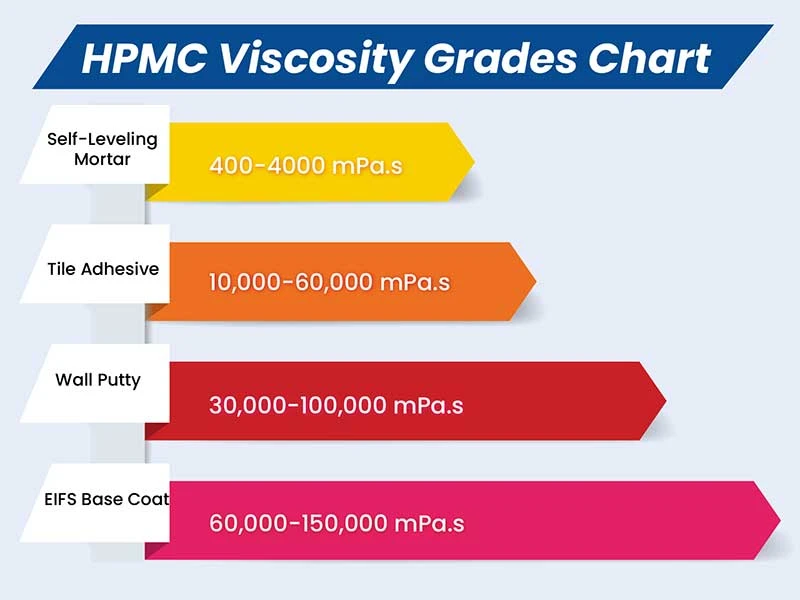
Viscosity, measured in mPa·s on a 2% aqueous solution at 20°C, is the specification that matters most. It controls water retention, workability, and how well the mix resists sagging. Here is a practical reference:
| Application | Recommended Viscosity Range |
|---|---|
| Self-leveling compounds | 400–15,000 mPa·s |
| Tile adhesives (C1/C2) | 30,000–75,000 mPa·s |
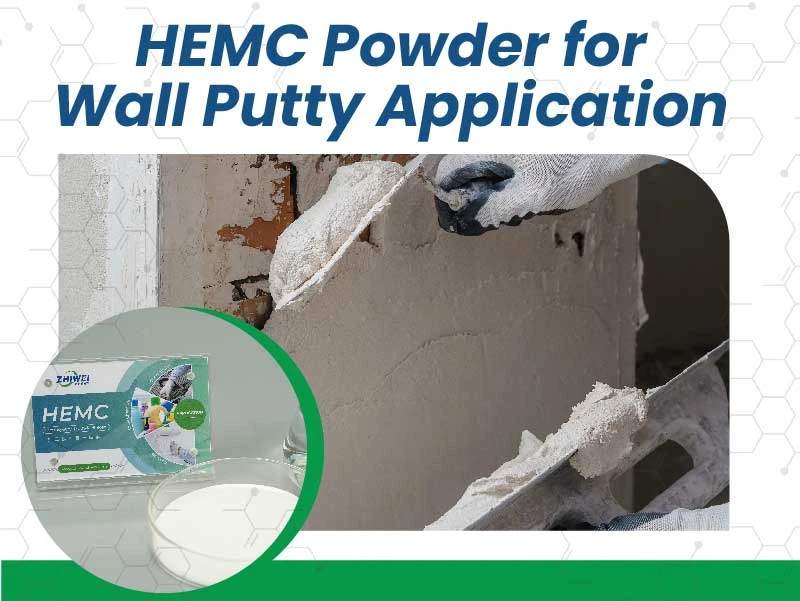
| Wall putty / skim coat | 75,000–100,000 mPa·s |
| EIFS base coat / adhesive mortar | 100,000–150,000 mPa·s |
Stock the viscosity grades that match your customers’ most common applications. For a general construction distributor, 40,000–60,000 and 75,000–100,000 mPa·s cover most demand.
Degree of Substitution (DS/MS)
DS (methyl group substitution) and MS (hydroxypropyl molar substitution) affect how HPMC dissolves, behaves under heat, and retains water. Most construction grade HPMC products have a DS of 1.5–2.0 and an MS of 0.1–0.3. Higher MS generally improves water retention but may reduce thermal gelation temperature. When a customer asks about performance in hot weather, this is the spec to check.
Water Retention
Water retention rate determines whether cement hydrates properly. HPMC with higher viscosity and appropriate DS/MS typically delivers better water retention. Ask the manufacturer for test data at their recommended dosage, not just a maximum claim.
Moisture Content and Ash
These two parameters get less attention but matter for formulation stability. High moisture content (above 5%) can cause clumping in storage. High ash content may indicate impurities from the manufacturing process. Both affect your customers’ batch consistency.
When you get a Certificate of Analysis (COA), check viscosity first, then moisture and ash. If those three are within spec, the batch is likely fine for construction use.
HPMC in Key Construction Applications
Understanding how your customers use HPMC helps you recommend the right grade and answer technical questions confidently.
Tile Adhesives
Tile adhesive is the largest single application for HPMC supplier for construction products. HPMC holds water in the adhesive mix, giving cement time to hydrate. The result is better bond strength. It also extends open time, so installers can adjust tiles after placement, and it improves anti-sag performance for heavy wall tiles.
C1 adhesives typically use medium-viscosity grades (30,000–60,000 mPa·s). C2 adhesives, which need higher bond strength and water retention, often use higher-viscosity grades (60,000–75,000 mPa·s).
Dry Mix Mortar
In dry mix mortar, HPMC keeps water in the mix long enough for cement to fully hydrate. Without adequate water retention, mortar ends up weak, dusty, or cracked. The typical HPMC dosage in cement mortar ranges from 0.1% to 0.4% of the total dry mix weight, depending on the application and the viscosity grade.
Consistency matters here. If one batch of HPMC retains 92% water and the next retains 85%, your customer’s mortar performance fluctuates. That is why batch-to-batch consistency is a primary concern when evaluating manufacturers.
Renders and Plaster
Renders and plasters need smooth application and minimal cracking. HPMC improves workability so the mix spreads easily and adheres to the wall. It also reduces shrinkage cracks by retaining moisture during early curing, when the render is most vulnerable.
For exterior renders in hot climates, some formulators prefer HEMC because of its higher thermal gelation temperature. We cover that comparison in a later section.
Self-Leveling and EIFS
Self-leveling compounds require low-viscosity HPMC grades (400–15,000 mPa·s). The mix must flow freely to create a flat surface, so too much viscosity defeats the purpose. But water retention is still needed for cement hydration.
EIFS (External Insulation and Finish Systems) base coats use higher-viscosity grades (100,000–150,000 mPa·s) for maximum water retention and anti-sag performance on vertical surfaces.
Certifications and Compliance: What Importers Need to Check
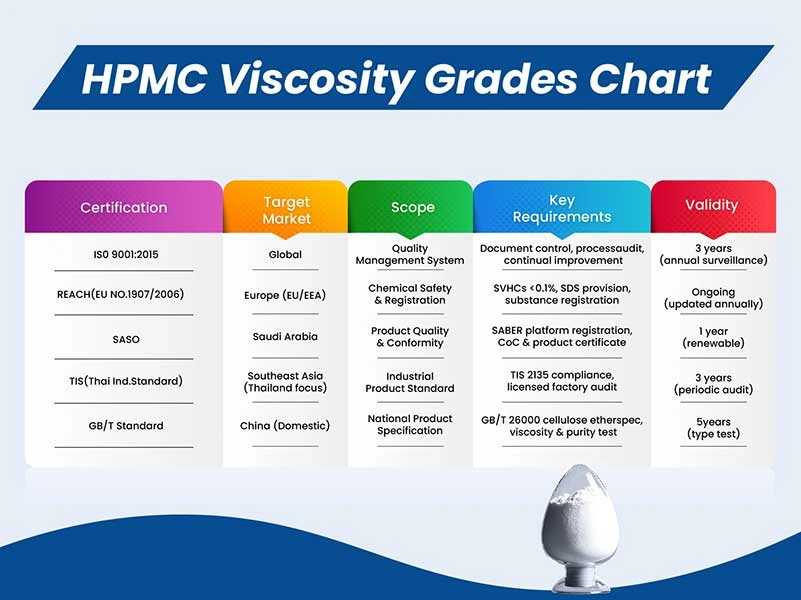
Certification requirements vary by target market. Importing HPMC without the right documentation can cause customs delays, rejected shipments, or lost customers. Here is what to look for.
ISO 9001
ISO 9001 is the baseline quality management certification. Most serious HPMC manufacturers hold it. If a supplier cannot provide an ISO 9001 certificate, that is a warning sign.
REACH Compliance for Europe
The European Union regulates chemicals under REACH (Registration, Evaluation, Authorisation, and Restriction of Chemicals). The International Cellulosics Association (ICA) has issued a statement confirming that cellulose ethers, including HPMC, have specific exemptions under REACH registration requirements. However, importers should still verify that their supplier has completed the necessary pre-registration or registration steps, and that the product documentation meets European import requirements.
Do not assume REACH exemption means zero paperwork. Your European customers will still ask for safety data sheets and compliance documentation.
Certificate of Analysis (COA)
A COA should accompany every shipment. At minimum, it must include viscosity, moisture content, ash content, and particle size distribution. Some manufacturers also include water retention test results. If your supplier does not provide a COA for each batch, find one that does.
Other Market Requirements
| Certification / Standard | Primary Market | Relevance |
|---|---|---|
| ISO 9001 | Global | Quality management baseline |
| REACH compliance | EU / EEA | Chemical registration and safety |
| SASO | Saudi Arabia | Product conformity for import |
| TIS | Thailand | Industrial standards compliance |
| GMP | Pharmaceutical | Required for pharma-grade HPMC only |
If you sell into the Middle East, check whether your manufacturer can provide SASO-compliant documentation. For Southeast Asia, TIS certification may be required depending on the country.
HPMC vs HEMC: When to Recommend Each
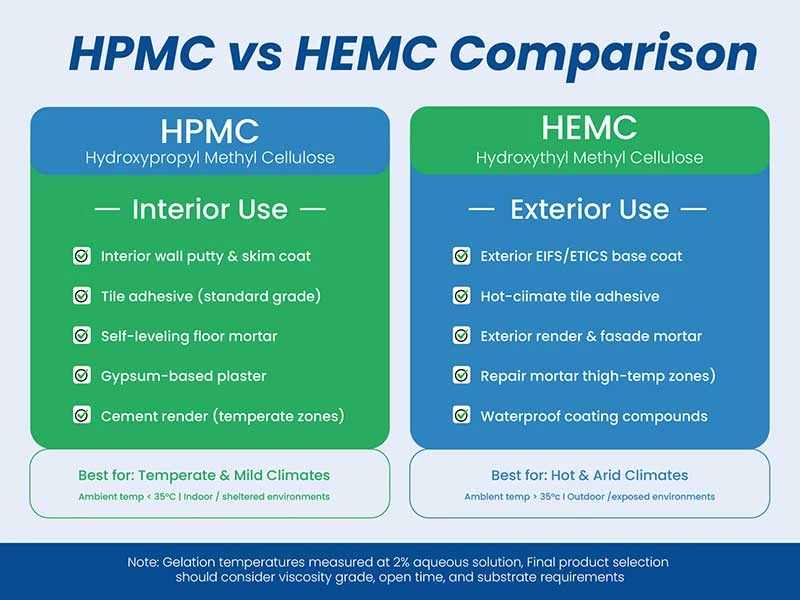
Your customers will ask whether they need HPMC or HEMC. The answer depends on the application and the climate. Here is a straightforward guide.
The Core Difference
The critical difference is thermal gelation temperature. HPMC begins to gel at approximately 55–75°C. When it gels, it releases water rapidly, which reduces water retention and shortens open time. HEMC has a higher gelation point, around 70–90°C, and holds water longer under heat.
Recommendation Logic
In temperate climates and interior applications, HPMC works well and typically costs less. For exterior applications in hot climates where wall temperatures exceed 40°C, HEMC is the safer choice.
| Condition | Recommended Product | Reason |
|---|---|---|
| Interior tile adhesive (air-conditioned) | HPMC | Cost-effective, adequate performance |
| Exterior tile adhesive (temperate climate) | HPMC | Sufficient thermal stability |
| Exterior tile adhesive (hot climate, 40°C+) | HEMC | Higher gelation temperature |
| Dry mix mortar (general) | HPMC | Widely available, proven track record |
| EIFS base coat (hot climate) | HEMC | Better water retention under heat |
| Renders in GCC / North Africa | HEMC | Maintains performance on hot walls |
Distributor Strategy
Many successful distributors stock both HPMC and HEMC. They recommend HPMC for standard conditions and upsell HEMC for hot-climate or exterior applications. This approach covers a wider customer base and positions you as a knowledgeable supplier, not just a commodity trader.
Evaluating a China-Based HPMC Manufacturer
China produces the majority of the world’s HPMC. But production volume does not guarantee production quality. Here is how to evaluate a specific cellulose ether manufacturer before committing.
Production Capacity and Lead Time
Ask for actual annual output, not just nameplate capacity. A factory that claims 20,000 tons but runs at 60% utilization may deliver more reliably than one claiming 50,000 tons with inconsistent output. Confirm minimum order quantities (MOQ) and standard lead times. If your supplier cannot commit to a delivery window, your customers will find one who can.
Quality Control
Does the manufacturer test every batch? Can they provide COAs for the last five shipments on request? Batch-to-batch consistency in viscosity and moisture content separates reliable suppliers from problem suppliers. Ask for third-party test results if you want independent verification.
Raw Material Source
HPMC starts with cellulose, usually from refined cotton or wood pulp. The raw material affects product purity and performance. Cotton-based HPMC generally has lower ash content and more consistent viscosity. Ask where the cellulose comes from and whether the source is consistent year-round.
OEM and Customization
Can the manufacturer adjust viscosity within a specified range? Can they print your brand on packaging? Do they offer custom bag sizes? These capabilities matter when you are building a private-label business or serving customers with specific formulation requirements.
Technical Support
Some manufacturers just sell powder. Others help you solve problems. Look for a supplier who can recommend viscosity grades for specific applications, troubleshoot formulation issues, and provide application data sheets. That support saves you from having to hire a technical consultant.
About Zhiwei
Zhiwei (Jinan) New Materials Co., Ltd. manufactures HPMC, HEMC, HEC, RDP, and PCE at its production facility in China. The company uses Xinjiang refined cotton as its raw material base and maintains an annual production capacity of 15,000 tons. Zhiwei holds multiple patents and provincial-level scientific achievement certifications. The company provides COAs for every batch and offers OEM and custom viscosity services for qualified buyers. For product inquiries, contact info@zhiweichem.com or call +86 183 6616 3707.
Frequently Asked Questions
How do I verify an HPMC manufacturer’s quality before placing a large order? Request COAs from recent batches, ask for third-party test results, and order a sample lot first. Test the sample in your own formulation or have an independent lab verify viscosity, moisture, and ash content. A manufacturer who refuses to provide documentation or samples is one to avoid.
What viscosity grade of HPMC should I stock for general construction use? For a general construction portfolio, 40,000–60,000 mPa·s covers tile adhesives and most mortars. Adding 75,000–100,000 mPa·s covers wall putty and skim coat. If your market includes self-leveling work, a low-viscosity grade (4,000–15,000 mPa·s) rounds out the lineup.
Can I get HPMC with custom viscosity or packaging from a Chinese manufacturer? Many Chinese HPMC manufacturers offer custom viscosity grades and private-label packaging. Minimum order quantities vary. Discuss your requirements before placing an order, and confirm that the manufacturer can deliver consistent results across custom batches.
What certifications should an HPMC manufacturer have for export to Europe? ISO 9001 is the baseline. REACH compliance documentation is required for EU import. Confirm that the manufacturer can provide safety data sheets and compliance statements. Cellulose ethers have specific exemptions under REACH registration, but importers should verify the supplier’s registration or pre-registration status.
Is HPMC the same as MHEC, and can I substitute one for the other? HPMC and MHEC (also called HEMC) are different cellulose ethers with different thermal properties. HPMC has a lower gelation temperature (55–75°C) while HEMC gels at 70–90°C. In some formulations you can substitute one for the other, but you must test. The substitution works best in temperate, interior applications. For hot-climate exterior work, HEMC is generally the better choice.
Conclusion
Choosing an HPMC manufacturer is a business decision, not just a purchasing transaction. The supplier you select directly affects your product quality and your standing with customers.
Focus on production capacity, batch consistency, certification compliance, and technical support. Verify claims with COAs and sample testing before committing to large orders. If you serve hot-climate markets, consider stocking HEMC alongside HPMC to cover the full range of customer needs.
Zhiwei (Jinan) New Materials Co., Ltd. produces construction-grade HPMC, HEMC, HEC, RDP, and PCE with an annual capacity of 15,000 tons. For technical data sheets, sample requests, or pricing, contact info@zhiweichem.com or call +86 183 6616 3707.
For product inquiries:Email: info@zhiweichem.comPhone: +86 183 6616 3707Zhiwei (Jinan) New Materials Co., Ltd.