
Why HEC Matters in Water-Based Paint
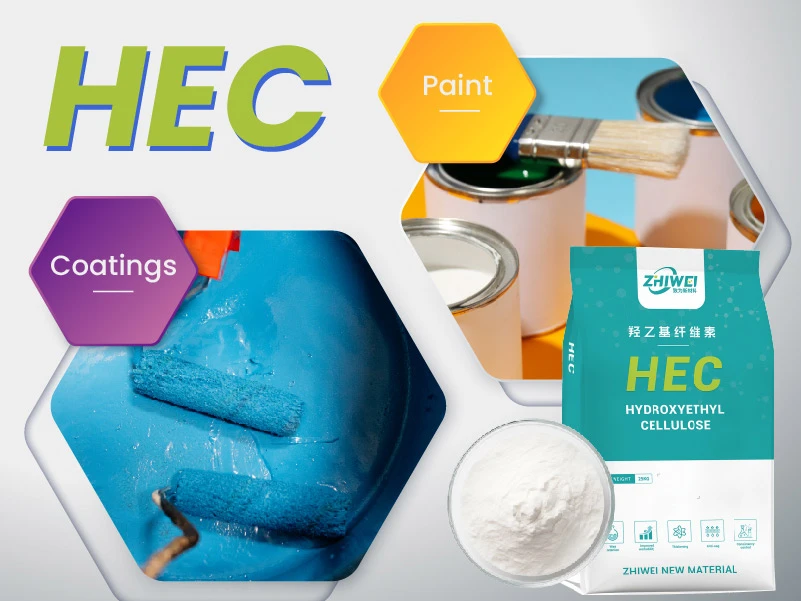
If you formulate or distribute water-based paints, you already use thickeners. The question is whether you are using the right one. Hydroxyethyl cellulose (HEC) remains the most widely used cellulose ether thickener in architectural coatings worldwide. It thickens, stabilizes, and adjusts rheology in latex paints, emulsion coatings, and water-based inks.
The global HEC market was valued at approximately USD 1.2 billion in 2024 and is projected to reach USD 1.8 billion by 2034, growing at a CAGR of 4.2%. Paint and coatings account for the largest single application segment. As water-based formulations continue to replace solvent-based systems worldwide, demand for reliable HEC thickeners keeps growing.
This guide covers what paint formulators and coatings distributors need to know about selecting, using, and sourcing HEC for water-based paint systems.
How HEC Works in Paint Formulations
Thickening and Viscosity Control
HEC thickens by dissolving in water and forming a hydrated polymer network. This network increases the viscosity of the continuous phase in a latex paint. The result is better in-can stability, less settling, and more consistent application.
HEC is a non-ionic polymer. That means it does not interact with ionic components in the paint, such as dispersants or surfactants, in ways that cause instability. This compatibility is one reason HEC remains popular across a wide range of formulations.
Spatter Resistance
Roller application creates spatter. Paint that throws droplets across the room makes a mess and wastes material. HEC reduces spatter by increasing the elasticity of the paint film during roller application. Formulators who need low-spatter performance often choose HEC or hydrophobically modified HEC (HMHEC) instead of associative thickeners alone.
Leveling and Film Build
HEC provides a balance between leveling and sag resistance. The paint flows enough to level out brush or roller marks, but not so much that it sags on vertical surfaces. This balance depends on the viscosity grade you select and the dosage in your formulation.
Color Acceptance
Color acceptance refers to how consistently a tinted paint develops its intended color. HEC does not interfere with colorant dispersion the way some associative thickeners can. That matters when you are producing tint bases that need to accept universal colorants reliably.
Water Retention and Open Time
HEC holds water in the wet paint film. In exterior applications and hot climates, this water retention extends open time and prevents premature skinning. The painter gets more time to work the coating, and the final film develops more uniformly.
Choosing the Right HEC Viscosity Grade
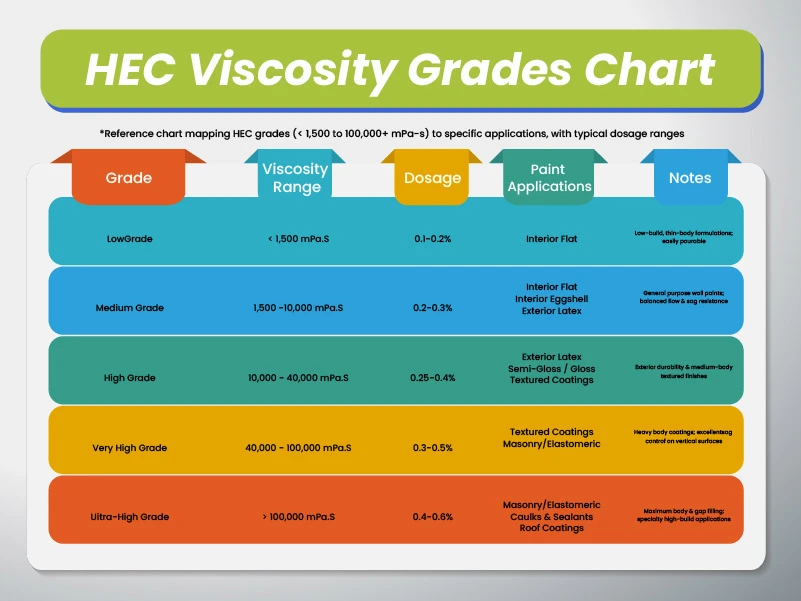
Not all HEC grades work the same way in paint. Viscosity, measured in mPa·s on a 2% aqueous solution at 20°C, determines how much thickening you get per unit of HEC added. Selecting the right grade is a formulation decision, not a purchasing afterthought.
Low Viscosity HEC (below 1,500 mPa·s)
Low-viscosity grades provide thickening with less impact on high-shear viscosity. They work well in formulations where you need flow and leveling but still want some body in the can. Some formulators use low-viscosity HEC as a co-thickener alongside associative thickeners.
Medium Viscosity HEC (4,000–15,000 mPa·s)
Medium-viscosity grades are the workhorses of interior flat and eggshell paints. They provide enough thickening for good in-can viscosity and roller application without making the paint too thick to flow. Typical dosage ranges from 0.2% to 0.5% based on total paint weight.
High Viscosity HEC (30,000–100,000+ mPa·s)
High-viscosity grades deliver maximum thickening efficiency. You need less HEC by weight to reach the same target viscosity, which can reduce raw material cost. They also provide more thixotropy, which helps with sag resistance in textured coatings and masonry paints.
| Paint Type | Recommended HEC Viscosity | Typical Dosage |
|---|---|---|
| Interior flat / eggshell | 4,000–15,000 mPa·s | 0.2–0.5% |
| Semi-gloss / satin | 4,000–15,000 mPa·s | 0.15–0.35% |
| Exterior latex | 15,000–30,000 mPa·s | 0.2–0.4% |
| Textured / masonry coatings | 30,000–60,000 mPa·s | 0.15–0.3% |
| Elastomeric roof coatings | 60,000–100,000+ mPa·s | 0.1–0.25% |
These are starting points. Your actual dosage depends on PVC, binder type, and the other thickeners in your system. Always test.
HEC vs Associative Thickeners: When to Use Each
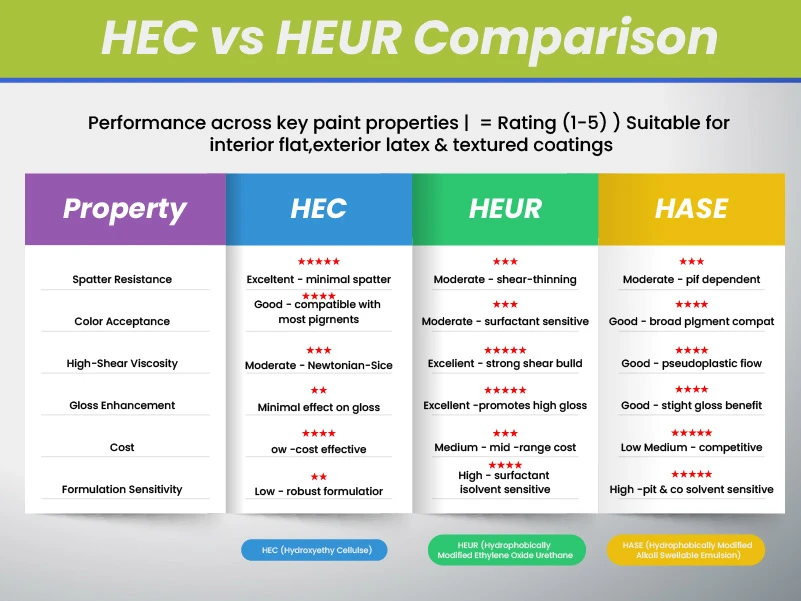
Most modern water-based paints use a combination of thickeners. The common question is how HEC fits alongside associative thickeners like HEUR (hydrophobically modified ethoxylated urethane) and HASE (hydrophobically modified alkali-soluble emulsion).
What HEC Does Better
HEC excels at spatter resistance and color acceptance. It also provides good in-can stability. It is less sensitive to formulation variables like surfactant type and latex particle size. Formulators value this predictability, especially when producing tint bases that must accept a wide range of colorants.
HEC is also cost-effective compared to HEUR. In price-sensitive markets, a formulation that relies more on HEC and less on HEUR can hit the same performance targets at lower cost.
What Associative Thickeners Do Better
HEUR provides better high-shear viscosity (ICI viscosity), which translates to better film build and feel under the roller. HEUR-thickened paints often have higher gloss and better flow at low thickener levels.
HASE offers good thickening efficiency at low cost but requires pH adjustment and can interact with other formulation components in unpredictable ways.
The Practical Approach
Most formulators use both. HEC handles the low- and mid-shear viscosity (in-can and application viscosity), while HEUR or HASE fine-tunes the high-shear response. This combination gives you the spatter resistance and color acceptance of HEC with the film build and gloss of associative thickeners.
| Property | HEC | HEUR | HASE |
|---|---|---|---|
| Spatter resistance | Excellent | Poor to moderate | Moderate |
| Color acceptance | Excellent | Can be sensitive | Variable |
| High-shear viscosity | Moderate | Excellent | Good |
| Gloss contribution | Low | High | Moderate |
| Cost | Lower | Higher | Lower |
| Formulation sensitivity | Low | High | High |
How to Incorporate HEC into Your Paint Process
Direct Addition vs Pre-Dispersed
HEC powder can be added directly to the grind or letdown, but it must be added slowly with good agitation to avoid lumping. Many formulators prefer to pre-disperse HEC in water before adding it to the batch.
Surface-treated HEC grades are designed for delayed hydration. They disperse easily in water without lumping, then hydrate and thicken after a few minutes. This eliminates the need for pre-dispersion in many formulations.
Addition Order
Add HEC early in the process, typically during the grind phase or at the start of the letdown. Adding it too late can cause inadequate hydration and inconsistent viscosity. If you are using surface-treated HEC, follow the supplier’s recommended wait time before checking viscosity.
Bio-Stability
Standard HEC is susceptible to microbial attack, which causes viscosity loss over time. Bio-stable or enzyme-resistant HEC grades are available for formulations that need extended shelf life. If you distribute paint in markets with hot, humid storage conditions, bio-stable HEC is worth specifying.
Evaluating an HEC Supplier for Paint Applications
Paint formulators and coatings distributors have specific requirements when sourcing HEC. Here is what to evaluate.
Viscosity Consistency
Batch-to-batch viscosity consistency is critical. If one lot of HEC gives you 10,000 mPa·s and the next gives you 8,000 mPa·s, your paint viscosity swings. Ask the supplier for COA data showing viscosity ranges across recent shipments. Tight specification ranges mean fewer adjustments on your production line.
Surface Treatment Options
Does the supplier offer both standard and surface-treated HEC grades? Surface-treated HEC simplifies production by eliminating pre-dispersion steps. If your customers run high-speed manufacturing lines, they will prefer surface-treated grades.
Bio-Stable Grades
Does the supplier offer enzyme-resistant HEC? This is increasingly important in markets where paint sits in warehouses or on store shelves for months before use.
Technical Support
Can the supplier help you select the right viscosity grade for your formulation? Can they troubleshoot issues like poor color acceptance or viscosity drift? That expertise matters when you are developing new formulations or optimizing existing ones.
About Zhiwei
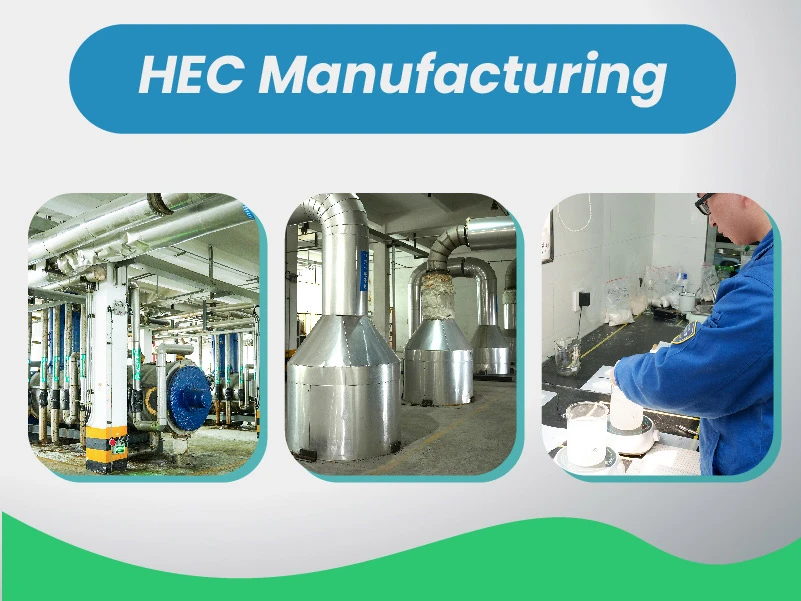
Zhiwei (Jinan) New Materials Co., Ltd. produces HEC alongside HPMC, HEMC, RDP, and PCE at its manufacturing facility in China. The company uses Xinjiang refined cotton as its raw material and maintains an annual production capacity of 15,000 tons. Zhiwei offers multiple HEC viscosity grades for paint and coatings applications, including surface-treated and bio-stable options. The company provides COAs for every batch and holds multiple patents and provincial-level scientific achievement certifications. For product inquiries, contact info@zhiweichem.com or call +86 183 6616 3707.
Frequently Asked Questions
What viscosity grade of HEC should I use for interior latex paint? Most interior flat and eggshell paints use medium-viscosity HEC in the 4,000–15,000 mPa·s range. This provides enough thickening for in-can stability and roller application without excessive high-shear viscosity. Adjust your dosage based on PVC and the other thickeners in the system.
Can I use HEC alone without associative thickeners? You can, and many economy paints do. HEC alone gives good spatter resistance, color acceptance, and in-can stability. The trade-off is lower high-shear viscosity, which means less film build and potentially lower gloss. For premium paints, a combination of HEC and HEUR usually performs better.
What is surface-treated HEC, and do I need it? Surface-treated HEC is coated with a delaying agent that prevents immediate hydration. It disperses easily in water without lumping, then hydrates after a short delay. If your production process does not allow for careful pre-dispersion, or if you run high-speed mixing lines, surface-treated HEC saves time and reduces waste.
How much HEC should I add to my paint formulation? Typical dosage ranges from 0.1% to 0.5% of total paint weight, depending on the viscosity grade and the target viscosity. Higher-viscosity HEC grades require less material to reach the same target. Always test with your specific formulation.
Is HEC compatible with all paint binders? HEC is non-ionic, so it is compatible with most common binders including acrylic, styrene-acrylic, and VAE latexes. It does not interact with ionic dispersants or surfactants in ways that cause instability. However, always verify compatibility when working with a new binder system.
Conclusion
Hydroxyethyl cellulose for paint does more than thicken. It reduces spatter, improves color acceptance, extends open time, and stabilizes the can. The viscosity grade you select and how you incorporate it into your process both affect final paint performance.
For formulators, the practical approach is usually a combination of HEC for low- and mid-shear viscosity with associative thickeners for high-shear performance. For distributors, offering multiple HEC viscosity grades and both standard and surface-treated options covers the widest range of customer needs.
Zhiwei (Jinan) New Materials Co., Ltd. manufactures HEC, HPMC, HEMC, RDP, and PCE with an annual capacity of 15,000 tons. For technical data sheets, sample requests, or pricing, contact info@zhiweichem.com or call +86 183 6616 3707.
For product inquiries: Email: info@zhiweichem.com Phone: +86 183 6616 3707 Zhiwei (Jinan) New Materials Co., Ltd.