
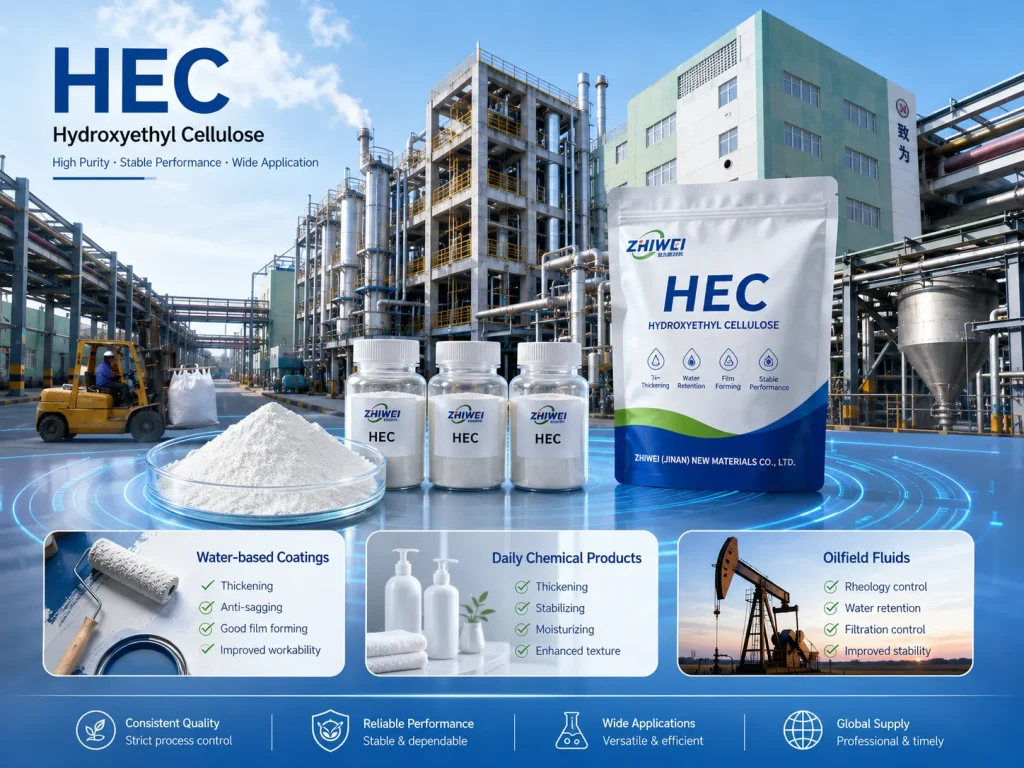
At Zhiwei (Jinan) New Materials Co., Ltd., we supply Hydroxyethyl Cellulose for customers who need stable viscosity, smooth flow control, and reliable performance in water-based systems. Our focus is direct: we support global customers with HEC and HEMC cellulose ethers, with production and shipment running from our Zhejiang manufacturing base. Zhiwei (Jinan) works as the international sales and operations center. Our team handles customer communication, grade selection, sample follow-up, and order execution. This structure helps customers get both factory backing and fast export service from one team.
For us, being a Hydroxyethyl Cellulose Supplier means more than shipping powder. HEC is a performance material. It has to match the customer’s formula, process, and final application. A coating customer may care about flow, leveling, and spatter control. A shampoo or body wash customer may care about clear texture, rich body, and smooth slip. An oilfield customer may care about viscosity control in brine-based or drilling fluid systems. The same chemical family can serve different markets, but the grade choice and test method must follow the final use.
What Hydroxyethyl Cellulose Does In A Formula
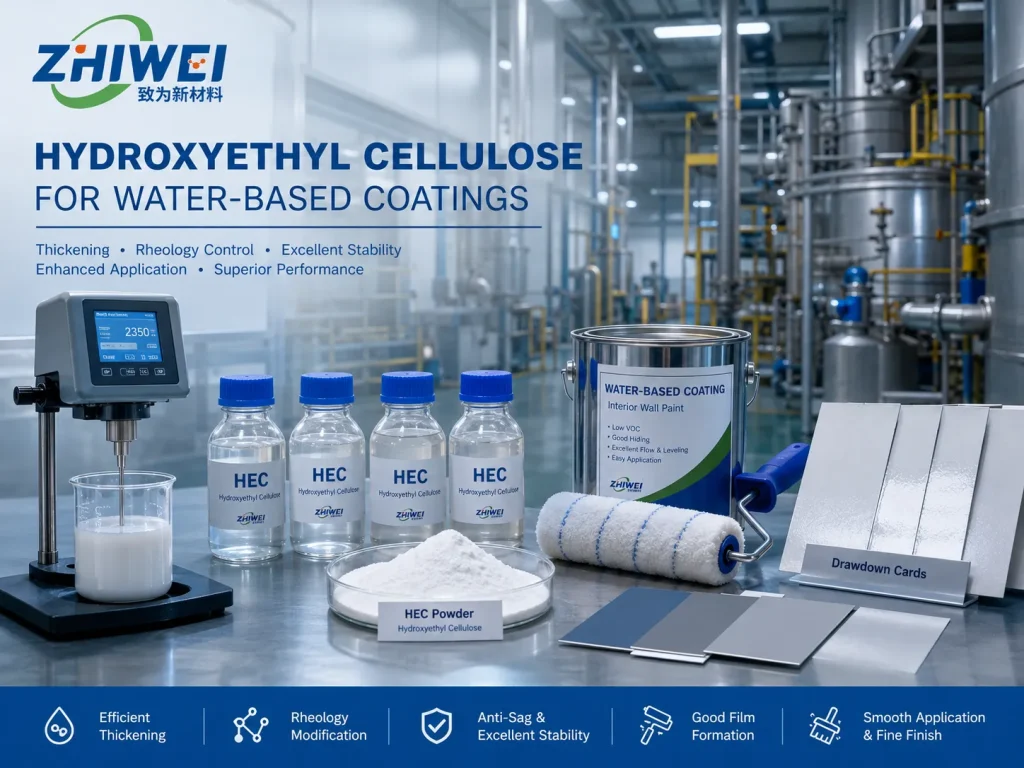
Hydroxyethyl Cellulose, also called HEC, is a nonionic, water-soluble cellulose ether. In practical use, it builds viscosity, adjusts flow, supports suspension, and helps water-based products stay stable during production, storage, and use. Ashland describes hydroxyethylcellulose as a nonionic water-soluble polymer, and Dow’s CELLOSIZE hydroxyethyl cellulose grades are positioned as thickeners and rheology modifiers in water-based systems.
This is why HEC is used in so many different formulas. It does not act like a simple filler. It changes how the system behaves. It can make a liquid product feel fuller. It can help paint flow better from the brush or roller. It can support better suspension in systems where solids or active materials need to stay evenly distributed. In many formulas, the value of HEC is felt before the final product is even packed. It appears during mixing, hydration, viscosity adjustment, and final stability testing.
Our Main HEC Application Fields
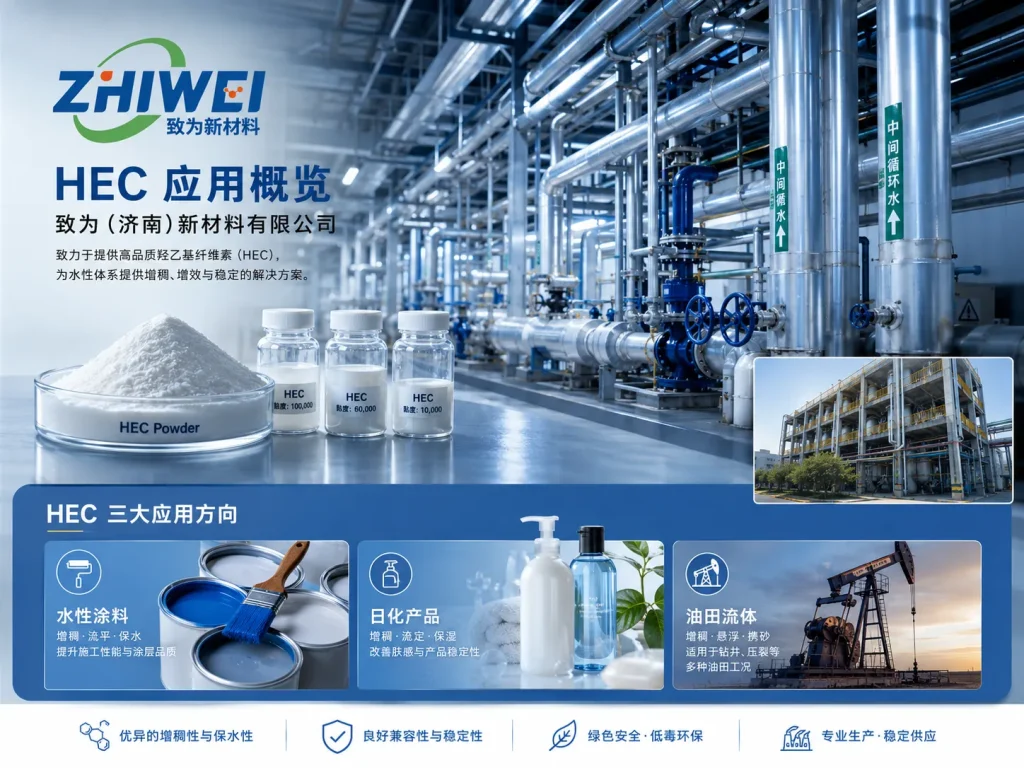
We focus HEC on three major application directions: coatings, daily chemical products, and oilfield fluids. This is the clearest way to present the product because these markets use HEC for real performance needs. On our product structure, HEC covers architectural latex paint, high-PVC latex paint, waterborne industrial coatings, texture and high-build coatings, water-based inks, shampoo and body wash, lotions and sun care, household cleaners, laundry and dish detergents, drilling fluids, workover fluids, completion fluids, and oil production fluids.
This range does not mean one grade fits every formula. It means HEC is a flexible cellulose ether family. The correct grade depends on the target viscosity, hydration behavior, clarity requirement, salt level, pH range, and final use. When customers send application details, we can suggest evaluation options more clearly. That is how we prefer to work. We do not want customers to choose only by a product name. We want the selected HEC grade to fit the real formula.
HEC For Coatings
In coatings, Hydroxyethyl Cellulose is mainly used to adjust viscosity and improve rheology. It helps water-based paints reach the right balance between flow, leveling, storage stability, and application feel. Dow describes CELLOSIZE QP-4400H hydroxyethyl cellulose as a latex paint thickener with rheological properties, flow and leveling benefits, and tolerance to dissolved electrolytes. This fits the way many coating producers use HEC in practice.
For coating customers, the key questions are usually simple but important. What is the target viscosity? Is the paint a low-PVC or high-PVC system? Does the customer need better brush feel, roller application, sag control, or spatter resistance? Does the formula contain high electrolyte levels or special dispersants? HEC selection should start from these questions. A grade that performs well in one coating may not give the same result in another system.
At Zhiwei, we treat coating-grade HEC as a formulation tool. The goal is not only to thicken the paint. The goal is to help the paint feel stable and predictable during production, storage, and application. A good HEC grade should support the finished coating without making the process difficult.
HEC For Daily Chemical Products
In daily chemical products, HEC is used to build viscosity, improve texture, support clarity in suitable systems, and make the product feel smoother during use. In shampoo and body wash, HEC can help create richer body, smooth spreading, and more stable texture. In many surfactant systems, it can also support lather stability and salt tolerance, but the final result depends on the surfactant blend, electrolyte level, pH, fragrance, and process conditions.
This is why we ask customers for formula details before recommending a grade. A shampoo system with anionic and amphoteric surfactants may need a different evaluation route from a mild body wash or a clear gel system. If the customer has a clarity target, salt curve, fragrance load, or special thickener combination, those details matter. HEC can perform well in many personal care systems, but it still needs correct hydration and proper addition.
For lotions and sun care systems, HEC can also support viscosity and emulsion stability. The product goal is different from shampoo. The customer may care more about slip, rubbing feel, pH flexibility, and emulsion body. HEC helps the formula hold a more stable texture, but the final grade choice still depends on the oil phase, emulsifier package, electrolyte level, and processing method.
HEC For Oilfield Fluids
Hydroxyethyl Cellulose is also used in oilfield systems where viscosity control and fluid behavior matter. Our HEC application structure includes drilling fluids, workover fluids, completion fluids, and oil production fluids. These applications usually need a different technical discussion from coatings or personal care. The fluid environment may involve salts, brines, temperature changes, shear, and field-specific performance requirements.
For oilfield customers, HEC selection should focus on fluid type, salinity, target viscosity, temperature range, mixing method, and expected field conditions. A simple product code is not enough. The grade has to be tested under the customer’s own conditions. That is why sampling and evaluation support matter. We can help customers start with a practical test direction, then adjust according to the actual fluid system.
How We Support Grade Selection
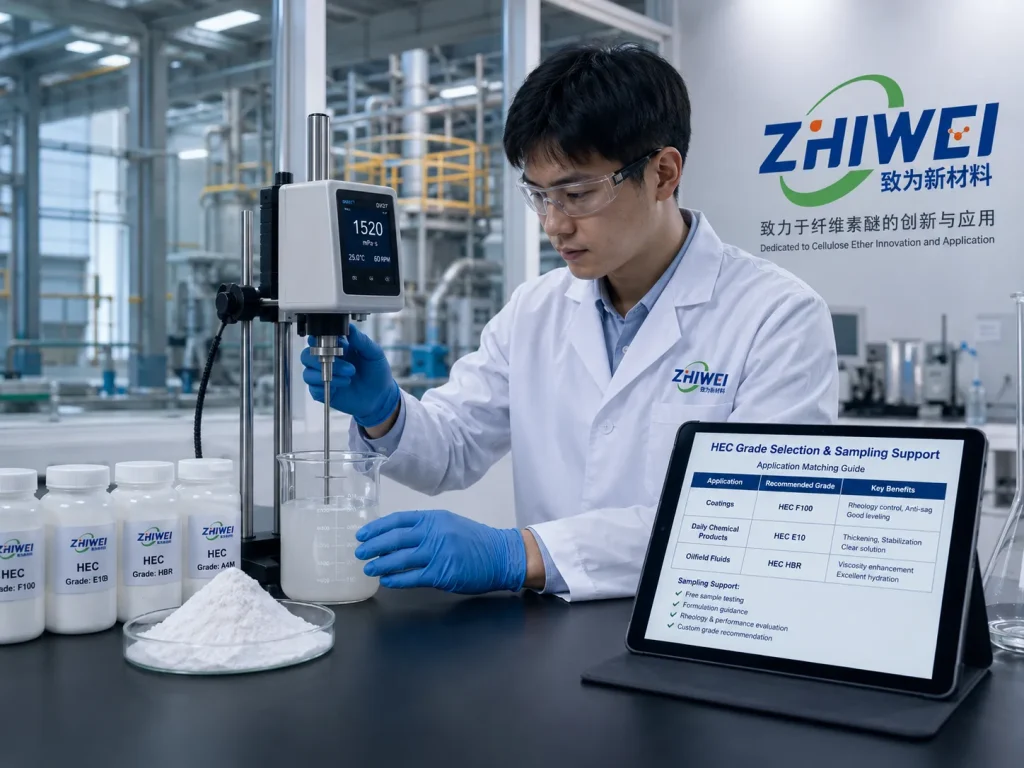
We prefer to start with the customer’s application, not with a fixed sales script. For shampoo and body wash, we ask about surfactant type, target viscosity range, clarity target, salt level, pH range, other thickeners, mixing equipment, and packaging type. These details make the recommendation more useful because HEC performance depends on the surrounding formula.
For coatings, we want to know the coating type, PVC level, binder system, target viscosity, application method, and any existing rheology problem. For oilfield use, we need fluid type, salinity, temperature range, and target viscosity behavior. This process saves time because it avoids blind grade selection. Customers can move into sample testing with a clearer starting point.
Why Factory Backing Matters
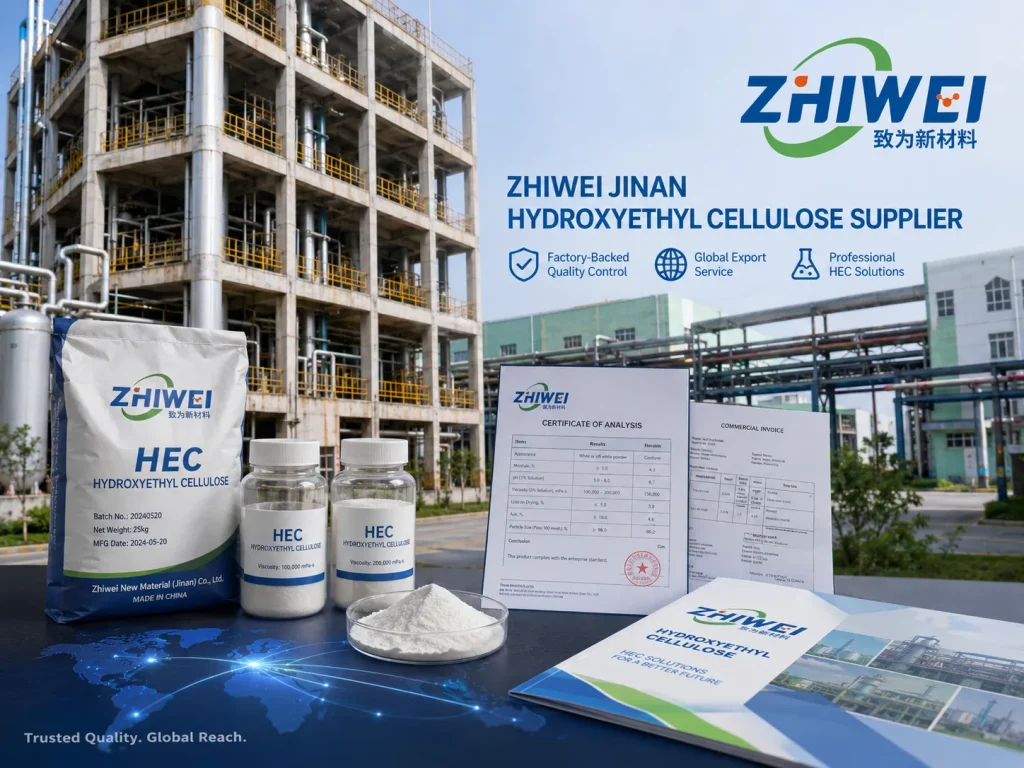
HEC performance depends on production control. A customer may test one sample successfully, but long-term cooperation depends on repeatable batch output. Our manufacturing system focuses on unified production, consistent batch control, routine testing, stable viscosity, fineness control, moisture management, ash content, appearance checks, and batch traceability. COA can be provided by batch on request.
This is the difference between a simple trading source and a factory-backed supplier. A trader may only pass along a product. A factory-backed supplier can connect the product to process, quality control, documentation, and follow-up. For international customers, this makes communication easier. It also makes repeat orders more reliable.
At Zhiwei, we want customers to see HEC as part of a full supply system. The system includes production, QC, sampling, export service, and technical communication. This is especially important for distributors and manufacturers who need stable product over time.
What Makes A Reliable Hydroxyethyl Cellulose Supplier
A reliable Hydroxyethyl Cellulose Supplier should be able to answer several practical questions. What application is the customer working on? What viscosity range is needed? What processing method will be used? What documents are required? What problem is the customer trying to solve? These questions sound basic, but they decide whether the recommended grade will be useful.
We also believe a supplier should speak clearly. The customer should not receive only a long list of product codes. The customer should understand which grade direction is worth testing and why. A good supplier should also support TDS, SDS, COA by batch, sample follow-up, and order execution. This is the working standard we use for HEC supply.
Our Position In The HEC Market
Zhiwei (Jinan) New Materials Co., Ltd. is built around cellulose ether supply for international customers. Our core focus is HEC and HEMC. HEC serves coatings, daily chemical products, and oilfield fluids. HEMC supports water-based systems and construction-related applications such as tile adhesive, dry-mix mortar, wall putty, coatings, and daily chemical products. This focus helps us communicate clearly with customers and avoid a scattered product message.
For HEC buyers, the most important point is simple. We supply HEC as a performance material. We help customers test it in real systems. We support the order with factory-backed production and quality control. We do not want to be judged only by price. We want to be judged by whether the product works, whether the batch stays stable, and whether the customer can continue using it with confidence.
Conclusion
At Zhiwei (Jinan) New Materials Co., Ltd., we supply Hydroxyethyl Cellulose for customers who need stable thickening, flow control, texture support, and repeatable performance in water-based systems. Our HEC is used in coatings, daily chemical products, and oilfield fluids. We support customers with grade selection, sample follow-up, TDS, SDS, COA by batch, and export order execution.
A good Hydroxyethyl Cellulose Supplier should not only sell HEC. It should help customers choose the right grade, test it in the right system, and keep performance stable from sample to repeat order. That is the way we position Zhiwei: factory-backed supply, practical application support, and clear communication for customers who need HEC to perform in real formulas.