
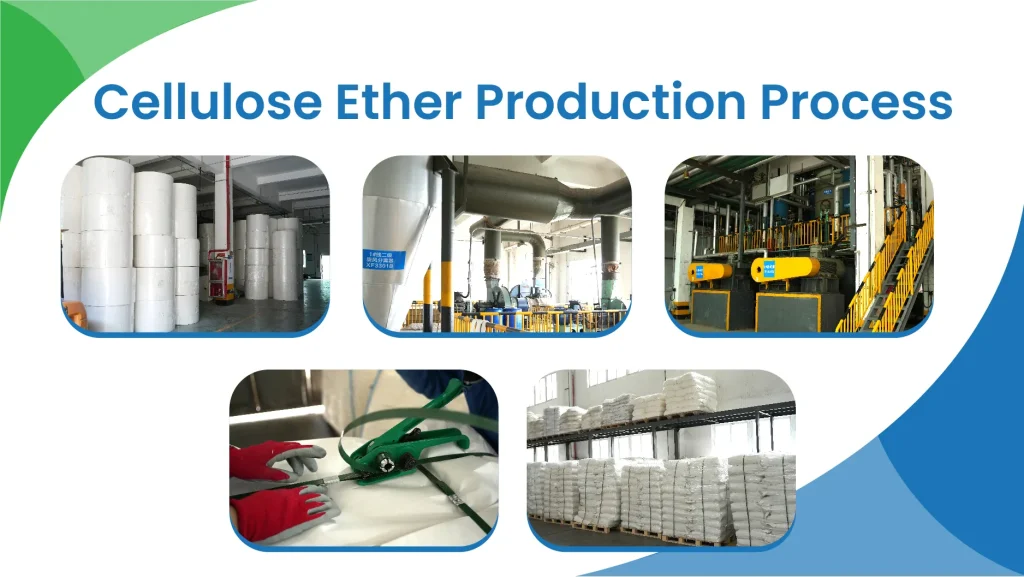
At Zhiwei (Jinan) New Materials Co., Ltd., we see cellulose ether production as a full manufacturing chain, not a single chemical reaction. A stable cellulose ether product starts from the raw cellulose source, then moves through raw material preparation, alkalization, etherification, neutralization, washing or solvent recovery, drying, crushing, sieving, and final quality control. Each step affects the finished powder. Each step also affects how the product performs later in coatings, daily chemical products, oilfield fluids, dry-mix mortar, wall putty, tile adhesive, and other water-based systems.
Zhiwei find out that many customers only know cellulose ether by its final product name, such as HEC, HEMC, HPMC, or CMC. But behind each name is a different production route and a different substitution structure. The raw cellulose backbone is similar, but the etherifying agent changes. That is why different cellulose ethers have different names, different application directions, and different performance balances.
For Zhiwei, this production logic is very important. We supply HEC and HEMC cellulose ethers to global customers, and we focus on repeatable performance. A customer does not only need a powder sample. The customer needs stable viscosity, stable fineness, controlled moisture, reliable batch records, and application support that matches the real formula. That is why understanding the production process helps buyers understand product quality.
What Cellulose Ether Is
Cellulose ether is a modified cellulose polymer. The base material is cellulose, which can come from refined cotton, cotton linters, wood pulp, or other purified cellulose sources. Natural cellulose itself is not enough for most industrial thickening and water-retention uses. It must be activated and chemically modified so it can deliver useful performance in water-based systems.
After modification, cellulose ether can provide thickening, water retention, suspension, film formation, adhesion, dispersion support, and stable rheology. These functions explain why cellulose ethers are used in coatings, daily chemical products, oilfield fluids, construction mortar, wall putty, tile adhesive, grouts, and many other systems.
The final product name depends on the substituent groups introduced during etherification. For example, hydroxyethyl cellulose uses hydroxyethyl substitution. Hydroxyethyl methyl cellulose uses hydroxyethyl and methyl substitution. Hydroxypropyl methylcellulose uses hydroxypropyl and methyl substitution. Carboxymethyl cellulose uses carboxymethyl substitution. The production principle is connected, but the product performance is not identical.
The Core Production Logic
The traditional cellulose ether route can be summarized in one clear sequence:
Raw cellulose material → raw material opening or crushing → alkalization → alkali cellulose → etherification → neutralization → washing or solvent recovery → separation → drying → crushing → finished powder.
This sequence looks simple, but every step must be controlled. If the raw material is not uniform, alkalization may not be even. If alkalization is unstable, etherification becomes harder to control. If drying and crushing are not well managed, the final powder may show poor flowability, uneven fineness, or unstable hydration behavior.
Zhiwei find out that cellulose ether quality is built through the whole process. Final QC is important, but final QC cannot replace good manufacturing control. A stable product must be controlled from raw material preparation to finished powder packaging.
Step 1: Raw Material Preparation
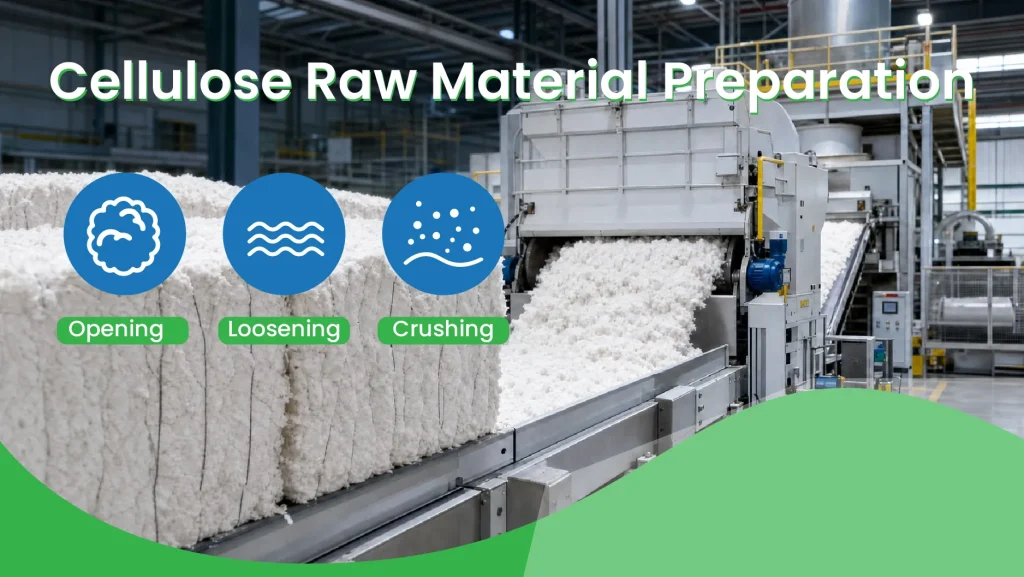
Cellulose ether production starts from cellulose raw material. In many traditional routes, refined cotton is used because of its high cellulose purity and good reaction potential. In some production routes, wood pulp can also be prepared and processed as a cellulose source. The key is not only the name of the raw material. The key is whether the material can meet the production requirements for purity, looseness, bulk density, and reaction uniformity.
Raw cellulose usually needs opening, loosening, or crushing before it enters the reaction system. This step helps improve contact between cellulose and alkali. If the cellulose remains too dense or uneven, alkali penetration can be poor. That can cause unstable activation and uneven reaction later.
In one process direction, wood pulp is first loosened, then crushed into a powder-like cellulose material. The target is to make the processed wood pulp reach a loose bulk density close to refined cotton. When the bulk density and physical state meet the production requirement, the raw material can enter the alkalization stage.
Why Raw Material Form Matters
Raw material form matters because cellulose is not a simple liquid reactant. It is a fibrous solid. The reaction depends on contact, swelling, activation, and diffusion. If the fiber is too compact, reaction efficiency can drop. If the particle state is too uneven, the final cellulose ether may show unstable substitution and viscosity.
For buyers, this step is easy to ignore. But for manufacturers, it is one of the first quality-control points. A stable cellulose ether product starts before the reactor. It starts when the raw material is selected and prepared.
Step 2: Alkalization
After raw material preparation, the cellulose is treated with sodium hydroxide. This step is called alkalization. The purpose is to activate the cellulose and form alkali cellulose, sometimes also described as sodium cellulose. This activated intermediate is much more suitable for the next etherification reaction.
In practical production, alkalization is affected by alkali concentration, temperature, moisture, mixing time, and raw material uniformity. Some process descriptions use heating to dissolve sodium hydroxide, then cooling before adding the prepared cellulose. The cellulose is then alkalized under controlled temperature and time conditions. During this process, mixing and resting may be alternated to help alkali penetrate the cellulose more evenly.
Why Alkalization Is Critical
Alkalization decides whether the cellulose is ready for etherification. If activation is not sufficient, the etherification reaction will be incomplete or uneven. If the alkali treatment is too aggressive or poorly controlled, it can affect polymer structure and final viscosity.
This is why alkalization is one of the key control stages in cellulose ether production. It creates the foundation for the final product’s substitution level, viscosity behavior, and application performance.
For Zhiwei, this is also why production control matters. A customer may only see the final powder, but the performance of that powder is already being shaped during alkalization.
Step 3: Etherification
Etherification is the step that gives cellulose ether its final product identity. After alkalization, the activated cellulose reacts with one or more etherifying agents. The selected etherifying agent determines the substituent group, and the substituent group determines the product type.
Common etherifying agents include ethylene oxide, propylene oxide, methyl chloride, and chloroacetic acid. Different combinations lead to different cellulose ethers. Ethylene oxide can introduce hydroxyethyl groups. Propylene oxide can introduce hydroxypropyl groups. Methyl chloride can introduce methyl groups. Chloroacetic acid can introduce carboxymethyl groups.
This is why HEC, HEMC, HPMC, and CMC are not the same material. They all start from cellulose, but they do not go through the same substitution route.
Etherification And Product Naming
The name of a cellulose ether comes from its chemical modification. If the cellulose contains hydroxyethyl groups, it becomes hydroxyethyl cellulose. If it contains methyl and hydroxyethyl groups, it becomes hydroxyethyl methyl cellulose. If it contains methyl and hydroxypropyl groups, it becomes hydroxypropyl methylcellulose.
This naming logic matters for customers. A buyer should not choose a cellulose ether only by the word “cellulose.” The substituent structure affects water solubility, thermal gel behavior, salt response, water retention, viscosity build, workability, and application suitability.
Reaction Control
Etherification is not only about adding the correct chemical. It is also about controlling reaction temperature, time, mixing, pressure, medium, and reaction sequence. Some production routes use staged heating, holding, and reaction periods to complete the etherification. After the reaction is finished, the material must be cooled and moved into downstream finishing.
Zhiwei find out that this stage is where many product differences begin. Two products may both be called cellulose ether, but if the substitution level, reaction uniformity, or molecular structure differs, the final application performance can also differ. That is why stable etherification control is essential for repeatable product quality.

Step 4: Neutralization And pH Adjustment
After etherification, the reaction material must be neutralized. Neutralization helps stop the reaction, adjust pH, and prepare the material for washing, solvent recovery, and further finishing. In some routes, ethanol solution and acetic acid are used to neutralize and wash the material. The final pH is often adjusted to a controlled range before the next process step.
pH control is important because cellulose ether is used in many sensitive formulations. If pH is not properly controlled, it can affect storage stability, compatibility, and customer application performance.
For customers, pH may look like a small COA item. In reality, it reflects whether the upstream reaction and downstream finishing were properly controlled. This is why batch testing should not only focus on viscosity. It should also include appearance, moisture, ash content, pH, fineness, and other practical indicators.
Step 5: Solvent Recovery And Washing
After neutralization, the material usually contains solvent, salts, by-products, and process residues that must be managed. Washing and solvent recovery help remove unwanted components and prepare the cellulose ether for drying. Some process routes use hot soft water to replace and recover solvent. The recovered solvent can then be handled through the plant’s recovery system.
This stage matters for both cost and quality. Good solvent recovery can reduce waste and production cost. Good washing can improve product cleanliness and reduce unwanted residues. If the washing or recovery stage is poorly controlled, it may affect final ash content, odor, pH, purity, or application performance.
Zhiwei find out that downstream recovery and washing are not secondary details. They are part of the product-quality chain. A good cellulose ether factory must manage both reaction efficiency and post-reaction purification.
Step 6: Separation
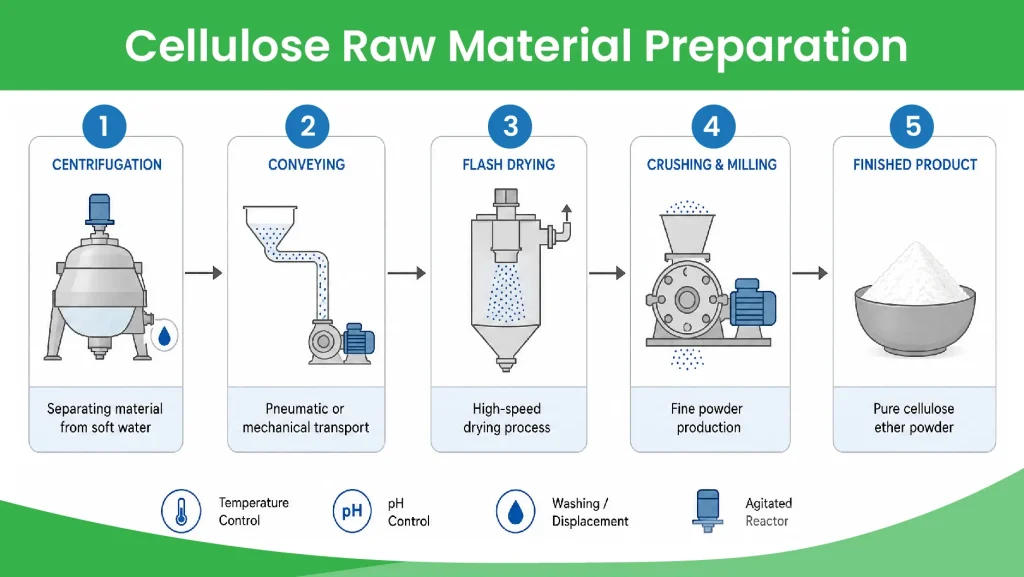
After washing and solvent recovery, the solid material must be separated from the liquid phase. Centrifugation is a common industrial method for this step. The goal is to remove liquid efficiently while keeping the material suitable for drying.
Separation affects moisture load and drying efficiency. If separation is poor, the drying process becomes more difficult and energy consumption may increase. If the material is not handled carefully, physical consistency can also be affected.
For cellulose ether production, every downstream step is connected. Better separation supports better drying. Better drying supports better crushing. Better crushing supports better final powder handling. The quality chain continues until the product is packaged.
Step 7: Drying
After separation, the wet material must be dried. Flash drying is one possible method used in cellulose ether finishing. Drying removes moisture and helps convert the wet material into a stable powder-ready form.
Drying must be controlled carefully. Too much residual moisture can affect storage stability. Overdrying or poor temperature control may affect product quality or powder behavior. Good drying should support stable moisture content, good flowability, and consistent downstream crushing.
For Zhiwei, drying is not only a factory operation. It is one of the steps that helps make performance repeatable. If drying is unstable, the final product may show changes in hydration speed, powder handling, or storage behavior.
Step 8: Crushing, Sieving, And Finished Powder Control
After drying, the cellulose ether material is crushed or milled into the required powder form. Particle size and fineness affect customer handling, dispersion, and hydration. If the powder is too coarse, it may hydrate slowly or disperse poorly. If it is too fine, dust handling may become more difficult.
Finished powder control usually includes appearance, fineness, viscosity, moisture, pH, ash content, and batch traceability. For some customer applications, additional tests may be needed according to the target formula.
This is why finished product inspection is still important. It confirms whether the whole production chain has delivered the target product. But inspection is not the only quality control. It is the final confirmation after all previous steps have been managed.
Refined Cotton Route And Wood Pulp Route
The traditional route often uses refined cotton as the cellulose source. Refined cotton has good purity and has been widely used in cellulose ether production. However, raw material cost can become a major issue, especially when cotton prices rise. When refined cotton cost rises, cellulose ether production cost also increases, which can affect product pricing and market promotion.
Zhiwei find out that wood pulp routes are also discussed in the industry as a way to reduce raw material cost and improve production economics. In one described route, wood pulp is loosened and crushed until it reaches a loose bulk density comparable to refined cotton. It is then alkalized with sodium hydroxide, etherified with propylene oxide and methyl chloride, neutralized, washed, separated, dried, and finished into hydroxypropyl methylcellulose ether.
The important lesson is not that one raw material is always better in every situation. The real lesson is that raw material preparation must match the process target. Refined cotton and wood pulp may both serve as cellulose sources, but the factory must control purity, bulk density, looseness, reactivity, and process stability.
What Zhiwei Learns From The Process
Zhiwei find out that cellulose ether manufacturing depends on three major controls.
First, raw material control. Cellulose quality and physical form determine how well the material can be activated and reacted. If raw material preparation is poor, later steps become harder to control.
Second, reaction control. Alkalization and etherification decide the structure of the cellulose ether. These steps influence viscosity, solubility, water retention, and application performance.
Third, finishing control. Neutralization, washing, recovery, separation, drying, crushing, and final testing decide whether the material becomes a stable commercial powder.
A good cellulose ether supplier should understand all three. Customers may only ask for a model number or viscosity grade, but real product performance depends on the complete manufacturing chain.
Why This Matters For HEC And HEMC Customers
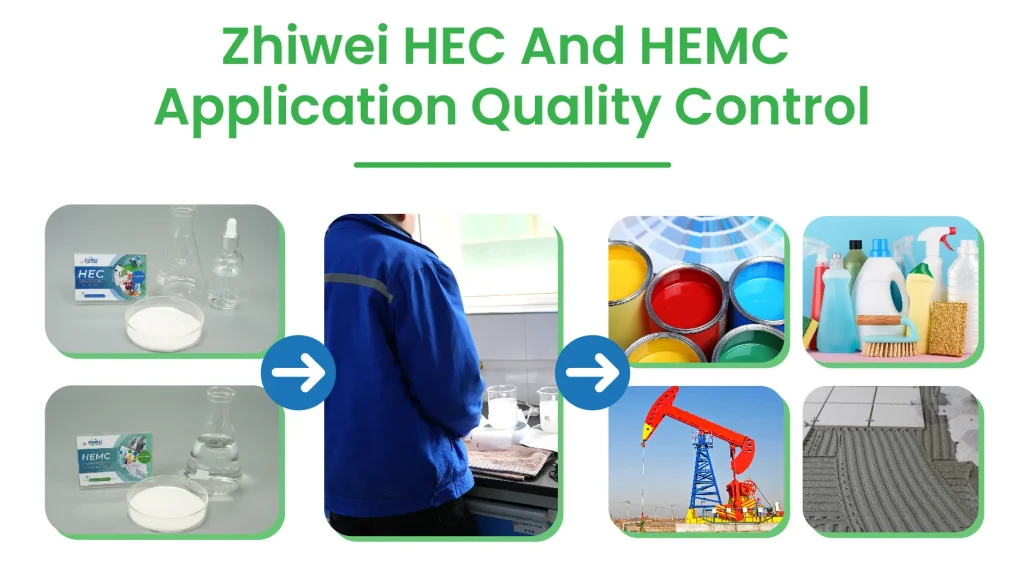
At Zhiwei, our core cellulose ether product lines are HEC and HEMC. HEC is mainly used to build viscosity and adjust flow in coatings, daily chemical products, and oilfield fluids. HEMC supports viscosity build, water retention, and stable handling in coatings, daily chemical products, and construction mixes.
The production principles behind cellulose ether help explain why grade selection matters. HEC for shampoo and body wash is not selected the same way as HEC for oilfield fluids. HEMC for wall putty is not selected the same way as HEMC for tile adhesive. Different applications need different viscosity levels, hydration behavior, water retention, dispersion, and compatibility.
This is why we ask customers for application details before recommending a grade. The right cellulose ether is not chosen only by product name. It is chosen by formula, process, and performance target.
What Customers Should Check When Choosing Cellulose Ether
A customer should not evaluate cellulose ether only by price. Price matters, but performance stability matters more. Before choosing a supplier, customers should check several points.
The first point is raw material and process stability. A factory should understand how raw material preparation affects final product quality.
The second point is viscosity consistency. Cellulose ether is often used for thickening and rheology control, so viscosity stability is critical.
The third point is fineness and dispersion behavior. These affect mixing, hydration, and customer processing.
The fourth point is moisture and ash control. These indicators reflect the finishing process and product cleanliness.
The fifth point is application support. A supplier should help match the grade to the formula, not simply send a random sample.
The sixth point is documentation. TDS, SDS, and COA by batch help customers review, test, and approve the product more efficiently.
Zhiwei’s Approach To Cellulose Ether Supply
At Zhiwei (Jinan) New Materials Co., Ltd., we supply cellulose ethers with factory-backed production, verified QC, grade selection support, sample follow-up, and clear export communication. Our goal is to help customers make performance repeatable.
For HEC customers, we focus on coatings, daily chemical products, and oilfield fluids. For HEMC customers, we support construction mixes, coatings, and daily chemical products. In both product lines, we care about stable viscosity, proper fineness, moisture control, appearance, batch traceability, and practical formula testing.
We believe cellulose ether supply should be application-driven. A customer should be able to tell us the target formula, target viscosity, process conditions, and performance issue. Then we can suggest a more useful sample direction. This is better than blind selection and helps customers save testing time.
Conclusion
Cellulose ether is produced through a controlled process that starts from cellulose raw material and moves through preparation, alkalization, etherification, neutralization, washing or solvent recovery, separation, drying, crushing, and final powder control. Different etherifying agents create different cellulose ether types, which is why HEC, HEMC, HPMC, and CMC have different names and different performance profiles.
Zhiwei find out that the real value of cellulose ether production is not only the reaction itself. It is the complete manufacturing chain. Raw material quality, alkali activation, etherification control, purification, drying, powder finishing, and QC all affect final product performance.
At Zhiwei (Jinan) New Materials Co., Ltd., we use this process understanding to support HEC and HEMC customers with practical grade selection, stable supply, sample testing, and batch control. For customers, the final goal is simple: the cellulose ether should work in the real formula, and its performance should stay repeatable from sample to long-term supply.