
Introduction
When people search for HEC manufacture, they usually want to know what HEC is, what an HEC manufacturer produces, and how HEC is used in real products. The wording can be confusing because HEC itself does not manufacture anything. HEC is a material. A manufacturer produces HEC powder and supplies different grades for different water-based formulas.
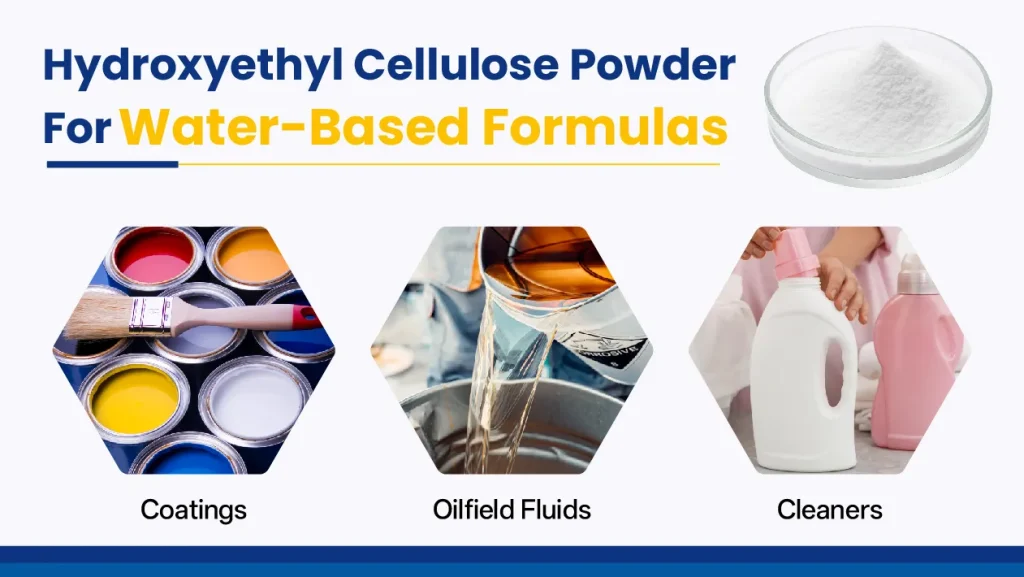
HEC means hydroxyethyl cellulose. It is a water-soluble cellulose ether. It is widely used as a thickener, stabilizer, flow modifier, and viscosity builder. You can find it in water-based paints, coatings, inks, shampoos, body wash, household cleaners, detergents, oilfield fluids, and many other industrial products.
For buyers, the more practical question is this: what does an HEC manufacturer make, and how do you choose the right product grade? This article explains HEC in simple words. It also explains how manufacturers produce and supply HEC grades, what the common applications are, and how Zhiwei helps customers choose suitable HEC products for stable production.
What Does HEC Mean?
HEC stands for hydroxyethyl cellulose. It is made from cellulose, which comes from plant-based raw materials. Through chemical modification, cellulose becomes easier to use in water-based systems. The final HEC product is usually a white or off-white powder.
When HEC is mixed with water in the right way, it hydrates and forms a thick solution. This helps the final formula get better body, better flow control, and better stability. In many products, HEC is not the main ingredient by weight. But it has a strong effect on the user experience.
For example, a paint formula may use HEC to improve roller feel and reduce sagging. A shampoo formula may use HEC to improve texture and make the product feel smoother. A cleaner may use HEC to give light body and controlled flow. An oilfield fluid may use HEC to build viscosity and support stable handling.
So, when users search for HEC manufacture, they are usually looking for the company, product, grade, or process behind this useful powder.
What Does An HEC Manufacturer Produce?
An HEC manufacturer produces hydroxyethyl cellulose powder in different grades. These grades are not all the same. They can differ in viscosity, particle size, moisture, ash content, surface treatment, and application performance.
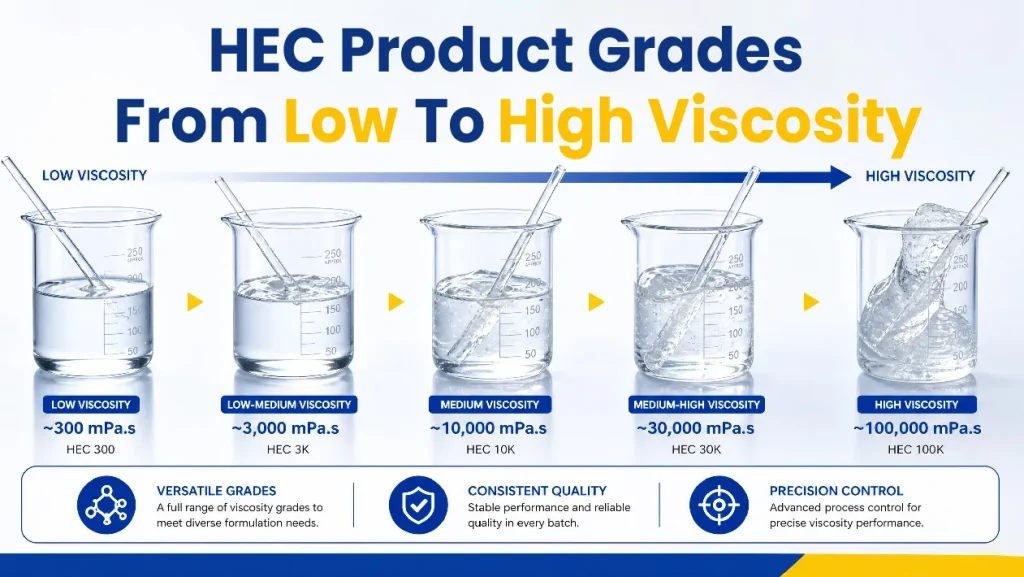
A good HEC manufacturer does not only make one general powder. It offers a product range that can match different formula needs. Low-viscosity grades may be used for light-body systems. Medium-viscosity grades may be used for coatings, inks, and cleaners. High-viscosity grades may be used for high-build coatings, gels, and fluid systems that need strong thickening.
At Zhiwei, HEC products include grades such as HEC 40, HEC 300, HEC 2K, HEC 6K, HEC 15K, HEC 30K, HEC 50K, HEC 100K, and HEC 150K. These names help customers understand the viscosity level and choose a better starting point for testing.
For example, HEC 40 and HEC 300 are low-viscosity hydroxyethyl cellulose grades. They are useful in light-body water-based systems, such as low-build coatings, water-based inks, and household cleaners. HEC 150K is a very high-viscosity grade. It is more suitable for systems that need strong thickening, suspension support, and stable high-body texture.
Why HEC Manufacture Is Important For Product Quality
HEC manufacture matters because the final powder must perform in a stable way. If the viscosity changes too much from one batch to another, the customer’s final product may also change. This can create problems in production and in the market.
A paint producer may see changes in brushing feel, roller marks, or sag resistance. A cleaner producer may see changes in flow and appearance. A shampoo producer may see changes in gel texture. An oilfield customer may see changes in fluid handling.
This is why buyers should not choose an HEC supplier only by price. The better choice is a supplier that can support stable output, proper grade selection, sample testing, and batch documents.
Zhiwei focuses on repeatable performance. The company supports overseas customers with product selection, sampling, and order execution. Its cellulose ether production and shipment are supported by the Zhejiang manufacturing base. The Jinan team works as the international sales and operations center for HEC, HEMC, and HPMC cellulose ethers.
What Are The Main Uses Of HEC?
HEC is used in many water-based formulas. Its main job is to build viscosity and control flow. But in real products, this simple function can affect many details.
HEC For Paints And Coatings
In water-based paints and coatings, HEC helps adjust viscosity and improve application feel. It can support smoother rolling, better brush feel, and more stable storage. It can also help reduce pigment settling and improve the body of the paint.
For low-build coatings or primers, a low-viscosity grade such as HEC 40 or HEC 300 may be a useful starting point. For texture coatings and high-build coatings, higher-viscosity grades such as HEC 30K, HEC 50K, HEC 100K, or HEC 150K may be more suitable.
The right choice depends on the binder system, pigment level, target viscosity, and production method. A supplier should not recommend only one grade without understanding the formula.
HEC For Daily Chemical Products
HEC is also used in daily chemical products. These include shampoo, body wash, hand soap, lotions, household cleaners, laundry products, and dish detergents.
In these products, HEC can improve texture and help the product look more stable. It can make a cleaner flow in a more controlled way. It can make a shampoo or body wash feel smoother. It can help a gel or liquid product keep a stable appearance during storage.
For light-body products, low-viscosity grades may be enough. For thicker gels and products that need more body, a higher-viscosity grade may be needed. Sample testing is important because surfactants, salts, fragrance, and other ingredients can affect the final viscosity.
HEC For Water-Based Inks
Water-based inks need controlled flow and stable pigment dispersion. HEC can help adjust rheology, reduce settling, and improve handling during printing or coating.
A grade such as HEC 40 or HEC 300 may be useful when the target is clean flow and moderate viscosity control. The final selection should be based on pigment system, resin type, pH, and the required printing behavior.
HEC For Oilfield Fluids
HEC can also be used in oilfield fluid systems. It can work as a viscosifier in drilling fluids, workover fluids, completion fluids, and other oil production fluid systems.
Oilfield use can be demanding. The product must support stable viscosity under the expected field conditions. For high-body waterborne systems, a very high-viscosity grade such as HEC 150K may be considered during screening.
For this type of application, buyers should share the brine system, temperature condition, target viscosity, and field use. This helps the supplier suggest a more suitable grade.
HEC Grade Selection Table
| HEC Grade | General Viscosity Direction | Possible Use Cases | Buyer Focus |
|---|---|---|---|
| HEC 40 | Low viscosity | Light-body coatings, inks, cleaners | Clean flow and easy handling |
| HEC 300 | Low viscosity | Primers, water-based inks, household cleaners | Slight body and stable appearance |
| HEC 2K / HEC 6K | Low to medium viscosity | Waterborne systems needing moderate body | Balance of flow and thickness |
| HEC 15K / HEC 30K | Medium to high viscosity | Coatings, detergents, daily chemical products | Better body and stability |
| HEC 50K / HEC 100K | High viscosity | High-build systems and thickened formulas | Stronger thickening |
| HEC 150K | Very high viscosity | Texture coatings, gels, oilfield fluids | Strong viscosity and suspension support |
This table is only a starting point. The final grade should always be tested in the real formula. Even two formulas in the same industry can need different HEC grades.
What Should Buyers Ask An HEC Manufacturer?
When you contact an HEC manufacturer, you should send clear application details. This helps the supplier recommend the right grade faster.
You can share the product type, target viscosity, pH, mixing method, raw material system, and current problem. You can also share whether you need light flow, strong gel texture, suspension support, or anti-sag behavior.
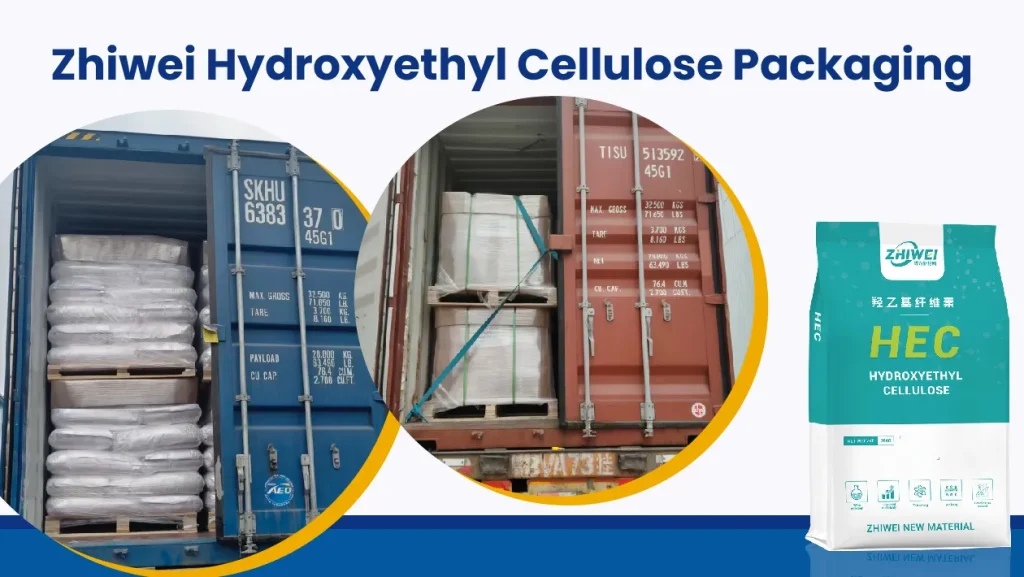
You should also ask for basic product documents. These include the Technical Data Sheet, Safety Data Sheet, Certificate of Analysis, and packing information. For bulk orders, you should confirm lead time, package size, shipping method, and batch traceability.
A reliable HEC manufacturer should be able to explain the difference between grades. It should also support sample testing before large orders. This is much safer than buying a random grade based only on price.
What Makes A Good HEC Manufacturer?
A good HEC manufacturer should have stable production, clear quality control, and practical technical support. It should understand that customers do not only buy powder. They buy a material that must work in a real product.
There are several things to check.
First, check the product range. A manufacturer with more HEC grades can support more applications. This is useful when your formula changes or when one grade does not give the best result.
Second, check the quality control items. Common checks include viscosity, fineness, moisture, ash content, appearance, and pH. These tests help keep performance stable from batch to batch.
Third, check the response speed. If you are developing a formula, slow communication can delay your project. A good supplier should give clear feedback and practical next steps.
Fourth, check export support. If you buy from another country, the supplier should understand documents, packing, shipping, and delivery schedules.
How Zhiwei Supports HEC Manufacture And Supply
Zhiwei (Jinan) New Materials Co., Ltd. supports global customers with cellulose ether products, including HEC, HEMC, and HPMC. For HEC, Zhiwei supplies grades for coatings, daily chemical products, water-based inks, cleaners, and oilfield fluids.
Zhiwei’s role is not only to sell standard grades. The team helps customers choose a suitable grade based on the formula and application. If a customer needs light viscosity and clean flow, Zhiwei may suggest a low-viscosity grade such as HEC 40 or HEC 300 for testing. If the customer needs stronger structure and high-body performance, Zhiwei may suggest higher-viscosity options such as HEC 30K, HEC 100K, or HEC 150K.
Zhiwei can provide product information and sample support for new formulas. The company also supports batch documents such as COA when needed. This helps purchasing teams and technical teams make better decisions before bulk purchase.
For many customers, the biggest value is not only the material itself. It is the ability to get a grade that fits production needs and keeps the final product stable.
How To Test HEC Before Bulk Purchase
Before buying HEC in bulk, test samples in your own formula. This is the most practical way to avoid mistakes.
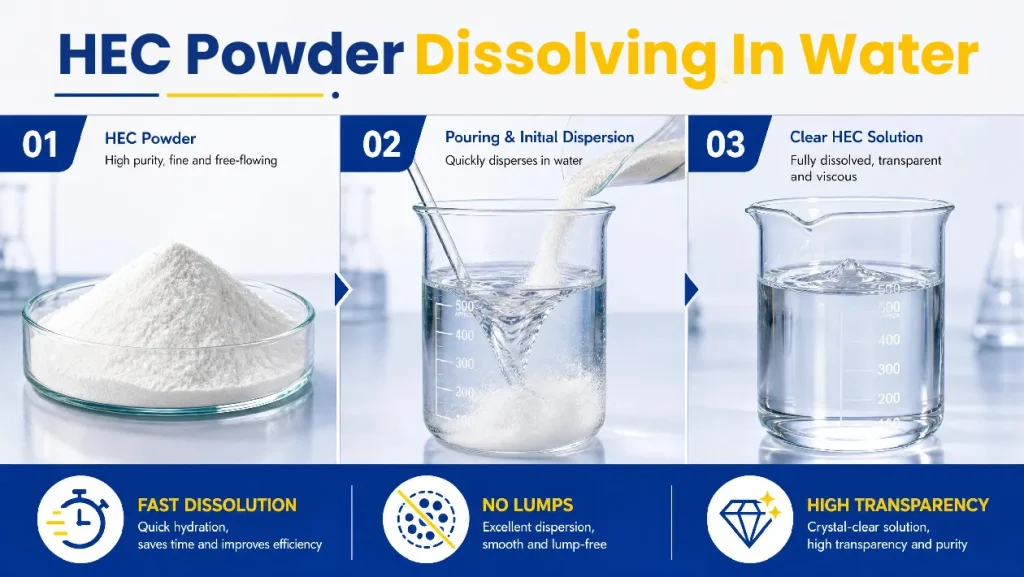
Use the same mixing speed, water temperature, mixing time, and dosage for each sample. Record how the powder disperses. Check whether lumps appear. Measure the final viscosity after full hydration. Then check storage stability, appearance, and product feel.
For coatings, test roller feel, brush feel, sag resistance, storage stability, and final film appearance.
For daily chemical products, test clarity, texture, flow, fragrance compatibility, and stability after storage.
For cleaners and detergents, test viscosity stability, salt tolerance, and appearance.
For oilfield fluids, test the grade under the real fluid conditions as much as possible.
After testing, compare performance and cost together. The cheapest grade is not always the best choice. A slightly better grade can reduce production risk and improve final product quality.
Common Mistakes In HEC Purchase
Many buyers make simple mistakes when buying HEC.
The first mistake is using the wrong keyword and then choosing the wrong product. Searching for HEC manufacture may lead to general results. It is better to also search for hydroxyethyl cellulose manufacturer, HEC supplier, or HEC powder grade.
The second mistake is choosing only by viscosity number. Viscosity is important, but it is not the only factor. Dissolution, compatibility, particle size, and batch stability also matter.
The third mistake is skipping sample tests. A grade may look correct on the data sheet but still fail in your formula.
The fourth mistake is not sharing enough formula details. If the supplier does not know the application, it can only guess.
The fifth mistake is ignoring documents. TDS, SDS, and COA help your team control quality and reduce purchasing risk.
Conclusion
HEC does not manufacture products by itself. HEC is hydroxyethyl cellulose, a water-soluble cellulose ether used to build viscosity, improve flow, and support stability in water-based formulas. When people search for HEC manufacture, they usually want to understand what an HEC manufacturer produces and how to choose the right HEC powder.
An HEC manufacturer produces different hydroxyethyl cellulose grades for different applications. Low-viscosity grades such as HEC 40 and HEC 300 can be used in light-body systems. Higher-viscosity grades such as HEC 30K, HEC 100K, and HEC 150K can support stronger thickening and more structured formulas.
If you need HEC for coatings, daily chemical products, inks, cleaners, detergents, or oilfield fluids, Zhiwei can help you review your application and choose a suitable grade for testing. Contact Zhiwei (Jinan) New Materials Co., Ltd. to request HEC product information, samples, and a quotation.