
What is HEC chemical?
HEC chemical refers to hydroxyethyl cellulose, a nonionic, water-soluble polymer derived from cellulose. Manufacturers use it to adjust viscosity and flow in products such as water-based paints, household formulations, personal care products, and selected oilfield fluids.
For formulators, HEC’s value comes from how it changes the behavior of water-based mixtures. It can give a liquid more body, influence spreading and pouring, and help control the movement of suspended particles. The result depends on the grade, concentration, mixing procedure, and other ingredients.
At Zhiwei, we supply HEC for coatings, daily chemical products, and oilfield applications. Selecting the right product begins with understanding the formulation’s requirements and the properties that need to be measured.
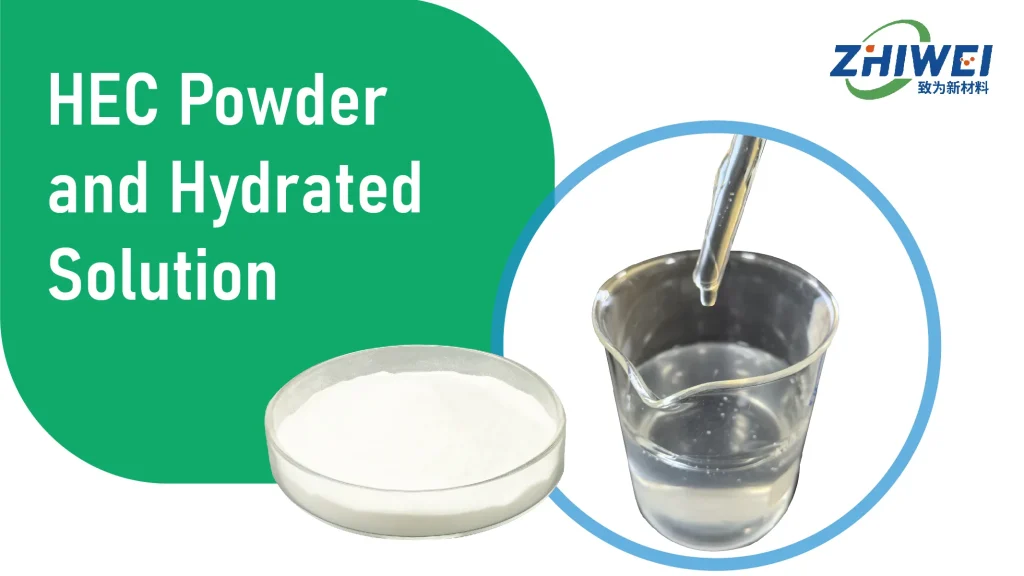
What Does HEC Stand For?
HEC stands for hydroxyethyl cellulose. It belongs to the cellulose ether family, which also includes hydroxypropyl methylcellulose, or HPMC, and hydroxyethyl methylcellulose, or HEMC.
Its CAS number is 9004-62-0. This identifier helps confirm chemical identity when reviewing purchasing documents, technical data sheets, and safety information. It does not specify the viscosity grade or establish suitability for a particular application. USP Hydroxyethyl Cellulose Monograph
Two materials sold under the same chemical name can have different molecular characteristics and processing behavior. A purchase specification should therefore identify the required grade and test conditions alongside the chemical name.
What Is the Chemistry Behind HEC?
HEC starts with cellulose, a polymer built from repeating glucose-derived units. Chemical modification introduces hydroxyethyl groups onto the cellulose structure, producing a derivative that can hydrate and dissolve in water.
Commercial HEC is a polymer with a distribution of chain lengths and substitution characteristics. It therefore cannot be adequately described by one fixed molecular weight or a small-molecule formula. These structural differences help explain why HEC products with the same chemical identity can produce different solution viscosities.
Unmodified HEC is nonionic: it does not carry the fixed ionic groups found in some other water-soluble polymers. Research on aqueous HEC solutions describes it as an uncharged polymer and documents concentration-dependent flow behavior. Broadband Rheology of Hydroxyethyl Cellulose Water Solutions
That chemistry provides a useful foundation for formulation work, but it does not establish compatibility with every salt, surfactant, solvent, or preservative package. The finished mixture remains the relevant test environment.
How Does HEC Work as a Thickener?
When HEC hydrates in water, its polymer chains contribute to resistance to flow. As concentration increases, interactions between chains become more important, and viscosity can rise substantially.
The response is not necessarily proportional to dosage. Doubling the HEC concentration does not automatically double the measured viscosity. Grade characteristics and formulation composition affect the result.
HEC solutions can also exhibit shear-thinning behavior, particularly at suitable concentrations and shear rates. Their apparent viscosity decreases as the applied shear increases. This helps explain why a formulation can have body at rest while flowing more readily during mixing or application. The exact response requires measurement in the intended formulation. Broadband Rheology of Hydroxyethyl Cellulose Water Solutions
For practical selection, identify the flow conditions that matter. A product intended for pouring, spraying, rolling, or suspension may need a different viscosity profile even when the same instrument reports a similar single-point value.
Which HEC Properties Matter Most?
Water solubility is central to HEC’s use, but viscosity grade is only part of the specification. Hydration behavior, powder handling, and consistency in the finished formulation also influence production.
| Property | Why it matters | What to confirm |
|---|---|---|
| Chemical identity | Establishes the material being purchased | Name and CAS number |
| Solution viscosity | Provides a basis for comparing grades | Concentration, temperature, instrument, and settings |
| Hydration behavior | Influences preparation and viscosity development | Grade-specific mixing instructions |
| Powder characteristics | Affect handling and dispersion | Relevant technical specifications |
| Formulation compatibility | Determines performance in the product | Tests with the actual ingredients |
| Required documentation | Supports qualification for the intended use | Current technical and safety data |
A viscosity value without its test conditions is incomplete. Results obtained at different solution concentrations or instrument speeds should not be treated as directly equivalent.
At Zhiwei, we recommend agreeing on the measurement method before comparing samples. This makes the results easier to interpret and helps establish a repeatable purchasing specification.
What Is HEC Chemical Used For?
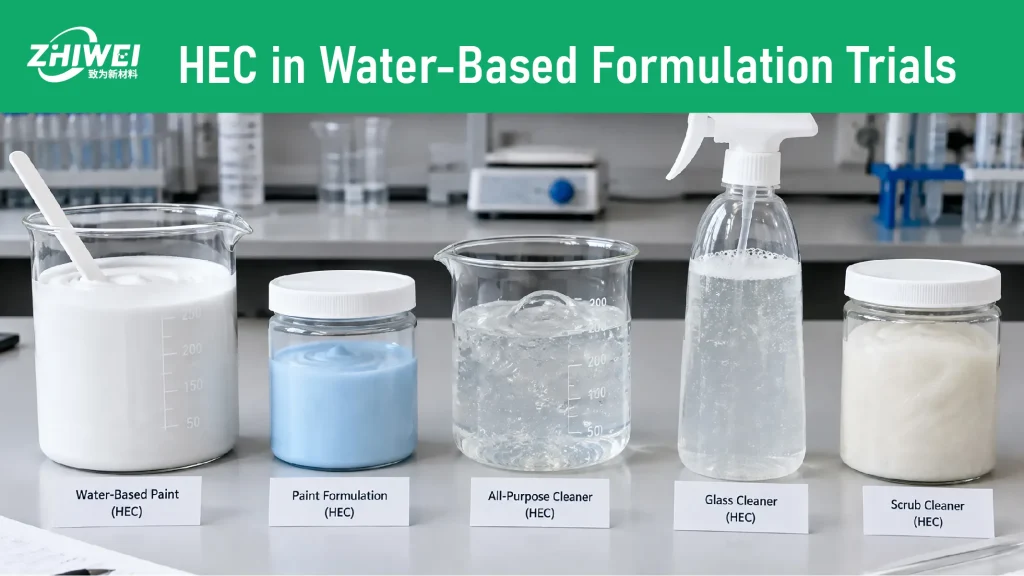
Water-Based Paints and Coatings
HEC is used to develop viscosity and adjust flow in water-based coatings. Its contribution should be evaluated through both laboratory measurements and practical application checks.
A paint needs more than an acceptable viscosity reading. Roller feel, spreading, leveling, sagging, and the behavior of suspended pigments all matter. These properties arise from the complete formulation, including the binder, pigment package, dispersants, and other rheology modifiers.
If a paint changes during storage, investigate the conditions and symptoms before replacing its thickener. A viscosity change does not, by itself, establish that HEC is the cause.
Household and Personal Care Formulations
HEC can be considered for water-based products where texture, pouring behavior, or consistency requires adjustment. Our application range includes household cleaners and selected home and personal care formulations.
Evaluation should cover the actual surfactant and electrolyte package. A successful water solution is a starting point, but it does not demonstrate that the same grade will develop the desired texture in a finished shampoo, cleaner, or lotion.
Appearance also deserves attention. If a formulation requires clarity, assess it after complete hydration and after incorporating the remaining ingredients. Record the preparation conditions so that apparent differences between grades are not caused by incomplete mixing.
Oilfield Fluids
HEC can serve as a viscosifier in selected aqueous oilfield systems. Suitability depends on the fluid composition, operating conditions, and required performance.
Viscosity development and fluid-loss control are separate functions. A fluid that becomes thicker does not automatically meet its filtration requirements. Evaluate each property using the procedure appropriate to the application.
Phase compatibility is equally important. Performance in an aqueous fluid does not establish that ordinary HEC will function as a direct viscosifier in an oil-continuous invert emulsion. Product selection must follow the actual fluid system.
How Do You Dissolve HEC in Water?
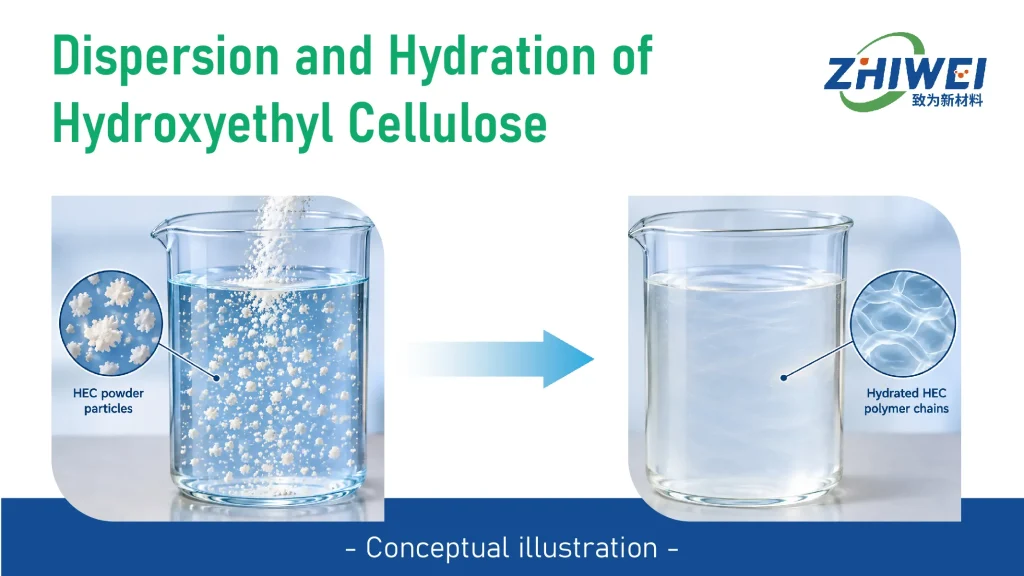
Successful HEC preparation requires both dispersion and hydration. Dispersion separates the powder particles; hydration allows the polymer to develop its solution behavior.
If powder is introduced too quickly, the outside of an agglomerate can hydrate before water reaches the interior. The resulting lump can contain incompletely hydrated material even when the surrounding liquid has already become viscous.
Use the procedure specified for the selected grade. In a suitable aqueous preparation, controlled powder addition under adequate mixing helps distribute the particles before viscosity development makes further dispersion more difficult.
Keep the addition rate, mixing conditions, water temperature, and preparation time consistent during trials. Also record when viscosity is measured. Comparing one freshly mixed sample with another that has fully hydrated can produce a misleading grade comparison.
Some grades have specific dispersion or hydration requirements. Do not assume that a pH adjustment, hot-water procedure, or fixed mixing time applies to every HEC product.
How Much HEC Should You Use?
There is no universal HEC dosage for paints, cleaners, personal care products, and oilfield fluids. The required addition depends on the desired flow behavior and the selected grade.
Begin with a documented screening range appropriate to the formulation. State the dosage basis clearly, such as a percentage of the total batch mass. A percentage based on total product differs from one calculated against the water phase.
Compare samples at the same temperature and after the same conditioning period. Record both the instrument result and the practical behavior relevant to the product.
A small series of measured additions is more useful than repeated adjustments by eye. It shows how sensitive the formulation is to concentration and helps identify a workable production tolerance.
Which Zhiwei HEC Grades Are Available?
Our HEC product range lists HEC 40, HEC 300, HEC 2K, HEC 6K, HEC 15K, HEC 30K, HEC 50K, HEC 100K, and HEC 150K within our Aurantix and Vandorix series.
These model names provide a starting point for discussing available products. The current technical data sheet should establish the viscosity specification and its measurement conditions. A model designation alone is not a complete application recommendation.
For example, HEC 30K and HEC 50K can be discussed as candidates within a formulation screening program. Their inclusion does not establish that either is the optimum choice for a particular paint or detergent.
To narrow the selection, we need the formulation type, target consistency, mixing method, and the problem being addressed. Samples should then be compared in the actual product rather than selected solely from the highest available viscosity designation.
Is HEC the Same as HPMC or HEMC?
HEC, HPMC, and HEMC are different cellulose ethers. Their names reflect different substituent groups on the cellulose structure, and their formulation behavior should be assessed accordingly.
Changing from one cellulose ether to another is a reformulation step. Matching a nominal viscosity value does not establish equivalent hydration, application behavior, or compatibility.
Define what the existing material does before evaluating a replacement. Is the objective viscosity development, moisture management, a particular application feel, or another property? That function determines the relevant comparisons.
This approach also prevents an incomplete substitution trial. A sample may reach the target viscosity while still differing in preparation time or finished-product behavior.
How Can You Troubleshoot HEC Performance?
Start by confirming preparation. Check the powder addition, mixing conditions, hydration time, and the temperature at which viscosity was measured.
Then review the formula. Changes in water content, salts, surfactants, pigments, or other additives can affect the result even when the HEC grade and dosage remain unchanged.
Use a retained control where possible. Comparing a new sample against a known formulation under the same conditions helps distinguish material differences from process variation.
For storage-related problems, record when the change occurred and what changed: viscosity, appearance, separation, or application behavior. These observations guide the next investigation more effectively than increasing the thickener without a defined reason.
Choosing HEC With Zhiwei
HEC chemical is hydroxyethyl cellulose: a water-soluble cellulose ether used to manage viscosity and flow in many aqueous formulations. Selecting it successfully requires a clear specification and tests that reflect the intended product.
At Zhiwei, we can discuss grade options based on your formulation, target viscosity, processing conditions, and application requirements. Share those details with us to establish a focused comparison of suitable HEC candidates.