

Why Your Choice of Hydroxypropyl Methylcellulose Suppliers Matters
Hydroxypropyl methylcellulose (HPMC) is the backbone additive in dry-mix mortar, tile adhesive, wall putty, water-based paint, and many other formulations. It controls water retention, workability, open time, and sag resistance. If the HPMC in your formula does not perform the same way in every batch, your end product will not perform the same way either.
That sounds obvious, but many buyers learn this lesson the hard way. They choose a supplier based on price alone, and then discover that the viscosity varies from shipment to shipment. Or the moisture content is too high, and the powder clumps in the bag. Or the substitution degree is off, and the water retention drops without warning.
The wrong HPMC supplier costs you more than money. It costs you customer complaints, production downtime, and damaged reputation. Your buyers do not care why their tile adhesive is sagging. They just know it is sagging, and they will find another brand next time.
This is why evaluating hydroxypropyl methylcellulose suppliers carefully before you commit is one of the most important decisions in your procurement process. In this article, we walk through seven specific criteria you should use to evaluate any HPMC supplier, and we share what we do at Zhiwei to meet each one.

7 Criteria to Evaluate Hydroxypropyl Methylcellulose Suppliers
Not all HPMC suppliers are equal. Some are manufacturers with their own production lines and quality control systems. Others are trading companies that buy from factories and resell under their own labels. Some have deep technical expertise. Others compete on price alone.
Here are seven criteria that separate reliable hydroxypropyl methylcellulose suppliers from the rest.
1. Manufacturing Capability
Does the supplier operate its own factory? This is the first and most important question. A manufacturer controls every step of the process — raw material selection, etherification, washing, drying, and packaging. A trading company controls none of these. They buy whatever is available and sell it to you.
Manufacturers can customize viscosity grades, adjust substitution degrees, and respond to technical issues quickly because they understand the chemistry. Trading companies can only relay messages between you and the actual factory, which slows everything down.
Ask your supplier directly: do you operate your own production line? Can we visit the factory? If the answer is vague, that is a warning sign.

2. Quality Control System
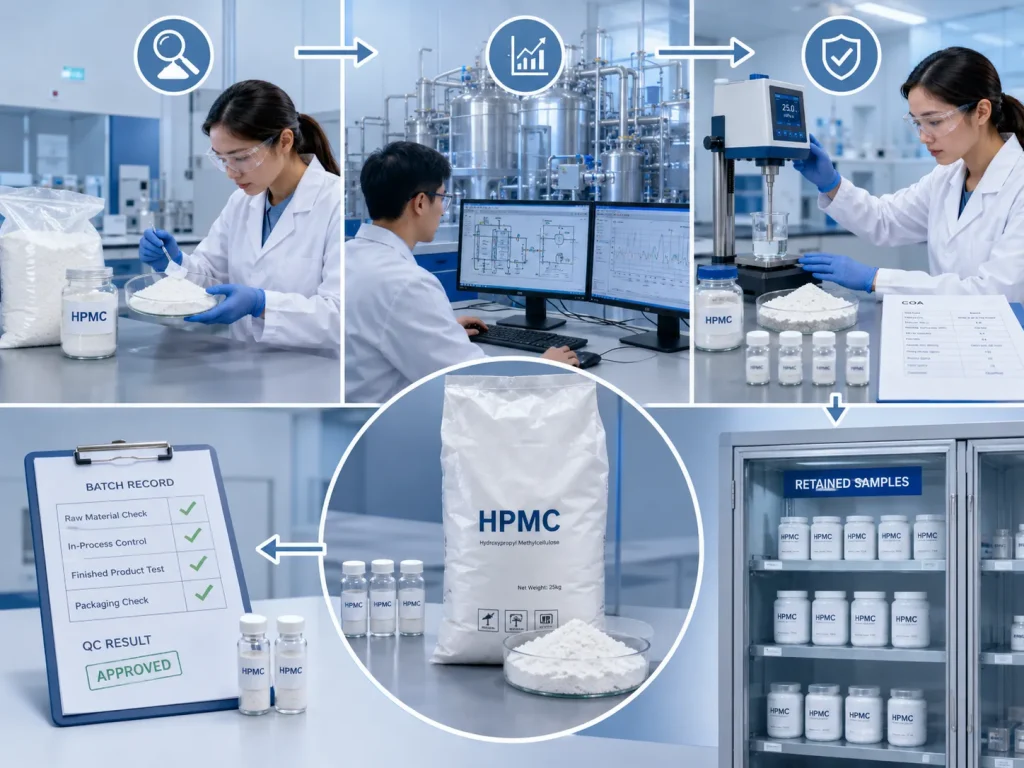
Quality control is not just about testing the final product. A proper QC system covers every stage:
- Incoming raw materials: testing cotton linter for purity, fiber length, and moisture before production starts
- In-process monitoring: tracking temperature, pressure, and reagent ratios during etherification
- Final product testing: measuring viscosity, moisture, ash, pH, and particle size for every batch
- Batch traceability: retaining samples and records so any issue can be traced back to its source
Ask your supplier for a detailed description of their QC process. If they only test the final product, they are not catching problems early enough.
3. Viscosity Consistency
Viscosity is the single most important performance parameter for HPMC. If viscosity varies between batches, your formulation behaves differently each time you mix a new batch of mortar or paint.
Good hydroxypropyl methylcellulose suppliers keep viscosity within a tight tolerance band — typically ±10% of the declared value. Suppliers with poor process control can have viscosity swings of 20% or more from batch to batch.
Before you commit, ask for COA (Certificate of Analysis) documents from three different production batches. Compare the viscosity values. If the spread is wide, the supplier has a consistency problem.

4. Certifications and Compliance
Certifications are not just paperwork. They show that the supplier has invested in systems and processes that meet international standards. Key certifications to look for include:
- ISO 9001: the baseline quality management standard
- REACH registration: required if you sell products containing HPMC in the European Union
- SGS or Intertek audit reports: third-party verification of manufacturing practices
- Halal or Kosher certification: important if you supply food or pharmaceutical markets
Ask for copies of these certifications, and check that they are current. Expired certificates are a red flag.
5. Export Experience and Documentation
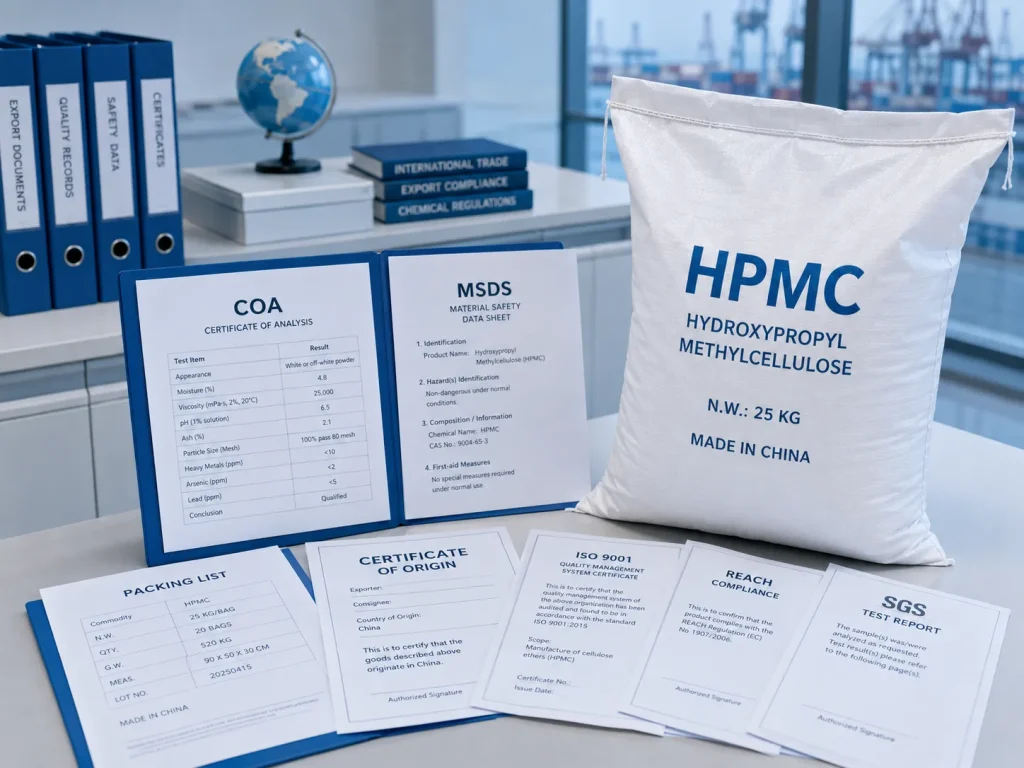
Selling HPMC domestically is different from exporting it. Export orders require proper documentation: commercial invoices, packing lists, certificates of origin, MSDS, and COA. Some destinations require additional documents like fumigation certificates or specific labeling.
Suppliers with limited export experience often make mistakes with documentation, which can delay shipments at customs or cause problems at your receiving port. Look for a supplier who has been exporting for at least several years and can provide references from customers in your region.
6. Technical Support
HPMC is not a commodity you buy and forget. You need technical support when you develop new formulations, troubleshoot performance issues, or switch between viscosity grades. A good supplier can answer questions like:
- Which HPMC grade works best for self-leveling mortar vs. tile adhesive?
- How do I adjust my formula if I switch from 100,000 mPa·s to 40,000 mPa·s?
- Why is my mortar losing workability too fast, and can HPMC help?
Trading companies usually cannot answer these questions in depth because they are not involved in production. Manufacturers can, because they understand how process parameters affect performance.

7. Sample and Trial Process
A reliable supplier should offer samples before you place a large order. Not just one sample — samples from the specific batch you would receive. Some suppliers send a “golden sample” that represents their best output, but then ship average or below-average material on production orders.
The right approach is to request samples from a current or recent production batch, test them in your own formulation, and then place a trial order of one or two pallets. Only after the trial order performs consistently should you scale up to full containers.
Red Flags That Signal an Unreliable HPMC Supplier
Watch for these warning signs when evaluating hydroxypropyl methylcellulose suppliers:
Prices that are too low. HPMC production involves refined cotton linter, etherification reagents, energy, and labor. If a supplier’s price is 30% below the market average, they are cutting corners somewhere — usually on raw materials or quality control.
No factory visit allowed. If a supplier refuses factory visits or makes excuses, they probably do not have their own production line. They are a trading company pretending to be a manufacturer.
Incomplete COA documents. A proper COA includes viscosity, moisture, ash, pH, and substitution degree. If a supplier only lists viscosity and nothing else, they are either not testing the other parameters or the results are bad.
No retained samples. Manufacturers keep retained samples from every batch for traceability. If a supplier cannot provide batch records or retained sample information, their quality system has gaps.
Frequent grade changes. If your supplier keeps sending different viscosity grades when you ordered the same product, their process control is weak. Consistent grades should be the norm, not the exception.
Slow response on technical questions. A manufacturer can answer technical questions quickly because they know their own process. A trading company has to ask the factory and wait for a reply. If technical answers take days, you are probably dealing with a trader.
How We Meet These Standards at Zhiwei
At Zhiwei (Jinan) New Materials Co., Ltd., we understand that buyers evaluate us using the same criteria we just described. Here is how we address each one.
We operate our own factory. Our production base is in Zhejiang Province, China, with an annual capacity of 15,000 metric tons. We produce HPMC, HEMC, HEC, RDP, and PCE on our own lines. We welcome factory visits and third-party inspections. You can see the production line, the laboratory, and the warehouse in person.
We test at every stage. We test incoming cotton linter for purity and fiber length. We monitor the etherification reaction in real time with automated controls. We test every finished batch for viscosity, moisture, ash, pH, and particle size. We retain samples from every batch and keep full records.
We keep viscosity within ±10%. Our process control system maintains tight tolerances on temperature, pressure, and reagent ratios during production. This keeps viscosity consistent from batch to batch. We provide COA documents with every shipment so you can verify the numbers yourself.
We hold current certifications. We are ISO 9001 certified. We can provide REACH documentation for EU customers. We work with SGS and other third-party auditors when customers request inspections.
We have export experience in over 30 countries. Our export team handles documentation, logistics, and customs requirements for markets in the Middle East, Southeast Asia, South America, Africa, and Europe. We know what documents your destination requires, and we prepare them correctly.
We provide technical support. Our team can help you select the right HPMC viscosity grade for your application, troubleshoot formulation issues, and adjust product specs for custom orders. We also offer OEM services with custom viscosity grades and packaging for customers building their own brands.
We offer a structured trial process. We send samples from current production batches, not specially prepared golden samples. We encourage trial orders of one or two pallets before you commit to full containers. We provide COA documents for every batch, including trial orders.
HPMC Viscosity Grades and Application Matching
Choosing the right viscosity grade is just as important as choosing the right supplier. Here is a reference table for common HPMC applications:
| Application | Recommended Viscosity (2% solution, 20°C) | Key Performance Requirement |
|---|---|---|
| Tile adhesive (cementitious) | 40,000–100,000 mPa·s | Open time, adhesion, anti-sag |
| Wall putty / skim coat | 40,000–100,000 mPa·s | Workability, water retention |
| Self-leveling mortar | 400–15,000 mPa·s | Flow, flatness, no segregation |
| Exterior plaster / render | 40,000–100,000 mPa·s | Water retention, crack resistance |
| EIFS base coat | 60,000–100,000 mPa·s | Bond strength, flexibility |
| Gypsum-based products | 40,000–100,000 mPa·s | Setting control, smooth finish |
| Water-based paint | 30,000–60,000 mPa·s | Thickening, spatter resistance |
| Detergent | 400–6,000 mPa·s | Dissolution speed, clarity |
When you evaluate hydroxypropyl methylcellulose suppliers, make sure they offer the viscosity range your application requires. A supplier who only produces one or two grades may not be able to serve you as your product line grows.
At Zhiwei, we produce HPMC across a wide viscosity range from 400 to 200,000 mPa·s. This lets us serve customers in construction, coatings, and daily chemical applications with the right grade for each formulation.
Steps to Start a Trial With a New HPMC Supplier
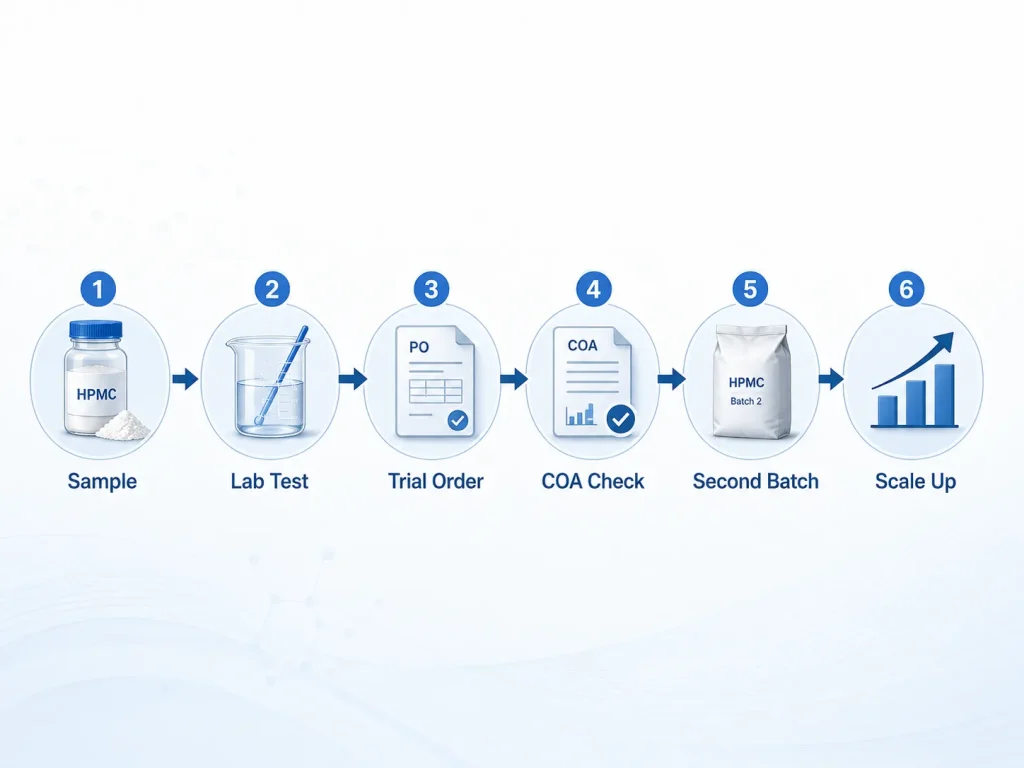
If you are considering a new HPMC supplier, here is a practical step-by-step process:
- Request samples from a current production batch. Ask the supplier to send material from their regular stock, not a special preparation. Test it in your lab for viscosity, moisture, and pH.
- Test in your actual formulation. Lab data tells you about the raw material, but your formulation tells you about real-world performance. Mix a trial batch and check workability, open time, water retention, and sag resistance.
- Place a small trial order. Order one or two pallets. Track the material through your full production process. Compare the results to your current supplier.
- Check the COA against your test results. Does the viscosity on the COA match what you measured in your lab? If there is a large gap, the supplier’s testing may not be reliable.
- Order a second batch and compare. Consistency is the key metric. If batch one and batch two perform the same way, you have a supplier who can deliver reliable results.
- Scale up gradually. Move from trial orders to full containers over two or three purchase cycles. This gives you time to catch any issues before you are fully committed.
- Maintain a backup supplier. Even with a reliable primary supplier, keep a secondary option qualified and ready. Supply chain disruptions happen, and having a backup protects your production.
Choosing the right hydroxypropyl methylcellulose supplier is a decision that affects your product quality, your production efficiency, and your customer satisfaction. Take the time to evaluate properly, and you will avoid costly problems later.
If you are looking for a hydroxypropyl methylcellulose supplier who produces their own material, controls quality at every stage, and supports you with technical expertise, contact our team at Zhiwei for samples and pricing.