
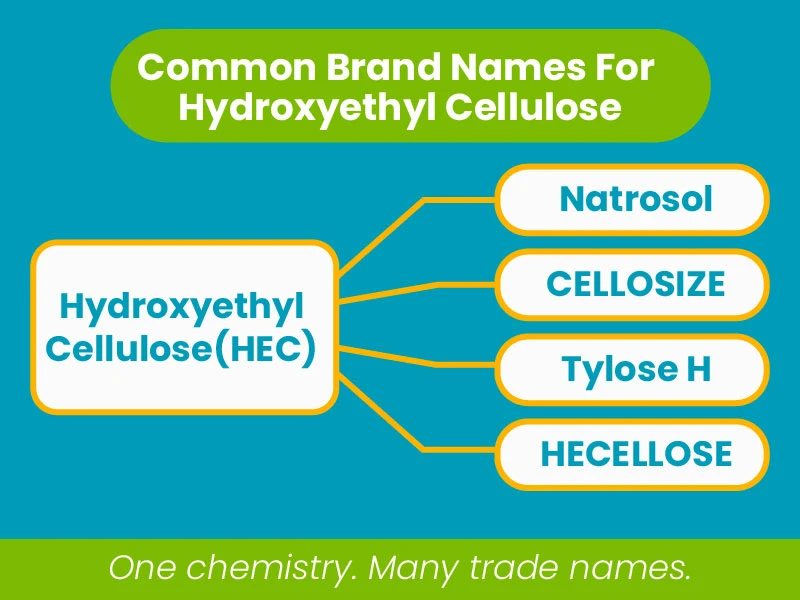
At Zhiwei, the shortest answer is this: hydroxyethyl cellulose is the generic chemical name, while the common commercial brand names buyers often see in the market include Natrosol™, CELLOSIZE™, Tylose® H, and HECELLOSE®. In some building-material and ready-mix contexts, buyers may also encounter Natrovis™ as another hydroxyethyl cellulose trade name. These are not different chemistries in the basic sense. They are brand or product-family names used by different manufacturers for their own hydroxyethyl cellulose grades.
This matters because many buyers search by trade name first and chemistry second. One customer may ask for Natrosol. Another may ask for CELLOSIZE. Another may ask for Tylose H. In many cases, all of them are still asking about hydroxyethyl cellulose, just through different supplier languages. That is why a clear article should separate the generic name from the brand names. The generic name tells you what the material is. The brand name usually tells you who makes it and how that company positions its grade family in the market.
Hydroxyethyl Cellulose Is The Generic Name
Before looking at brand names, it helps to start with the generic material. Hydroxyethyl cellulose, often shortened to HEC, is a nonionic, water-soluble cellulose ether. Ashland’s Natrosol pages describe it as hydroxyethylcellulose. Dow’s CELLOSIZE pages do the same. SE Tylose identifies Tylose HEC as hydroxyethyl cellulose, and Zhiwei’s own HEC product page also uses the generic name Hydroxyethyl Cellulose Ether HEC. That means the chemical identity stays the same even when the trade name changes.
For buyers, this distinction is practical. If a specification sheet says hydroxyethyl cellulose, that is the base material family. If the packaging or quotation says Natrosol, CELLOSIZE, Tylose H, or HECELLOSE, that is usually the supplier’s trade identity for a specific line of hydroxyethyl cellulose grades. In other words, the chemical name answers “what is it,” while the brand name answers “whose line is it.”
Natrosol™ Is One Of The Best-Known Hydroxyethyl Cellulose Brand Names
One of the most recognized brand names for hydroxyethyl cellulose is Natrosol™, which belongs to Ashland. Ashland’s official product pages explicitly use the phrase “Natrosol™ hydroxyethylcellulose (HEC)” and describe it as a nonionic, water-soluble polymer used across personal care, coatings, adhesives, ceramics, and other aqueous systems. Ashland also publishes individual Natrosol grade pages, such as Natrosol 250 MBR hydroxyethylcellulose, which confirm that Natrosol is a true hydroxyethyl cellulose brand family rather than a general marketing term.
Natrosol is not only well known because it exists. It is also strongly established in practical applications. Ashland stated in a company release that formulators around the world have relied on Natrosol hydroxyethylcellulose for more than 50 years and that Natrosol HEC is the most widely specified thickener brand for waterborne architectural coatings. That makes Natrosol one of the clearest answers to the title question. If someone asks for a common hydroxyethyl cellulose brand name, Natrosol is very often near the top of the list.
Ashland also uses related trade naming around hydroxyethyl cellulose in construction-oriented markets. Its official building-materials page presents Natrosol™ / Natrovis™ hydroxyethylcellulose for joint compounds, ready-to-use building materials, dry mortars, and self-leveling underlayments. That means buyers may see either Natrosol or Natrovis depending on the application channel, even though both are tied to Ashland’s hydroxyethyl cellulose offering.
CELLOSIZE™ Is Another Major Hydroxyethyl Cellulose Brand Name
Another very common hydroxyethyl cellulose brand name is CELLOSIZE™, which appears on Dow’s official product pages. Dow publishes multiple current CELLOSIZE hydroxyethyl cellulose grades, including CELLOSIZE QP-4400H, QP-30000H, QP-52000H, and personal-care grades such as CELLOSIZE Hydroxyethyl Cellulose PCG-10 Europe. These pages clearly identify CELLOSIZE as hydroxyethyl cellulose and show that it is used in paints, liquid cleaning products, detergents, hair care, skin care, and color cosmetics.
CELLOSIZE is important because it is not limited to one narrow market. Dow positions different CELLOSIZE hydroxyethyl cellulose grades across both industrial and personal-care applications. Some grades are framed as latex paint thickeners or general thickeners for water-borne systems, while others are described as high-quality rheology modifiers for cosmetics. This wide official use profile is one reason CELLOSIZE is one of the brand names buyers often encounter when they research hydroxyethyl cellulose suppliers.
Tylose® H Or Tylose® HEC Is Also A Common Trade Name
A third important brand family is Tylose® H, sometimes referred to more broadly as Tylose® HEC. SE Tylose’s official hydroxyethyl cellulose page states directly that Tylose HEC, also called Tylose H grades, is hydroxyethyl cellulose. The page lists many Tylose H grades and shows that the line is used in cement-based renders, troweling compounds, emulsion systems, paints, ceramics, polymerization, personal care, home care, oilfield applications, and more. That is strong official evidence that Tylose H is a real and established hydroxyethyl cellulose trade name.
The Tylose naming system also matters because it shows how one brand can hold many grades under one family name. On the official Tylose HEC page, SE Tylose lists numerous individual grades such as Tylose H 10 YG4, H 20 P2, H 300 NG4, H 100000 YP2, and others. In other words, “Tylose H” works as the broad hydroxyethyl cellulose brand family, while the longer grade code gives the specific viscosity, particle form, or modification profile. This is a common pattern in cellulose ether branding and one more reason why buyers often remember the brand name first.
Tylose also appears in the wider Shin-Etsu group product story. Shin-Etsu’s official personal-care page says that SE Tylose produces Tylose products and that Tylose hydroxyethyl cellulose is widely used in cosmetics. That broader group-level confirmation adds another layer of credibility to Tylose as a recognized hydroxyethyl cellulose brand family.
HECELLOSE® Is A Recognized Hydroxyethyl Cellulose Brand Name In Asia
Another common brand name buyers may see is HECELLOSE®, which is associated with LOTTE Fine Chemical. LOTTE’s official English fine-chemicals page lists HECELLOSE® under its industrial cellulose derivatives. LOTTE’s sustainability reports also pair MECELLOSE and HECELLOSE as the company’s industrial cellulose derivative brands and identify HECELLOSE as being used in paints, personal care, home care, and oil drilling. A company news release in English also refers to the “Yeosu HECELLOSE factory,” which further confirms HECELLOSE as a real hydroxyethyl cellulose brand and factory identity rather than just a marketing slogan.
HECELLOSE is especially useful to mention because it shows that hydroxyethyl cellulose branding is not limited to one region or one company tradition. In global sourcing, buyers may encounter Ashland, Dow, SE Tylose, and LOTTE materials in different sectors or markets. So while Natrosol and CELLOSIZE are often the first names many international buyers recognize, HECELLOSE is also part of the real commercial landscape for hydroxyethyl cellulose.
Are These Different Chemicals Or Just Different Brands?
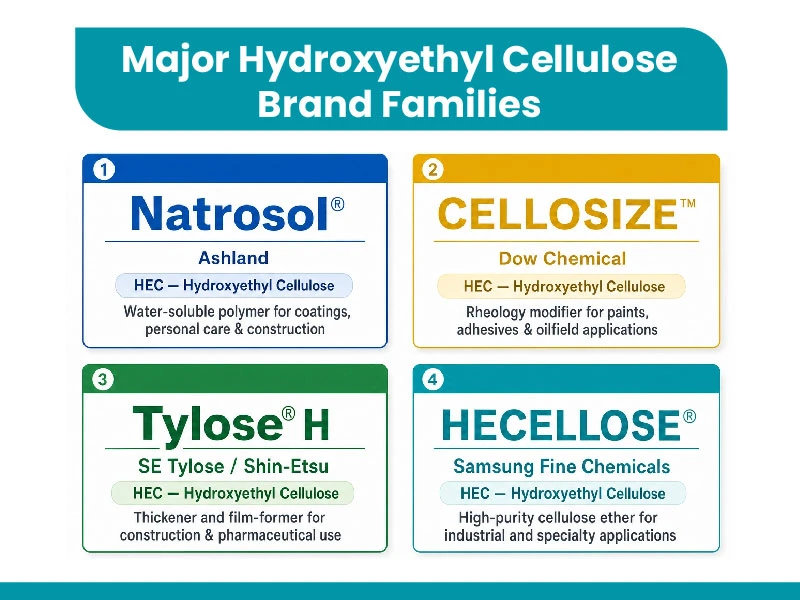
In most business conversations, these are primarily different brand families for hydroxyethyl cellulose, not different base chemistries. Natrosol is Ashland’s hydroxyethyl cellulose line. CELLOSIZE is Dow’s hydroxyethyl cellulose line. Tylose H is SE Tylose’s hydroxyethyl cellulose line. HECELLOSE is LOTTE Fine Chemical’s hydroxyethyl cellulose line. The differences that matter most to buyers are usually grade range, viscosity profile, particle size, treatment, end-use positioning, and supplier support, rather than the fact that they all start with hydroxyethyl cellulose as the base chemistry.
That said, brand does not mean the products are identical in use. Official product pages from all four manufacturers show that each brand family includes multiple grades for different applications. Ashland presents Natrosol in coatings, personal care, adhesives, and ceramics. Dow presents CELLOSIZE in paints, detergents, and cosmetics. SE Tylose presents Tylose H across paints, oilfield, personal care, and construction. LOTTE presents HECELLOSE in paints, personal care, home care, and drilling. So the chemistry family is shared, but the marketed grade systems are not necessarily interchangeable without technical review.
What Zhiwei Calls Hydroxyethyl Cellulose
At Zhiwei, we usually present the product directly as Hydroxyethyl Cellulose Ether HEC rather than relying on an older legacy-style trade name. Our official HEC product page uses the generic chemical identity clearly and describes HEC as being made by reacting refined cotton with alkali treatment in the presence of isopropyl alcohol and using ethylene oxide as the etherifying agent. The same page describes the finished product as a white to light yellow flowing powder with thickening, suspension, dispersion, emulsification, adhesion, film formation, moisture protection, and protective-colloid properties. Our company profile also places HEC inside a cellulose ether production system with three cellulose ether lines and annual capacity of 10,000 tons.
This direct naming approach has one clear advantage. It reduces confusion. A buyer immediately sees that the product is hydroxyethyl cellulose, even if that buyer is not familiar with older trade names like Natrosol or CELLOSIZE. At the same time, understanding those common brand names is still useful, especially when customers compare existing market references, competitor documents, or older formulation histories. That is why it helps to know both the generic name and the common trade names.
A Simple Way To Remember The Main Names
A simple way to remember the naming structure is this. Hydroxyethyl cellulose or HEC is the generic name. Natrosol, CELLOSIZE, Tylose H, and HECELLOSE are commercial brand names used by different manufacturers. Natrovis is another Ashland-linked hydroxyethyl cellulose trade name seen especially in building-material contexts. Once buyers understand that structure, product research becomes much easier. They can read a quotation, data sheet, or website and quickly tell whether they are looking at a chemistry name or a supplier brand name.
Conclusion
The common brand names for hydroxyethyl cellulose that buyers most often encounter include Natrosol™, CELLOSIZE™, Tylose® H, and HECELLOSE®. In some construction-focused contexts, Natrovis™ also appears as a hydroxyethyl cellulose trade name. These names come from different manufacturers, but they all point back to the same broader cellulose ether family.
At Zhiwei, we find it best to start with the generic name first and then explain the brand landscape around it. That makes the product easier to understand and easier to compare. For technical buyers, distributors, and formulators, the real value is knowing that hydroxyethyl cellulose may appear under several trade names in the market, even when the core chemistry is the same.