
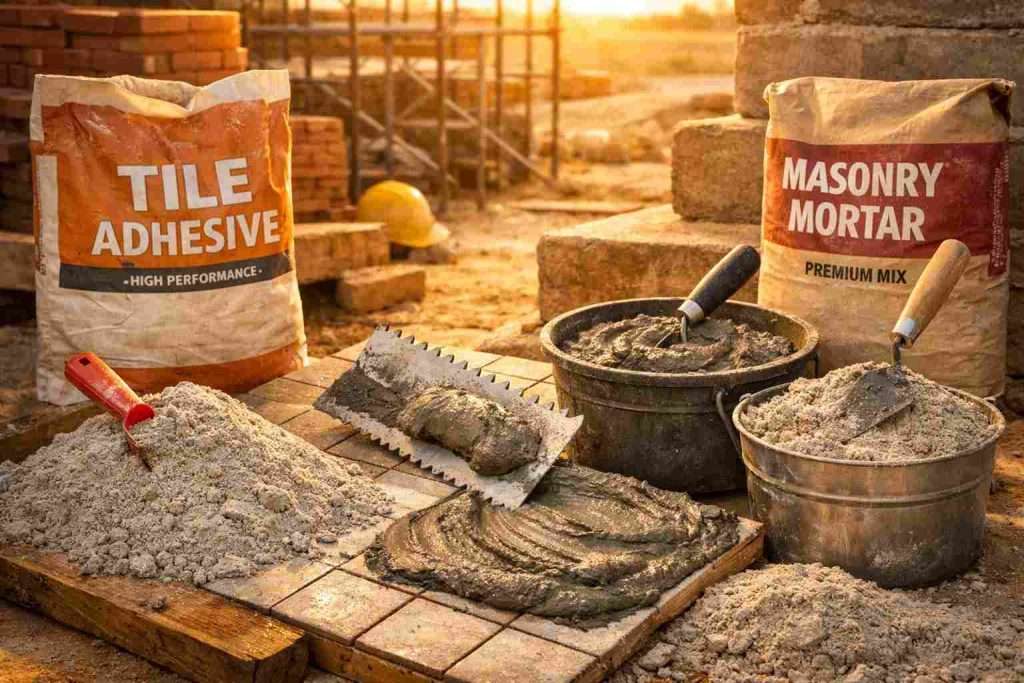
HEMC is used mainly in dry-mix construction materials. That is the clearest answer. In the market, hydroxyethyl methyl cellulose is added to tile adhesives, cement mortars, gypsum plasters, renders, skim coats, joint compounds, self-leveling products, and floor screeds because it helps the mix hold water, spread more smoothly, stay workable longer, and resist sagging during application. In some formulations, it is also used as a rheology modifier, a thickener, and a stabilizing aid. Outside construction, HEMC also appears in selected cosmetic formulations where viscosity control and formulation stability matter.
For buyers, the value of HEMC is practical rather than theoretical. It is not added because the formula needs another chemical name on the label. It is added because the finished product needs better handling and more stable performance. In cement-based systems, that often means better water retention, easier workability, more open time, and a stronger balance between flow and hold. In cosmetic-type systems, it usually means viscosity control and a more stable texture. This is why HEMC is best understood as a performance additive, not just a raw material.
What Is HEMC?
HEMC stands for hydroxyethyl methyl cellulose. It is a non-ionic cellulose ether. In practical use, that means it is a water-soluble polymer that can change how a wet formula behaves during mixing, spreading, leveling, and early curing. This family of additives is widely used in construction because it improves water retention and consistency in cement-based mortars. Research published in Cement and Concrete Research notes that cellulose ethers are commonly used as admixtures to improve water retention, workability, and open time in cement-based materials, and it identifies HEMC and HPMC as the most widespread cellulose ethers used in practice.
For a manufacturer such as Zhiwei, HEMC sits inside a broader cellulose-ether product platform. Zhiwei’s public company profile lists cellulose ethers as core products and describes them as additives valued for thickening, water solubility, suspension stability, film forming, water retention, and adhesion. The same public profile lists HEC, HEMC, and HPMC among its main product families and states that the company operates three cellulose-ether production lines with annual capacity of 10,000 tons. That is why HEMC is not a side product in the Zhiwei range. It is one of the core materials in the company’s construction-chemicals offering.
The Main Use Of HEMC Is In Construction Materials
The strongest commercial use of HEMC is still in construction. Official product pages from Dow and Ashland both center HEMC, or methylhydroxyethylcellulose, on cement-based building materials. Dow’s WALOCEL HEMC grades are described for cement-based applications such as tile adhesives and cement mortars, with stated functions that include rheology modification, thickening, and water retention. Ashland’s Culminal methylcellulose derivatives are positioned for cementitious adhesives, gypsum plasters and fillers, joint compounds, renders, skim coats, self-leveling underlayments, and floor screeds.
This matters because dry-mix construction products live or die by application feel. A mortar that loses water too fast may become hard to spread. A tile adhesive with poor sag resistance may slip on a wall. A plaster with poor consistency may drag during finishing. A self-leveling product with the wrong balance may not flow or hold as intended. HEMC is used in these systems because it helps the wet mix behave in a more controlled way before the binder fully sets. That makes it one of the most useful functional additives in construction-grade powder formulations.
HEMC In Tile Adhesives
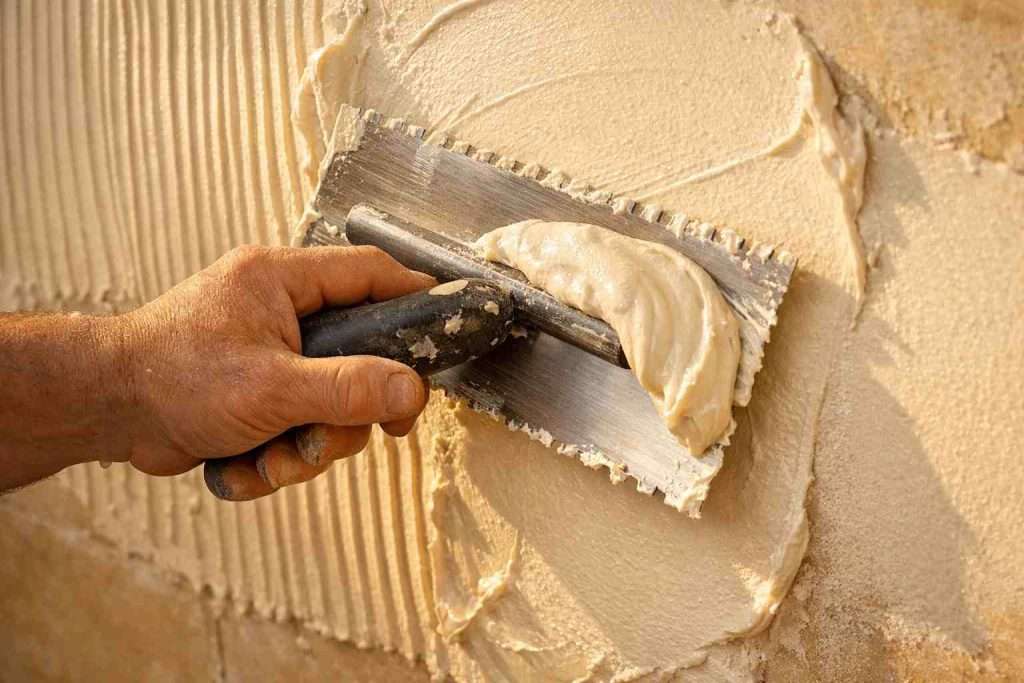
Tile adhesive is one of the clearest examples of where HEMC is used. Dow’s current HEMC product pages describe several WALOCEL grades developed for premium cementitious adhesive formulations such as tile adhesives and ETICS mortars. The listed benefits include excellent or good water retention, easy workability, adhesion and shear strength support, and in some grades strong slip resistance and early strength development. Those are exactly the properties tile-adhesive producers care about when they need a mix to apply smoothly and perform well after curing.
Ashland’s Culminal UP line points in the same direction. It describes modified methylhydroxyethylcellulose for premium cementitious adhesives, with emphasis on faster strength development, higher final tensile strength, excellent workability, and sag resistance. This is useful evidence because it shows that HEMC is not only a generic thickener in tile adhesive. It is a designed performance tool used to tune how the adhesive behaves during installation and how it develops strength after placement.
HEMC In Cement Mortars, Plasters, And Renders
HEMC is also widely used in cement mortars, gypsum plasters, fillers, renders, skim coats, and related dry-mix systems. Ashland lists these applications directly in its Culminal portfolio. Dow lists cement mortars as a use for WALOCEL M 120-01 and describes that product as a rheology modifier, thickening aid, and water retention aid for cement-based applications. In these products, the goal is not only to make the mix thicker. The goal is to create a more useful balance between flow, body, water control, and application time.
That balance is especially important on the jobsite. A plaster or mortar has to stay workable long enough for proper application, but it also has to hold on the wall and cure in a controlled way. The research literature supports this practical view. The Cement and Concrete Research paper notes that water retention is fundamental in mortar because it prevents rapid loss of water to the substrate, supports workability, and helps preserve bonding and mechanical performance. In other words, HEMC is used in mortars because it helps the mix keep the water it needs long enough to work well.
HEMC In Self-Leveling And Floor Systems
HEMC also appears in self-leveling underlayments and floor screeds. Ashland includes both applications in its methylcellulose-derivatives range. These systems need more than simple viscosity. They need controlled flow, uniform wet behavior, and stable water management during the early stage after mixing. That is why cellulose ethers remain important in floor systems even when the end goal is a smooth, level surface rather than a troweled wall finish.
Why HEMC Works So Well In Construction
The main reason is that HEMC changes how water behaves inside the mix. Cellulose ethers are widely used in mortars because they improve water retention, workability, and open time. Research has also shown that the substitution group matters. A 2021 Construction and Building Materials paper found that HEMC showed better water-retention capability than HEC in calcium sulfoaluminate cement mortar under the test conditions studied, and that above certain dosage levels HEMC could retain water through formation of a polymer network. That does not mean HEMC is always the best cellulose ether in every system, but it does explain why it is so established in construction-grade formulas.
Another reason is workability. Dow’s HEMC grades repeatedly emphasize easy workability. Ashland’s HEMC-related product pages emphasize excellent workability and sag resistance. In practical terms, this means the material helps the formulator shape how the mix feels during use. A good HEMC grade can help a mortar or adhesive feel smoother, stay on the tool more consistently, and resist unwanted slipping or collapse on vertical surfaces. Those effects are not cosmetic details. They directly affect job efficiency and final quality.
A third reason is that HEMC can support the balance between fresh performance and strength development. Some newer HEMC grades are described by Dow and Ashland as being developed to reduce the negative effect on cement hydration while preserving or improving early and final strength. That is a valuable point for modern low-clinker or low-carbon cement systems, where the additive package has to support both workable application and reliable curing.
HEMC Is Also Used In Cosmetic Formulations
Construction is the core market, but it is not the only one. In cosmetic ingredient references, methyl hydroxyethylcellulose is listed with viscosity-controlling and light-stabilizing functions. That is a much narrower claim than the construction use case, but it is still important. It shows that HEMC can be used where a formulator needs to adjust thickness, consistency, or stability in a personal-care system. This makes sense chemically, because the same water-soluble polymer behavior that helps construction formulas can also help liquid or semi-liquid cosmetic systems stay uniform and easy to handle.
Zhiwei’s public HEMC product page also places HEMC beyond building materials and identifies it as a cosmetic raw material. That should be read carefully. It does not mean every HEMC grade is automatically suitable for every cosmetic application. It means the chemistry has recognized value outside cement systems, especially in formulations that need viscosity control, film support, or dispersing and protective-colloid behavior. For buyers, the key point is that HEMC is a family material. The exact grade still has to match the final use.
HEMC Is Used Whenever A Formula Needs Rheology Control
A useful way to think about HEMC is by function rather than by industry name. Dow explicitly describes one HEMC grade as a rheology modifier, thickening aid, and water retention aid. Ashland describes methylcellulose derivatives as materials that help control thickening, water demand, open time, sag resistance, and strength in the final product. That means HEMC is used wherever the formulator needs tighter control over how a wet system flows, holds, spreads, or stays stable before drying or setting.
This function-first view also explains why grade selection matters so much. Two HEMC grades can both be called HEMC and still behave differently in practice. One may be designed for balanced tile-adhesive performance. Another may focus more on slip resistance. Another may aim for quick dissolution or better compatibility with specific binder systems. That is why professional buyers do not stop at the product name. They ask how the material behaves in the target formula.
What This Means For Zhiwei
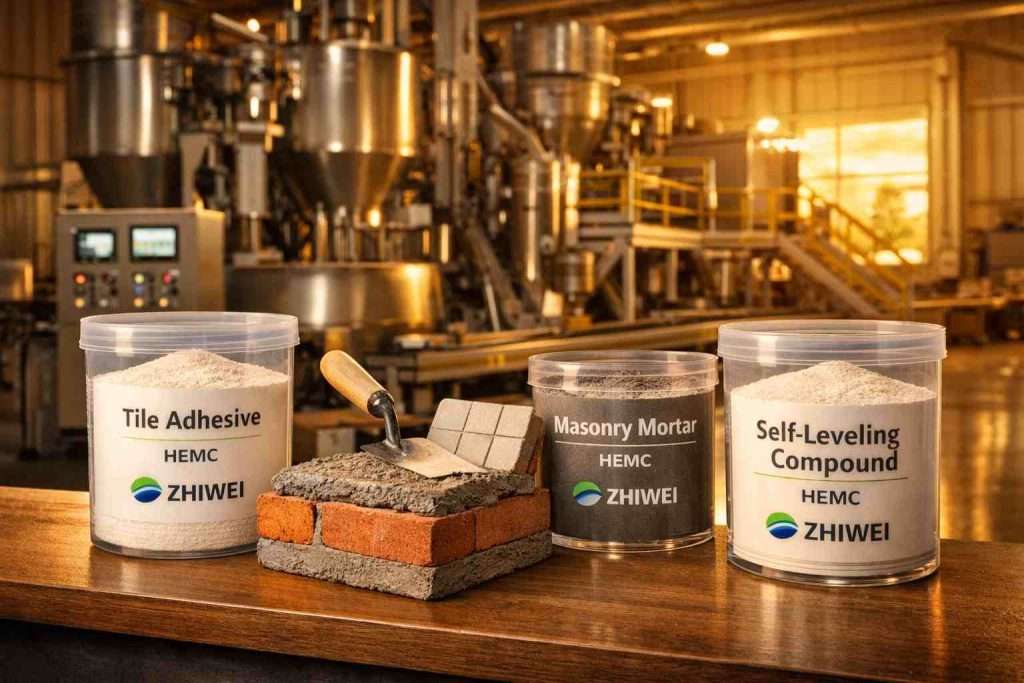
For Zhiwei (Jinan) New Materials Co., Ltd., the clearest commercial position for HEMC is construction grade. The company’s public profile is built around cellulose ether production, and its product range includes HEC, HEMC, and HPMC. In that context, HEMC is best presented as a practical additive for dry-mix building materials, especially where the customer needs stable water retention, good workability, and reliable application behavior. That is a stronger and cleaner message than treating HEMC as an all-purpose chemical for every market at once.
That position also fits how the market buys. Most HEMC demand is tied to performance-driven construction systems. Customers in this segment usually care about product feel, open time, sag resistance, hydration balance, and repeatability from batch to batch. A supplier that can connect HEMC to those real formulation goals will sound more credible than a supplier that only repeats broad chemistry terms.
Conclusion
The main uses of HEMC are in dry-mix construction products such as tile adhesives, cement mortars, plasters, renders, skim coats, joint compounds, self-leveling materials, and floor screeds. In these systems, HEMC is used to improve water retention, workability, rheology, open time, and sag resistance. A second, smaller use area is cosmetic formulation, where it can serve as a viscosity-controlling and stabilizing ingredient. Across both areas, the logic stays the same: HEMC is used when a formula needs better control over thickness, water, texture, and handling.
For Zhiwei, that leads to a clear article message. HEMC is not just another cellulose name in the catalog. It is a practical performance additive, and its strongest value is in construction systems where controlled application and stable fresh-state behavior matter most. That is the commercial center of the product, and it is the clearest answer to the question, “What are the uses of HEMC?”