
Introduction
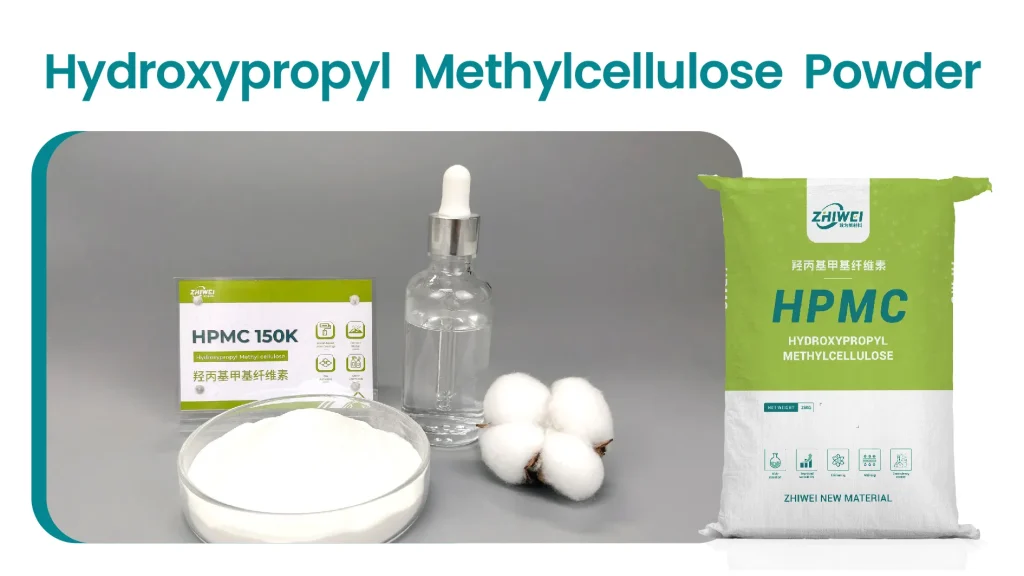
Hydroxypropyl methylcellulose, usually called HPMC, is a non-ionic cellulose ether made from purified natural cellulose. It is a white or off-white powder. It has no clear odor, no strong taste, and it can dissolve in cold water to form a clear or slightly cloudy viscous solution.
HPMC is widely used because it can do many jobs at the same time. It can improve water retention, thickening, workability, film formation, suspension, adhesion, lubrication, emulsification, and stability. This is why it is used in construction materials, water-based coatings, detergents, ceramics, adhesives, polymer systems, and many other water-based products.
In construction, HPMC is especially important. A small dosage can strongly affect mortar, tile adhesive, wall putty, gypsum plaster, self-leveling mortar, EIFS mortar, and repair mortar. It helps the material keep water, stay workable, resist sagging, spread smoothly, and develop better final performance.
For manufacturers, the key question is not only what HPMC is. The more useful question is how to choose the right HPMC grade. Zhiwei supplies HPMC grades such as HPMC 400, HPMC 4K, HPMC 40K, HPMC 100K, HPMC 150K, and HPMC 200K for different viscosity and application needs.
What Is HPMC?
HPMC is a non-ionic cellulose ether produced from refined cotton or other purified cellulose. The cellulose is treated under alkaline conditions and then modified through etherification. This process gives the cellulose better water solubility and useful thickening behavior.
HPMC is also known as hydroxypropyl methyl cellulose, hypromellose, cellulose hydroxypropyl methyl ether, and HPMC cellulose ether.
In powder form, HPMC is usually white to off-white. It can be fibrous, powdery, or granular. It dissolves in water and in some mixed solvent systems. It does not dissolve well in ethanol alone. After it dissolves in water, it forms a viscous solution with surface activity and colloid protection.
One important feature of HPMC is thermal gelation. Its water solution can become cloudy or form a gel when heated to a certain temperature. After cooling, it can return to the original solution state. This reversible sol-gel behavior depends on the HPMC type, concentration, substitution level, and heating rate.
Main Specifications Of HPMC
HPMC specifications are usually controlled by several key indexes.
| Specification Item | Why It Matters |
|---|---|
| Appearance | Shows basic product condition and cleanliness |
| Methoxy content | Affects gel temperature, solubility, and surface activity |
| Hydroxypropoxy content | Affects hydration, water solubility, and performance |
| Viscosity | Controls thickening, water retention, and application body |
| Gel temperature | Affects thermal behavior and processing conditions |
| Loss on drying | Shows moisture level and storage condition |
| Ash content | Helps judge purity and inorganic residue |
| pH | Affects compatibility in water-based systems |
| Particle size | Affects dispersion, dissolution, and mixing speed |
For Zhiwei HPMC grades, common product pages list HPMC as white to off-white powder with methoxy content around 19.0-24.0% and hydroxypropoxy content around 4.0-12.0%. Viscosity depends strongly on grade. For example, Zhiwei HPMC 400 is a low-viscosity grade, while Zhiwei HPMC 100K and HPMC 200K are high-viscosity grades for stronger water retention and application body.
Main Properties Of HPMC
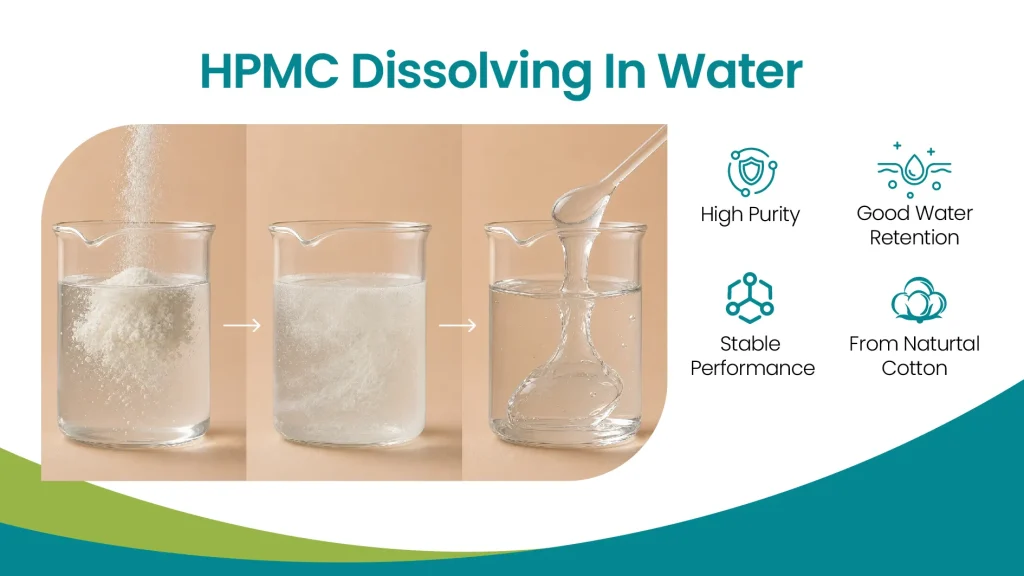
Water Retention
Water retention is one of the most important HPMC properties. HPMC can hold water in cement mortar, gypsum, putty, coatings, and other systems. In construction materials, this gives cement or gypsum more time to hydrate.
Better water retention can improve workability and reduce fast water loss into the wall or substrate. It can also reduce cracking, powdering, and weak bonding caused by rapid drying.
Thickening
HPMC increases the viscosity of water-based systems. This helps improve consistency, body, anti-sag behavior, and application feel. In mortar, it helps the paste stay on the wall. In paint, it helps improve storage stability and flow. In adhesives, it helps control spread and wet structure.
The thickening effect depends on viscosity grade, dosage, water amount, temperature, salt level, pH, and mixing method.
Surface Activity And Emulsification
HPMC water solutions have surface activity. This means HPMC can support dispersion, emulsification, and colloid protection in some systems. It can help solid particles stay more evenly distributed.
This is useful in coatings, polymer suspension systems, and water-based formulas where storage stability matters.
Film Formation
After drying, HPMC can form a strong, flexible, transparent film. This film-forming property helps in coatings, binders, paper products, ceramics, and some adhesive systems. The film can support surface quality, adhesion, and resistance to oil or grease in some uses.
Suspension And Anti-Settling
HPMC can help prevent solid particles from settling. This is useful in coatings, pigment systems, ceramic slurries, mortar, and other systems with powders or fillers.
In self-leveling mortar and water-based coatings, this helps keep the formula more uniform during storage and application.
Salt Resistance
HPMC is non-ionic. It is not a polymer electrolyte. Because of this, it can remain stable in many metal salt or organic electrolyte solutions. If the electrolyte level is too high, gelation or precipitation may still happen, so compatibility testing is still needed.
pH Stability
HPMC solutions are generally stable across a wide pH range. In many systems, the viscosity is not strongly affected by acid or alkali. A common practical range is about pH 3.0-11.0.
This makes HPMC useful in many construction and coating formulas. But each formula should still be tested because surfactants, salts, cement, pigments, and other additives can affect final behavior.
Lubrication
HPMC can reduce friction and improve slip. In construction materials, this makes mortar, gypsum, putty, and tile adhesive easier to spread. In extrusion systems, such as ceramic or concrete board processing, lubrication can improve shaping and processing.
Shape Retention
HPMC solutions have special viscoelastic behavior. This can help some extruded ceramic and cement products keep their shape after forming.
Low Ash Content
HPMC can be refined through hot water washing during production. This helps reduce ash content. Low ash is useful when formula cleanliness, stability, and predictable performance matter.
Safety And Handling
HPMC is widely used in industrial, construction, daily chemical, and even regulated food or pharmaceutical fields, depending on grade and purity. It is generally treated as a safe, non-toxic cellulose ether when used correctly.
In industrial handling, workers should still follow normal powder safety rules. Avoid breathing large amounts of dust. Avoid creating heavy dust clouds in closed spaces. Keep the product away from ignition sources when dust is present. Use eye protection and rinse with clean water if powder enters the eyes. Always follow the supplier SDS and local safety rules.
Advantages Of HPMC In Building Materials
HPMC gives several clear benefits in building materials.
Easy Compounding And Batching
HPMC can mix well with dry powder systems. It helps the formula become more uniform after water is added. It can also provide wetting and plasticizing effects, which helps the mixed material become finer and more even.
Better Dispersion And Mixing
HPMC can be used in dry-mix formulas that later mix with water. If it is well dispersed in the dry powder, it can hydrate more smoothly and reduce lump formation.
This is useful for tile adhesive, wall putty, gypsum plaster, mortar, and other dry-mix products.
Better Workability On Site
HPMC improves lubrication and plasticity. This makes mortar easier to apply, scrape, trowel, pump, or spread. It can also extend working time and open time.
In tile adhesive, this means workers have more time to place and adjust tiles. In plaster and wall putty, it means smoother application and better surface finish.
Better Finished Product Performance
HPMC can improve bonding strength, reduce cracking risk, improve anti-sag behavior, and improve final appearance. It can also help control air content. A controlled air structure can improve workability, but too much air may reduce strength, so testing is important.
How To Dissolve HPMC
HPMC should not simply be dumped into water without mixing. If the powder is added too quickly, it may form lumps or fisheyes. There are several practical dissolution methods.
Hot Water Method
HPMC does not dissolve quickly in hot water. This can be used to disperse it first.
One method is to add the required amount of hot water into a container and heat it to about 70°C. Add HPMC slowly under stirring. The powder first floats and disperses. As the system cools, the HPMC hydrates and forms a solution.
Another method is to add one-third or two-thirds of the required water as hot water. Disperse HPMC in the hot water. Then add the remaining cold water or ice water and stir while cooling.
Dry Powder Premixing Method
For dry-mix construction products, HPMC can be mixed with cement, gypsum, sand, filler, or other powder materials first. After dry blending is complete, water is added. This helps HPMC disperse more evenly and reduces lump formation.
This method is common in tile adhesive, wall putty, dry-mix mortar, gypsum plaster, and similar products.
Organic Solvent Wetting Method
HPMC can also be pre-wetted with a compatible organic solvent or wetting medium, such as ethanol, ethylene glycol, or oil, depending on the formula. After the powder is fully wetted, water can be added to dissolve it more smoothly.
This method is useful in some coating, adhesive, or specialty systems.
HPMC In Construction Materials
Cement Plaster And Cement Mortar
In cement plaster and mortar, HPMC improves uniformity and makes the material easier to spread. It can also improve anti-sag behavior, flow, and pumpability.
High water retention helps extend working time. It also supports cement hydration and helps the mortar form better mechanical strength during curing. Better water control can reduce microcracks and improve the final surface.
Gypsum Plaster And Gypsum Products
In gypsum products, HPMC mainly improves water retention, lubrication, and construction feel. It can reduce cracking and help solve problems where early strength is not enough.
It can also extend working time and improve surface quality. In gypsum plaster, this is important because workers need enough time to apply, level, and finish the material.
Water-Resistant Putty
In putty, HPMC improves water retention, adhesion, and lubrication. It helps prevent fast water loss, weak powdering, and cracking. It can make the putty smoother and easier to apply.
Good HPMC also helps the surface become more uniform and improves work efficiency.
Interface Agent
In interface agents, HPMC mainly works as a thickener. It can improve tensile strength and shear strength. It can also improve surface coating quality, adhesion, and contact strength between layers.
Exterior Wall Insulation Mortar
In exterior wall insulation mortar, HPMC improves bonding and helps the mortar spread more easily. It can also improve anti-sag behavior and extend open time.
Higher water retention helps extend working time and improve shrinkage resistance and crack resistance. This supports better surface quality and bonding strength.
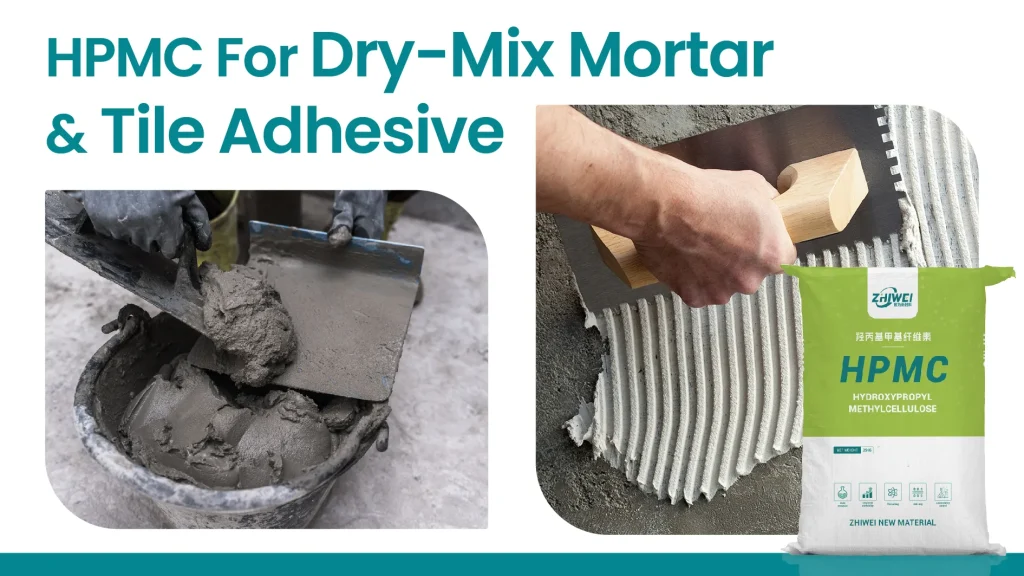
Tile Adhesive
In tile adhesive, HPMC helps the dry mix disperse and mix more easily. It reduces lump formation and saves mixing time.
It also extends open time and improves bonding. This helps workers place tiles more efficiently. HPMC can also provide high anti-slip performance, so tiles are less likely to slide on vertical surfaces.
For high-body tile adhesive, Zhiwei HPMC 100K and Zhiwei HPMC 200K can be tested because they support stronger water retention, open time, and vertical stability.
Tile Grout And Caulking Materials
In tile grout and caulking materials, HPMC helps dry powder mix evenly with water and reduces lump formation. This makes application faster and smoother.
It can also improve workability and reduce cost by improving construction efficiency.
Self-Leveling Mortar
In self-leveling mortar, HPMC provides viscosity and anti-settling support. It can improve flow and pumpability while helping control water retention.
Good water control can reduce cracking and shrinkage. For flowable systems, Zhiwei HPMC 400 and HPMC 4K can be considered because they provide light rheology control without excessive body.
Water-Based Coatings And Paint Removers
In water-based coatings, HPMC can work as a film former, thickener, emulsifier, and stabilizer. It helps improve storage stability, pigment dispersion, viscosity uniformity, leveling, surface appearance, and brushability.
It can also improve compatibility with pigments and help reduce sagging or dripping.
In water-based paint removers or organic solvent paint removers, HPMC can increase viscosity. This helps the remover stay on the workpiece surface instead of flowing away too quickly.
Extruded Concrete Boards And Ceramic Products
In extruded concrete boards, HPMC improves processability, bonding strength, and lubrication. It can improve wet strength and bonding after extrusion.
In ceramic products, HPMC can improve shape retention, lubrication, water retention, and green strength. It helps the formed body keep its shape and improves processing stability.
HPMC In Polymer And Resin Systems
HPMC can act as a protective colloid in synthetic resin production. It helps prevent polymer particles from agglomerating. In vinyl chloride suspension systems, it can support particle distribution, thermal stability, and product quality.
A good cellulose ether can help control particle size distribution and improve resin processing behavior.
How HPMC Affects Cement-Based Mortar
HPMC changes cement mortar in several important ways.
First, it improves water retention. Water stays in the mortar longer, so cement has more time to hydrate. In general, higher viscosity HPMC gives stronger water retention, although final performance also depends on dosage and formula water level.
Second, it improves workability. Mortar becomes easier to spread, scrape, pump, and finish.
Third, it improves lubrication. Fine particles disperse better after mixing with water, and the mortar feels smoother during application.
Fourth, it improves anti-sag behavior. This is important when mortar is applied in a thick layer or on a vertical surface.
Fifth, it affects air content. More air can improve yield and workability, and it can reduce some cracking risk. But too much air can reduce strength. Mixing time, HPMC grade, and formula design must be tested together.
How To Choose A Zhiwei HPMC Grade
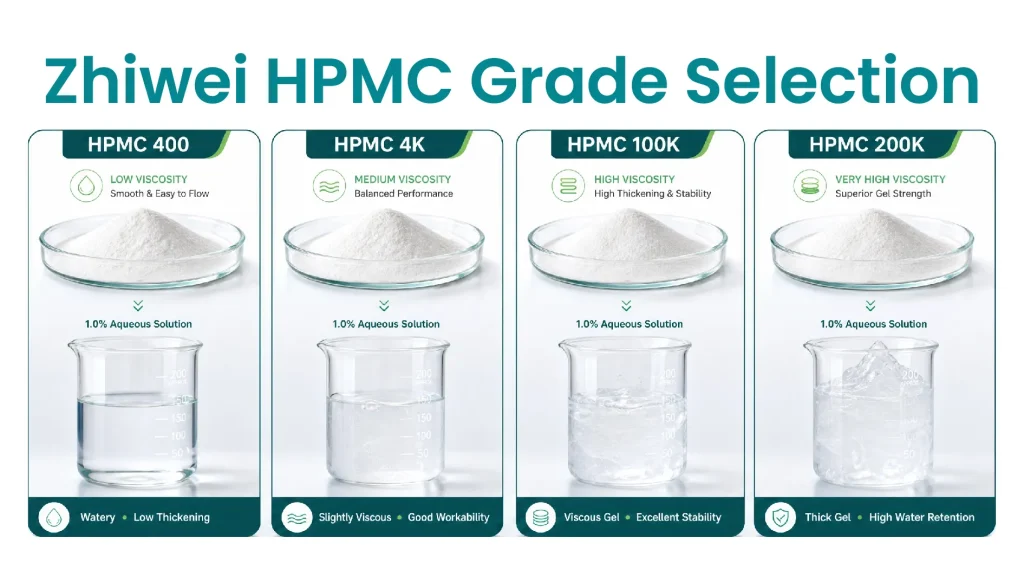
The best HPMC grade depends on the application. Viscosity is important, but it is not the only factor. You should also consider water retention, open time, anti-sag behavior, mixing speed, delayed solubility, particle size, and compatibility with cement, gypsum, filler, pigment, polymer powder, and other additives.
| Zhiwei HPMC Grade | General Direction | Suitable Starting Applications |
|---|---|---|
| HPMC 400 | Low viscosity | Self-leveling mortar, flowable systems, light rheology control |
| HPMC 4K | Low-to-mid viscosity | Flowable construction systems, gypsum products, light body formulas |
| HPMC 40K | Medium viscosity | Tile adhesive, wall putty, general dry-mix systems |
| HPMC 100K | High viscosity | Tile adhesive, wall putty, plaster, EIFS mortar, repair mortar |
| HPMC 150K | High viscosity | High-body construction formulas needing stronger water retention |
| HPMC 200K | Very high viscosity | High-body tile adhesive, putty, plaster, EIFS, repair mortar |
For tile adhesive and wall putty, HPMC 100K is a practical screening grade when the formula needs strong water retention and stable vertical application. For stronger body and higher viscosity needs, HPMC 200K can be tested. For self-leveling mortar or flowable systems, HPMC 400 or HPMC 4K may be better because they provide controlled water retention without making the formula too heavy.
Testing Checklist Before Bulk Purchase
Before choosing a bulk HPMC grade, test the sample in the real formula.
Check dry mixing behavior. The powder should disperse evenly and should not create serious lumping.
Check wet mixing behavior. The paste should hydrate smoothly and reach a stable consistency.
Check water retention. This is especially important for cement mortar, gypsum plaster, wall putty, and tile adhesive.
Check open time. Tile adhesive and plaster need enough working time.
Check anti-sag performance. Wall systems need stable vertical behavior.
Check final strength. HPMC improves workability, but the formula must still meet strength requirements.
Check surface quality. Look for cracking, powdering, poor leveling, or rough finish.
Check storage stability. HPMC should be stored in a dry, ventilated indoor place and protected from moisture.
Packaging, Storage, And Transport
HPMC is commonly packed in lined paper drums or plastic-coated polypropylene woven bags. A common industrial package is 25 kg per bag.
Store HPMC indoors in a dry and ventilated place. Keep it away from moisture. During transport, protect it from rain and direct sun exposure. Once a bag is opened, seal it well and use it as soon as practical.
Why Work With Zhiwei
Zhiwei (Jinan) New Materials Co., Ltd. supplies cellulose ether products for construction and daily chemical systems. For HPMC, Zhiwei provides grades for tile adhesive, mortar, putty, plaster, EIFS, detergent, and other water-based systems.
Zhiwei can help customers compare grades by viscosity, water retention, open time, anti-sag behavior, and application body. The goal is to make performance repeatable in real production, not only to choose a viscosity number on paper.
If you are developing a cement mortar, tile adhesive, wall putty, self-leveling mortar, gypsum plaster, or coating formula, Zhiwei can support sample testing and grade selection.
Conclusion
Hydroxypropyl methylcellulose is a highly useful non-ionic cellulose ether. It dissolves in cold water, forms a viscous solution, and provides water retention, thickening, film formation, suspension, adhesion, lubrication, dispersion, and stability.
In construction materials, HPMC helps improve workability, water retention, open time, anti-sag behavior, surface quality, and final performance. It is used in cement mortar, gypsum plaster, tile adhesive, wall putty, tile grout, self-leveling mortar, exterior insulation mortar, water-based coatings, paint removers, ceramics, and extruded building materials.
For formula development, grade selection matters. Zhiwei HPMC 400 and HPMC 4K are useful for flowable systems. Zhiwei HPMC 100K and HPMC 200K are practical options for higher-viscosity dry-mix systems that need stronger water retention, open time, and vertical stability.
Contact Zhiwei (Jinan) New Materials Co., Ltd. to request HPMC samples, technical information, and grade recommendations for your construction or water-based formula.