
At Zhiwei (Jinan) New Materials Co., Ltd., we work with many customers who produce wall putty, skim coat, smoothing mortar, exterior putty, and related finishing materials. In these products, cellulose ether is not the only additive, but it is one of the key materials that affects water retention, workability, scraping feel, fresh stability, and surface formation.
Zhiwei find out that wall putty formulation should not start from one raw material alone. A good putty formula must balance the base material, binder system, filler structure, functional additives, construction performance, environmental requirements, and final test results. If any part of this system is ignored, the final product may show poor scraping, weak adhesion, fast drying, bleeding, cracking, rough surface, or unstable performance after storage.
For Zhiwei, this topic is closely connected with HEMC. Hydroxyethyl Methyl Cellulose helps wall putty hold water, spread more smoothly, stay workable during scraping, and form a more stable fresh mix. But HEMC cannot replace correct binder design, filler selection, polymer modification, water resistance design, or proper testing. The best wall putty formula is always a complete system.
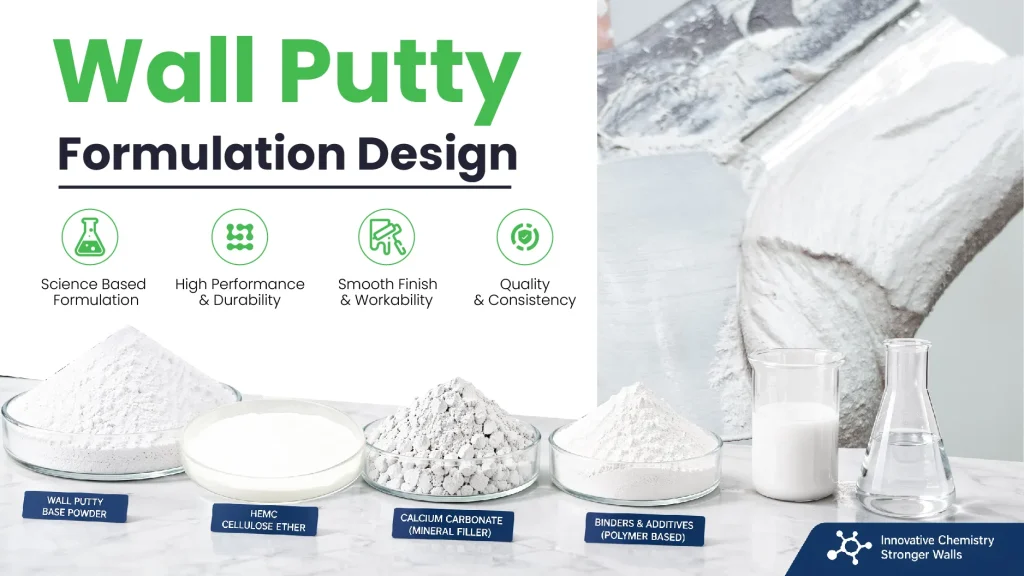
What Is Wall Putty?
Wall putty is a finishing material used to level, smooth, and prepare wall surfaces before coating, painting, or decorative finishing. It is usually applied as a thin layer, so the application feel and final surface quality are very important. A putty product may look simple, but its formula is not simple. It has to meet requirements for adhesion, workability, smoothness, water retention, surface hardness, flexibility, and environmental safety.
Zhiwei find out that wall putty is usually evaluated from several angles. The first is whether it bonds well to the substrate. The second is whether it is easy to scrape and polish. The third is whether it can resist water, temperature change, or slight movement when needed. The fourth is whether it gives a clean and stable surface after drying.
This is why wall putty should be designed as a full formulation system. A formula that works for an interior dry wall may not be suitable for exterior walls. A formula that works for ordinary interior putty may not be suitable for waterproof putty or flexible putty. A formula that works in one region may need adjustment in another region because raw materials, climate, and substrate conditions may change.
Common Types Of Wall Putty
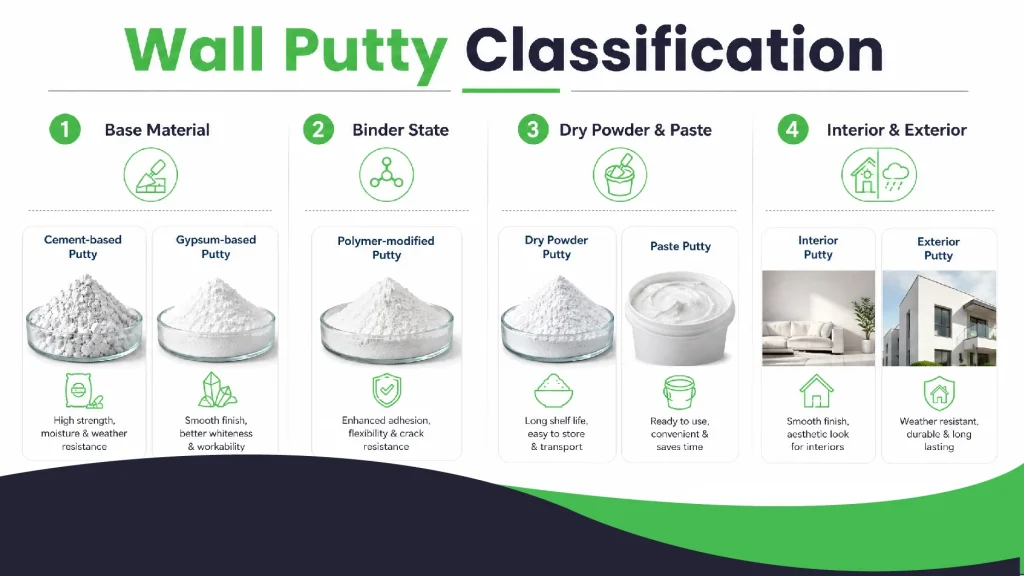
Zhiwei find out that wall putty can be classified in several ways. Each classification helps formulators understand the product target more clearly.
Classification By Base System
Wall putty can be divided by the base system. Common types include cellulose putty, PVA glue putty, and 107 glue putty. These names usually reflect the binding or modification system used in the product. In modern dry-mix construction products, cellulose ether is often used as a functional additive to improve water retention and workability, rather than as the only binder.
Classification By Binder
Wall putty can also be classified by binder type. Common systems include cement-based putty, latex or emulsion-based putty, and gypsum-based putty.
Cement-based putty is often used where water resistance, strength, and exterior durability are needed. Latex or emulsion-based putty may provide better flexibility and surface feel. Gypsum-based putty can be useful for interior applications where smoothness and easy finishing are important.
Classification By Product State
Wall putty can be dry powder putty or paste putty. Dry powder putty is mixed with water before application. Paste putty is supplied as a ready-to-use material. Dry powder products are easier to transport and store, while paste products may offer convenience for some users.
Classification By Application Area
Wall putty can also be divided into interior wall putty and exterior wall putty. Interior wall putty usually focuses more on smooth scraping, fine surface finish, and easy sanding. Exterior wall putty needs stronger water resistance, adhesion, weather resistance, and sometimes flexibility.
For Zhiwei, this classification is important because HEMC grade selection depends on the putty type. Interior putty, exterior putty, skim coat, waterproof putty, and flexible putty may need different viscosity, hydration behavior, and water-retention balance.
The Three Main Parts Of A Putty Formula
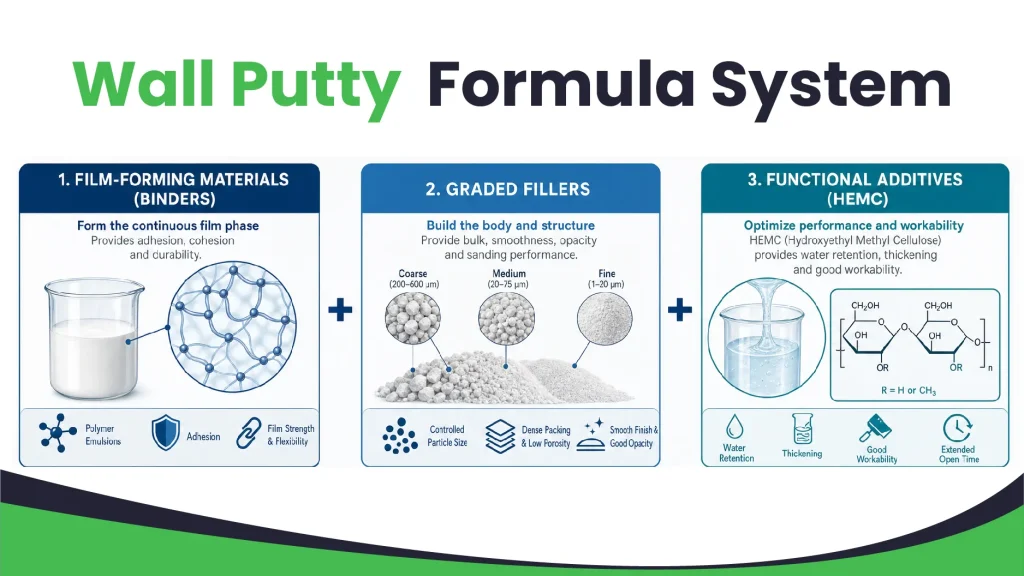
Zhiwei find out that a wall putty formula can be understood through three main parts: film-forming materials, graded fillers, and functional additives.
Film-Forming Materials
Film-forming materials provide bonding strength, cohesion, flexibility, and surface integrity. They help the putty bond to the wall and support the final layer after drying or curing.
Common inorganic film-forming materials include cement, lime, and gypsum. Common organic film-forming materials include emulsion and redispersible polymer powder. These materials help improve adhesion, strength, and flexibility. For exterior putty and flexible putty, polymer modification is especially important.
A strong film-forming system can improve adhesion between the putty and the substrate. It can also improve the internal strength of the putty layer. But if the binder system is too rigid, the product may crack under stress. If the binder is too weak, the putty may powder, peel, or lose adhesion.
Graded Fillers
Graded fillers form the body of the putty. They affect cost, hardness, surface smoothness, sanding behavior, impact resistance, and application feel. Common fillers include heavy calcium carbonate, light calcium carbonate, quartz powder, stone powder, and other mineral materials.
Filler selection is not only a cost decision. Particle size, fineness, oil absorption, whiteness, hardness, and grading all affect the final putty performance. A formula with poor filler design may feel rough, scrape badly, or form an uneven surface.
For smooth wall putty, filler fineness is especially important. Zhiwei find out that dry powder fine putty often needs finer raw materials, while paste-like putty may need even finer filler design to support a smoother surface.
Functional Additives
Functional additives adjust the detailed performance of the formula. These may include water-retention agents, thickeners, dispersants, defoamers, anti-mildew agents, water-repellent additives, lubricating additives, and other special additives.
This is where HEMC has strong value. HEMC can work as a water-retention and rheology-control additive. It helps the putty hold water, spread more smoothly, reduce rapid moisture loss, and stay stable during application.
However, HEMC should not be used blindly. Dosage, viscosity, hydration speed, formula compatibility, and mixing process all matter. A good HEMC grade should match the binder system, filler structure, target workability, and final application environment.
Key Performance 1: Environmental Safety
Environmental safety is one of the basic requirements for interior wall putty. Zhiwei find out that interior putty should pay attention to harmful substances such as VOC, benzene series compounds, free formaldehyde, and heavy metals.
For interior applications, this is not only a technical issue. It is also a market trust issue. Customers use putty inside homes, apartments, offices, schools, and public buildings. If the formula contains high levels of harmful substances, the product may fail market requirements and damage the brand.
For Zhiwei, this reminds us that raw material selection must be controlled. Cellulose ether, polymer powder, fillers, preservatives, and other additives should be selected with the final use in mind. A low-cost raw material may look attractive at first, but it can create risk if it affects safety, odor, emissions, or long-term stability.
Key Performance 2: Adhesion
Adhesion is one of the most important performance indicators for wall putty. If adhesion is poor, the putty layer may peel, hollow, crack, or detach from the substrate. Strong adhesion is especially important for exterior wall putty, wet areas, repaired substrates, and surfaces exposed to temperature change.
Zhiwei find out that exterior wall putty is often evaluated under both standard condition and freeze-thaw cycling. A strong exterior putty should still keep acceptable bonding performance after durability testing. Interior putty also needs reliable bonding, but the performance requirements may differ by product type and local standard.
In formulation design, adhesion is influenced by binder quality, polymer modification, filler grading, substrate condition, water ratio, curing condition, and cellulose ether selection. HEMC can help by improving water retention and fresh-state stability, but it cannot replace a proper binder system. If the binder content is too low or the substrate is weak, HEMC alone cannot solve the adhesion problem.
Key Performance 3: Workability
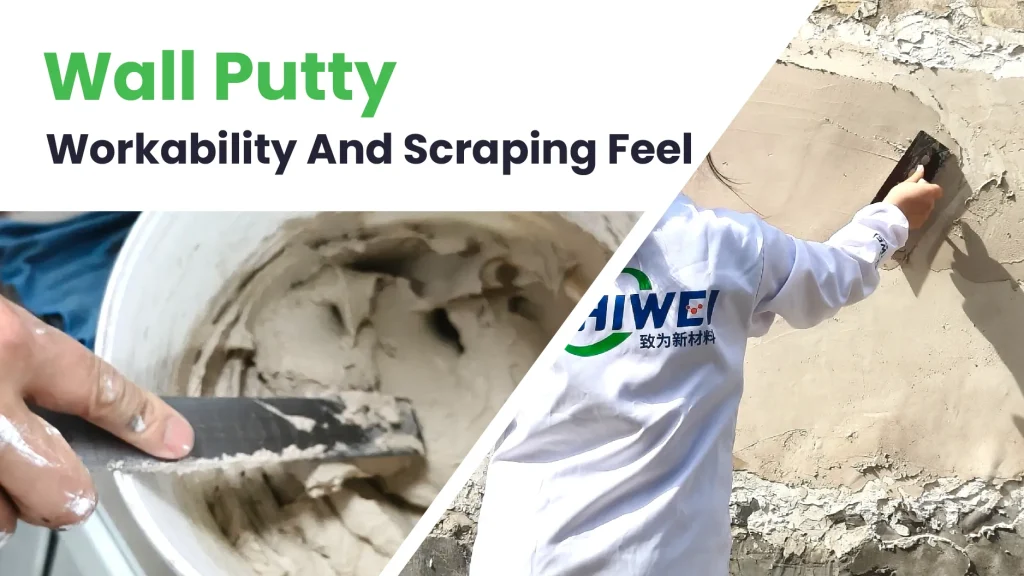
Workability is the performance that workers feel during application. Wall putty is usually applied by scraping, troweling, or smoothing. The material should feel smooth and stable. It should not drag heavily, roll under the scraper, dry too quickly, or become too sticky.
Zhiwei find out that the workability of putty is very important because it directly affects user acceptance. Even if the laboratory strength is acceptable, a product with poor scraping feel may still be rejected by applicators.
HEMC helps improve workability by adjusting wet consistency and water retention. It can make the putty easier to spread and easier to scrape into a thin, even layer. It also helps keep the working state more stable during application.
Still, workability is not decided by HEMC alone. Filler fineness, water demand, polymer type, wood fiber, lubricating additives, and mixing process can all change the application feel. A good formula must balance smoothness, body, anti-sag behavior, and open working time.
Key Performance 4: Water Resistance
Water resistance is important for exterior wall putty, waterproof putty, bathroom-related systems, and other areas where moisture exposure may occur. If putty has poor water resistance, it may soften, lose strength, powder, or detach after moisture exposure.
Zhiwei find out that water-resistant putty should be designed through the full formula. Cement or other inorganic binder can improve water resistance. Polymer powder can improve bonding and durability. Water-repellent additives can be added when needed, but their dosage must be confirmed by testing.
HEMC supports water retention during application, but it is not the same as a waterproofing additive. This distinction matters. HEMC helps the putty keep water during the fresh stage. Waterproofing design focuses on the hardened product’s resistance to water penetration and moisture damage. These are connected, but they are not the same function.
Key Performance 5: Flexibility
Flexibility matters when the substrate may move slightly or when the putty layer may face stress from temperature change, vibration, or deformation. A rigid putty layer may crack under movement. A flexible system can absorb a certain amount of deformation.
Zhiwei find out that flexible putty should use suitable flexible polymer powder. A polymer with a lower glass transition temperature can help improve flexibility, especially when low-temperature performance is required. This is important for exterior systems and high-stress areas.
HEMC contributes to fresh-state handling, but flexibility mainly depends on the binder and polymer system. If customers need flexible putty, the formula should be designed with polymer modification, filler balance, and crack resistance in mind.
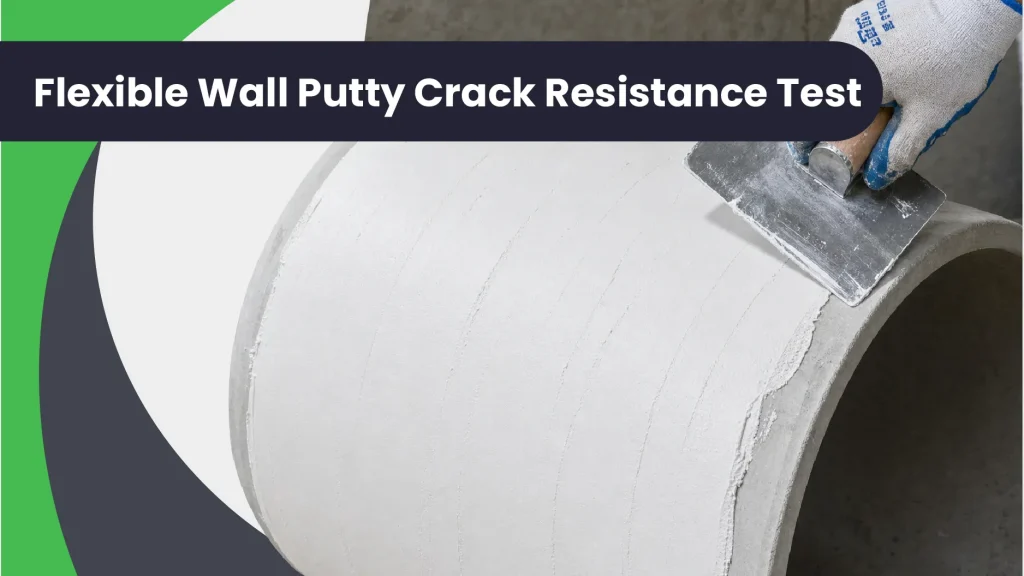
The cylinder bending test shown in the training material is a good reminder. A flexible putty should be able to resist cracking under bending or deformation conditions. This kind of test helps show whether the product has real flexibility instead of only good scraping feel.
Special Wall Putty Design
Not all putty products have the same target. Zhiwei find out that special putty products need special formula design.
Smooth Surface Putty
Smooth surface putty needs fine raw materials and a clean surface finish. Fine powder selection is important. If the filler is too coarse, the surface may feel rough and the final finish may not meet customer expectations.
In dry powder smooth putty, filler fineness around 100 mesh may be used as a reference in some systems. In paste-like putty, a much finer filler design may be needed. The exact standard depends on the product target, market requirement, and customer application method.
Waterproof Putty
Waterproof putty may need water-repellent powder or other water-resistant additives. The addition level should not be decided only by experience. It should be confirmed through testing because water-repellent additives can affect workability, adhesion, and surface behavior.
Flexible Putty
Flexible putty should use a suitable flexible polymer powder. A low Tg polymer can help improve flexibility and crack resistance. This is especially important when the putty must handle slight movement or temperature stress.
Recommended Formula Direction
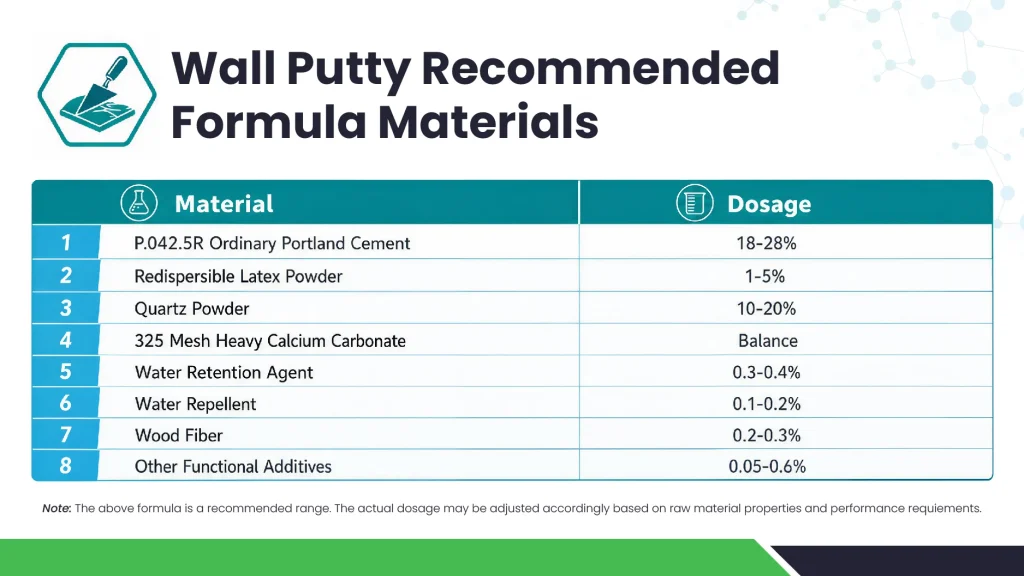
Zhiwei find out that a typical putty formulation can be built around cement, redispersible polymer powder, mineral fillers, water-retention agent, alkali-resistant agent, wood fiber, and other functional additives.
A reference formula direction can be understood as follows:
| Material | Suggested Range |
|---|---|
| P.O 42.5 ordinary Portland cement | 18–28% |
| Redispersible polymer powder | 1–5% |
| Quartz powder | 10–20% |
| 325 mesh calcium powder | Balance |
| Water-retention agent | 0.3–0.4% |
| Alkali-resistant agent | 0.1–0.2% |
| Wood fiber | 0.2–0.3% |
| Other functional additives | 0.05–0.6% |
This is not a universal formula. It is a starting direction. The final formula must be adjusted according to local raw materials, putty type, performance target, substrate, climate, and test results.
For Zhiwei, the water-retention agent position is where HEMC can play an important role. HEMC dosage and grade should be tested according to water retention, scraping feel, fresh stability, surface smoothness, and application time.
Formulation Design Principles
Zhiwei find out that wall putty formulation design should follow several practical principles.
First, choose raw materials that are easy to obtain. A formula that depends on rare or unstable raw materials may be difficult to produce consistently.
Second, use local raw materials when possible. Local fillers and mineral powders can reduce cost and improve supply stability, but they must be tested for quality and consistency.
Third, design the dosage of bulk raw materials with packaging and production convenience in mind. For large-volume materials, integer bag or sack usage can simplify production and reduce weighing errors.
Fourth, every lab formula must pass small-scale testing and pilot testing before mass production. A formula that works in a small cup may not perform the same way in a mixer, production line, or jobsite application.
Fifth, test the product in real use conditions. Wall putty should be tested for scraping feel, surface finish, adhesion, water resistance, freeze-thaw durability when needed, flexibility, and storage stability.
How Zhiwei Supports Wall Putty Customers
At Zhiwei (Jinan) New Materials Co., Ltd., we support wall putty customers by helping them select HEMC grades according to the real formula. We usually ask for the putty type first. Is it interior wall putty, exterior wall putty, skim coat, smoothing mortar, waterproof putty, or flexible putty?
Then we ask about binder type, filler system, filler fineness, polymer powder, target water retention, target scraping feel, surface finish, application method, mixing process, and current problems. Common problems include poor spreading, fast drying, drag under the scraper, bleeding, segregation, rough surface, weak adhesion, or poor crack resistance.
After we understand the formula target, we can suggest a HEMC grade direction and a simple sample test plan. The customer can then test the product in the real formula. Based on the result, the grade or dosage can be adjusted.
This is how we define useful technical support. We do not want customers to test blindly. We want HEMC selection to be connected with the final putty performance.
What HEMC Can And Cannot Do
HEMC can improve water retention, workability, scraping smoothness, fresh mix stability, and surface formation. It can help the putty stay workable longer and reduce rapid moisture loss on absorbent walls. It can also improve consistency and reduce some fresh-state defects.
However, HEMC cannot solve every formula problem. It cannot replace enough binder. It cannot create water resistance by itself. It cannot provide flexibility without a suitable polymer system. It cannot fix a poor filler structure or weak substrate. It cannot compensate for incorrect water ratio or poor mixing process.
A strong putty formula needs balance. HEMC is one important part of that balance.
Conclusion
Wall putty formulation design is a system. It includes product classification, binder selection, filler grading, functional additives, environmental safety, adhesion, workability, water resistance, flexibility, and real testing.
Zhiwei find out that the most successful putty formulas are not built by copying one fixed recipe. They are built by understanding the target application and then adjusting the formula around real performance. Interior putty, exterior putty, waterproof putty, flexible putty, skim coat, and smoothing mortar all need different design logic.
At Zhiwei, we supply HEMC for wall putty customers who need stable water retention, smoother troweling, better scraping feel, fresh mix stability, and repeatable quality. Our role is to help customers choose the right Hydroxyethyl Methyl Cellulose grade, test it in the real formula, and keep performance stable from sample to long-term production.