
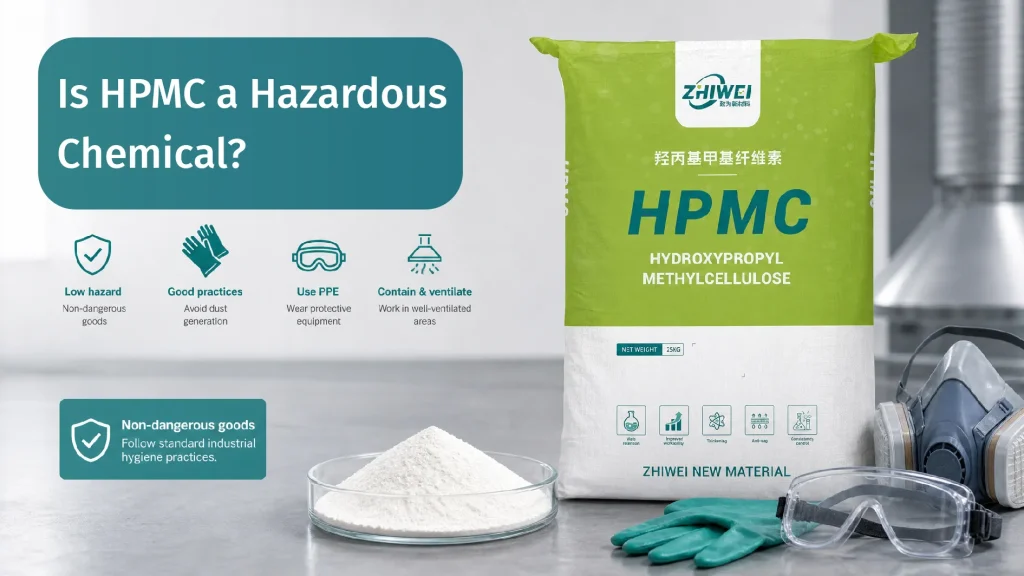
Hydroxypropyl methylcellulose, commonly called HPMC or hypromellose, is generally not classified as a hazardous chemical when supplied as a pure industrial cellulose ether. It is also commonly transported as non-dangerous goods.
However, this answer needs an important qualification.
HPMC is a fine organic powder. Airborne powder can irritate the eyes, nose, and throat. Under suitable conditions, a cloud of fine HPMC dust may also burn rapidly or cause a dust explosion. Therefore, “not classified as hazardous” does not mean that no workplace controls are needed.
The final answer always depends on the exact product, its ingredients, its particle size, the country of use, and the current Safety Data Sheet supplied with the product.
The Short Answer
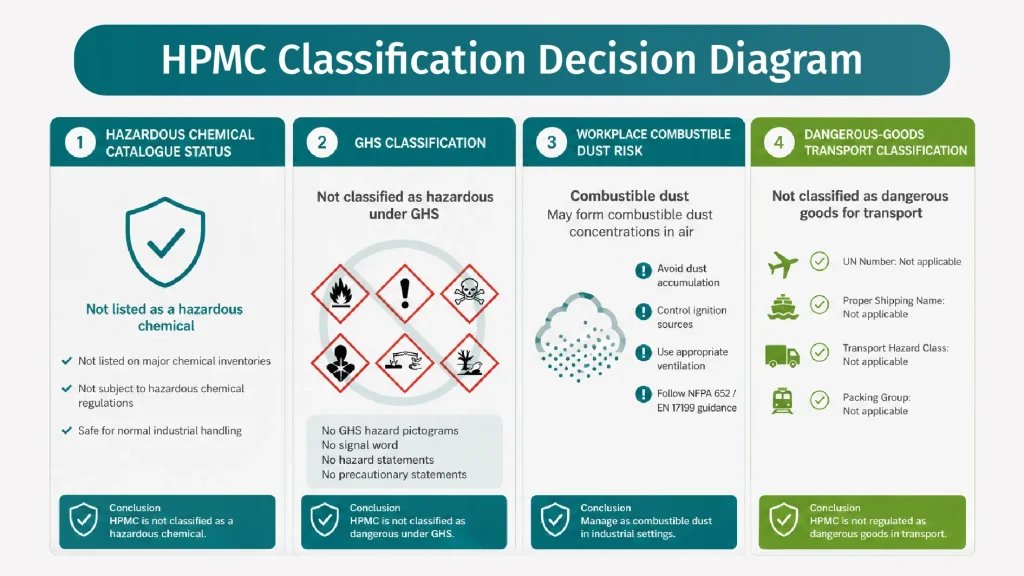
The following table separates several questions that are often incorrectly treated as the same question.
| Question | Typical Answer for Pure HPMC | What Must Be Checked |
|---|---|---|
| Is HPMC listed in China’s hazardous chemical catalogue? | HPMC and CAS 9004-65-3 are not specifically named in the 2015 catalogue | Current regulations, product composition, and regional requirements |
| Is HPMC classified as hazardous under GHS or EU CLP? | Many pure HPMC grades are not classified for acute health hazards under CLP | The region-specific SDS for the exact grade |
| Is HPMC dangerous goods for transport? | Pure commercial grades are commonly not regulated as dangerous goods | Section 14 of the latest SDS and carrier requirements |
| Is HPMC powder completely risk-free? | No | Dust exposure, ignition sources, ventilation, housekeeping, and process conditions |
| Can every HPMC grade be used in food or medicine? | No | Only certified food-grade or pharmaceutical-grade material may be used |
| Does a higher viscosity grade have a higher hazard classification? | Not necessarily | Composition, particle size, additives, and surface treatment matter more than the viscosity label |
For purchasing, shipping, and factory safety decisions, the SDS for the actual product should take priority over a general statement about HPMC.
What Is Hydroxypropyl Methylcellulose?
Hydroxypropyl methylcellulose is a nonionic cellulose ether produced by chemically modifying purified cellulose. Its CAS number is 9004-65-3.
Commercial HPMC is usually supplied as a white or off-white powder. It is widely used as a thickener, water-retention agent, stabilizer, binder, film former, and rheology modifier.
Common applications include tile adhesive, wall putty, plaster, repair mortar, self-leveling compounds, detergents, personal care products, tablet coatings, capsules, and selected food products.
HPMC has low volatility because it is a high-molecular-weight solid. It does not behave like a volatile solvent. Its aqueous solution is generally close to neutral, although the exact pH range depends on the grade and test method.
These properties explain why pure HPMC normally does not meet the usual criteria for corrosive liquids, flammable liquids, oxidizing chemicals, or highly acutely toxic substances.
Is HPMC Listed as a Hazardous Chemical in China?
Hydroxypropyl methylcellulose is not specifically named in China’s Catalogue of Hazardous Chemicals (2015 Edition) under the name HPMC, hydroxypropyl methylcellulose, or CAS 9004-65-3.
The official catalogue was published by several Chinese government departments and came into force on May 1, 2015. The original announcement and catalogue are available from the Ministry of Industry and Information Technology.
This normally means that pure HPMC is not managed simply as a named substance in that catalogue. It does not, however, remove every classification or safety responsibility.
The catalogue implementation guidance requires chemical hazards, labels, and Safety Data Sheets to be determined using applicable classification standards. A mixture containing HPMC may have a different classification if it also contains a hazardous solvent, surface-treatment agent, preservative, or other additive. The official implementation guidance should be considered together with the catalogue.
In practical terms, buyers should ask two separate questions:
First, is the product named in the catalogue?
Second, does the actual formulation meet any hazard classification criteria?
For ordinary pure HPMC powder, the answer to the first question is generally no. The second question must still be verified through the current SDS.
Why HPMC Is Usually Not Classified for Acute Health Hazards
Available safety information for commercial HPMC generally indicates low acute toxicity. Many supplier Safety Data Sheets do not classify pure HPMC for acute oral toxicity, skin corrosion, serious eye damage, carcinogenicity, mutagenicity, or reproductive toxicity.
This does not mean that HPMC should be eaten, inhaled, or handled without normal industrial hygiene.
Animal toxicity figures should not be converted directly into a supposed safe human dose. For example, multiplying an animal LD50 value by a person’s body weight does not produce a valid human consumption limit. Toxicity tests are used as part of hazard classification. They are not instructions for human exposure.
The most realistic health concern during normal industrial use is often excessive airborne dust. A high concentration of powder may cause mechanical irritation even when the substance is not classified as chemically toxic.
Workers who open bags, pour powder into mixers, clean filters, or handle spills may experience temporary discomfort in the eyes, nose, or throat if dust control is poor.
“Not Hazardous” Does Not Mean “No Risk”
A hazard classification describes defined properties under a regulatory system. Workplace risk also depends on the amount handled, how the material is used, and the controls in place.
A sealed 25 kg bag stored in a dry warehouse presents a different risk from several tonnes of powder transferred through pneumatic equipment. The chemical is the same, but the exposure and dust conditions are very different.
Airborne Dust
Fine HPMC particles can become airborne when bags are opened, dropped, emptied, or compressed. Fast charging into a mixer can also push dust back toward the operator.
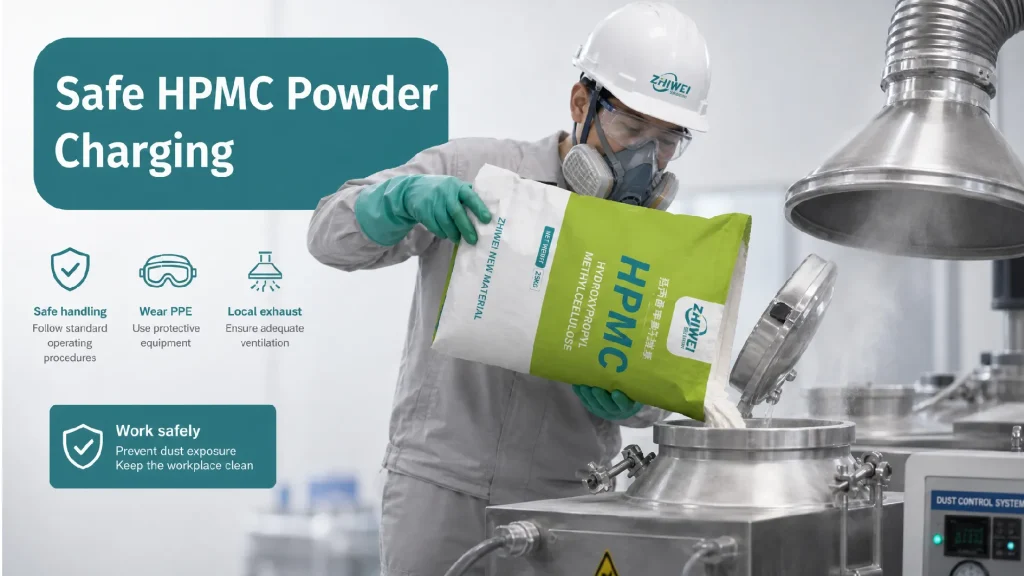
Good handling should keep the powder close to the receiving opening, reduce the drop height, and use local exhaust ventilation where practical. A closed or partially enclosed feeding system is preferable for repeated production.
Safety glasses help protect the eyes. Gloves reduce unnecessary skin contact and keep hands clean. Respiratory protection should be selected from the exposure assessment, local requirements, and the supplier’s SDS rather than chosen from a universal rule.
Combustible Dust
HPMC is an organic cellulose-based material. When it is dispersed as a fine dust cloud, it can present a combustible dust hazard.
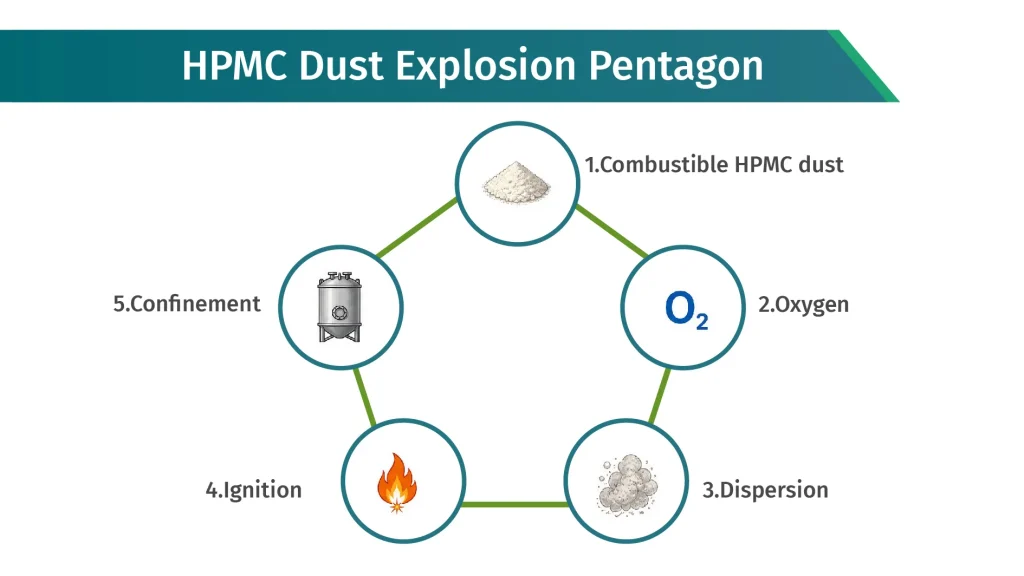
The conditions for a dust explosion are often described by five elements: combustible dust, oxygen, dispersion, an ignition source, and confinement. Removing one or more of these elements greatly reduces the risk.
The US Occupational Safety and Health Administration explains that even materials that are difficult to ignite in larger pieces may become explosible when finely divided and suspended in air. Its combustible dust guidance applies this principle across food, chemical, pharmaceutical, plastic, paper, and other powder-processing industries.
A current HPMC SDS may therefore say that the product is not classified as hazardous under one system while still warning that it may form combustible dust concentrations in air. These statements are not contradictory.
For example, a European SDS for a commercial METHOCEL HPMC grade states that the mixture is not classified as hazardous under the EU CLP Regulation, but it also includes a combustible dust warning. Another HPMC SDS lists the product as not regulated for road, sea, or air transport while requiring controls for heat, sparks, flames, static discharge, and airborne dust.
Is HPMC Flammable or Explosive?
HPMC should not be described simply as “nonflammable” or “nonexplosive.”
It is not a flammable liquid, and a bulk pile may not ignite as easily as fuel, solvent, or gas. However, fine HPMC dust suspended in air may burn rapidly when exposed to a sufficient ignition source.
The practical answer is therefore:
HPMC is not normally handled like a flammable solvent, but its fine powder may create a combustible dust hazard.
Potential ignition sources include open flames, hot surfaces, electrical sparks, unsuitable motors, static discharge, welding, smoking, and overheated equipment. Dust layers can also contribute to a secondary explosion if an initial event lifts settled powder into the air.
Factories that perform bulk unloading, milling, pneumatic conveying, sieving, or dust collection should evaluate the process rather than relying only on the product name. Depending on the scale, the evaluation may include dust explosibility data, equipment classification, grounding, bonding, explosion venting, isolation, and suppression systems.
How Should HPMC Be Handled Safely?
Routine industrial handling should focus on dust prevention, ventilation, ignition control, and good housekeeping.
| Activity | Recommended Control | Reason |
|---|---|---|
| Opening bags | Open carefully and keep the bag close to the mixer inlet | Reduces the amount of airborne dust |
| Charging a mixer | Use local exhaust or an enclosed feeding station | Controls dust near its source |
| Repeated powder transfer | Consider closed conveying or automated dosing | Reduces worker exposure and powder loss |
| Cleaning floors and equipment | Use a suitable industrial vacuum or careful collection method | Prevents settled dust from becoming airborne |
| Removing dust with compressed air | Avoid this practice | It can create a concentrated dust cloud |
| Handling metal transfer equipment | Ground and bond equipment where required | Reduces static discharge risk |
| Eye protection | Wear safety glasses with side shields or goggles | Protects against mechanical irritation |
| Respiratory protection | Select it through an exposure assessment and the SDS | The required level depends on dust concentration |
| Skin protection | Wear normal work clothing and suitable gloves | Supports good industrial hygiene |
| Wet HPMC on floors | Clean it promptly and mark the area | Hydrated HPMC can create a slippery gel |
OSHA’s combustible dust guidance recommends minimizing dust generation and accumulation, controlling ignition sources, and using suitable grounding and bonding practices. Compressed air should not be used for cleaning when it can disperse combustible dust. More details are provided in OSHA’s Hazard Communication Guidance for Combustible Dusts.
What Should You Do After an HPMC Spill?
The response should depend on the amount released and whether the powder has become airborne.
For a small dry spill, stop unnecessary movement around the area. Avoid actions that throw the powder into the air. Carefully collect the material in a suitable closed container. Where a vacuum is used in a combustible dust area, it should be suitable for the material and the area classification.
Do not use an ordinary household vacuum for a significant industrial powder spill. Its motor, filtration system, and construction may not be suitable for combustible dust.
For a large release, isolate the area, remove ignition sources, improve ventilation, and follow the emergency procedure in the product SDS. Trained personnel should manage releases involving heavy airborne dust.
If HPMC contacts the eyes, rinse gently with clean water. If dust is inhaled, move the affected person to fresh air. Persistent irritation, coughing, breathing difficulty, or other unusual symptoms require medical attention.
Dry powder on a floor can create dust. Wet HPMC creates a different problem because it hydrates and forms a slippery, viscous layer. Both conditions require prompt housekeeping.
How Should HPMC Be Stored?
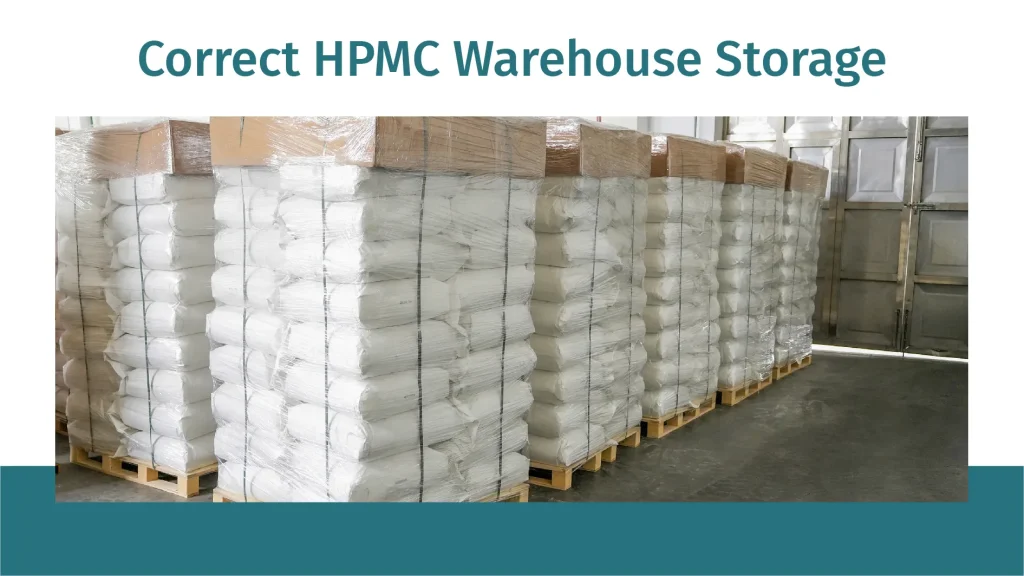
HPMC should be stored in sealed packaging in a cool, dry, and well-ventilated location.
The material absorbs moisture from the environment. Damaged or unsealed bags may develop lumps, poor dispersion, microbial contamination, or changes in measured moisture and viscosity. This can affect production even when the material does not become legally hazardous.
Bags should be stored on pallets rather than directly on the floor. They should be protected from roof leaks, condensation, rain, and contact with wet walls. The warehouse should also keep the material away from unnecessary heat, flames, sparks, and strong oxidizing materials.
A first-in, first-out inventory system helps control storage time and batch traceability.
A wet or damaged bag should not simply be dried and returned to production. It should be quarantined and inspected. Depending on the application, testing may include appearance, moisture, viscosity, dissolution, microbial condition, and final-product performance. Contaminated material should be disposed of according to local requirements.
Is HPMC Dangerous Goods for Transportation?
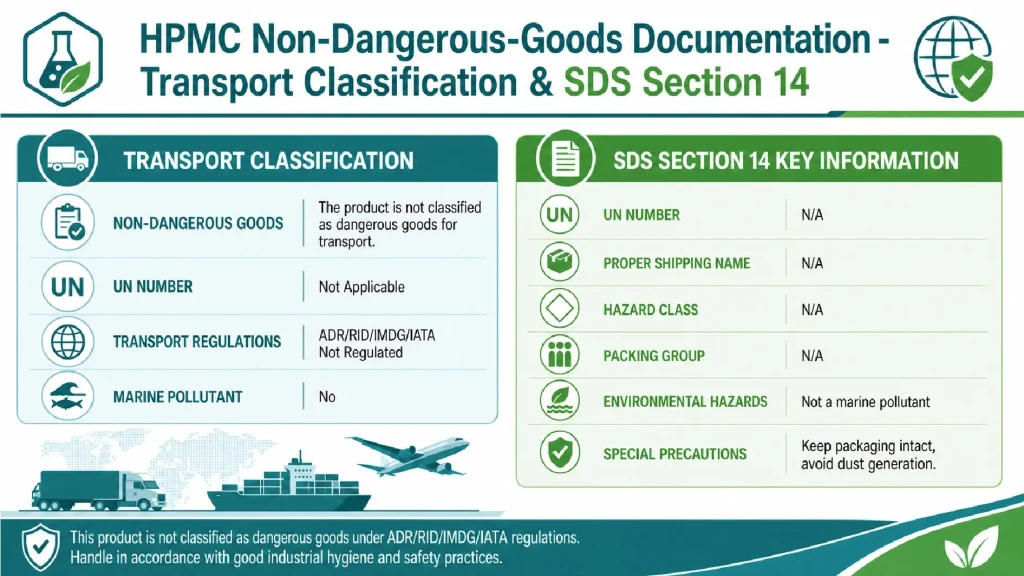
Pure commercial HPMC grades are commonly described as not regulated for transportation by road, sea, or air.
For example, the transport section of an HPMC Safety Data Sheet for METHOCEL F4M-PRG states that the product is not regulated under US DOT, IMDG sea transport, or IATA/ICAO air transport. The same document warns about combustible dust during handling. The product SDS demonstrates why transport classification and workplace dust classification must be reviewed separately.
A non-dangerous-goods transport status may simplify shipping, but it does not eliminate documentation requirements. Customs authorities, carriers, ports, airlines, or customers may request an SDS, a non-dangerous-goods declaration, or a transport identification report.
Before shipment, suppliers and buyers should check Section 14 of the latest SDS for the exact product. Classification can change when HPMC is supplied as part of a mixture or when local transport rules impose additional requirements.
Does Food or Pharmaceutical Use Prove That All HPMC Is Safe?
No. The existence of food-grade or pharmaceutical-grade HPMC does not mean that every industrial grade is suitable for ingestion.
HPMC has recognized uses in food and pharmaceutical products. In the United States, food use is addressed by 21 CFR 172.874. Pharmaceutical HPMC, usually called hypromellose, must meet the applicable pharmacopoeial requirements.
These approvals are grade-specific and use-specific. Food and pharmaceutical grades must meet defined requirements for purity, substitution, residual substances, microbial limits, and manufacturing control.
Construction-grade HPMC may be designed for tile adhesive, plaster, wall putty, or mortar. It should not be used in food, medicine, or personal care products unless the supplier has provided the required grade certification and compliance documents.
Some industrial grades may also use surface treatment or processing aids to control dispersion and delayed hydration. These differences may change the information shown in the composition, handling, or regulatory sections of the SDS.
Does HPMC Viscosity Affect Its Hazard Classification?
HPMC viscosity is mainly a performance specification. It indicates how strongly a specified HPMC solution builds viscosity under a defined test method.
A model name such as HPMC 400, HPMC 4K, HPMC 40K, or HPMC 100K does not by itself determine whether the product is hazardous.
A high-viscosity grade is not automatically more toxic than a low-viscosity grade. However, products with different particle-size distributions, surface treatments, or added ingredients may produce different dust behavior and SDS statements.
For example, Zhiwei HPMC 100K is a high-viscosity construction grade with CAS number 9004-65-3. Its published specification also includes particle-size information because fineness affects dispersion and handling. The full technical information is available on the Zhiwei HPMC 100K product page.
Zhiwei’s HPMC range includes HPMC 400, HPMC 4K, HPMC 40K, HPMC 100K, HPMC 150K, and HPMC 200K. These viscosity options support different construction and industrial formulations. The appropriate safety decision must still be based on the SDS for the selected grade rather than the viscosity number alone.
What Documents Should an HPMC Buyer Request?
Professional HPMC purchasing should include both technical and safety documentation.
| Document | What It Tells the Buyer |
|---|---|
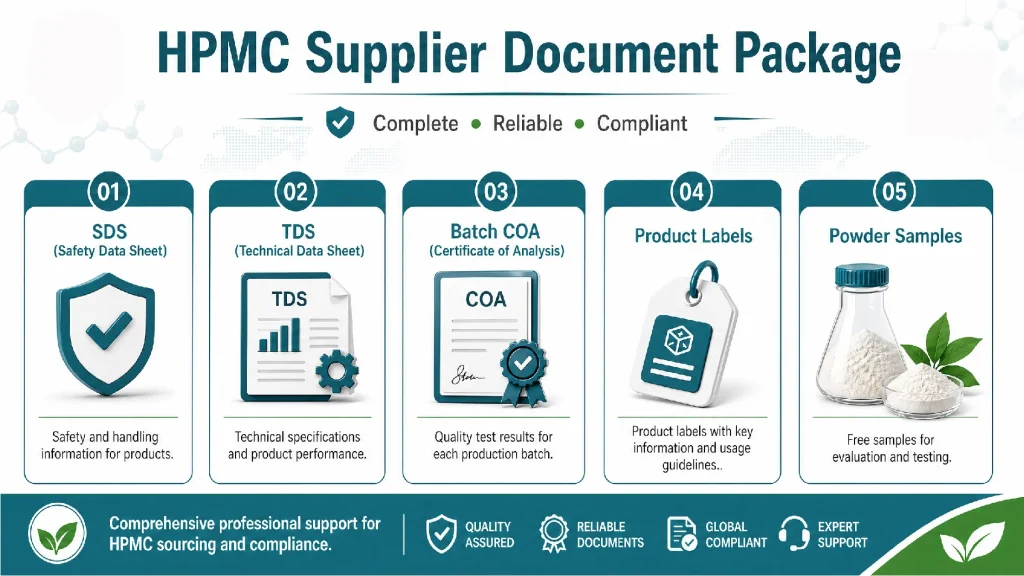
| Safety Data Sheet | Hazard classification, first aid, firefighting, handling, storage, exposure controls, disposal, and transport status |
| Technical Data Sheet | Viscosity, test method, pH, moisture, particle size, substitution, appearance, and recommended applications |
| Certificate of Analysis | Batch-specific test results and conformity with the agreed specification |
| Regulatory declaration | Compliance information for the destination country and intended application |
| Dust safety data | Information needed for bulk powder handling, dust collection, or explosion-risk assessment |
| Food or pharmaceutical certificate | Evidence that the exact grade meets the required food or pharmacopoeial standard |
Zhiwei (Jinan) New Materials Co., Ltd. supports grade selection and sample testing for construction and industrial applications. The company states that TDS and SDS documents are available and that a batch COA can be provided on request. Its production information also identifies routine checks such as viscosity, fineness, moisture, ash content, and appearance. These details are available on the Zhiwei company website.
A serious supplier should also be able to confirm the product name, CAS number, intended use, packaging, storage conditions, and transport classification before shipment.
Frequently Asked Questions
Is HPMC toxic to humans?
Pure HPMC generally has low acute toxicity and is commonly not classified for acute toxic effects. It should still be handled using normal industrial hygiene. Avoid breathing concentrated dust, and do not ingest industrial-grade material.
Can HPMC dust damage the lungs?
Short-term exposure to excessive powder may irritate the respiratory tract. The actual risk depends on particle size, concentration, frequency, and duration. Dust-generating operations should use ventilation and exposure controls. Respiratory protection should be selected through a workplace risk assessment.
Is HPMC flammable?
HPMC is not a flammable liquid. However, fine airborne HPMC powder may form combustible dust concentrations. It must be kept away from ignition sources during powder processing.
Can HPMC explode?
A sealed bag does not spontaneously explode under normal storage conditions. A dispersed dust cloud may burn or deflagrate if the required concentration, oxygen, ignition source, and confinement are present.
Does HPMC require dangerous-goods transportation?
Pure HPMC is commonly not regulated as dangerous goods for road, sea, or air transport. Always confirm this in Section 14 of the current product SDS before shipping.
Do workers need to wear a mask when handling HPMC?
A mask or respirator may be appropriate when dust cannot be adequately controlled by enclosure or ventilation. The selection should be based on measured or expected exposure, local occupational rules, the work task, and the SDS.
Can a wet HPMC bag be dried and reused?
It should not be returned directly to production. Moisture may cause caking, contamination, or performance changes. Quarantine the bag and test the material before deciding whether it remains suitable.
Are MSDS and SDS the same?
They serve the same general purpose, but SDS is the current standardized term under GHS-based systems. Buyers should request the latest regional SDS rather than relying on an old MSDS.
Conclusion
So, is hydroxypropyl methylcellulose hazardous?
Pure HPMC is generally not listed or classified as a hazardous chemical in the same way as toxic, corrosive, oxidizing, or flammable-liquid substances. It is also commonly shipped as non-dangerous goods.
The powder is not completely free from risk. Airborne dust can cause irritation, and fine HPMC dust may create a combustible atmosphere under certain industrial conditions. Safe use requires dust control, ventilation, suitable housekeeping, ignition control, dry storage, and product-specific documentation.
Buyers should never make a final decision from the chemical name or viscosity model alone. Review the latest SDS for the exact grade, destination country, and intended process.
Zhiwei (Jinan) New Materials Co., Ltd. supplies multiple HPMC viscosity grades for construction and industrial formulation development. Buyers can provide their application, target viscosity, packaging, destination, and handling method to receive grade recommendations, samples, TDS, SDS, and batch documentation.