
Introduction
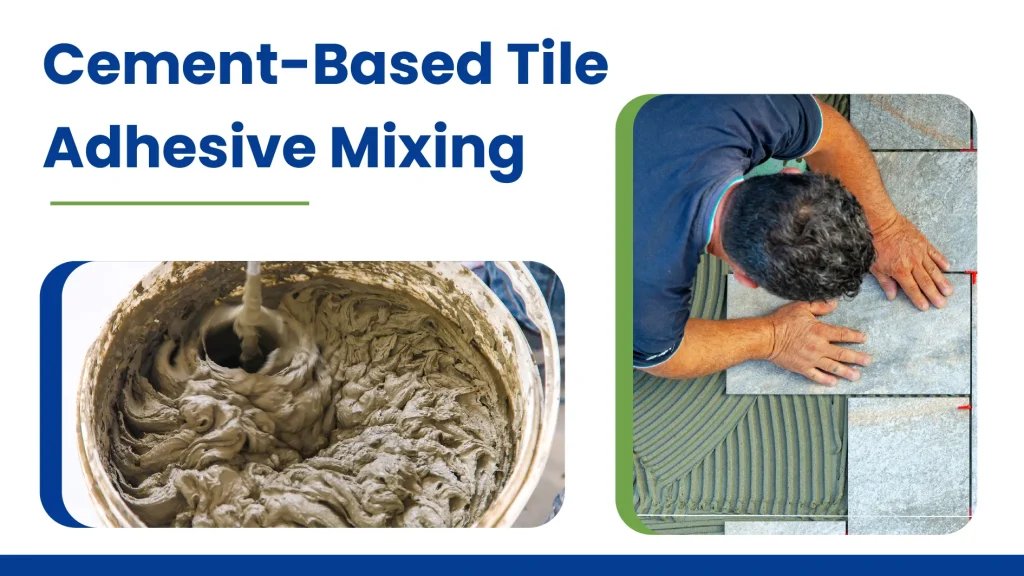
Tile adhesive is a cement-based bonding material used to fix ceramic tiles, wall tiles, floor tiles, stone tiles, and other decorative materials. It is widely used on interior walls, exterior walls, floors, bathrooms, kitchens, and other building surfaces.
Compared with traditional cement and sand mortar, modern tile adhesive has stronger bonding strength, better water resistance, better freeze-thaw resistance, better aging resistance, and easier application. It also allows a thinner bonding layer. This can save space and reduce material waste.
A good tile adhesive is not made by cement alone. It needs cement, graded sand, cellulose ether, polymer powder, calcium formate, and sometimes other additives. Each material has a clear job. Cement gives strength. Sand controls volume and cost. Cellulose ether improves water retention and workability. Polymer powder improves bonding and flexibility. Other additives help open time, anti-slip behavior, early strength, and water resistance.
For manufacturers, the real question is not only “how do you make tile adhesive?” The more useful question is how to design a formula that works on the job site. The adhesive must be easy to mix, easy to spread, stable on the wall, strong after curing, and safe for different tile sizes.
What Is Tile Adhesive?
Tile adhesive is a polymer-modified cement-based dry-mix mortar. It is supplied as a dry powder. Before use, the powder is mixed with water to form a smooth paste. The paste is then applied to the wall or floor with a notched trowel.
Tile adhesive is used for ceramic tiles, porcelain tiles, mosaic, stone tiles, wall tiles, floor tiles, and some large-format tiles. It can be used on cement mortar surfaces, concrete surfaces, plastered surfaces, old tile surfaces, boards, and other prepared substrates. The exact application depends on the grade of the adhesive and the condition of the base surface.
Modern tile adhesive is often divided into ordinary type, enhanced type, and higher-performance type for larger tiles or stone. The formula becomes more demanding as tile size increases. Large tiles are heavier. They need stronger bonding, better open time, better anti-sag performance, and better flexibility.
Main Types Of Tile Adhesive
Ordinary Tile Adhesive
Ordinary tile adhesive is used for common wall tiles and floor tiles on normal cement mortar surfaces. It is suitable for standard ceramic tiles and smaller tile sizes.
This type of formula focuses on basic bonding strength, easy mixing, smooth spreading, and stable construction performance. It usually uses cement, graded sand, HPMC, redispersible polymer powder, and calcium formate.
Enhanced Tile Adhesive
Enhanced tile adhesive has stronger bonding strength and better anti-sag performance. It is more suitable for wall tiles, higher bonding requirements, and some non-standard surfaces.
This type of formula may use more polymer powder or other additives to improve adhesion and flexibility. It may also use cellulose ether grades with stronger water retention and better vertical stability.
High-Performance Tile Adhesive
High-performance tile adhesive is used for larger tiles, marble, stone, old tile surfaces, gypsum board, fiberboard, plywood, or other difficult substrates. It needs stronger bonding and better flexibility because the bonding layer must resist stress from thermal expansion and contraction.
For this kind of formula, grade selection becomes very important. Zhiwei products such as HPMC 100K, HPMC 200K, and HEMC 100H can be tested when the formula needs stronger water retention, longer open time, and better anti-sag support.
Basic Tile Adhesive Formula
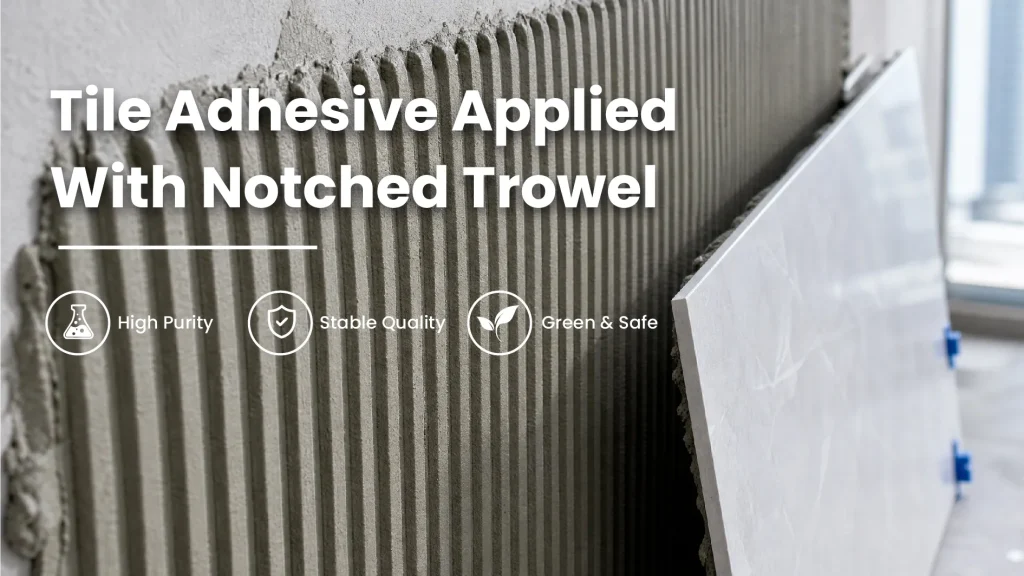
A basic tile adhesive formula is usually designed by weight. The exact formula should be adjusted based on tile size, substrate type, local standard, climate, and application method.
Here is a practical starting structure for ordinary cement-based tile adhesive.
| Raw Material | Typical Function | Formula Direction |
|---|---|---|
| Cement PO 42.5 | Main strength and bonding base | Around 330 parts |
| Graded sand | Filler, volume stability, workability | Main balance of the formula |
| Fine sand | Improves packing and surface feel | Adjust based on grading |
| HPMC or HEMC | Water retention, thickening, workability | Around 2.5-4 parts for testing |
| Redispersible polymer powder | Bonding strength and flexibility | Around 10-18 parts for testing |
| Calcium formate | Early strength support | Around 3-5 parts |
| PVA or other polymer aid | Bonding and film support | Optional, based on formula |
| Modified starch ether | Anti-slip and handling | Optional |
| Wood fiber | Crack resistance and open time | Optional |
| Hydrophobic agent | Water resistance | Optional |
A common water ratio is powder:water = 1:0.25-0.30. In site terms, 25 kg of dry powder may use about 6-6.5 kg of water. The exact water dosage depends on sand grading, cement type, cellulose ether grade, polymer powder, and required paste consistency.
Do not add water randomly. Too much water makes the adhesive easier to spread at first, but it can reduce bonding strength, increase shrinkage, and hurt durability.
What Each Raw Material Does
Cement
Cement is the main mineral binder. It gives the adhesive strength after hydration. PO 42.5 cement is commonly used in cement-based tile adhesive formulas.
The cement must be stable. If cement strength, setting time, or fineness changes too much, the final adhesive may also change. This can affect open time, bonding strength, and site performance.
Sand
Sand is the largest part of many tile adhesive formulas. It controls cost, shrinkage, workability, and the final body of the adhesive. A mix of different sand sizes can improve packing and help the paste spread better.
For tile adhesive, clean and well-graded sand is important. Dirty sand, too much fine powder, or unstable grading can cause poor workability and weak bonding.
Cellulose Ether
Cellulose ether is one of the most important additives in tile adhesive. HPMC and HEMC help control water retention, viscosity, open time, and application feel.
Without enough water retention, cement may lose water too fast into the substrate or air. This can reduce hydration and weaken bonding. Without enough viscosity, the adhesive may sag on vertical walls. Without good workability, the worker may find the adhesive hard to spread.
Zhiwei supplies HPMC and HEMC grades for construction dry-mix systems. HPMC 100K is a high-viscosity hydroxypropyl methyl cellulose grade for tile adhesive, wall putty, plaster, EIFS mortar, and other dry-mix systems. It supports water retention, open time, and vertical stability. HPMC 200K is a very-high-viscosity grade for stronger application body and high water retention. HEMC 100H is a high-viscosity hydroxyethyl methyl cellulose grade that supports strong water retention, application body, anti-sag behavior, and wet mortar consistency.
The best grade depends on the formula. A standard tile adhesive may need a balanced HPMC grade. A large-format tile adhesive may need stronger water retention and anti-sag support. A formula for hot or dry weather may also need better open time.
Redispersible Polymer Powder
Redispersible polymer powder improves bonding strength, flexibility, and stress resistance. It helps the tile adhesive bond better to tiles and substrates. It also helps the cured adhesive resist movement from temperature change, vibration, or minor substrate stress.
Common polymer systems may include vinyl acetate-ethylene copolymer, acrylic systems, and other polymer powders. The final choice depends on bonding strength, flexibility, water resistance, and cost target.
For enhanced tile adhesive, polymer powder dosage is usually higher than in ordinary tile adhesive.
Calcium Formate
Calcium formate is often used as an early strength additive. It helps cement-based systems develop strength faster. This can be useful when the adhesive needs better early performance.
The dosage should be controlled. Too much early strength additive can change setting time and workability.
Starch Ether, Wood Fiber, And Other Additives
Modified starch ether can improve anti-slip performance. This is useful for wall tile adhesive because tiles should not slide down after placement.
Wood fiber can improve crack resistance and open time. It also helps the fresh mortar hold a stable structure.
Hydrophobic additives can reduce water absorption and improve water resistance. They are useful in wet areas or higher-performance tile adhesive systems.
Why HPMC And HEMC Matter In Tile Adhesive
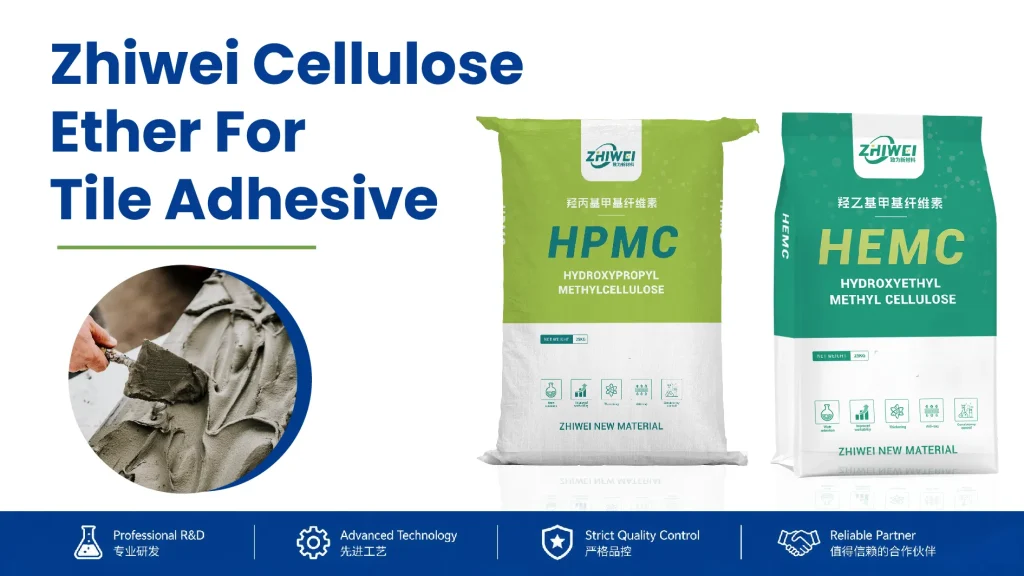
HPMC and HEMC do not replace cement or polymer powder. Their role is different. They control the fresh paste.
In tile adhesive, fresh paste quality matters a lot. The adhesive must hold water long enough for cement hydration. It must stay workable during spreading. It must form clean trowel ridges. It must support tiles on vertical surfaces. It must allow small position adjustment before setting.
This is why cellulose ether selection is important.
For ordinary tile adhesive, Zhiwei HPMC 100K can be a useful starting point when the formula needs strong water retention, open time, and vertical stability.
For high-body or large-format tile systems, Zhiwei HPMC 200K can be tested when stronger viscosity and application body are needed.
For formulas that need high water retention, stable wet mortar performance, and better anti-sag behavior, Zhiwei HEMC 100H can be tested.
The right product should always be confirmed through real formula testing. Cement type, sand grading, polymer powder, temperature, water dosage, and mixing method all affect the final result.
How To Mix Tile Adhesive
To make tile adhesive on site, start with clean water. Add the dry powder into the water slowly. Do not add water into a pile of powder. This helps reduce lumps and improves mixing.
Use an electric mixer when possible. Mix until the paste is smooth and free of dry powder lumps. After the first mixing, let the paste stand for about 10 minutes. Then mix again briefly before use.
This resting time helps the cellulose ether hydrate and helps the paste reach a more stable consistency.
Use the mixed adhesive within the allowed working time. In many cases, the mixed paste should be used within about 2 hours, depending on weather, formula, and site conditions. Do not add water again to hardened or dried adhesive paste. Re-tempering can reduce strength and cause bonding problems.
How To Apply Tile Adhesive
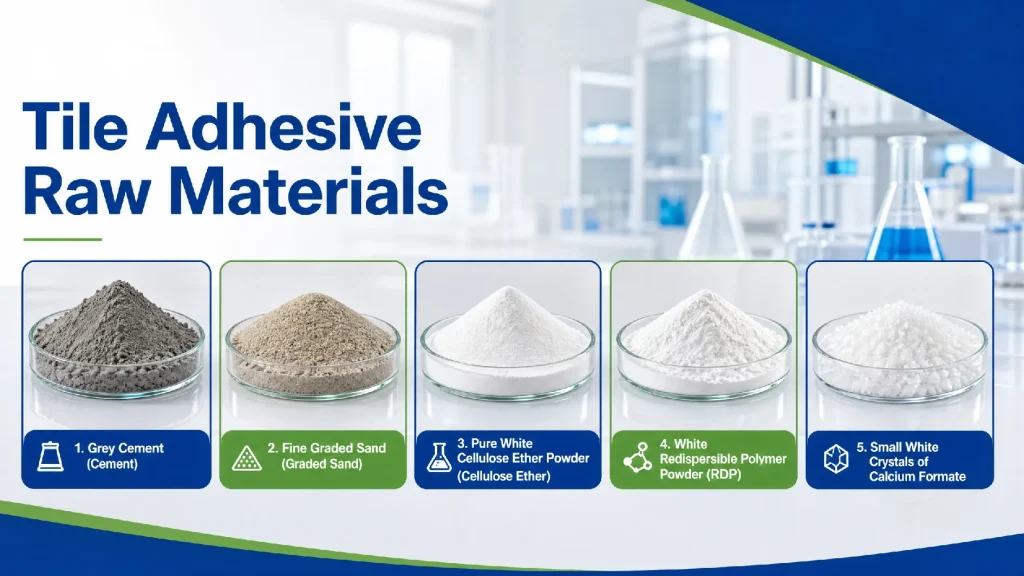
The substrate must be firm, dry, clean, and stable. It should have no oil, wax, dust, loose material, or movement. Painted surfaces should be roughened before tiling. New concrete should be cured well before tile installation. New plaster should also be cured before use.
Use a notched trowel to spread the adhesive on the working surface. The trowel ridges should be even. The trowel angle controls adhesive thickness. A common application thickness is around 3 mm, but it depends on tile size and substrate flatness.
Apply only a workable area each time. In many site conditions, about 1 square meter is a practical working area. Press the tile into the adhesive within the open time. For many systems, tiles should be placed within about 5-15 minutes after spreading, and position adjustment should be done within about 20-25 minutes.
For large tiles, heavy stone, or tiles with deep back grooves, use the double-buttering method. Apply adhesive to both the substrate and the back of the tile. This improves coverage and reduces hollow spots.
Keep movement joints. Do not cover expansion joints with rigid adhesive. After tile installation, wait until the adhesive is fully hardened before grouting. Around 24 hours is a common practical reference, but the exact time depends on formula, temperature, humidity, tile type, and substrate.
Performance Targets For Good Tile Adhesive
A good tile adhesive should have strong bonding strength. It should resist water, freeze-thaw cycles, and aging. It should also have good flexibility and crack resistance.
For many cement-based tile adhesives, tensile adhesion strength is a key test. C1-type reference requirements often check bonding strength after original curing, water immersion, heat aging, freeze-thaw treatment, and open time conditions. A common reference value is >=0.5 MPa. Always confirm the standard required in your target market.
The adhesive should also have good anti-sag performance. This is important for wall tile installation. The tile should stay in place after pressing.
Open time is also important. Workers need enough time to spread adhesive, place tiles, and adjust position. If the surface skins too fast, bonding strength can drop.
Common Mistakes When Making Tile Adhesive
The first mistake is using poor sand grading. Sand is not only filler. It affects workability, water demand, shrinkage, and strength.
The second mistake is using too much water. Extra water may make the paste feel easy to spread, but it weakens the bonding layer.
The third mistake is choosing the wrong cellulose ether. A low-viscosity grade may not provide enough anti-sag support. A very high-viscosity grade may make the paste too heavy if the dosage is not adjusted.
The fourth mistake is ignoring open time. Tile adhesive must stay active long enough after spreading. This is especially important in hot, dry, or windy conditions.
The fifth mistake is applying adhesive on dirty or unstable surfaces. Even a good formula can fail if the substrate is weak.
How Zhiwei Supports Tile Adhesive Manufacturers
Zhiwei (Jinan) New Materials Co., Ltd. supplies cellulose ether products for construction dry-mix systems. For tile adhesive, Zhiwei can help customers compare HPMC and HEMC grades based on water retention, viscosity, open time, anti-sag behavior, and wet mortar consistency.
Zhiwei products such as HPMC 100K, HPMC 200K, and HEMC 100H are practical options for tile adhesive formula screening. They can support stronger water retention, better workability, cleaner trowel ridges, and more stable vertical application.
For a standard ceramic tile adhesive, Zhiwei can help test a balanced HPMC grade. For large-format tile adhesive or high-performance systems, Zhiwei can help screen higher-viscosity grades or HEMC options. The goal is simple: make the performance repeatable.
Conclusion
To make tile adhesive, you need more than cement and sand. A practical formula should include cement, graded sand, cellulose ether, polymer powder, and selected additives. Cement gives strength. Sand controls structure. HPMC or HEMC improves water retention, open time, workability, and anti-sag performance. Polymer powder improves bonding strength and flexibility.
For ordinary tile adhesive, start with a balanced cement-sand system and test HPMC dosage carefully. For enhanced or large-format tile adhesive, increase the focus on polymer powder, water retention, flexibility, and anti-sag behavior.
If you are developing a tile adhesive formula, Zhiwei can help you choose suitable cellulose ether grades for testing. Contact Zhiwei (Jinan) New Materials Co., Ltd. to request samples, technical information, and grade recommendations for your dry-mix tile adhesive production.