
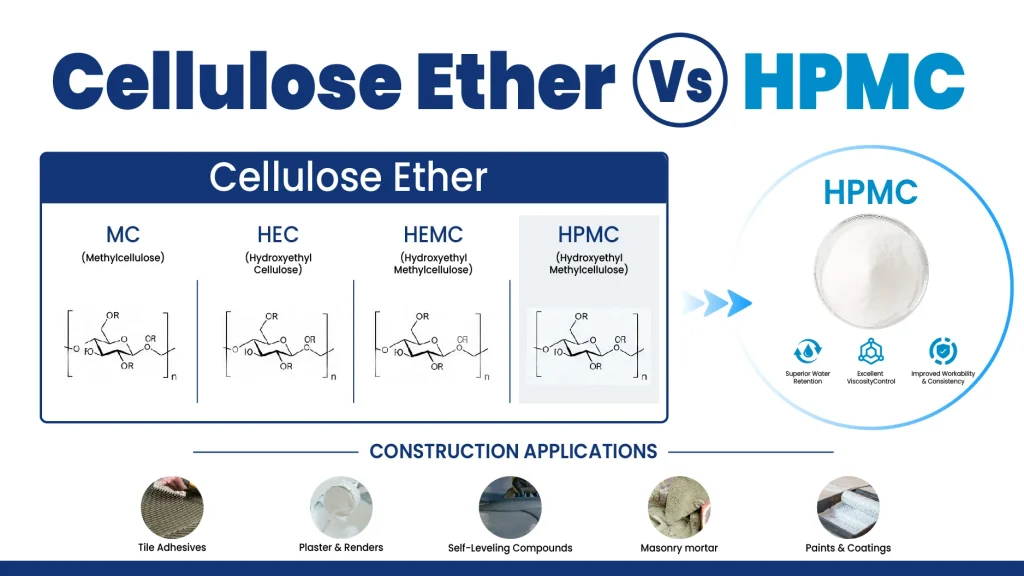
At Zhiwei (Jinan) New Materials Co., Ltd., customers often ask a simple question: Are cellulose ether and HPMC the same thing? The short answer is no. Cellulose ether is a broad material family. HPMC is one specific type inside that family.
A simple way to understand it is this: cellulose ether is the category, while Hydroxypropyl Methylcellulose, or HPMC, is one member of that category. Other cellulose ethers include HEC, HEMC, MC, CMC, and several other modified cellulose products. They all come from cellulose, but they do not have the same substitution groups, solubility, viscosity behavior, application range, or performance balance.
Zhiwei find out that many buyers use these names too casually. Some customers say “cellulose ether” when they actually mean HPMC. Some ask for HPMC when HEMC may be more suitable for construction mortar. Some compare HEC, HEMC, and HPMC only by viscosity, while ignoring substitution type, water retention, rheology, gel behavior, salt tolerance, and formula compatibility.
This article explains the difference clearly from a technical and application point of view.
The Short Answer: HPMC Is One Type Of Cellulose Ether
Cellulose ether is not one single product. It is a family of cellulose derivatives. Natural cellulose has hydroxyl groups on its molecular chain. Through chemical modification, some of these groups are replaced or modified by ether groups. This creates different cellulose ethers with different properties.
HPMC stands for Hydroxypropyl Methylcellulose. It is a cellulose ether with hydroxypropyl and methyl substitution groups. This structure gives HPMC cold-water solubility, viscosity-building ability, film-forming properties, thermal gel behavior, and useful performance in construction, food, pharmaceutical, coating, and daily chemical systems.
Zhiwei find out that the biggest misunderstanding is treating “cellulose ether” and “HPMC” as equal terms. They are not equal. HPMC is part of the cellulose ether family, but the family is much bigger than HPMC.
What Cellulose Ether Means
Cellulose ether refers to a group of modified cellulose materials. The specific product name depends on the substitution groups introduced onto the cellulose chain.
For example:
HEC means Hydroxyethyl Cellulose.
HEMC means Hydroxyethyl Methyl Cellulose.
HPMC means Hydroxypropyl Methylcellulose.
MC means Methyl Cellulose.
CMC means Carboxymethyl Cellulose.
These materials share a cellulose backbone, but their side groups are different. That difference changes how they dissolve, thicken, hydrate, gel, interact with salts, form films, and perform in real formulas.
For Zhiwei, this distinction matters because construction customers do not only need “a cellulose ether.” They need the right cellulose ether for the formula. Wall putty, tile adhesive, dry-mix mortar, coatings, detergent, drilling fluid, and gypsum plaster may require different cellulose ether directions.
What HPMC Means
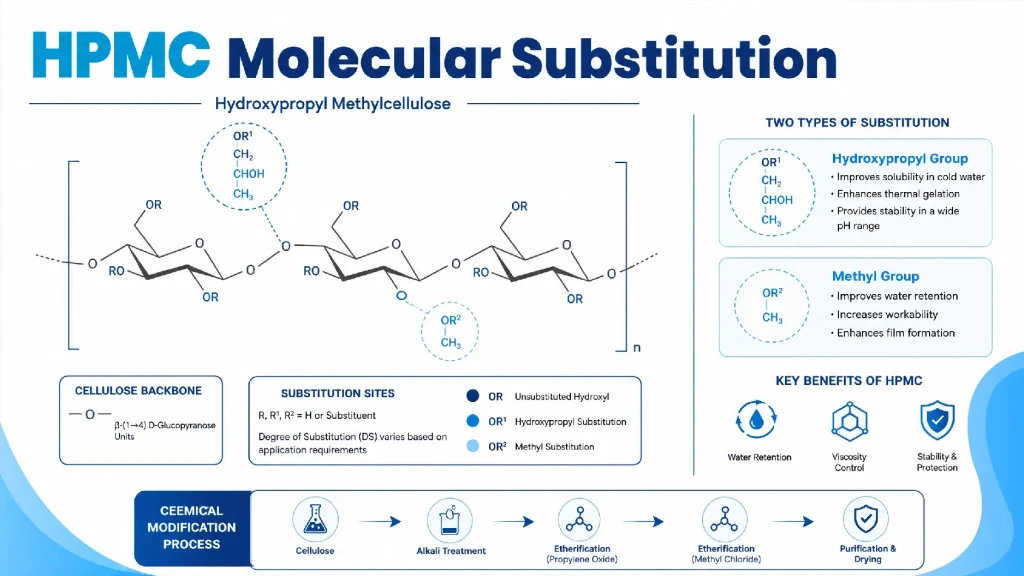
HPMC is a specific cellulose ether made by introducing hydroxypropyl and methyl groups onto cellulose. These two substitution groups are the key reason HPMC behaves differently from other cellulose ethers.
The hydroxypropyl group improves water interaction and affects solubility, hydration, and gel behavior. The methyl group affects thickening, thermal gelation, film formation, and hydrophobic balance. Together, these groups give HPMC a useful balance of water solubility, viscosity, stability, compatibility, and film-forming performance.
Zhiwei find out that HPMC is especially important in construction materials because it can help control water retention, consistency, workability, open time, and fresh-state stability. It is widely used in wall putty, mortar, tile adhesive, gypsum plaster, EIFS mortar, self-leveling material, and related dry-mix products.
Difference 1: Material Scope
The first difference is scope.
Cellulose ether is broad. HPMC is specific.
When a buyer says “cellulose ether,” that may refer to HEC, HEMC, HPMC, MC, CMC, or another cellulose derivative. When a buyer says “HPMC,” the material is much more specific.
This difference matters in purchasing and formulation. If a customer only says “cellulose ether for mortar,” the supplier must still confirm whether the customer needs HPMC, HEMC, or another type. If a customer says “HPMC for wall putty,” the direction is clearer, but grade selection is still needed.
At Zhiwei, we prefer to start with the application. The right cellulose ether is not chosen by category name alone. It is chosen by what the formula needs to do.
Difference 2: Chemical Structure
The second difference is chemical structure.
Cellulose ethers have different substitution groups depending on product type. HEC has hydroxyethyl groups. HEMC has hydroxyethyl and methyl groups. HPMC has hydroxypropyl and methyl groups. CMC has carboxymethyl groups.
HPMC is defined by its hydroxypropyl and methyl groups. This makes it different from other cellulose ethers in water solubility, viscosity behavior, gelation, film formation, and compatibility.
Zhiwei find out that this chemical difference is the root of many performance differences. Two cellulose ethers may look like similar white powders, but they can behave very differently after water is added. Their substitution groups decide how they hydrate, thicken, gel, and interact with other formula components.
This is why a specification sheet should not only show viscosity. It should also identify the product type clearly.
Difference 3: Solubility
Cellulose ethers can show different solubility behavior depending on their substitution groups. Some cellulose ethers dissolve well in water. Some may have better compatibility with certain organic systems. Some are more sensitive to salts or pH conditions.
HPMC is known for good cold-water solubility. It disperses and hydrates in water to form a colloidal or viscous solution. In construction and daily chemical systems, this is one of its most useful features.
Zhiwei find out that solubility is not only a laboratory property. It directly affects production. If the powder disperses poorly, lumps or fisheyes may form. If hydration is too slow, viscosity development may be delayed. If hydration is too fast without proper dispersion, the surface of the particles may swell and block full wetting.
For construction customers, good dispersion and hydration behavior can make batching and mixing more stable.
Difference 4: Viscosity Range
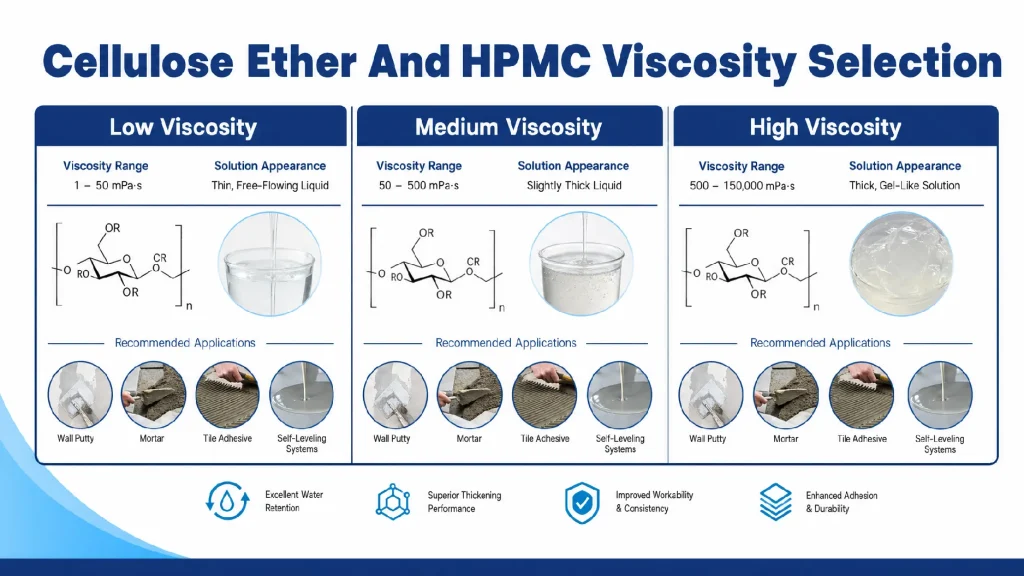
Cellulose ether products can have a very wide viscosity range. Some grades are low viscosity and mainly support dispersion, stabilization, or light thickening. Other grades are high viscosity and provide strong body, water retention, and structure.
HPMC also has different viscosity grades. In construction, customers often choose HPMC by viscosity level, but this is only one part of the selection. A high-viscosity HPMC may provide stronger body and water retention, but it may also increase stickiness or reduce flow if the formula is not balanced.
Zhiwei find out that HPMC viscosity should be matched with the application. Wall putty may need smooth scraping and stable water retention. Tile adhesive may need open time, troweling feel, and anti-slip behavior. Self-leveling material may need controlled viscosity without killing flow. Gypsum plaster may need water retention and working time control.
The best grade is not always the highest viscosity grade. The best grade is the grade that matches the formula target.
Difference 5: Rheology
Rheology describes how a material flows under force. This is very important in construction. A tile adhesive must spread under the trowel but hold ridges after application. A wall putty must scrape smoothly but stay on the wall. A mortar must be workable but not collapse. A paint must flow during brushing but resist sagging after application.
Cellulose ethers can show complex rheological behavior. This depends on molecular weight, substitution type, concentration, temperature, salts, pH, and the rest of the formula.
HPMC usually provides more predictable rheology in many construction systems. It can help build body, improve consistency, and support stable application. In dry-mix products, this means better troweling, better scraping, better open time, and more stable fresh-state behavior.
Zhiwei find out that rheology is one of the main reasons construction customers test HPMC and other cellulose ethers. The customer does not only need a thick solution. The customer needs a formula that feels right during real use.
Difference 6: Stability
Cellulose ethers differ in stability under different environments. Some types may be more sensitive to pH, salts, temperature, or other additives. Some are more stable in neutral and alkaline conditions.
HPMC generally has good stability in neutral and alkaline systems. This is useful in construction materials because cement-based formulas are alkaline. It also helps HPMC work in many water-based industrial formulas.
Zhiwei find out that stability should always be tested inside the real formula. A cellulose ether may look stable in clean water, but construction materials contain cement, lime, gypsum, fillers, salts, polymers, defoamers, retarders, and other additives. These components can change hydration, viscosity, and final performance.
A good supplier should help customers test cellulose ether in the full system, not only in water.
Difference 7: Gelation Behavior
Some cellulose ethers show gelation behavior under certain conditions. HPMC is known for thermal gelation. In simple terms, an HPMC solution can change its structure when heated to a certain temperature range. This behavior depends on substitution, concentration, and grade.
This is different from simply “getting thicker.” Thermal gelation is a special behavior caused by the balance of hydrophilic and hydrophobic groups in the polymer structure.
Zhiwei find out that gelation behavior can be useful in some applications, but it also needs attention. In construction, temperature changes can affect working behavior, hydration speed, and viscosity development. In food and pharmaceutical systems, gelation and film-forming behavior can be used more directly.
The key point is clear: cellulose ether gelation behavior depends on product type, and HPMC has its own characteristic thermal gel properties.
Difference 8: Appearance And Powder Form
Cellulose ethers may appear as powders, granules, or treated particles depending on product type and grade. HPMC is usually supplied as a fine white or off-white powder. It has good dispersion potential when handled correctly.
Zhiwei find out that powder form affects processing. Particle size, surface treatment, moisture, and flowability can change how the product disperses in water or dry-mix materials. A good HPMC powder should be easy to distribute evenly in a dry blend and should hydrate predictably after water is added.
In construction, this affects production stability. If the cellulose ether is not evenly dispersed in the dry mix, the final mortar, putty, or adhesive may show inconsistent viscosity or local lumps after mixing.
Difference 9: Environmental And Safety Profile
Cellulose ethers are generally valued because they come from cellulose-based raw materials and can improve water-based formulation performance at low dosage. HPMC is often viewed as a practical and relatively environmentally friendly functional polymer in construction, food, and pharmaceutical fields.
Zhiwei find out that environmental discussion should still be specific. The final profile depends on grade, manufacturing route, application, and local regulation. Construction-grade HPMC should not automatically be treated as food-grade or pharmaceutical-grade HPMC. The product name may be similar, but purity standards, documentation, and intended use can be different.
For construction buyers, the main point is to use the correct grade for the correct application.
Difference 10: Salt Tolerance
Cellulose ethers behave differently in salt-containing systems. Some are more sensitive to electrolytes. Others can keep useful viscosity and stability under certain salt conditions.
HPMC can show good performance in some salt-containing systems, but the result depends on concentration, formula, and grade. Salt tolerance matters in construction systems, detergents, coatings, and other formulas where electrolytes or mineral components are present.
Zhiwei find out that salt tolerance should be tested in the actual customer system. A formula containing cement, lime, salts, surfactants, or other ionic components may affect viscosity and hydration differently from clean water.
This is why technical testing is more reliable than choosing only by general product description.
Difference 11: Film Formation
Different cellulose ethers have different film-forming properties. HPMC can form clear and tough films under suitable conditions. This is one reason it is used in pharmaceutical coatings, food applications, and some industrial systems.
In construction materials, film formation is not always the primary function of HPMC. Water retention, thickening, rheology, and workability are usually more important. But film-forming behavior can still support surface behavior and system stability in certain applications.
Zhiwei find out that customers should not assume every cellulose ether has the same film behavior. The film quality depends on product type, substitution, grade, concentration, drying condition, and other formula materials.
Difference 12: Compatibility
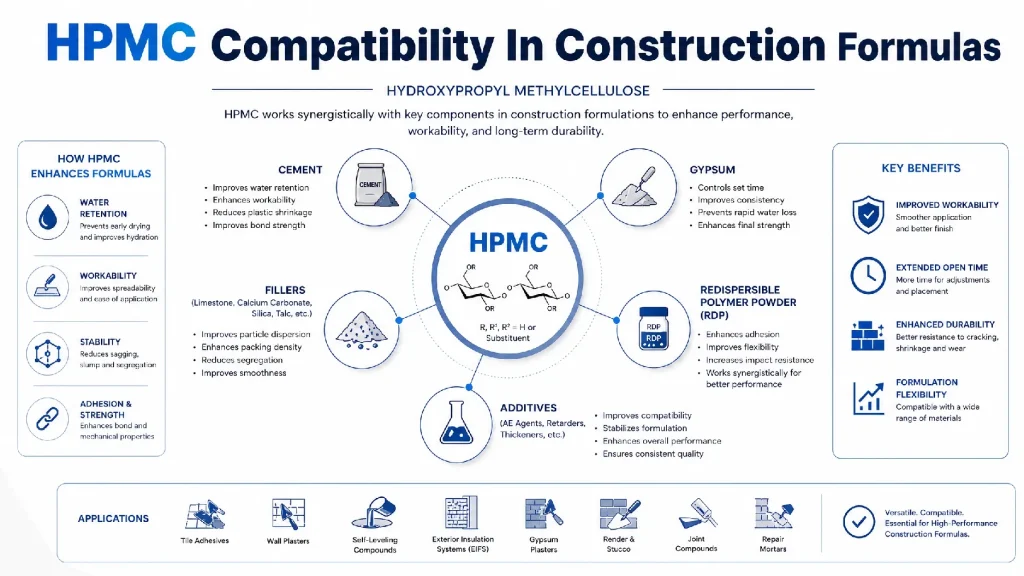
Compatibility is another key difference. Cellulose ethers interact differently with cement, gypsum, polymers, surfactants, salts, fillers, pigments, preservatives, and other additives.
HPMC usually has good compatibility in many construction and water-based systems. It can work with mineral binders, polymer powders, fillers, and other additives when the formula is designed correctly.
Zhiwei find out that compatibility problems often appear during production or application. A formula may become too sticky, too thin, too slow to hydrate, too fast to set, or unstable after storage. These problems are not always caused by one ingredient. They usually come from the full formulation balance.
For this reason, HPMC and other cellulose ethers should be tested together with the customer’s real raw materials.
Application Difference: Cellulose Ether Is Broader
Cellulose ether has a wider application range than HPMC alone. Because the family includes many different types, it can serve many industries, such as construction, coatings, daily chemical products, oilfield fluids, food, medicine, ceramics, paper, textiles, and polymerization.
HPMC is also widely used, but it is still one member of the family. It is especially common in construction materials, food systems, pharmaceutical excipients, coatings, and some industrial formulations.
Zhiwei find out that in construction, HPMC is often selected for wall putty, mortar, tile adhesive, gypsum plaster, self-leveling compounds, EIFS systems, and similar dry-mix materials. In these systems, its main value is water retention, viscosity control, workability, and fresh-state performance.
But in some other systems, HEC or HEMC may be more suitable. For example, HEC is often used in coatings, personal care, detergents, and oilfield systems. HEMC is widely used in construction, coatings, and daily chemical products. The best choice depends on the formula.
Cellulose Ether Vs HPMC: Simple Comparison Table
| Item | Cellulose Ether | HPMC |
|---|---|---|
| Scope | Broad material family | One specific cellulose ether type |
| Full meaning | Modified cellulose derivatives with ether groups | Hydroxypropyl Methylcellulose |
| Main substitution | Depends on product type | Hydroxypropyl and methyl groups |
| Common examples | HEC, HEMC, HPMC, MC, CMC | HPMC only |
| Water solubility | Varies by type | Generally good cold-water solubility |
| Viscosity range | Very broad | Grade-dependent, widely used in construction |
| Rheology | Different by type and structure | Useful for construction workability and consistency |
| Gelation | Depends on cellulose ether type | Known for thermal gelation behavior |
| Salt tolerance | Varies by type | Grade and formula dependent |
| Film formation | Varies by type | Can form clear and tough films under suitable conditions |
| Main construction role | Depends on selected cellulose ether | Water retention, thickening, workability, open time |
| Selection method | Choose by application and chemistry | Choose by formula target and grade test |
How To Choose Between Cellulose Ether Types
The correct selection should start from the application, not from a broad name.
If the customer is making wall putty, the key points may be water retention, smooth scraping, fresh stability, surface finish, and powdering resistance.
If the customer is making tile adhesive, the key points may be open time, slip resistance, troweling feel, adhesion, and water retention.
If the customer is making coatings, the key points may be viscosity control, flow, leveling, storage stability, and compatibility with pigment and resin systems.
If the customer is making detergent or personal care products, the key points may be clarity, salt tolerance, texture, foam feel, pH stability, and compatibility with surfactants.
If the customer is making oilfield fluids, the key points may be salinity, viscosity, hydration, temperature, and fluid stability.
Zhiwei find out that no cellulose ether should be selected blindly. Even if HPMC looks suitable from the product name, the grade must still be tested in the real formula.
What This Means For Zhiwei Customers
At Zhiwei (Jinan) New Materials Co., Ltd., we explain cellulose ether from the application side. We do not want customers to choose only by chemical name or viscosity number. We want them to choose by performance target.
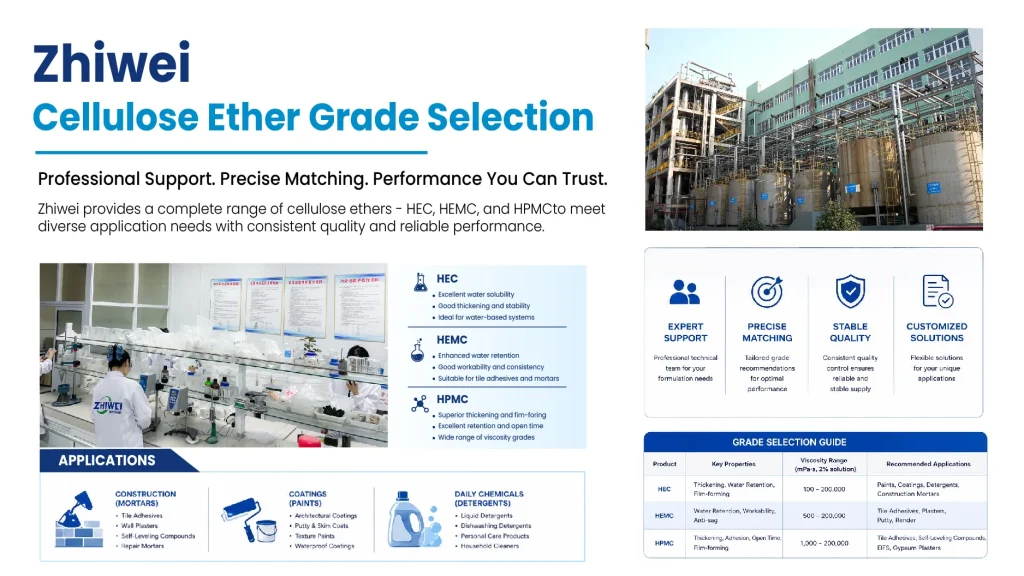
For HEC, customers usually focus on coatings, daily chemical products, and oilfield fluids.
For HEMC, customers usually focus on construction materials, coatings, and daily chemical products.
For HPMC, customers usually focus on construction systems, daily chemical products, and other water-based systems where water retention, thickening, workability, and stability matter.
The right grade depends on the formula. That is why we ask customers to share the application, target viscosity, pH, temperature, binder system, filler system, salt level, mixing method, and main issue. With these details, we can suggest a clearer test direction.
Conclusion
Cellulose ether and HPMC are not the same. Cellulose ether is the broad family. HPMC is one specific type of cellulose ether. The difference starts from chemical structure and continues into solubility, viscosity, rheology, gelation, salt tolerance, film formation, compatibility, and application range.
Zhiwei find out that this distinction is important for real formulation work. A customer should not simply ask for “cellulose ether” without clarifying the target application. A customer should also not assume that HPMC can replace every cellulose ether type in every formula.
For construction materials, HPMC is valuable because it supports water retention, thickening, workability, consistency, and open time. But HEC and HEMC also have their own strong application areas. The correct choice depends on the formula, process, climate, raw materials, and final performance target.
At Zhiwei, our goal is to help customers choose cellulose ether by application logic, not by name confusion. When the right type and grade are selected, cellulose ether can make performance more stable, production more predictable, and final products easier to use.