
Why Does Latex Paint Change During Storage?
A latex paint can leave production with acceptable consistency and still develop lumps, coarse particles, or an uneven texture during storage. Cold-weather transport creates a particular challenge: after freezing and thawing, the paint may no longer return to its original condition, even after thorough stirring.
Latex paint storage stability depends on the complete formulation and the conditions it experiences. Pigment volume concentration, the binder system, glycol additives, and coalescent selection all deserve attention when investigating low-temperature failures. HEC contributes to viscosity and flow control, but its role should be evaluated separately from freeze-thaw protection.
At Zhiwei, we recommend starting with the failure itself. A paint that becomes temporarily thicker when cold presents a different problem from one that retains hard particles after returning to room temperature. Identifying that difference helps avoid unnecessary changes to a thickener that may already be performing as intended.
Storage Stability Includes More Than One Test
Storage stability describes a paint’s ability to resist unacceptable changes under defined storage conditions. These changes can include thickening, settling, caking, coagulation, and unusual odor. Room-temperature storage, elevated-temperature storage, and low-temperature exposure examine different aspects of performance.
Passing a heat-storage test does not establish freeze-thaw resistance. Likewise, surviving several cold cycles cannot demonstrate a particular shelf life under every warehouse condition. The test must match the question being asked.
For winter distribution, the immediate concern is whether the paint remains usable after cold exposure and recovery. Check its appearance after thawing, its response to controlled stirring, and whether coarse material remains. Viscosity is useful, but a viscosity reading alone cannot describe all of these changes.
What Happens When Latex Paint Freezes?
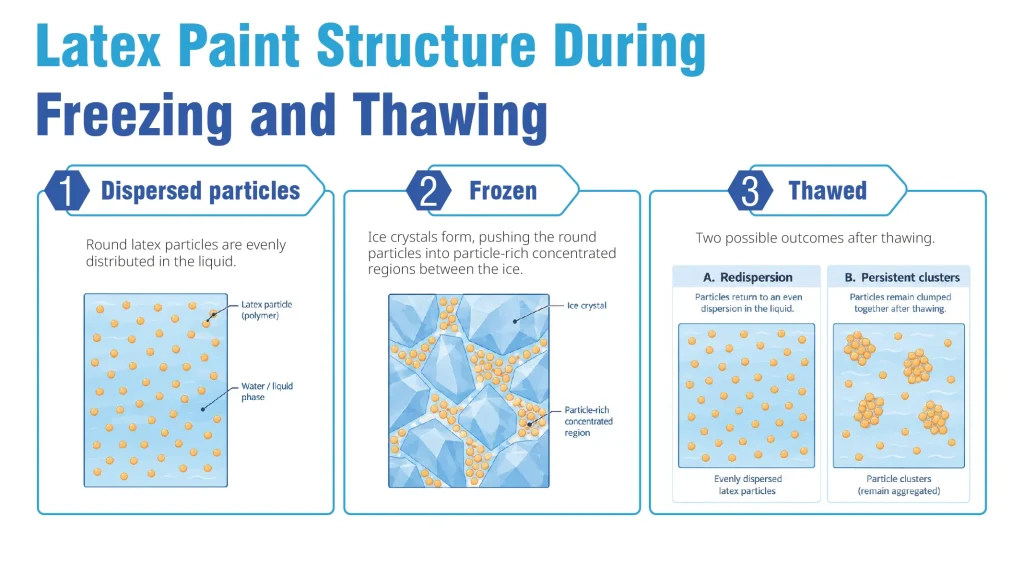
Research using cryogenic scanning electron microscopy has shown that frozen latex paint can contain ice crystals alongside regions concentrated in particles. After thawing, some formulations redisperse, while others retain particle clusters. In the systems investigated, propylene glycol concentration and thawing rate both influenced the resulting structure. These observations help explain why recovery conditions matter as well as the freezing stage. Effects of Freezing and Thawing on the Microstructure of Latex Paints
For practical troubleshooting, the important distinction is between reversible physical change and persistent damage. A cold sample should not be judged against a room-temperature control without first bringing both to the same measurement temperature. If lumps and coarse particles remain afterward, simply adjusting the apparent viscosity will not demonstrate that the original dispersion has recovered.
How Does PVC Affect Low-Temperature Storage Stability?
Pigment volume concentration, or PVC, expresses the volume of pigments and extenders as a percentage of their combined volume with binder solids. It is not the pigment weight percentage and does not include water in the denominator.
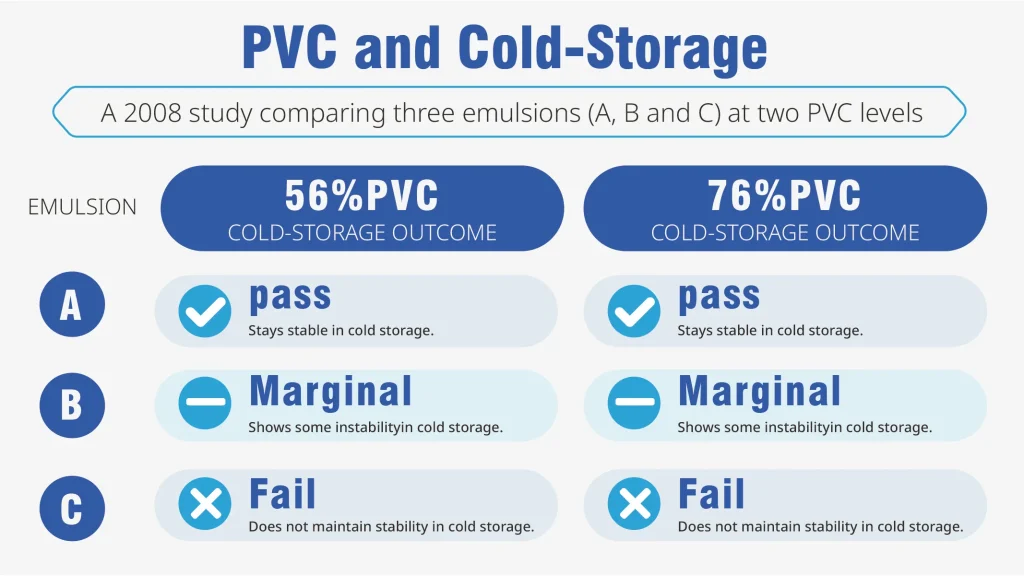
A 2008 study published in Shanghai Coatings compared three emulsions, identified as A, B, and C, in paints formulated at 56% and 76% PVC. The initial comparison excluded both antifreeze additives and coalescents. All six paints had a reported initial fineness reading of 50 μm.
After the cold-storage cycles, each 56% PVC paint developed lumps and showed particles across the fineness gauge. The three 76% PVC paints showed no reported abnormality and retained the 50 μm fineness reading. Within this experimental set, the higher-PVC formulations performed better.
That finding makes PVC a useful investigation variable, but it does not establish 76% as a universal target. The comparison covers three emulsions and two PVC levels, not every binder, pigment package, or paint category. Nor does it isolate every compositional change involved in moving from one PVC to another.
For a working formulation, compare PVC changes alongside the properties required of the finished coating. A paint that survives cold storage still needs acceptable application behavior and film performance. Use the published result to design a controlled comparison, rather than treating a higher filler level as an automatic correction.
What Did Glycol Addition Change?
In a second comparison, the 56% PVC paints received a reported 1% ethylene glycol addition and were allowed to mature for one day before testing. All three untreated paints formed lumps. With ethylene glycol, all three were recorded as showing no abnormality.
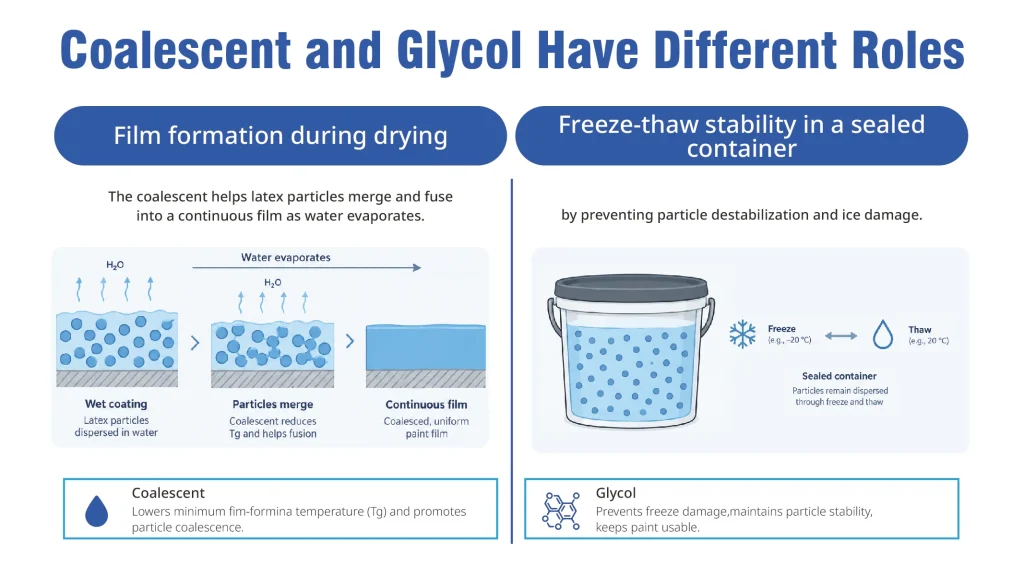
The result supports evaluating a dedicated freeze-thaw additive when a formulation fails at low temperature. It does not establish that every paint requires the same glycol or addition level. The reported percentage also lacks a clearly stated calculation basis, so it should not be transferred directly into a production batch sheet.
This distinction matters whenever formulation percentages are discussed. An addition calculated against total paint mass differs from one calculated against wet emulsion mass or polymer solids. Before comparing trials, define the denominator and use it consistently.
A practical screening series should include an untreated control and several clearly documented additive levels. Keep the binder, PVC, thickener package, preparation sequence, and conditioning time unchanged. That makes it easier to determine whether the improvement comes from the additive being investigated.
The ethylene glycol result is historical experimental evidence, not a blanket recommendation for present-day use. Final additive selection requires a separate review of the product’s safety documentation and intended application.
Why Is a Coalescent Not a Substitute for Freeze-Thaw Protection?
A coalescent helps the binder form a continuous film during drying. That function differs from keeping the packaged paint stable through cold exposure. Good film formation and good low-temperature storage performance therefore require separate checks.
The third comparison examined the same three emulsions at 56% PVC. Untreated paints were compared with paints containing 0.9% TEXANOL and paints containing both 0.9% TEXANOL and 1% propylene glycol. The experimental outcomes are summarized below.
| Formulation condition | Emulsion A | Emulsion B | Emulsion C |
|---|---|---|---|
| No added coalescent or glycol | Lumps | Lumps | Lumps |
| 0.9% TEXANOL | Lumps | Lumps | Lumps |
| 0.9% TEXANOL + 1% propylene glycol | No abnormality reported | No abnormality reported | No abnormality reported |
These percentages are reported experimental additions; their mass basis was not clearly specified. They are comparative evidence, not a ready-to-use formulation.
The coalescent alone did not prevent failure under the conditions tested. The combination with propylene glycol performed better. However, this comparison did not include a propylene-glycol-only condition, so it cannot establish that the two additives produced a special synergistic effect.
The study also cautioned against excessive coalescent addition. Its published table does not provide a graded overdose series, so there is no basis for extracting a universal failure threshold. The useful formulation lesson is narrower: set the coalescent level for the required film formation, then verify storage stability independently.
Where Does HEC Fit Into the Formulation?
Our HEC range is intended for viscosity development and flow control in water-based systems, including architectural latex paints. Available models include HEC 30K, HEC 50K, and HEC 100K. These can be considered during grade screening, with selection based on the target consistency, mixing process, and formulation chemistry. Product names alone should not be treated as complete viscosity specifications. Explore Our HEC Range
For a meaningful comparison, confirm each candidate’s technical data and viscosity measurement conditions before testing. A higher grade designation does not, by itself, demonstrate better freeze-thaw resistance.
The PVC, glycol, and coalescent experiments discussed above did not compare HEC grades. They therefore cannot support a claim that a particular HEC model would prevent the observed coagulation. We would evaluate an HEC change as a separate formulation variable and keep the freeze-thaw protection package under review at the same time.
When investigating a complaint, first establish whether the main issue is a consistency change or persistent coarse material. That observation helps define the next trial. Replacing HEC without checking the cold-storage history and the rest of the formula can leave the actual failure unresolved.
How Should You Test Latex Paint Storage Stability?
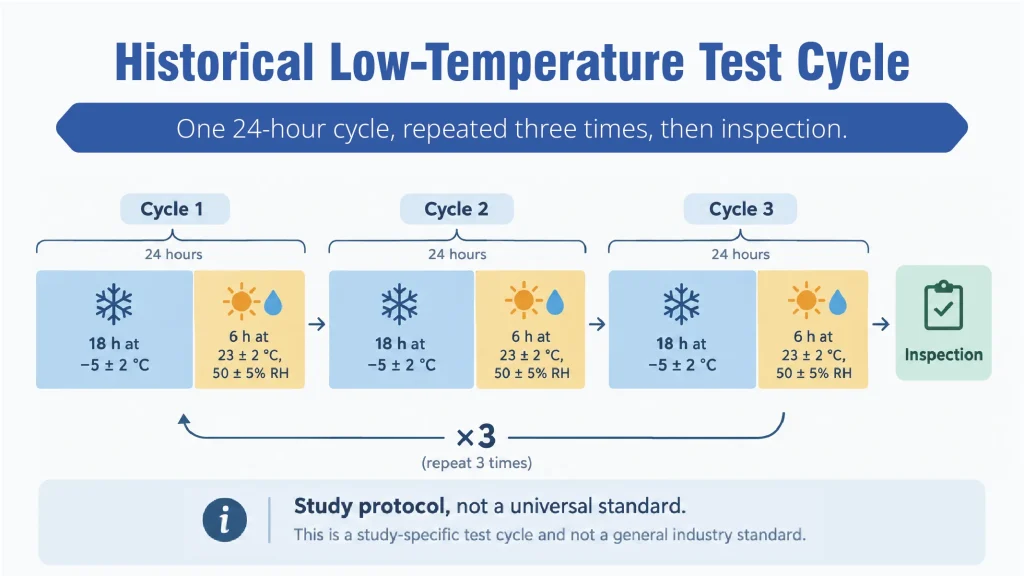
The historical comparison used sealed one-liter containers. Samples underwent 18 hours at −5 ± 2°C, followed by six hours at 23 ± 2°C and 50 ± 5% relative humidity. This sequence was repeated three times. Afterward, the samples were thoroughly stirred and inspected for lumps and separated coagulated material.
These conditions provide context for the results; they should not be presented as a universal acceptance method or a substitute for a customer’s required procedure. A different temperature, cycle count, container, or recovery period creates a different exposure.
For internal screening, document the procedure before starting. Use consistent containers, fill levels, sample preparation, and conditioning times. Retain an unexposed control from the same batch. After the specified recovery period, compare both samples at the same temperature and with the same stirring and measurement procedure.
Record more than a simple pass or fail. Note visible separation, ease of redispersion, remaining lumps, fineness changes, and viscosity under stated measurement conditions. A drawdown can also provide a practical check for visible particles and changes in application quality, although that extends beyond the historical study’s reported endpoints.
Acceptance criteria should reflect the intended product. “No visible lumps” is a useful observation, but it does not establish that all application and film properties remain unchanged.
How Can You Make Formulation Trials More Useful?
Begin with the existing formula as the control. If you change the PVC, glycol level, coalescent, and HEC simultaneously, a better result will still leave uncertainty about which change helped.
Instead, organize the work into focused comparisons. First evaluate the variable most closely linked to the observed failure. Then examine interactions once an individual adjustment shows promise. Keep accurate records of addition basis, mixing sequence, and sample age so that a successful laboratory result can be repeated.
For a paint that fails only after cold exposure, the source experiments provide a reasonable starting point: examine the binder–PVC combination and the freeze-thaw additive package, while checking whether the coalescent is being expected to perform a function it has not demonstrated.
HEC screening can then address the required viscosity and handling characteristics without being confused with proof of cold-storage resistance. The final candidate should be tested as a complete formulation, because approval of individual ingredients does not establish approval of the finished paint.

Conclusion
Latex paint storage stability depends on the formulation and the exposure conditions. The published comparisons show that PVC and glycol addition can substantially affect low-temperature outcomes, while a coalescent alone may not prevent coagulation. Those findings are useful starting points for testing, not universal dosage rules.
At Zhiwei, we recommend selecting HEC within that broader formulation assessment. Share your binder type, PVC, current additive package, target viscosity, and the changes observed after storage. We can discuss suitable HEC candidates and the comparisons needed to assess them in your paint.