
When latex paint becomes thinner, separates, or develops floating color during storage, hydroxyethyl cellulose is often one of the first raw materials to be questioned. However, blaming HEC alone usually oversimplifies the problem.
The apparent loss of viscosity may come from pigment settling, water-phase separation, insufficient rheological recovery, excessive color-paste addition, coarse pigment particles, or an unbalanced combination of thickeners and leveling agents.
HEC is one of the organic thickeners used in latex paint. Its function is to increase the viscosity of the aqueous phase and help the paint resist settling. Nevertheless, a water-phase thickener cannot independently control every interaction among emulsion particles, pigments, fillers, surfactants, and color paste.
For dark latex paint, the more useful question is not simply, “Is the HEC defective?” The correct question is:
Does the complete rheology system provide enough low-shear structure, thixotropic recovery, dispersion stability, and application flow after the color paste has been added?

Is the Paint Really Losing Viscosity?
A stored paint that looks thinner does not necessarily have a uniform reduction in viscosity throughout the container.
When pigment and filler particles settle, the upper layer contains fewer solids and may appear noticeably thinner. The material near the bottom becomes more concentrated and can form a dense sediment. A viscosity measurement taken only from the upper layer will naturally be lower, but this does not prove that the thickener has chemically failed.
Several different conditions can therefore be described as “viscosity loss.”
| Observed condition | Possible interpretation |
|---|---|
| Thin liquid appears at the top | Water-phase separation or pigment settling |
| Paint is thin at the top but thick at the bottom | Nonuniform composition caused by stratification |
| Viscosity decreases during mixing and later recovers | Normal thixotropic behavior |
| Paint remains thin after the shear stops | Insufficient structure recovery |
| Initial KU viscosity is acceptable but storage separation occurs | The rheology profile is unbalanced even though the single viscosity value looks correct |
| Re-stirred paint reaches the original viscosity but develops floating color during application | Physical remixing has not fully restored the original paint structure |
A reliable diagnosis must distinguish uniform viscosity loss from separation. Otherwise, a formulator may increase the HEC dosage while leaving the actual cause unchanged.
Why Dark Latex Paint Is More Vulnerable During Storage
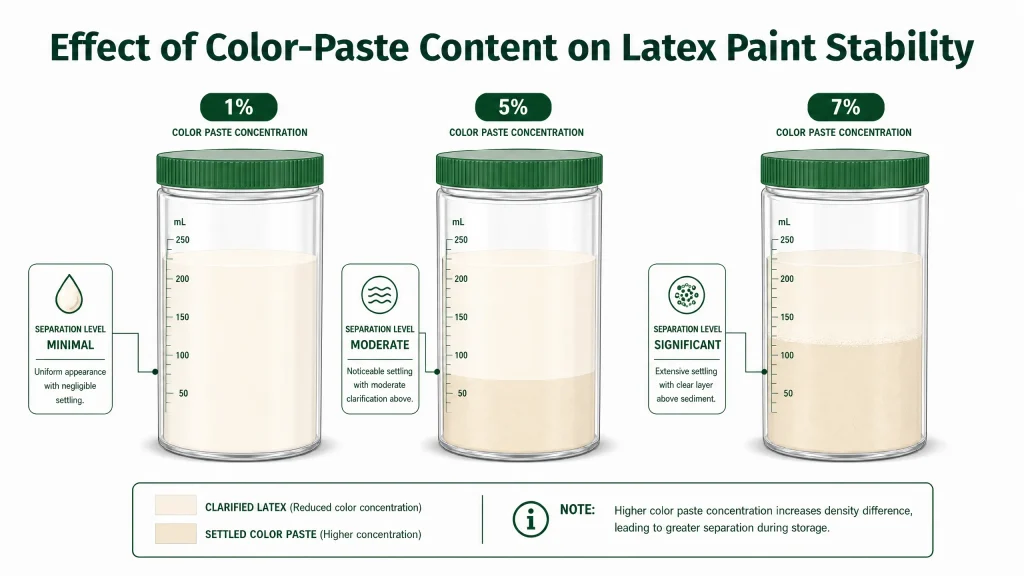
Dark latex paint usually requires more color paste than a light-colored or white base. This additional color paste changes the balance among pigment, liquid phase, dispersant, surfactant, emulsion, and thickener.
A storage comparison using the same basic paint formulation but different color-paste contents demonstrated how strongly this variable can influence stability.
| Paint sample | Color-paste content | After 15 days | After 30 days | After 60 days |
|---|---|---|---|---|
| Paint A | 1% | No separation, slight floating color | Slight separation, 4.2% | Slight separation, 5.3% |
| Paint B | 5% | Slight separation, 4.9% | More separation, 10% | Obvious separation, 11% |
| Paint C | 7% | More separation, 14.9% | Severe separation, 25% | Severe separation, 29% |
All three paints used the same basic formulation. The main difference was the amount of color paste.
At 1% color-paste content, the paint showed only limited separation after extended storage. Increasing the content to 7% produced severe stratification, reaching 29% after 60 days.
This result has two important implications.
First, a base paint can pass a storage test and still become unstable after tinting. Testing only the untinted product does not represent the behavior of a deep-color finished paint.
Second, an instability that appears after tinting should not immediately be attributed to HEC. The higher color-paste content has introduced additional particles, liquid carriers, and formulation components that can alter both viscosity and particle interactions.
Thixotropy Determines What Happens After Shear Stops
Latex paint is expected to change viscosity as it moves through different stages of production, storage, and application.
During mixing, pumping, brushing, or rolling, the paint is exposed to shear. Its internal structure breaks down and the viscosity decreases, allowing the product to flow and level.
After application, the shear force falls. The paint should then rebuild its internal structure and recover viscosity. This recovery reduces sagging on vertical walls and helps maintain a uniform wet film.
Storage represents an extremely low-shear condition. Under these conditions, the paint should have sufficient structure and viscosity to resist pigment and filler settling.
This reversible change is described as thixotropic behavior:
- Shear breaks down the internal structure.
- Viscosity decreases and the paint flows.
- The shear force is removed.
- The structure gradually rebuilds.
- Viscosity recovers.
A paint may show acceptable viscosity immediately after production but still have weak structural recovery. Once placed in storage, the insufficient low-shear network allows particles to move downward and the liquid phase to migrate upward.
The resulting separation may then be interpreted as viscosity loss, even though the more fundamental problem is incomplete rheological recovery.

Particle Settling Explains Why Viscosity Is Only Part of the Problem
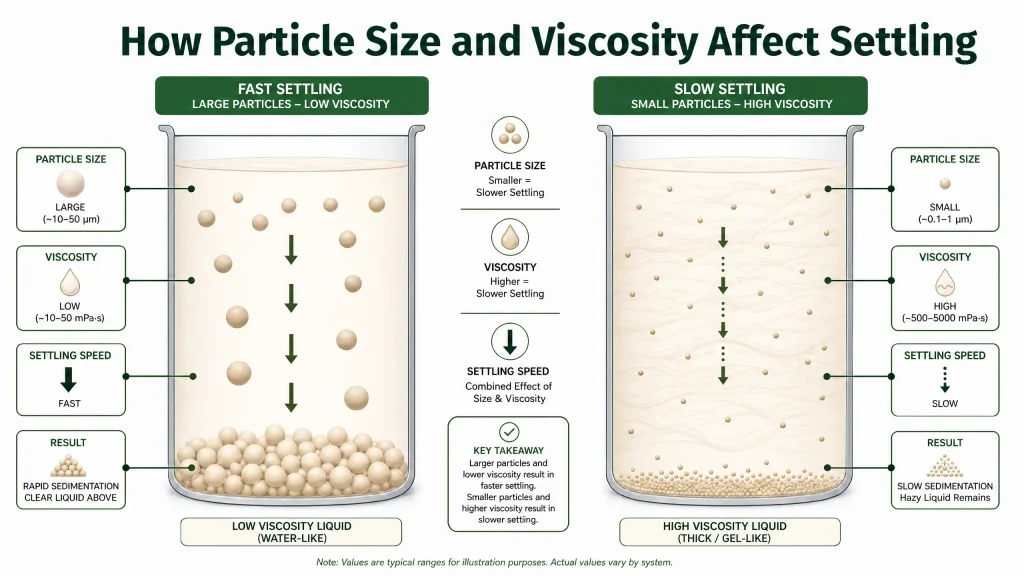
The settling tendency of pigment and filler particles can be described using Stokes’ law:
u₀ = d²(ρs − ρ)g / 18μ
In this equation:
- u₀ represents the settling velocity.
- d is the particle diameter.
- ρs − ρ is the density difference between the particle and liquid phase.
- g represents gravitational acceleration.
- μ is the viscosity of the liquid phase.
The relationship highlights two practical formulation levers.
A higher liquid-phase viscosity can slow particle movement. This is one reason cellulose thickeners such as HEC are useful in latex paint.
Particle size has an even stronger mathematical influence because diameter is squared. A relatively small reduction in pigment or filler particle size can therefore produce a significant change in settling velocity.
This explains why increasing the thickener is not always the most efficient response. If the pigment particles remain too coarse or poorly dispersed, raising the viscosity may improve the appearance temporarily without correcting the underlying dispersion problem.
How Pigment Fineness Affects Storage Stability
A grinding comparison demonstrates the relationship between pigment fineness and dark-paint separation.
| Paint sample | Grinding time | Final fineness | After 15 days | After 30 days |
|---|---|---|---|---|
| Paint A | 30 minutes | 60 μm | Relatively obvious separation | Severe separation |
| Paint B | 50 minutes | 40 μm | Relatively obvious separation | Severe separation |
| Paint C | 60 minutes | 25 μm | No separation | Relatively obvious separation |
| Paint D | 80 minutes | 25 μm | No separation | Relatively obvious separation |
Reducing the particle size from 60 μm or 40 μm to approximately 25 μm substantially improved the 15-day result. Extending the grinding time from 60 to 80 minutes did not reduce the fineness below 25 μm, so the additional processing time produced no corresponding stability improvement.
The practical conclusion is not that every latex paint must use the same grinding time. Grinding equipment, pigment type, filler, dispersant, and batch size all affect the result.
The important point is that storage instability cannot be solved only through thickener selection. Pigment and filler fineness should be investigated before HEC is blamed or its dosage is increased.
Within the tested system, bringing the particle fineness close to approximately 20-25 μm greatly reduced the separation tendency while avoiding unnecessary grinding time.

Can HEC Cause Latex Paint to Lose Viscosity?
The available evidence does not demonstrate that HEC itself causes latex paint to lose viscosity during storage.
HEC is identified as one of the main organic thickener categories used in waterborne latex paint. Its presence generally increases water-phase viscosity, which should reduce particle settling rather than accelerate it.
However, this does not mean that every HEC-containing formulation will remain stable.
A paint that relies primarily on water-phase thickening may have sufficient initial viscosity but an incomplete rheological structure. Deep-color paint also introduces more color paste, making the original thickener balance less reliable.
HEC selection can therefore be part of the formulation review, but the diagnosis should consider the complete system:
- Is the pigment sufficiently fine and uniformly dispersed?
- Did instability begin only after the color paste was added?
- Does viscosity recover after shear?
- Is the paint stable under low-shear storage conditions?
- Does the formula rely on only one thickening mechanism?
- Does the leveling agent provide flow without weakening storage stability?
- Are the application properties still acceptable after rheology adjustment?
The test data do not compare different HEC grades or identify an HEC dosage as the direct cause of viscosity loss. A conclusion such as “HEC caused the paint to become thin” would therefore go beyond what the formulation results prove.
Associative and Non-Associative Thickening Work Differently
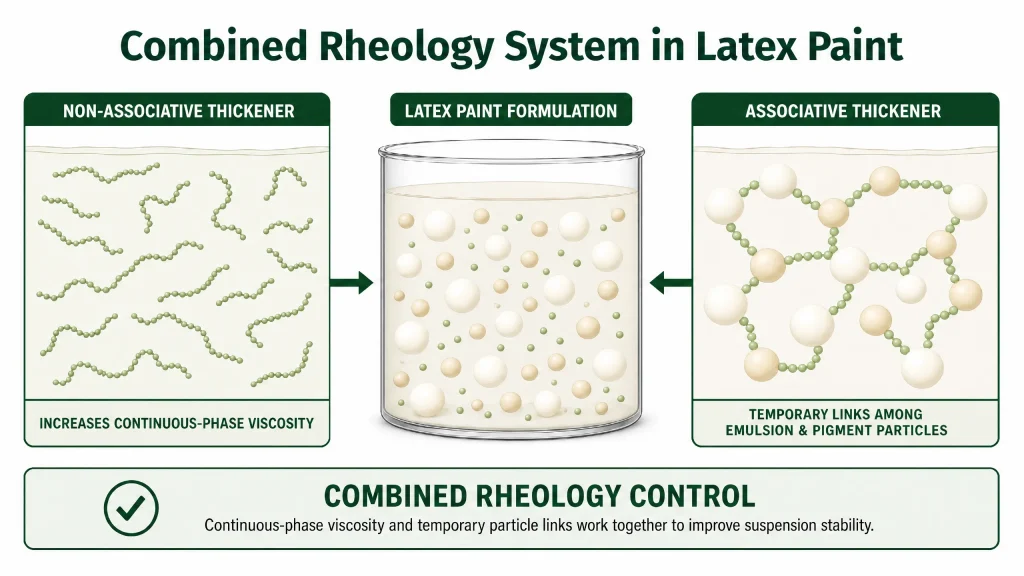
Latex paint thickeners can be considered according to how they interact with the liquid phase and dispersed particles.
Non-Associative Thickening
A non-associative thickener mainly increases the hydrodynamic volume and viscosity of the water phase. This helps slow pigment and filler movement.
Cellulose thickeners are commonly used to build this aqueous-phase viscosity. Polyacrylic emulsion thickeners may also provide non-associative thickening through their behavior in water.
This mechanism is valuable, but water-phase viscosity alone may not produce the ideal balance of storage stability, application flow, leveling, and structure recovery.
Associative Thickening
An associative thickener interacts with surfactants, emulsion particles, and pigment surfaces. Hydrophobic groups participate in temporary associations, creating a network throughout the paint.
Under shear, the associations break and allow the paint to flow. When the shear force disappears, the network can form again and restore the structure.
This behavior makes associative thickening especially relevant to thixotropy and low-shear stability. Its effectiveness still depends on the emulsion, surfactant package, pigment, and other formulation components.
Why a Combined System Can Perform Better
A non-associative thickener raises water-phase viscosity, while an associative thickener builds interactions among dispersed components. Combining the two mechanisms can provide better control than relying on either one alone.
The goal is not to maximize viscosity. A useful system must simultaneously provide:
- Sufficient resistance to settling during storage
- Acceptable flow during mixing and application
- Adequate leveling after brushing or rolling
- Rapid enough structure recovery to control sagging
- A full and uniform coating film
- Reduced floating color and separation
The balance among these properties is more important than the amount of one thickener.
Similar KU Viscosity Does Not Guarantee Similar Storage Stability
One of the clearest findings is that paints with nearly identical KU viscosity can behave very differently during storage.
Four exterior dark latex paints containing 7% color paste were prepared with different combinations of associative thickener, non-associative thickener, and leveling agent.
| Paint | Rheology system | KU viscosity | Flow and film behavior | Storage result |
|---|---|---|---|---|
| Paint A | 0.19% associative thickener + 1.3% leveling agent | 91 KU | Average flow | Slight floating color at 15 days, slight separation at 30 days, severe separation at 60 days |
| Paint B | 0.2% non-associative thickener + 1.3% leveling agent | 90 KU | Relatively good flow | Slight floating color at 15 days, slight separation at 30 days, severe separation at 60 days |
| Paint C | 0.15% associative thickener + 0.1% non-associative thickener | 92 KU | Poor flow | No separation at 15 days, slight floating color at 30 and 60 days |
| Paint D | 0.15% associative thickener + 0.1% non-associative thickener + 1.3% leveling agent | 90 KU | Good flow and a full coating film | No separation at 15 days, slight floating color at 30 and 60 days |
The initial viscosity values fall within a narrow range of 90-92 KU. Nevertheless, Paints A and B showed severe separation after 60 days, whereas Paints C and D showed only slight floating color.
A single KU measurement was therefore unable to predict storage stability.
Paint C demonstrated that the combined thickener system could control separation, but its flow was poor. Adding the leveling agent in Paint D restored better flow and film fullness without sacrificing the improved storage result.
This comparison shows why replacing one HEC grade with a higher-viscosity grade may fail to solve the problem. Two paints can reach the same KU value through different rheological structures and still behave very differently in the container.
Is the 1.5:1 Thickener Ratio Suitable for HEC?
In the tested formula, the associative and non-associative thickeners were used at 0.15% and 0.1%, respectively. This corresponds to an associative-to-non-associative ratio of 1.5:1.
That ratio produced the best overall storage result in the specific dark-paint system, particularly when combined with the leveling agent.
It should be treated as a formulation reference rather than a universal rule.
The non-associative thickener evaluated in this comparison was a polyacrylic emulsion thickener, not HEC. Consequently, the 1.5:1 ratio cannot be transferred directly to an HEC-containing formula without testing.
HEC has its own thickening efficiency and hydration behavior. Replacing the tested non-associative thickener with HEC at the same percentage would not automatically reproduce the same KU viscosity, flow, leveling, or storage stability.
For an HEC-containing paint, the combined system should be rebuilt around the actual color paste, emulsion, pigments, fillers, and target application properties.
How to Troubleshoot Viscosity Loss in Dark Latex Paint
A structured investigation provides more useful information than changing several additives at the same time.
1. Compare the Base Paint and Tinted Paint
Evaluate the untinted base and the finished deep color separately. If the base remains stable but separation develops after tinting, the color-paste addition is a major formulation variable.
The comparison should use the same observation periods so that changes can be related to storage time.
2. Check the Entire Container
Inspect the upper, middle, and lower portions of the sample. A thin upper layer and dense lower layer indicate stratification rather than uniform viscosity loss.
Record separation, floating color, sediment condition, and ease of remixing. Viscosity from a single part of a separated sample does not represent the complete paint.
3. Measure Pigment Fineness
Coarse pigment or filler particles settle faster. If the final fineness remains around 40-60 μm, adjusting the grinding process may produce a greater benefit than adding more thickener.
Grinding should continue only while it delivers a meaningful reduction in particle size. Additional processing after the equipment has reached its effective limit reduces production efficiency without necessarily improving stability.
4. Examine Thixotropic Recovery
Observe how the paint behaves after mixing or application shear stops. A good product should flow when worked but regain enough structure afterward.
Poor recovery points to a rheological balance problem, even when the initial KU viscosity meets its target.
5. Compare Thickening Mechanisms
Instead of testing only higher and lower dosages of one thickener, compare:
- A water-phase or non-associative thickener used alone
- An associative thickener used alone
- A combination of associative and non-associative thickening
- The combined system with a suitable leveling agent
This approach reveals whether the paint needs more viscosity or a different rheological structure.
6. Evaluate Application and Storage Together
A formula that resists separation but has poor flow is not a finished solution. Conversely, excellent leveling does not compensate for severe storage stratification.
KU viscosity, flow, film fullness, floating color, and separation should be reviewed together.
7. Use Realistic Storage Intervals
The comparison used 15-, 30-, and 60-day observations. Some differences were not obvious after 15 days but became severe after 60 days.
A short test may therefore approve a formulation that later fails. Deep-color paint requires enough storage time to reveal gradual settling and structural weakness.
How We Approach HEC Selection at Zhiwei
At Zhiwei (Jinan) New Materials Co., Ltd., we do not recommend judging an HEC product only from the initial KU viscosity of the paint.
When a customer reports viscosity loss or separation, we first examine whether the problem appears in the base paint or only after tinting. Color-paste content, pigment fineness, low-shear stability, thixotropic recovery, leveling, and storage time all help identify the real cause.
If HEC is used as the water-phase thickener, its dosage should be evaluated within the complete rheology package. The test should determine whether HEC provides sufficient aqueous-phase viscosity and whether an associative component is also required to build particle interactions and structure recovery.
We have not assigned a specific Zhiwei HEC model to this formula because the material does not provide the HEC viscosity grade, target low-shear rheology, hydration process, or detailed base-paint composition needed for a responsible model selection.
Naming a grade without those conditions would make the recommendation look precise while leaving the main formulation variables unresolved.

Practical Ways to Improve Storage Stability
The available results support four main improvement directions.
Reduce the Final Pigment and Filler Fineness
Bringing the particle size down from 40-60 μm to approximately 20-25 μm substantially reduced early separation. The grinding process should be optimized within the productive capability of the equipment.
Rebalance the Thickener System
A combination of associative and non-associative thickening delivered better storage stability than either mechanism used alone in the test formula.
The objective is to combine water-phase viscosity with a recoverable particle-interaction network.
Coordinate the Thickener and Leveling Agent
The thickener blend without a leveling agent controlled separation but produced poor flow. Introducing the leveling agent improved application behavior and coating-film fullness while retaining the storage benefit.
Control Storage Time
Deep latex paint should not be stored indefinitely. Once severe separation has developed, remixing may restore a uniform appearance in the container but cannot guarantee that the original coating behavior has returned.
Floating color, blooming, or an uneven film may still appear during the final application.
Common Misdiagnoses
“The KU Value Is Low, So More HEC Will Solve It”
A higher viscosity may slow settling, but it does not automatically rebuild the required rheological network. The four-paint comparison produced similar KU values and very different storage results.
“The KU Value Is Normal, So the Paint Must Be Stable”
Initial KU viscosity cannot describe the complete low-shear behavior, thixotropic recovery, or interactions among the dispersed particles.
“The Base Paint Is Stable, So the Dark Color Will Also Be Stable”
Higher color-paste addition sharply increased separation even when the underlying base formulation remained unchanged.
“Longer Grinding Will Always Improve the Paint”
Grinding from 60 to 80 minutes produced the same 25 μm fineness in the comparison. Once the equipment reached its effective limit, the additional time did not improve the result.
“Re-Stirring Makes the Paint Equivalent to a Fresh Batch”
Remixing can redistribute separated material, but the coating may still develop floating color or blooming during application.
“HEC Is Present, So HEC Must Be the Cause”
The evidence does not test HEC as the cause of viscosity loss. HEC is only one part of the total dispersion and rheology system.
Frequently Asked Questions
Why Does Latex Paint Lose Viscosity During Storage?
The paint may have insufficient low-shear structure, poor thixotropic recovery, or physical separation between the liquid phase and pigment or filler particles. In a separated container, the upper layer appears thinner even if the whole batch has not undergone uniform viscosity loss.
Can HEC Cause the Viscosity to Decrease?
HEC should not be identified as the cause without comparative testing. It normally increases water-phase viscosity and helps resist particle settling. An unsuitable overall rheology system, however, may remain unstable even when HEC is present.
Why Does Deep-Color Latex Paint Separate More Easily?
Deep colors require more color paste. The additional paste changes the balance of particles, liquid carriers, surfactants, dispersants, and thickeners. Separation increased significantly as color-paste content rose from 1% to 7% in the storage comparison.
Does Higher KU Viscosity Mean Better Storage Stability?
Not necessarily. Paints with initial viscosities between 90 and 92 KU showed markedly different results after 60 days. Rheological structure and thickener combination mattered more than the small difference in KU value.
Can Finer Pigment Improve Stability?
Yes. Reducing the measured fineness from 40-60 μm to approximately 25 μm greatly reduced separation during the first 15 days. Finer particles have a lower settling velocity.
Should HEC Be Combined With an Associative Thickener?
A combined thickening approach can provide a better balance between water-phase viscosity, particle interaction, storage stability, and application flow. The exact ratio must be verified in the actual paint because the 1.5:1 ratio in the comparison did not use HEC as the non-associative component.
Can Separated Paint Be Restored by Mixing?
Mixing can redistribute the components, but it may not completely restore the original application behavior. Floating color, blooming, or film defects can still appear.
Conclusion
Latex paint does not always lose viscosity because the HEC has failed. In many cases, the visible thinning is a consequence of pigment settling, liquid-phase separation, inadequate thixotropic recovery, or an unbalanced rheology system.
Dark latex paint is especially sensitive because higher color-paste content changes the formulation and increases the tendency toward separation. Coarse particles further accelerate settling, while a single viscosity measurement can conceal weaknesses in the paint structure.
HEC remains useful for building water-phase viscosity. However, it should be evaluated alongside pigment fineness, color-paste content, associative thickening, leveling, flow, and long-term storage behavior.
The most reliable solution is not simply to add more thickener. It is to create a rheology system that remains structured during storage, flows during application, recovers after shear, and maintains a uniform coating film.