
Exterior render fails for a handful of reasons: it cracks, it slides off the wall, or it dries out before the cement sets properly. Most of those failures trace back to one ingredient: the cellulose ether. HEMC (hydroxyethyl methyl cellulose, also written as MHEC) is the cellulose ether that render formulators in hot climates turn to first. This guide explains why, and gives you the practical information you need to specify, source, and use HEMC in render and plaster systems.
If you distribute construction chemicals or manage plastering projects, you need to understand what HEMC does in the mix, which viscosity grade to choose, and when HEMC is the better option over HPMC. That is what this article covers.
What HEMC Does in Render and Plaster

HEMC for render has four functions that directly affect how a render performs on the wall.
Water retention. This is the primary reason HEMC exists in render formulations. Without it, water migrates out of the fresh render into the absorbent substrate or evaporates into hot air before the cement hydrates. Incomplete hydration produces weak, powdery render that cracks under thermal stress. HEMC forms a hydrated polymer network that holds water in the render layer long enough for full cement hydration. Under hot and windy conditions, HEMC at 0.15–0.25% by dry weight can reduce evaporative water loss by up to 80%.
Workability. HEMC gives render a smooth, buttery consistency under the trowel. The worker can spread it evenly without tearing or dragging. This matters on large wall areas where consistent thickness and finish quality determine whether the job passes inspection.
Sag resistance. On vertical surfaces, render without enough thickener slides down the wall. HEMC provides yield stress that keeps the material in place after application, even in thick passes. This is especially important for exterior base coats that go on at 10–15 mm thickness in a single pass.
Open time. HEMC extends the period during which the render remains workable after mixing. Longer open time means the applicator has more time to adjust, level, and texture the surface before the material stiffens. In hot climates, open time is the difference between a smooth finish and a rushed, textured mess.
HEMC or MHEC: Same Product
Both names refer to the same chemical compound. MHEC stands for methyl hydroxyethyl cellulose. HEMC stands for hydroxyethyl methyl cellulose. The difference is only the order of the substituent group names. If a supplier lists MHEC on their certificate of analysis, you are getting the same product. This guide uses HEMC throughout.
Why HEMC Outperforms Other Cellulose Ethers in Render
HEMC vs HPMC in Render Applications
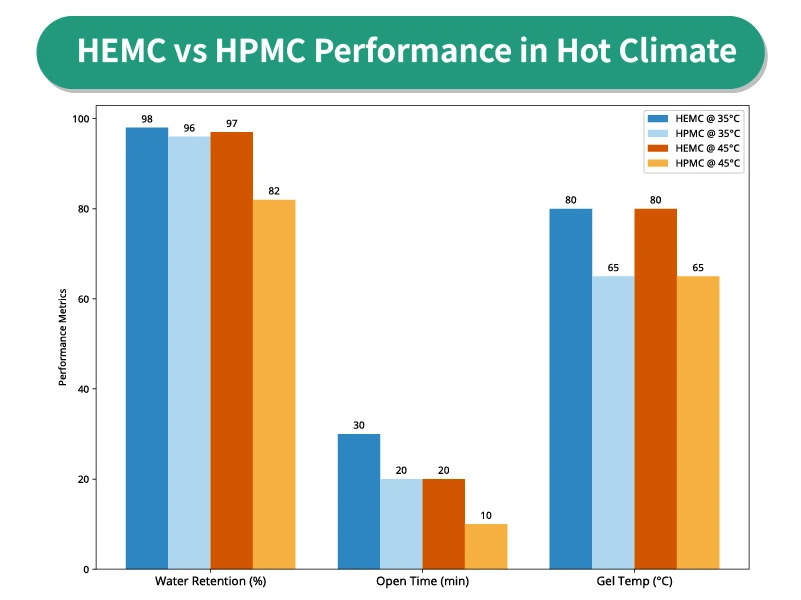
HPMC (hydroxypropyl methylcellulose) is the more widely used cellulose ether in construction, and it works well in many mortar and tile adhesive formulations. But render in hot climates is where HEMC pulls ahead.
The main difference is gel temperature. HPMC gels at approximately 60–70°C. HEMC gels at approximately 65–75°C. That 5–10°C gap sounds small, but it matters on a wall in direct sun at 45°C ambient temperature. The surface of the render can reach 55–60°C within minutes of application. At that temperature, HPMC is approaching its gel point. HEMC still has thermal headroom.
The practical consequence: HEMC-based renders maintain workability and water retention longer under hot-weather conditions. Studies published in Construction and Building Materials (2025) confirmed that HEMC-modified mortars maintain better fluidity retention and extended setting times compared to HPMC-modified counterparts under equivalent high-temperature conditions.
Water retention also favors HEMC. Because HEMC typically has a higher degree of substitution (DS) than HPMC, it holds water more tightly in the cement matrix. For exterior render, where water loss is the primary failure mode, that difference translates into fewer shrinkage cracks and better long-term adhesion.
| Property | HEMC | HPMC |
|---|---|---|
| Gel temperature | 65–75°C | 60–70°C |
| Water retention in hot conditions | Better | Good |
| Open time at 40°C+ | Longer | Shorter |
| Freeze-thaw stability | Moderate | Better |
| Best for exterior render (hot climate) | Yes | Acceptable |
| Best for interior plaster (controlled) | Yes | Yes |
| Typical price vs HPMC | Slightly higher | Baseline |
HEMC vs HEC in Plaster Systems
HEC (hydroxyethyl cellulose, no methyl substitution) sees limited use in cement-based render because it lacks the methyl group that gives HEMC and HPMC their thermal gelation resistance. HEC performs well in paint and personal care formulations, but in high-pH cement systems it is more susceptible to enzymatic degradation and has a lower gel temperature than HEMC. For render and plaster applications, HEMC is the safer choice.
HEMC in Different Render and Plaster Systems
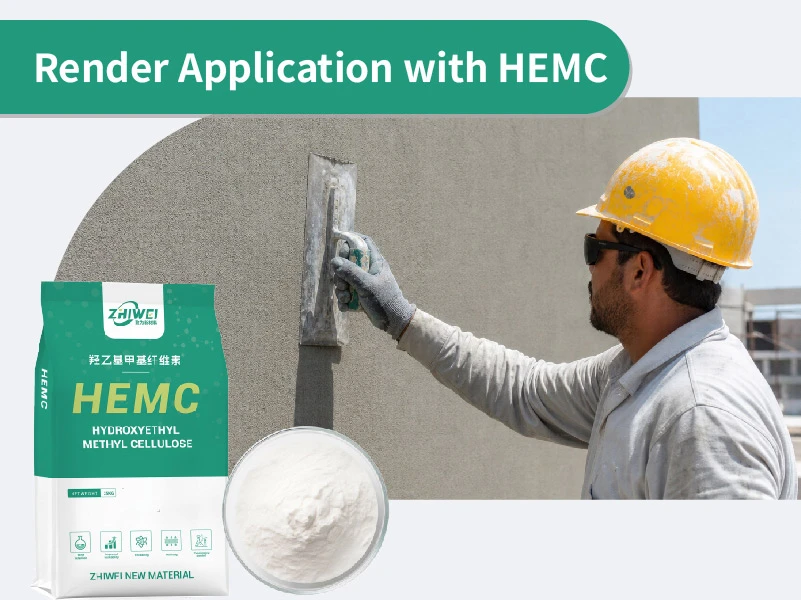
Not all render is the same. The HEMC grade and dosage change depending on the system. Here is how HEMC performs across the main categories.
Exterior Render and EIFS Base Coat
This is where HEMC’s advantages matter most. The global EIFS (exterior insulation and finish system) market was valued at approximately 92.7billionin2023andisprojectedtoreach92.7billionin2023andisprojectedtoreach178.35 billion by 2030 according to Grand View Research. Every EIFS base coat contains a cellulose ether, and in hot-climate markets, HEMC is the standard.
The base coat goes on at 5–15 mm over insulation board. It needs to stay workable long enough for the mesh to be embedded, and it needs to hold water long enough for the cement to set before the sun bakes the surface. HEMC at 0.15–0.25% dosage provides the water retention and open time required.
For one-coat render systems applied at up to 20 mm in a single pass, sag resistance becomes the dominant concern. A higher viscosity HEMC grade (60,000–100,000 mPa·s) provides the yield stress needed to keep the material on the wall without slumping.
Interior Plaster and Skim Coat
Interior plaster in temperature-controlled environments has fewer performance demands than exterior render. Both HEMC and HPMC work well. HEMC’s advantage in this setting is consistency: it provides a smoother troweling feel, which matters for premium skim coat products where the final finish quality is the selling point.
Dosage for interior plaster typically runs 0.1–0.2% HEMC by dry weight, slightly lower than exterior applications because evaporation rates are lower and the substrate is less absorbent.
Stucco and Decorative Render
Stucco systems in Mediterranean, Latin American, and Middle Eastern markets use HEMC for two reasons: water retention during the slow curing that decorative finishes require, and workability control that lets the applicator create consistent textures (skip-trowel, swirl, dash) across large wall areas.
Decorative render often uses a lower viscosity HEMC grade (30,000–60,000 mPa·s) to achieve a lighter, more spreadable consistency that still holds texture.
Lime-Cement and Renovation Plaster
Renovation plaster applied over old, damaged masonry requires good adhesion and controlled water absorption. HEMC’s compatibility with lime-based binders is slightly better than HPMC’s, because the higher DS gives HEMC a more hydrophobic character that interacts well with the calcium hydroxide in lime. For renovation projects on heritage buildings or older structures, HEMC at 0.1–0.2% is a common specification.
Formulation Guide: Viscosity, Dosage, and Mix Design
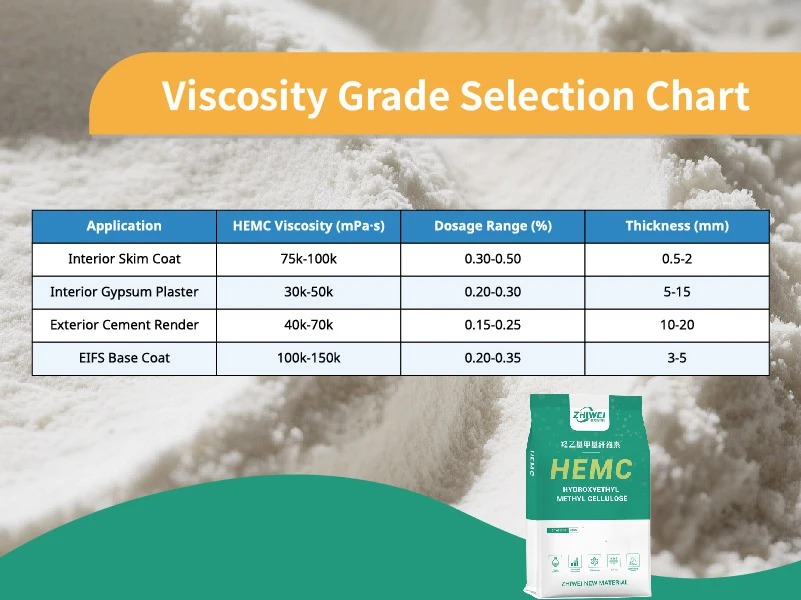
Viscosity Grade Selection
| Application | Recommended Viscosity (mPa·s) | Typical Dosage (%) |
|---|---|---|
| EIFS base coat (thin-bed) | 40,000–60,000 | 0.15–0.25 |
| Exterior one-coat render | 60,000–100,000 | 0.15–0.30 |
| Interior plaster | 30,000–60,000 | 0.10–0.20 |
| Decorative stucco | 30,000–60,000 | 0.15–0.25 |
| Lime-cement renovation plaster | 40,000–60,000 | 0.10–0.20 |
| Skim coat (thin finish) | 30,000–40,000 | 0.10–0.15 |
Higher viscosity grades provide more sag resistance and water retention. Lower viscosity grades give better workability and spreadability. Select the grade based on which performance parameter matters more for your specific application.
Typical Render Formulation Framework
| Component | Exterior Render | Interior Plaster |
|---|---|---|
| Cement | 20–35% | 15–25% |
| Sand (graded) | 55–70% | 60–75% |
| Lime (optional) | 0–10% | 0–5% |
| HEMC | 0.15–0.30% | 0.10–0.20% |
| RDP (redispersible polymer) | 0–2.0% | 0–1.0% |
| Air entraining agent | 0.01–0.05% | 0.01–0.03% |
These ranges are starting points. Adjust based on your local raw materials, climate conditions, and the performance standard you are targeting (EN 998-1 is the common European reference for render and plaster).
Common Render Problems and How HEMC Solves Them
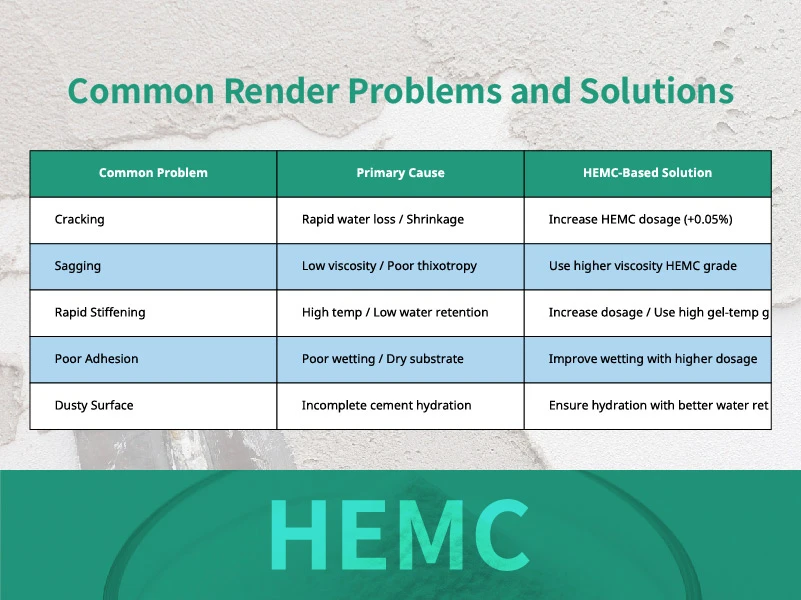
Cracking after application. The most frequent complaint on exterior render jobs. Hairline cracks appear within hours or days of application. The root cause is usually rapid water loss: the cement does not hydrate fully, the render shrinks as it dries, and the surface cracks. HEMC’s water retention addresses this directly. If you are seeing cracking, first verify that the HEMC dosage is adequate (at least 0.15% for exterior work), then check that the viscosity grade is not too low for the application thickness.
Sagging on vertical surfaces. Render slides down the wall during or after application. This is a yield stress problem. Either the HEMC dosage is too low, or the viscosity grade is insufficient for the coat thickness. Moving to a higher viscosity grade (60,000–100,000 mPa·s) or increasing the dosage by 0.05% usually resolves this.
Rapid stiffening in hot weather. The render becomes unworkable within minutes of mixing. This happens when the cellulose ether approaches its gel temperature. If you are using HPMC, switching to HEMC (higher gel temperature) often solves the problem. If you are already using HEMC and the problem persists, consider adding a set retarder or adjusting the mixing water upward slightly.
Poor adhesion to substrate. The render does not bond to the wall. This is not always a cellulose ether issue. Check substrate preparation first: is the wall clean, pre-wetted, and free of dust? If the substrate is fine, adding RDP (0.5–1.0%) alongside HEMC improves adhesion on difficult substrates like smooth concrete or painted surfaces.
Dusty, powdery surface after curing. The render surface is weak and powders off when touched. This indicates incomplete cement hydration, which means water left the render too fast. Increase HEMC dosage and verify that the substrate was pre-dampened before application.
HEMC for Hot-Climate Rendering
If you supply or work in the Middle East, South Asia, Southeast Asia, or North Africa, hot-climate rendering is your daily reality. Ambient temperatures of 35–50°C, low humidity, and direct sun exposure create conditions where ordinary render fails fast.
HEMC has specific advantages in these conditions:
- Higher gel temperature. At surface temperatures approaching 60°C, HEMC retains its thickening and water retention function longer than HPMC. This gives the applicator more working time and reduces the risk of premature stiffening.
- Superior water retention under heat stress. Studies and field experience consistently show that HEMC holds more water in the render under high-temperature conditions than HPMC at equivalent viscosity grades. This produces more complete cement hydration, fewer cracks, and better long-term durability.
Extended open time is the third advantage. In 40°C+ heat, the difference between a 20-minute open time and a 30-minute open time is the difference between finishing a section and having to remix. HEMC extends that window.
For EIFS projects in the Gulf States, Saudi Arabia, the UAE, and similar markets, HEMC is the default cellulose ether in base coat formulations. If you are distributing render products into these markets, stocking HEMC-based formulations is not optional. It is what your customers expect.
How to Source HEMC for Render Applications
When you are sourcing HEMC for render and plaster, focus on a few things:
Batch consistency. Viscosity should not swing between shipments. Request COA (certificate of analysis) for every batch and compare the viscosity readings against the stated specification. A variance of more than ±10% in viscosity between batches is a red flag.
Correct viscosity grade. Make sure the supplier offers the viscosity range you need. Render applications typically use 30,000–100,000 mPa·s grades. If a supplier only offers one or two grades, they may not have the flexibility to support your product range.
Documentation. For European markets, REACH compliance documentation is required. For most other regions, ISO 9001 certification and SDS (safety data sheets) are the baseline. Ask for these before placing your first order.
Zhiwei (Jinan) New Materials Co., Ltd. manufactures HEMC from Xinjiang cotton linter at an annual capacity of 15,000 tons. The product line covers viscosity grades from 30,000 to 100,000 mPa·s, which covers the full range needed for render and plaster applications. Batch consistency is maintained through in-process viscosity testing and third-party verification.
Contact: info@zhiweichem.com | +86 183 6616 3707
Frequently Asked Questions
Is HEMC or HPMC better for exterior render?
In hot climates, HEMC is generally the better choice. It has a higher gel temperature and better water retention under heat stress. In temperate or cold climates, HPMC works well and costs slightly less. Many EIFS manufacturers in the Middle East and South Asia use HEMC as their standard.
What dosage of HEMC should I use in render?
For exterior render, 0.15–0.30% by dry weight is typical. EIFS base coats usually use 0.15–0.25%. Interior plaster uses slightly less, around 0.10–0.20%. Start at the middle of the range and adjust based on your specific mix design and climate conditions.
What viscosity grade of HEMC is best for render?
For thin-coat exterior render (5–10 mm), use 40,000–60,000 mPa·s. For thick-coat or one-coat render (10–20 mm), use 60,000–100,000 mPa·s. Interior plaster and skim coat work well with 30,000–60,000 mPa·s grades.
Why does my render crack even with HEMC?
Cracking after HEMC addition usually means the dosage is too low, the viscosity grade is wrong for the application thickness, or the substrate was not pre-dampened. Check all three. Also verify that the sand grading and cement content in your formulation are appropriate. HEMC prevents water-loss cracking, but it does not fix structural or formulation issues.
Can I use HEMC in lime-based render?
Yes. HEMC is compatible with lime-cement blends and pure lime renders. Its higher degree of substitution gives it slightly better compatibility with the calcium hydroxide in lime compared to HPMC. Dosage for lime-based render is typically 0.1–0.2%.
Conclusion
HEMC for render and plaster is not a generic additive. It is the cellulose ether that performs best when the conditions are toughest: hot walls, fast evaporation, thick coats, and demanding finish requirements.
If you are formulating or distributing render products for hot-climate markets, HEMC should be your default cellulose ether. It provides better water retention, higher gel temperature, and longer open time than HPMC under the same conditions. For interior plaster in controlled environments, both HEMC and HPMC work well. Choose based on price and availability.
When sourcing HEMC, verify batch consistency, select the right viscosity grade for your application, and make sure your supplier can provide the documentation your market requires. Zhiwei manufactures HEMC from Xinjiang cotton linter at 15,000 tons annual capacity, with grades covering the full render and plaster viscosity range.
Contact: info@zhiweichem.com | +86 183 6616 3707