
Introduction
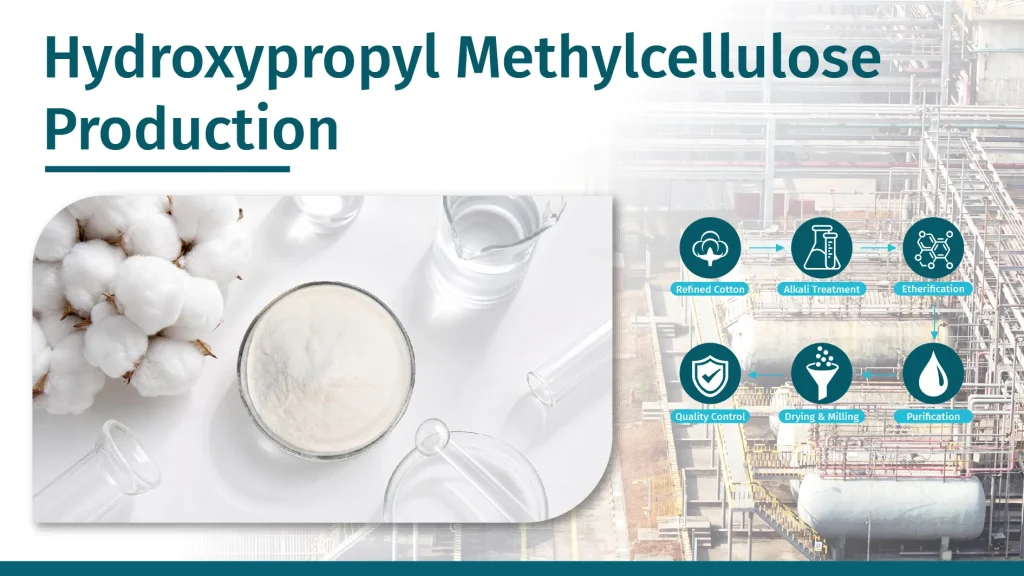
The hydroxypropyl methylcellulose production process converts natural cellulose into a versatile, water-soluble cellulose ether. Manufacturers use controlled alkalization and etherification reactions to introduce methoxy and hydroxypropoxy groups into cellulose.
This chemical modification gives HPMC several valuable functions. HPMC can thicken water-based systems, retain water, stabilize particles, form films, improve adhesion, and control rheology. These functions make HPMC useful in construction materials, coatings, daily chemical products, PVC production, food systems, pharmaceutical formulations, ceramics, textiles, and adhesives.
However, HPMC performance does not depend only on viscosity. The cellulose source, substitution level, reaction efficiency, washing process, particle size, moisture, ash, and surface treatment all affect the final product. A reliable HPMC manufacturer must control the complete production process.
What Is Hydroxypropyl Methylcellulose?
Hydroxypropyl methylcellulose, commonly called HPMC, is a non-ionic cellulose ether. It is derived from natural cellulose such as refined cotton or wood pulp.
Natural cellulose does not dissolve easily in water. The HPMC production process replaces some hydroxyl groups on the cellulose chain with methoxy and hydroxypropoxy groups. This modification changes the solubility and functional behavior of the cellulose.
The finished HPMC product is normally a white or off-white powder. It is usually odorless and has good cold-water solubility. Its aqueous solution can be clear or slightly cloudy, depending on the grade and concentration.
HPMC offers several important properties:
| HPMC Property | Practical Function |
|---|---|
| Water solubility | It forms a viscous solution in cold water |
| Thickening | It increases viscosity and application body |
| Water retention | It slows water loss in cement and gypsum systems |
| Film formation | It creates a continuous, transparent film |
| Emulsion stabilization | It helps stabilize dispersed phases |
| Protective colloid action | It reduces particle agglomeration |
| Binding | It improves cohesion and adhesion |
| Rheology control | It adjusts flow, leveling, and anti-sag behavior |
| Acid and alkali stability | It works across many water-based formulations |
| Enzyme resistance | It offers better storage stability than many natural polymers |
Main Raw Materials Used To Manufacture HPMC
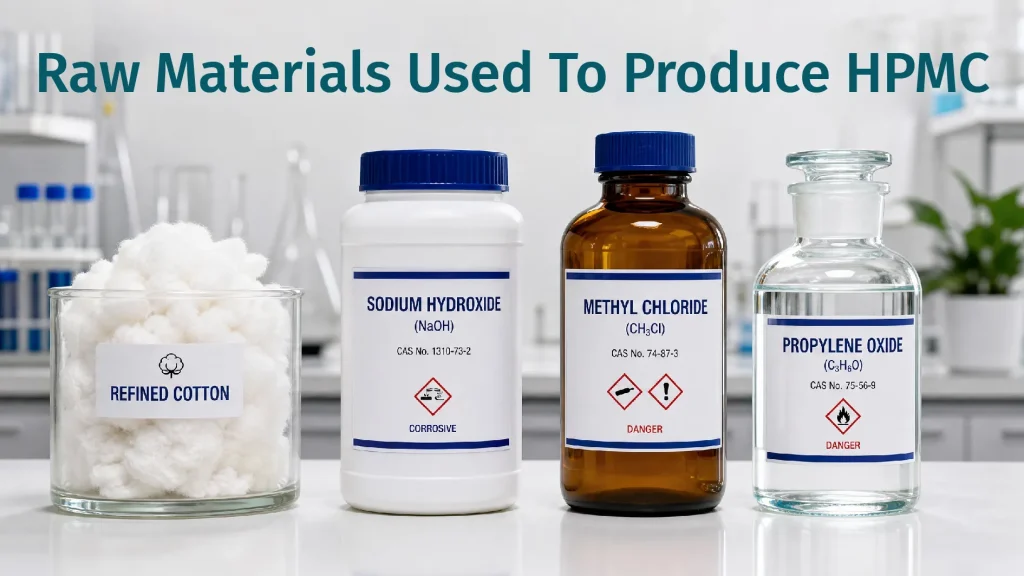
The main HPMC raw materials are refined cellulose, sodium hydroxide, methyl chloride, and propylene oxide.
Refined Cellulose
Refined cotton is a common cellulose source. Some manufacturers also use high-purity wood pulp. The cellulose source affects polymerization degree, purity, final viscosity, color, and insoluble matter.
The manufacturer must control cellulose moisture and alpha-cellulose content. A stable cellulose source helps improve batch consistency.
Sodium Hydroxide
Sodium hydroxide activates the cellulose. It breaks part of the hydrogen-bond structure and converts cellulose into alkali cellulose.
The concentration and distribution of sodium hydroxide affect reaction uniformity. Poor alkalization can create uneven substitution and insoluble particles.
Methyl Chloride
Methyl chloride introduces methoxy groups into the cellulose structure. Methoxy content affects water solubility, thermal gelation, surface activity, and application performance.
Methyl chloride is volatile and requires closed, pressure-rated equipment. A modern plant must control leakage, recovery, and worker exposure.
Propylene Oxide
Propylene oxide introduces hydroxypropoxy groups. These groups help adjust solubility, gel temperature, flexibility, and compatibility.
The ratio between methoxy and hydroxypropoxy substitution is one of the main differences between HPMC grades.
Process Media And Auxiliary Materials
The process may also use solvents, washing media, neutralizing agents, and anti-agglomeration materials. The manufacturer must recover or treat these materials correctly to improve efficiency and reduce emissions.
Hydroxypropyl Methylcellulose Production Process
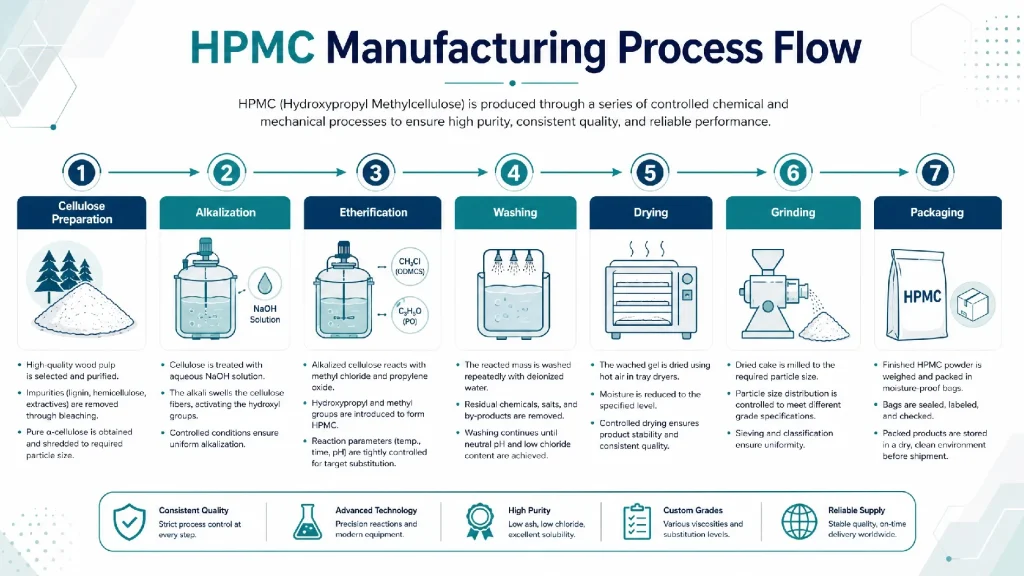
A typical HPMC manufacturing process includes eight main stages:
- Cellulose preparation
- Alkalization
- Etherification
- Reaction completion
- Neutralization
- Washing and purification
- Drying and particle processing
- Quality control and packaging
Each stage affects the final product.
Step 1: Cellulose Preparation
The manufacturer first cleans and processes refined cotton or wood pulp. The cellulose is cut, opened, or pulverized to create a suitable particle structure.
A uniform particle size improves contact between cellulose and sodium hydroxide. It also helps the etherification agents reach the cellulose more evenly.
The cellulose moisture level must remain stable. Excessive moisture can consume reactants and affect substitution. Very dry cellulose may also become difficult to wet uniformly.
Step 2: Alkalization
The manufacturer treats the cellulose with sodium hydroxide solution. This step produces alkali cellulose.
Alkalization causes the cellulose fibers to swell. The swelling opens the structure and makes the hydroxyl groups more accessible to etherification agents.
The manufacturer must control several factors:
- Sodium hydroxide concentration
- Cellulose-to-alkali ratio
- Mixing uniformity
- Reaction time
- Temperature
- Cellulose moisture
Uneven alkalization can lead to unstable viscosity, high insoluble matter, and poor dissolution.
Step 3: Etherification
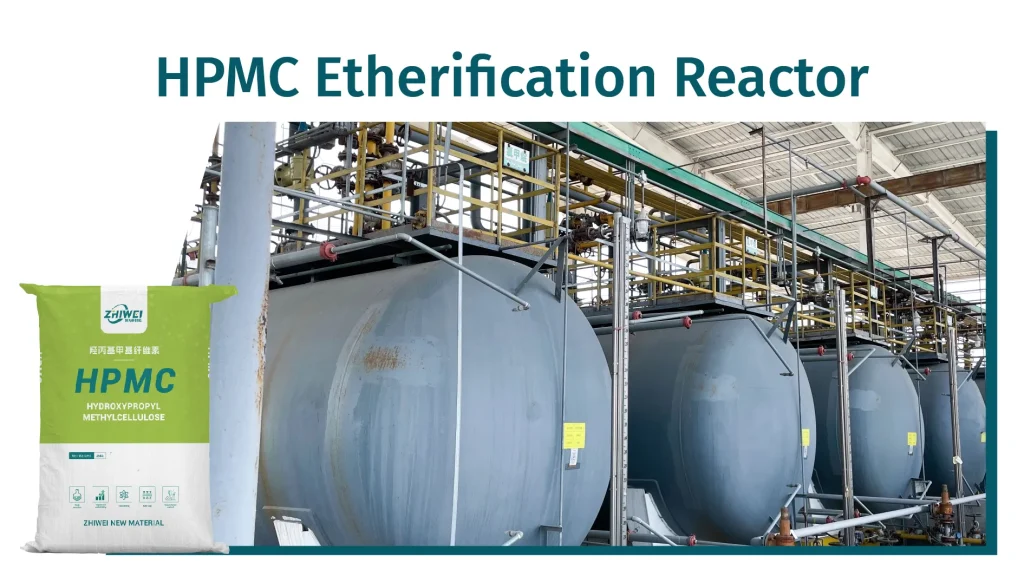
The manufacturer reacts alkali cellulose with methyl chloride and propylene oxide. Methyl chloride introduces methoxy groups, while propylene oxide introduces hydroxypropoxy groups.
The plant must use a closed reactor with reliable agitation, temperature control, and pressure control. The reaction conditions affect substitution efficiency and product uniformity.
Two main etherification methods can be used.
One-Step Etherification
The one-step method carries out methylation and hydroxypropylation in the same general reaction stage.
This method can simplify the production route and shorten the process. However, the manufacturer must carefully control reaction distribution. Poor control can produce uneven substitution.
Stepwise Etherification
The stepwise method separates hydroxypropylation and methylation into different stages.
This method gives the manufacturer more control over substitution distribution and certain performance indicators. However, the process needs more time, equipment control, and operational steps.
Neither method is automatically better for every product. The manufacturer should select the process according to the target grade, viscosity, substitution range, gel temperature, and application.
Step 4: Reaction Completion
The manufacturer continues the reaction until the required substitution level is reached. The reaction endpoint affects methoxy content, hydroxypropoxy content, solubility, and gel temperature.
The process team must monitor temperature, pressure, reaction time, and reagent consumption. The manufacturer must also control cellulose degradation because excessive degradation reduces molecular weight and viscosity.
Step 5: Neutralization
The reaction product contains alkali and reaction by-products. The manufacturer neutralizes the material before washing.
The neutralization process must be uniform. Incomplete neutralization can affect pH and storage stability. Excessive neutralizing agent can increase ash or salt content.
Step 6: Washing And Purification
The manufacturer washes the crude HPMC to remove sodium chloride, residual alkali, unreacted chemicals, and other process by-products.
Washing has a major effect on product purity. Poor washing can produce high ash, unusual odor, unstable pH, and weak dissolution.
The plant must also balance purity with product loss. Excessive washing can reduce yield and increase wastewater.
Step 7: Drying, Granulation, And Grinding
The washed HPMC contains a large amount of moisture. The manufacturer dries it under controlled conditions.
Excessive temperature can damage the polymer and reduce viscosity. Incomplete drying can cause caking and poor storage stability.
After drying, the manufacturer may granulate or grind the HPMC. Particle processing affects:
- Powder flow
- Dust level
- Dissolution speed
- Lump resistance
- Dry-mix dispersion
- Packaging efficiency
Some grades need rapid dissolution. Other grades use delayed solubility to improve dispersion before hydration begins.
Step 8: Quality Control And Packaging
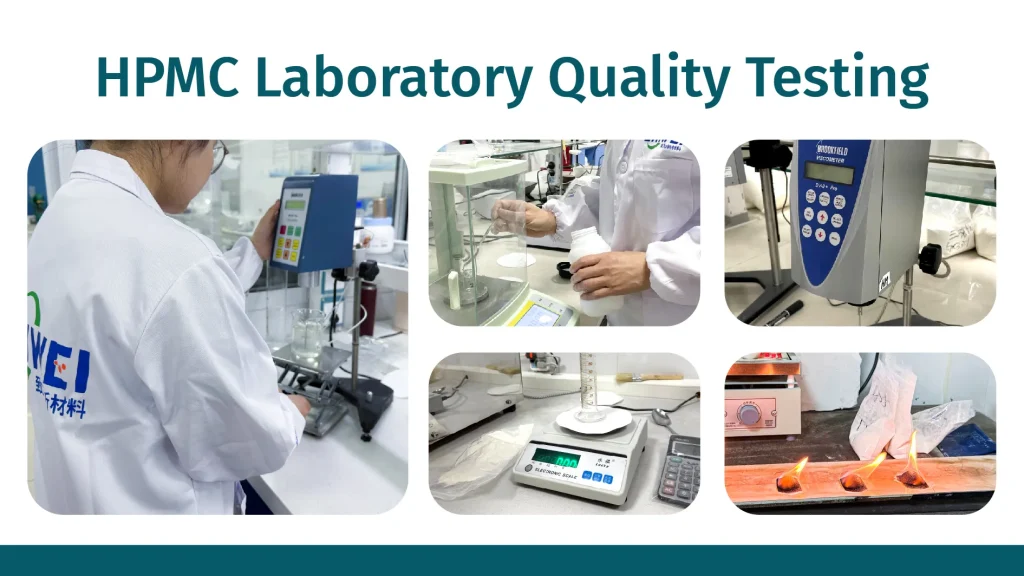
The manufacturer tests every production batch before packaging. The most important quality indicators include:
| Test Item | Why It Matters |
|---|---|
| Viscosity | It controls thickening and rheology |
| Methoxy content | It affects solubility and gel behavior |
| Hydroxypropoxy content | It affects compatibility and gel temperature |
| Moisture | It affects storage and active content |
| Ash | It indicates salts and inorganic residue |
| pH | It affects formulation compatibility |
| Particle size | It affects dispersion and dissolution |
| Insoluble matter | It shows reaction and purification quality |
| Gel temperature | It helps match HPMC to the application |
| Appearance | It helps identify contamination or process variation |
The manufacturer should package HPMC in moisture-resistant bags. HPMC is hygroscopic, so the warehouse should remain dry and well ventilated.
Representative Raw Material Consumption
A representative older process balance for one metric ton of HPMC used approximately:
| Raw Material | Representative Consumption |
|---|---|
| Refined cotton, moisture not above 6% | 0.93 tons |
| Sodium hydroxide solution, at least 50% | 1.15 tons |
| Methyl chloride, at least 99% | 0.75 tons |
| Propylene oxide, at least 99% | 0.25 tons |
These values are not universal production specifications. Modern consumption depends on substitution targets, reaction efficiency, recovery equipment, product yield, and plant design.
Key Equipment In HPMC Manufacturing
The main production equipment includes reactors, washing and separation equipment, dryers, granulators, mills, dust collectors, and packaging machines.
The reactor is the most important unit. It must provide uniform mixing and stable temperature and pressure control. Poor mixing creates uneven alkalization and etherification.
The dryer must remove moisture without excessive polymer degradation. The grinding and granulation system must create the required particle size while controlling dust.
A well-designed plant also needs chemical recovery, ventilation, emission control, wastewater treatment, and process monitoring systems.
How Production Conditions Affect HPMC Performance
The HPMC production process determines how the product works in a customer’s formula.
Higher polymer molecular weight usually produces higher viscosity. Stronger degradation during production lowers viscosity. Substitution distribution affects dissolution, thermal gelation, and surface activity.
Particle treatment also affects customer experience. A technically correct HPMC can still perform poorly if it forms lumps or disperses unevenly.
A reliable supplier should control both chemical performance and powder handling.
HPMC Applications In Construction Materials
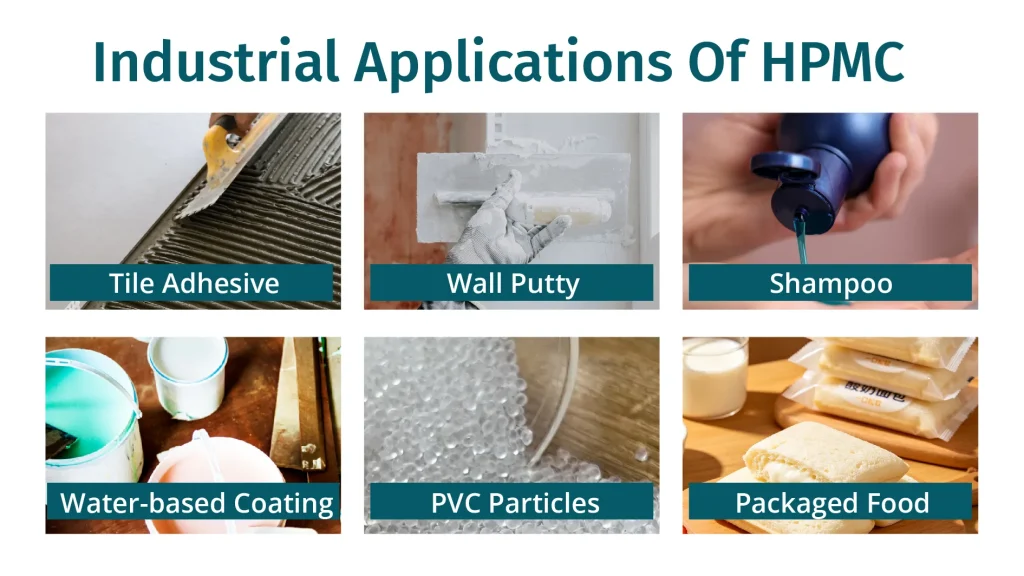
Construction is one of the main industrial applications of HPMC. HPMC helps control water retention, workability, consistency, open time, and fresh-state stability in dry-mix products. Zhiwei lists tile adhesive, cement mortar, plaster, putty, skim coat, render, and EIFS among its current HPMC applications. Zhiwei HPMC product page
Typical construction applications include:
- Tile adhesive
- Wall putty and skim coat
- Cement plaster
- Gypsum plaster
- EIFS adhesive and base coat
- Repair mortar
- Decoration mortar
- Masonry mortar
- Self-leveling compounds
In a simple cement bonding system, HPMC dosage may start around 0.2%-0.5% of the dry powder. The final dosage depends on cement, sand, polymer powder, temperature, substrate absorption, and required open time.
HPMC For Tile Adhesive
HPMC retains water inside tile adhesive. This gives cement more time to hydrate and helps the installer place and adjust tiles.
HPMC also improves troweling, ridge stability, open time, and vertical anti-slip behavior. A higher-viscosity grade can give the adhesive stronger application body, but excessive viscosity may make spreading harder.
For high-viscosity construction systems, Zhiwei HPMC 100K offers an NDJ viscosity range of 90,000-120,000 mPa·s in a 2% solution at 20°C. The product is positioned for tile adhesive, wall putty, plaster, EIFS, and other dry-mix systems. Zhiwei HPMC 100K
HPMC In Coatings
HPMC can work as a thickener, stabilizer, film former, and anti-sag aid in water-based coatings.
In one representative coating system, HPMC increased viscosity from about 800 cP to 4,600 cP. This higher viscosity improved resistance to sagging.
The formulator must still control dosage. Too much HPMC can affect leveling, water resistance, and film appearance. Coating manufacturers should also compare HPMC with HEC and HEMC because each cellulose ether provides a different rheology profile.
HPMC In Daily Chemical Products
HPMC is used in shampoo, toothpaste, lotions, creams, hair styling products, liquid soaps, antiperspirants, and deodorant systems.
It can work as:
- A thickener
- A film former
- A suspending agent
- A water retention agent
- A lubricant
- A binder
- A texture modifier
- An emulsion stabilizer
The formulator should select the viscosity according to the desired texture and surfactant system. The final formula should be tested for clarity, salt compatibility, foam, stability, and skin feel.
HPMC In PVC And Chemical Polymerization
HPMC can act as a suspension stabilizer and protective colloid in PVC suspension polymerization. It helps control monomer droplets and polymer particle structure.
HPMC can also work as an auxiliary emulsifier in vinyl chloride emulsion polymerization and as a dispersant in other polymerization systems.
The selected grade affects PVC particle size, porosity, bulk density, plasticizer absorption, and processing behavior.
HPMC In Food And Pharmaceutical Systems
Approved HPMC grades can be used as binders, thickeners, stabilizers, film formers, coating materials, and dispersion aids in food and pharmaceutical products.
These applications require specific purity, microbiological, heavy-metal, residual-solvent, and regulatory documentation. Construction-grade or daily-chemical-grade HPMC must not be treated as food-grade or pharmaceutical-grade material.
How To Select A Zhiwei HPMC Grade
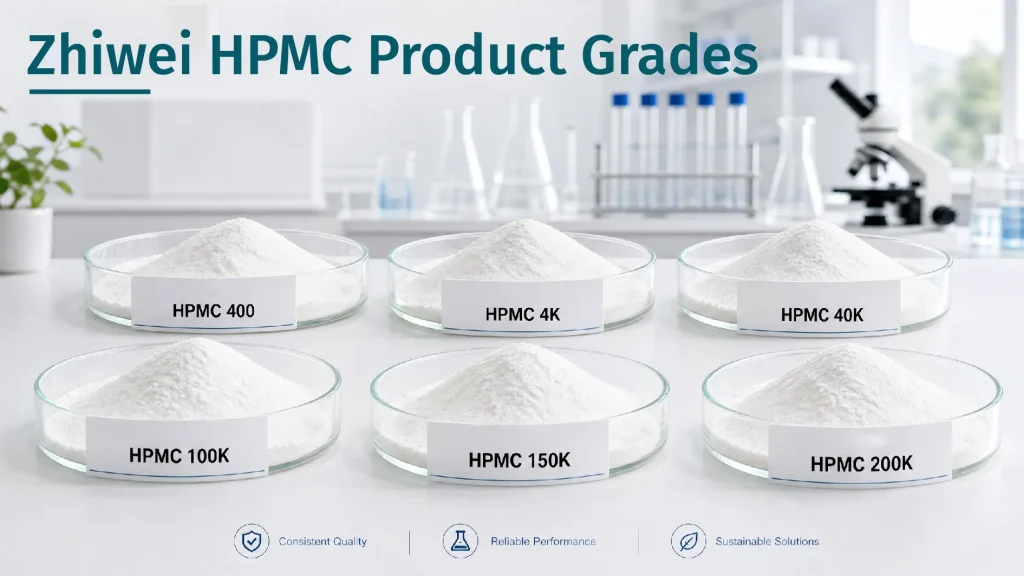
Zhiwei’s current HPMC product range includes HPMC 400, HPMC 4K, HPMC 40K, HPMC 100K, HPMC 150K, and HPMC 200K. The correct grade depends on the target viscosity and application.
| Formulation Requirement | Suggested Grade Direction |
|---|---|
| Low-viscosity flow and light stabilization | HPMC 400 or HPMC 4K |
| Moderate thickening and easier application | HPMC 40K |
| Strong water retention and open time | HPMC 100K |
| Higher application body | HPMC 150K |
| Very high viscosity screening | HPMC 200K |
The manufacturer should run a small application test before confirming the grade. The same viscosity can behave differently when substitution, gel temperature, particle treatment, cement, salts, or surfactants change.
Conclusion
The hydroxypropyl methylcellulose production process starts with natural cellulose and uses alkalization, methylation, and hydroxypropylation to create a water-soluble, non-ionic cellulose ether.
The complete process includes cellulose preparation, alkalization, etherification, neutralization, washing, drying, grinding, quality control, and packaging. Every stage affects viscosity, purity, solubility, gel temperature, and application performance.
HPMC is used in construction materials, coatings, detergents, personal care products, PVC polymerization, adhesives, food systems, and pharmaceutical formulations. Each application needs a suitable viscosity, substitution type, particle treatment, and purity level.
Zhiwei (Jinan) New Materials Co., Ltd. supplies HPMC grades from HPMC 400 to HPMC 200K. This product range allows formulators to screen low-, medium-, and high-viscosity options for construction and daily chemical systems.