
Introduction
Carbon-based tile adhesive is a new direction in high-performance cement-based tile adhesive. It uses cement, graded sand, polymer powder, cellulose ether, and special carbon materials to improve bonding, flexibility, crack resistance, heat transfer, and durability.
The carbon materials can be modified graphene derivatives, carbon fibers, activated carbon powder, conductive graphite powder, carbon black, hydrophobic carbon materials, or carbon-coated ceramic microspheres. Each carbon material has a different function. Some improve strength. Some reduce cracking. Some help the adhesive handle heat and moisture better. Some improve durability in outdoor or wet environments.
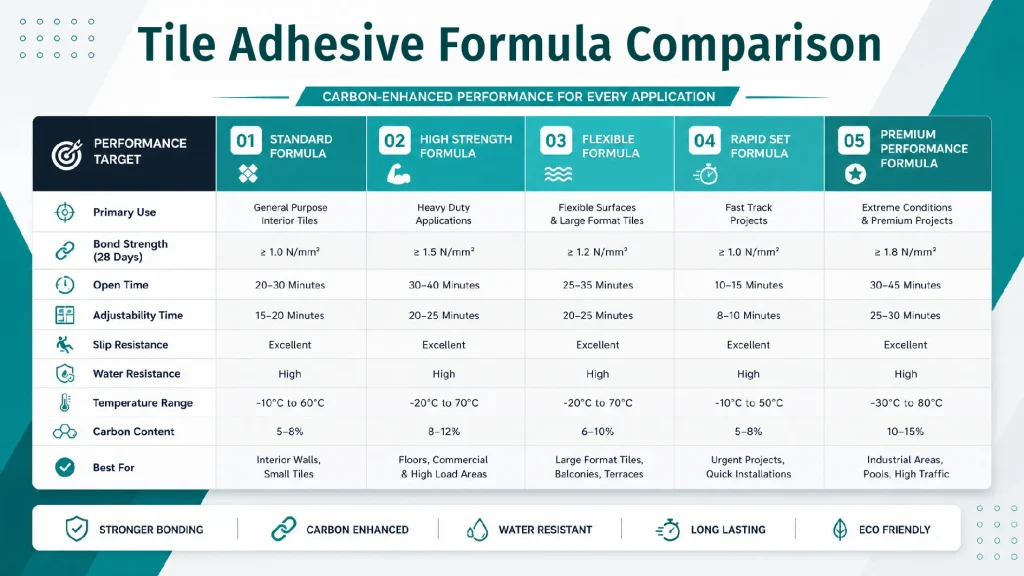
This article explains five practical carbon-based tile adhesive formulas. Each formula has a different target:
| Formula Type | Main Target |
|---|---|
| Basic universal type | Indoor wall and floor tile installation |
| High-strength fast-setting type | Fast construction and early strength |
| Ultra-flexible anti-crack type | Large tiles and deformable substrates |
| Low-shrinkage anti-crazing type | Large-area and thin-bed tile installation |
| High water-resistant weather-resistant type | Bathrooms, pools, kitchens, balconies, and outdoor use |
These formulas are useful starting points for dry-mix mortar producers, tile adhesive manufacturers, and construction material formulators. The final formula should still be tested with local cement, sand, water ratio, tile type, temperature, and target standard.
What Is Carbon-Based Tile Adhesive?
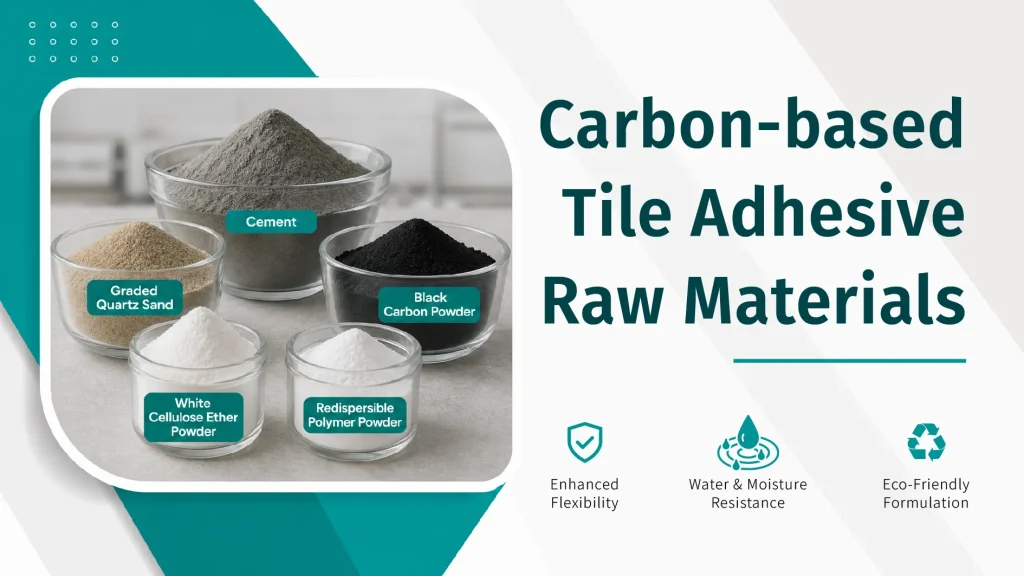
Carbon-based tile adhesive is a cement-based tile adhesive modified with functional carbon materials. It still has the normal structure of dry-mix tile adhesive. It usually contains cement, sand, cellulose ether, redispersible polymer powder, and other additives. The difference is that carbon materials are added to solve specific performance problems.
For example, graphene derivatives can improve bonding and toughness. Carbon fiber can help transfer stress inside the adhesive layer. Conductive graphite powder can support heat transfer, which is useful in floor heating systems. Activated carbon powder can help improve environmental performance and adjust the internal micro-environment. Hydrophobic carbon materials can help reduce water absorption in wet-area formulas.
A good carbon-based tile adhesive should not only have strong bonding. It should also have stable workability, enough open time, good water retention, low shrinkage, and strong resistance to cracking. This is where cellulose ether becomes important.
Zhiwei (Jinan) New Materials Co., Ltd. supplies HPMC and HEMC products for tile adhesive and dry-mix mortar. In carbon-based tile adhesive, grades such as Zhiwei HPMC 40K, HPMC 100K, HPMC 150K, HEMC 100H, and HEMC 150H can help control water retention, thickening, open time, troweling feel, and slip resistance. The best grade depends on cement type, sand grading, polymer dosage, temperature, and target application.
Formula 1: Basic Universal Carbon-Based Tile Adhesive
This formula is designed for normal indoor wall and floor tile installation. It offers good cost control, better toughness than a simple cement-sand adhesive, and stable basic bonding performance.
Formula By Weight
| Raw Material | Suggested Dosage |
|---|---|
| 42.5 grade Portland cement | 38-40 parts |
| Graded quartz sand, 40-70 mesh and 70-140 mesh | 45-48 parts |
| Modified graphene derivative powder | 0.3-0.5 parts |
| Biomass activated carbon powder | 2-3 parts |
| Methyl cellulose ether or HPMC/HEMC | 0.2-0.3 parts |
| Redispersible polymer powder, general type | 1.5-2.0 parts |
Formula Logic
The cement provides basic strength. The graded quartz sand controls the skeleton structure and reduces shrinkage. The modified graphene derivative works as the functional carbon material. It improves bonding, toughness, and stress distribution inside the adhesive.
Biomass activated carbon powder can help adsorb certain impurities and support a more stable cement hydration environment. It also gives the formula a more environmentally friendly direction.
The cellulose ether is small in dosage, but it is critical. It keeps water inside the mortar for cement hydration. It improves open time and makes the adhesive easier to spread. For this formula, Zhiwei HPMC 40K or HEMC 60K can be tested when the target is smooth troweling and normal indoor application. If the adhesive needs stronger water retention or better vertical tile support, Zhiwei HPMC 100K or HEMC 100H can be tested.
Suitable Applications
This formula is suitable for ceramic tiles, glazed tiles, and normal indoor tile installation. It can reduce hollowing and cracking risk compared with very simple cement mortar. It is a practical choice when the project needs better performance but does not need premium fast-setting or extreme flexibility.
Formula 2: High-Strength Fast-Setting Carbon-Based Tile Adhesive
This formula is designed for projects that need fast strength development. It is useful for low-temperature construction, commercial areas, underground passages, quick repair jobs, and floor heating systems.
Formula By Weight
| Raw Material | Suggested Dosage |
|---|---|
| 52.5 grade rapid-hardening Portland cement | 40-42 parts |
| Graded silica sand, mainly 50-100 mesh | 40-43 parts |
| Chopped carbon nanofiber | 0.8-1.2 parts |
| Conductive graphite powder | 1.0-1.5 parts |
| Methyl cellulose ether or HPMC/HEMC | 0.25-0.35 parts |
| VAE redispersible polymer powder | 2.0-2.5 parts |
| Calcium formate | 0.5-1.0 parts |
Formula Logic
The high-grade rapid-hardening cement gives the adhesive early strength. Calcium formate helps accelerate early strength and setting. Conductive graphite powder can support heat transfer inside the adhesive layer, which is helpful when the formula is used in floor heating or cold construction conditions.
Chopped carbon nanofiber acts like a micro-reinforcement structure. It helps transfer stress and improves tensile and impact resistance. The polymer powder improves internal cohesion and adhesion.
The cellulose ether needs careful selection in this formula. A fast-setting tile adhesive should still keep enough water for hydration, but it should not slow the early strength too much. Zhiwei HEMC 100H can be tested when the formula needs a balance between water retention, early performance, and workability. Zhiwei HPMC 40K or HPMC 100K can also be tested depending on the required viscosity and open time.
Suitable Applications
This formula is suitable for fast construction areas, winter indoor work, shopping malls, passages, and floor heating systems. The operator should mix smaller batches because the working time can be shorter. The construction team should apply and set tiles quickly after mixing.
Formula 3: Ultra-Flexible Anti-Crack Carbon-Based Tile Adhesive
This formula is designed for deformable substrates, large-format tiles, thin slabs, light partition walls, and areas with vibration or temperature movement.
Formula By Weight
| Raw Material | Suggested Dosage |
|---|---|
| 42.5 grade Portland cement | 35-38 parts |
| High elastic modulus quartz sand, mainly 70-120 mesh | 40-43 parts |
| High aspect ratio graphene nanosheets | 0.4-0.6 parts |
| Flexible resin-modified carbon microspheres | 2.5-3.5 parts |
| HPMC, high water retention and high thickening type | 0.3-0.4 parts |
| Flexible redispersible polymer powder, such as acrylic type | 3.0-4.0 parts |
| Polypropylene short fiber | 0.05-0.1 parts |
Formula Logic
This is a flexibility-focused formula. Graphene nanosheets provide sheet-like reinforcement and stress distribution. Flexible resin-modified carbon microspheres work as elastic buffer points in the structure. They help absorb deformation energy.
The higher polymer powder dosage improves flexibility and adhesion. Polypropylene fiber helps control micro-cracking. HPMC improves water retention, thickening, anti-sag behavior, and open time.
For large-format tile adhesive, Zhiwei HPMC 100K, HPMC 150K, HEMC 100H, or HEMC 150H can be considered for testing. These grades are more suitable when the adhesive needs stronger body, better open time, and more stable ridges after troweling.
Suitable Applications
This formula is suitable for tiles larger than 600 mm, large slabs, stone composite panels, light walls, wooden structure areas, and substrates with visible movement risk. Before application, the substrate should be reinforced or treated with a suitable primer when necessary.
Formula 4: Low-Shrinkage Anti-Crazing Carbon-Based Tile Adhesive
This formula is designed to reduce dry shrinkage cracks in thin-bed installation and large-area floor projects.
Formula By Weight
| Raw Material | Suggested Dosage |
|---|---|
| 52.5 grade low-alkali Portland cement | 38-40 parts |
| Optimized graded quartz sand, mainly 40-70 mesh | 46-49 parts |
| Special-structure carbon black | 0.8-1.2 parts |
| Expansion-compensating functional carbon material | 1.5-2.0 parts |
| Methyl cellulose ether or HPMC/HEMC | 0.2-0.3 parts |
| Redispersible polymer powder | 1.8-2.2 parts |
| High-efficiency water reducer | 0.2-0.4 parts |
Formula Logic
Shrinkage is often caused by high water demand, poor particle grading, excessive fine powder, and uneven moisture loss. This formula reduces shrinkage from several directions.
Low-alkali cement improves stability. Optimized sand grading reduces water demand. The water reducer lowers the water-cement ratio. The expansion-compensating carbon material creates a mild compensation effect after water contact. Special carbon black improves matrix density and helps reduce capillary shrinkage.
The cellulose ether improves water distribution and makes drying more uniform. For this formula, Zhiwei HPMC 40K, HPMC 100K, or HEMC 100H can be tested. The final choice should be made after checking water retention, troweling feel, open time, and shrinkage behavior.
Suitable Applications
This formula is suitable for large living rooms, commercial floors, thin-bed installation, and projects that require better dimensional stability. It helps reduce surface crazing and cracking caused by drying shrinkage. Good ventilation is important, but the drying environment should not change too suddenly.
Formula 5: High Water-Resistant And Weather-Resistant Carbon-Based Tile Adhesive
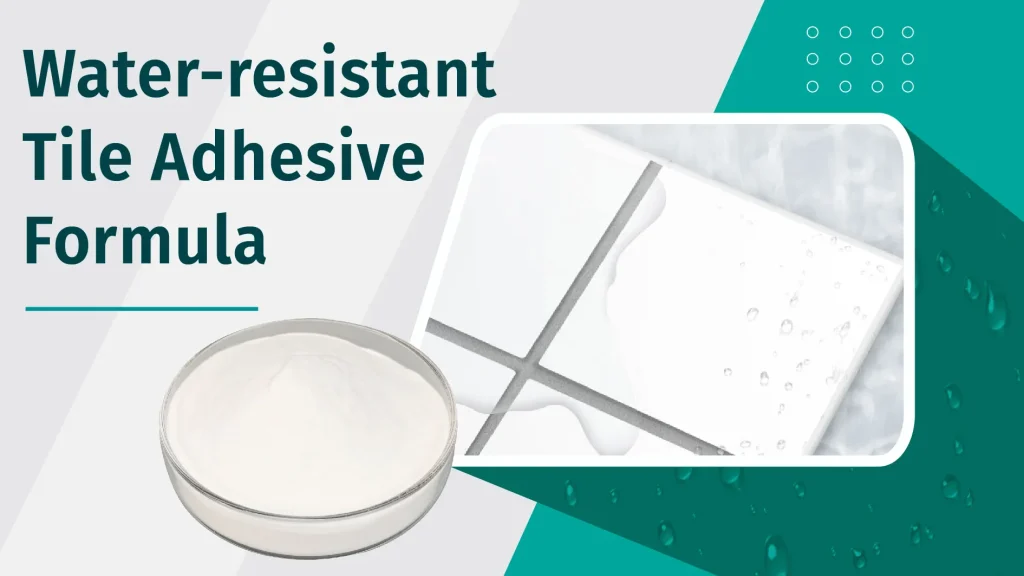
This formula is designed for wet areas, outdoor exposure, freeze-thaw risk, bathrooms, kitchens, swimming pools, balconies, and semi-outdoor tile systems.
Formula By Weight
| Raw Material | Suggested Dosage |
|---|---|
| Sulphoaluminate cement, or high-alumina cement with Portland cement | 30-35 parts |
| Portland cement for later strength and stability | 5-10 parts |
| Graded quartz sand | 40-45 parts |
| Hydrophobic graphene-coated ceramic microspheres | 3.0-4.0 parts |
| Chemically resistant chopped carbon fiber fabric | 1.0-1.5 parts |
| Water-resistant modified cellulose ether | 0.25-0.35 parts |
| Hydrophobic redispersible polymer powder, such as pure acrylic type | 2.5-3.5 parts |
| High-efficiency defoamer | 0.1-0.2 parts |
Formula Logic
The cement system is important here. Sulphoaluminate cement or high-alumina cement can form a denser hydration structure with good early strength and improved water resistance. The Portland cement supports later strength and formula stability.
Hydrophobic graphene-coated ceramic microspheres help reduce water absorption. They create a more water-repellent structure inside the adhesive. Chopped carbon fiber improves toughness and long-term durability under moisture or chemical attack.
Hydrophobic polymer powder improves interface sealing. The defoamer reduces entrapped air and helps the adhesive form a denser layer.
For this formula, the cellulose ether must provide water retention without damaging water resistance. Zhiwei HEMC 150H, HEMC 200H, HPMC 100K, or HPMC 150K can be tested depending on the viscosity target, anti-sag requirement, and open time. The final adhesive should also be tested with the selected grout and waterproofing system because water resistance depends on the complete tile installation structure.
Suitable Applications
This formula is suitable for bathrooms, swimming pool walls, kitchens, balconies, exterior tile systems, and areas with long-term water contact. The tile adhesive should be used together with suitable waterproofing, grout, and sealing materials.
Why HPMC And HEMC Matter In Carbon-Based Tile Adhesive
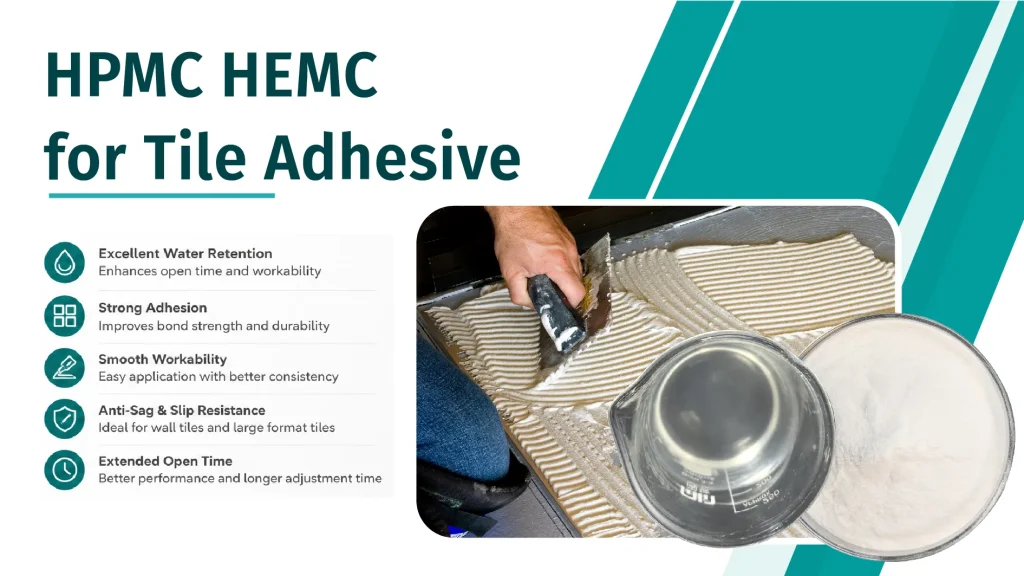
Carbon materials can improve strength, toughness, heat transfer, and durability. However, they do not replace cellulose ether. A tile adhesive still needs good fresh-state performance. The installer must be able to spread it, comb it, adjust the tile, and maintain enough wet contact before cement hydration.
HPMC and HEMC help solve these practical problems:
| Function | Why It Matters |
|---|---|
| Water retention | Keeps water in the mortar for cement hydration |
| Open time | Gives the installer enough time to place and adjust tiles |
| Workability | Improves spreading and troweling feel |
| Slip resistance | Helps tiles stay in position on vertical surfaces |
| Thickening | Builds body and improves ridge stability |
| Consistency control | Reduces batch-to-batch handling differences |
Zhiwei HEMC products are used in cement-based tile adhesive systems to support water retention, open time, workability, and slip resistance. Zhiwei HPMC products are also used in tile adhesive, dry-mix mortar, wall putty, and construction materials where water retention and handling matter.
For basic tile adhesive, formulators can start with Zhiwei HPMC 40K or HEMC 60K. For stronger open time and large-format tile systems, Zhiwei HPMC 100K, HPMC 150K, HEMC 100H, and HEMC 150H are more suitable test options. For premium or difficult formulas, the grade should be selected after testing cement type, sand grading, polymer powder, carbon material dosage, and construction temperature.
Mixing And Application Notes
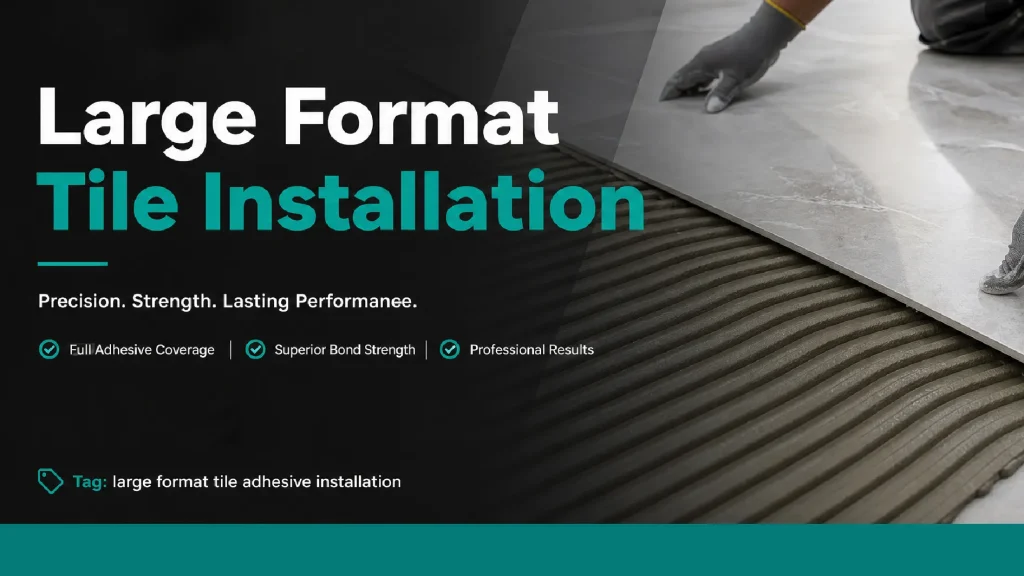
A strong formula can still fail if mixing and construction are poor. Carbon-based tile adhesive needs stable dry blending and correct water addition.
First, all dry powders should be blended evenly. Carbon materials are often light and easy to agglomerate, so they need enough dry mixing time. Second, water should be added under steady mixing. The powder should be mixed until the mortar becomes uniform and free of visible lumps. Third, the mortar should rest for 3-5 minutes. This maturation time helps cellulose ether hydrate and improves consistency. The mortar should then be mixed again briefly before use.
The usual water-powder ratio can start around 20%-25%, but it must be adjusted based on raw materials and target workability. The operator should not add too much water after the mortar has already matured. Extra water can reduce strength, increase shrinkage, and damage slip resistance.
The substrate must be strong, clean, and free of oil, dust, loose particles, and weak layers. The surface should have suitable absorbency. Very dense or weak substrates may need primer or interface treatment.
A notched trowel should be selected based on tile size. Large-format tiles need better adhesive coverage. For demanding applications, back-buttering may be needed to improve contact area.
How To Choose The Right Formula
The best carbon-based tile adhesive formula depends on the application.
For normal indoor ceramic tile, the basic universal formula is usually enough. For commercial areas that need quick use, the high-strength fast-setting formula is better. For large-format tiles, thin slabs, and deformable substrates, the ultra-flexible anti-crack formula is the safer choice. For large-area floor work and thin-bed installation, the low-shrinkage formula should be considered. For bathrooms, pools, balconies, kitchens, and outdoor systems, the high water-resistant formula is more suitable.
The cellulose ether grade should follow the same logic. A simple formula may only need moderate viscosity. A large-format tile adhesive needs stronger body and open time. A fast-setting adhesive needs a grade that supports water retention but does not slow early strength too much. A wet-area formula needs stable workability and should be tested together with the full waterproofing and grouting system.
Conclusion
Carbon-based tile adhesive gives tile adhesive manufacturers a practical way to build higher-performance products. By using different carbon materials, the formula can be designed for bonding strength, flexibility, anti-crack performance, low shrinkage, fast setting, heat transfer, water resistance, and long-term durability.
The five formulas in this article show different design paths. Modified graphene derivatives are useful for basic toughness and bonding. Carbon nanofibers and conductive graphite support fast-setting and high-strength systems. Graphene nanosheets, flexible carbon microspheres, and polymer powder help create anti-crack formulas. Carbon black and expansion-compensating carbon materials help reduce shrinkage. Hydrophobic carbon materials and carbon fibers support wet-area and outdoor durability.
For stable production, carbon materials must work together with the correct cellulose ether. Zhiwei HPMC and HEMC grades can help tile adhesive manufacturers improve water retention, open time, workability, slip resistance, and fresh-state stability. A short lab test with the real cement, sand, polymer powder, carbon material, and water ratio is the best way to confirm the final grade and dosage.