
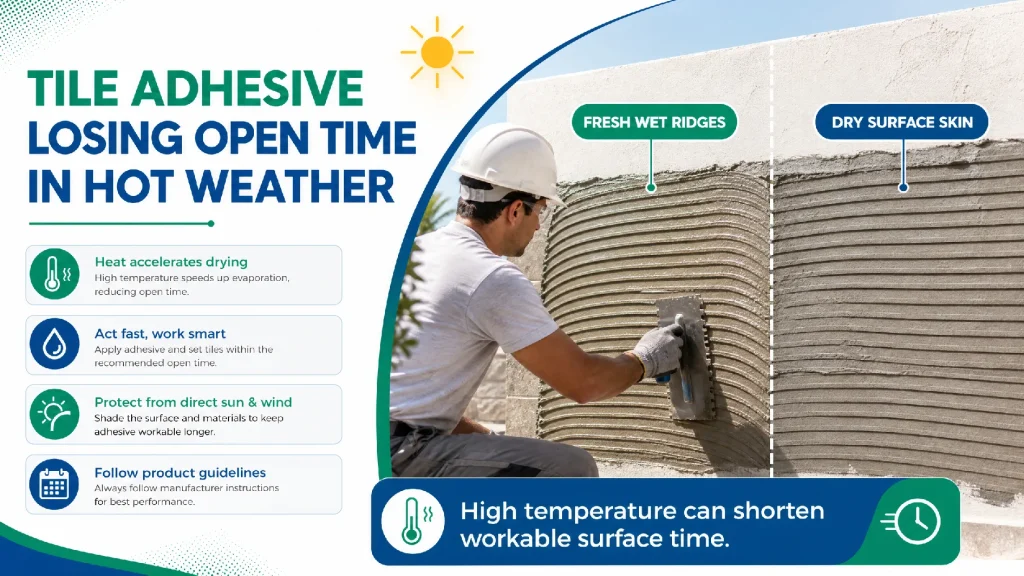
Tile adhesive loses open time at high temperature because heat accelerates cement hydration while also increasing water loss from the freshly spread mortar. Strong wind, low humidity, a hot substrate, and direct sunlight make the problem more severe.
As moisture leaves the adhesive surface, a dry skin begins to form over the trowel ridges. The mortar underneath may still feel soft, but the skinned surface can no longer wet the back of the tile properly. This reduces adhesive transfer and increases the risk of hollow spots, weak bonding, cracking, or eventual tile detachment.
HPMC and HEMC can improve water retention and help the adhesive remain workable for longer. However, cellulose ether cannot compensate for every summer construction problem. Excessively large spreading areas, hot materials, incorrect water addition, delayed tile placement, and dry absorbent substrates can still cause rapid skin formation.
A reliable high-temperature solution therefore requires both a suitable tile adhesive formulation and disciplined site application.
Open Time Is Not the Same as Pot Life
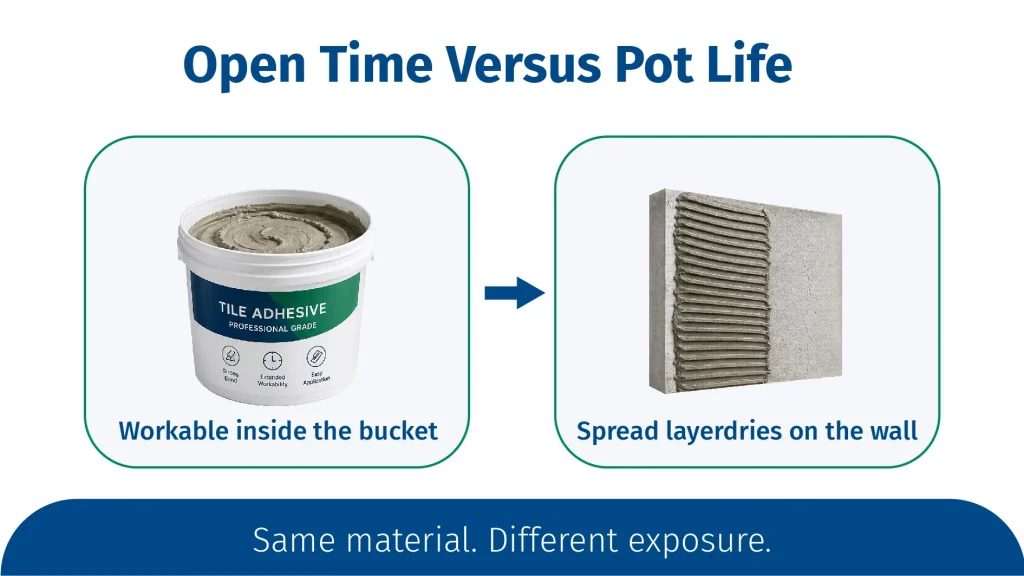
Open time and pot life are often treated as the same property, but they describe different stages of application.
| Property | What it means | Where it is evaluated |
|---|---|---|
| Pot life or workable time | How long the mixed adhesive remains usable in the bucket | Mixing container |
| Open time | How long the spread adhesive can remain exposed before the tile is installed | Substrate surface |
| Adjustment time | How long the tile can still be repositioned after installation | Bonded tile |
| Curing time | How long the adhesive needs to develop sufficient strength | Completed installation |
A mortar can remain workable in the bucket while losing open time rapidly after it is spread. The thin trowel ridges have a much larger surface area exposed to heat and moving air, so they dry faster than the bulk material inside the container.
This distinction matters when diagnosing a complaint. If the adhesive stays soft in the bucket but fails to transfer onto the tile, the primary problem is probably surface drying rather than short pot life.
Adding more water to the bucket will not reliably restore the exposed adhesive layer.
How Temperature Shortens Workable Time
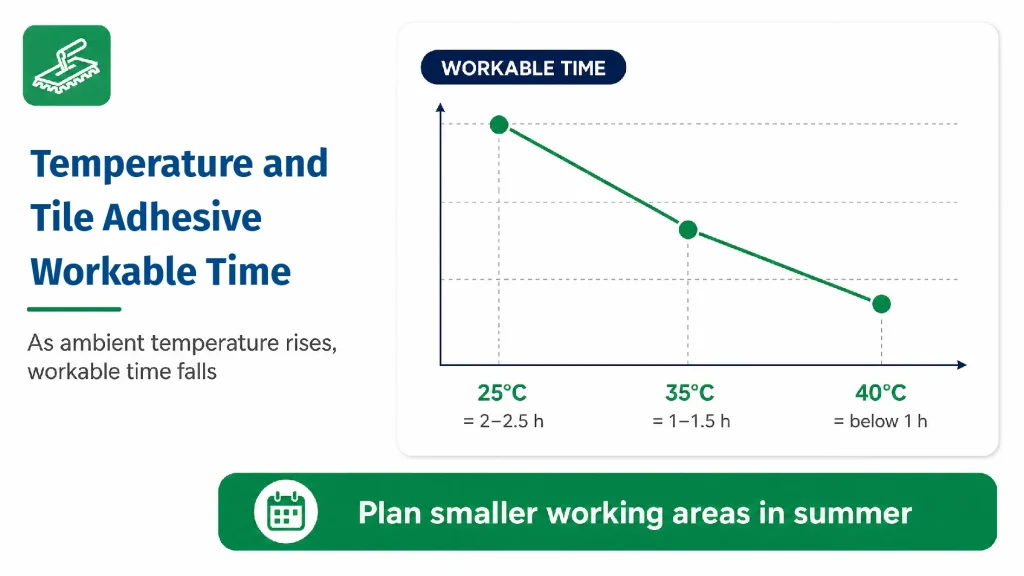
When the ambient temperature rises above 30°C, the hydration reaction of the cementitious binder can accelerate by approximately 30%-50%. The mortar consumes water more quickly and begins developing structure earlier.
A standard tile adhesive that remains workable for two hours or more at moderate temperature may behave very differently during summer installation.
| Ambient temperature | Indicative workable time |
|---|---|
| Around 25°C | Approximately 2-2.5 hours |
| Around 35°C | Approximately 1-1.5 hours |
| Around 40°C | May fall below 1 hour |
These values describe the mortar in the mixing container. The practical open time after troweling is considerably shorter.
Under hot summer conditions, tiles should normally be installed within approximately 15 minutes after the adhesive is spread. Material exposed for more than 20 minutes should not be assumed to remain bondable simply because it still looks wet underneath.
Temperature creates two simultaneous effects:
- Cement hydration proceeds more quickly.
- Water evaporates more rapidly from the exposed adhesive.
The first process reduces the workable time of the whole batch. The second creates premature surface skinning and directly reduces open time.
Humidity and Wind Can Be as Important as Temperature
High temperature is not the only environmental factor controlling open time.
Summer relative humidity can fluctuate between approximately 60% and 90%. At humidity above 80%, surface evaporation slows, which can help preserve open time. However, a substrate containing free water may develop an interface water film and reduce bonding.
At humidity below 50%, the adhesive surface loses moisture much faster. When low humidity is combined with wind force above level 3, the amount of water evaporating during the first ten minutes can reach approximately twice that under standard conditions.
This rapid loss can create an “outside hard, inside soft” structure:
- The exposed surface forms a dry skin.
- The mortar below remains incompletely hydrated.
- The tile contacts the skin instead of fresh adhesive.
- Adhesive transfer becomes incomplete.
- The final bond contains weak or unbonded areas.
A hot and windy afternoon can therefore be more damaging than temperature alone suggests.
The Substrate Can Remove Water from the Adhesive
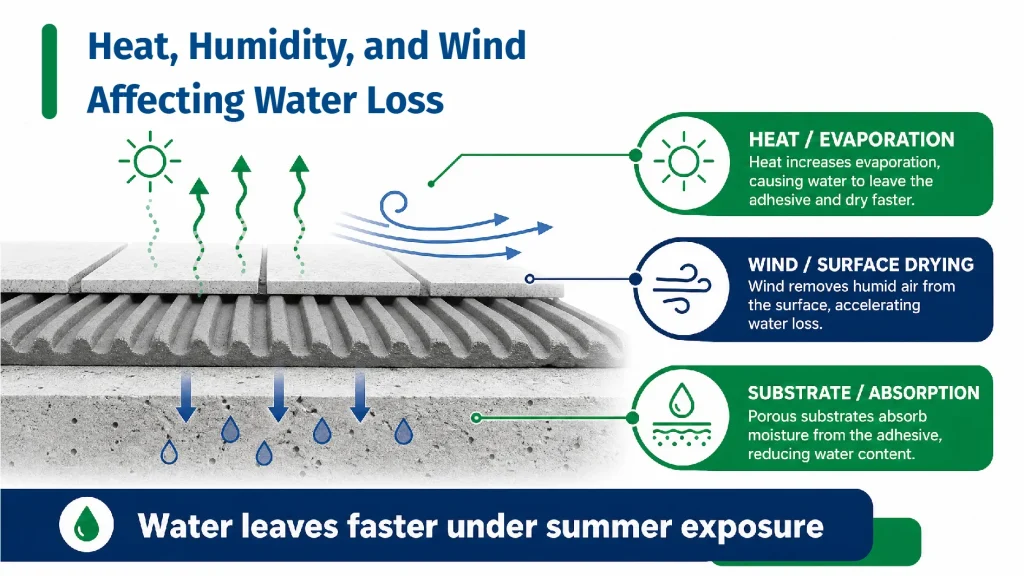
A dry absorbent substrate competes with the cement for mixing water. This condition is often described as the substrate “stealing” water from the mortar.
When fresh tile adhesive is applied to a hot, porous wall or floor, water can leave in two directions at once. Some evaporates from the exposed surface while the substrate absorbs moisture from underneath.
The result is a narrow bonding window even when the adhesive contains a water-retaining polymer.
Before summer installation, the substrate should be dampened evenly without leaving visible water. A practical preparation target is a slightly moist surface rather than a saturated one.
The construction plan uses a substrate moisture range of approximately 8%-12% as a reference. Water can be sprayed about two hours before application so that the surface has time to absorb the moisture. Any visible water must disappear before the adhesive is spread.
Highly porous tiles or masonry materials with water absorption above 10% require separate moisture control. They can be preconditioned in advance and allowed to dry until no surface water remains.
Low-absorption porcelain tiles, vitrified tiles, and slabs should not be treated in the same way as porous materials.
What Happens When Tile Adhesive Forms a Skin?
Fresh adhesive should wet and transfer to the back of the tile. Once a skin develops, the surface becomes less capable of making intimate contact.
The installer may still be able to press the tile into position, but pressure alone does not guarantee bonding. The ridges can remain visible and only their highest points may contact the tile.
Several defects can follow:
Reduced Adhesive Transfer
The tile touches a dry surface rather than fresh mortar. Coverage appears acceptable from the front, but the actual contact area is too low.
Hollow Areas
Incomplete ridge collapse leaves air pockets or unbonded zones. These areas may later be detected as hollow sounds.
Weak Interface Bond
The mortar can harden while remaining poorly bonded to the tile or substrate. The failure occurs at the interface instead of within the adhesive layer.
Cracking
Rapid surface drying and large day-night temperature changes create different shrinkage rates between the outer and inner parts of the mortar.
Tile Detachment
A combination of insufficient transfer, incomplete hydration, and thermal movement can eventually lead to loose or detached tiles.
Large-format tiles are particularly sensitive because their low absorption and large contact area leave little tolerance for incomplete adhesive transfer.
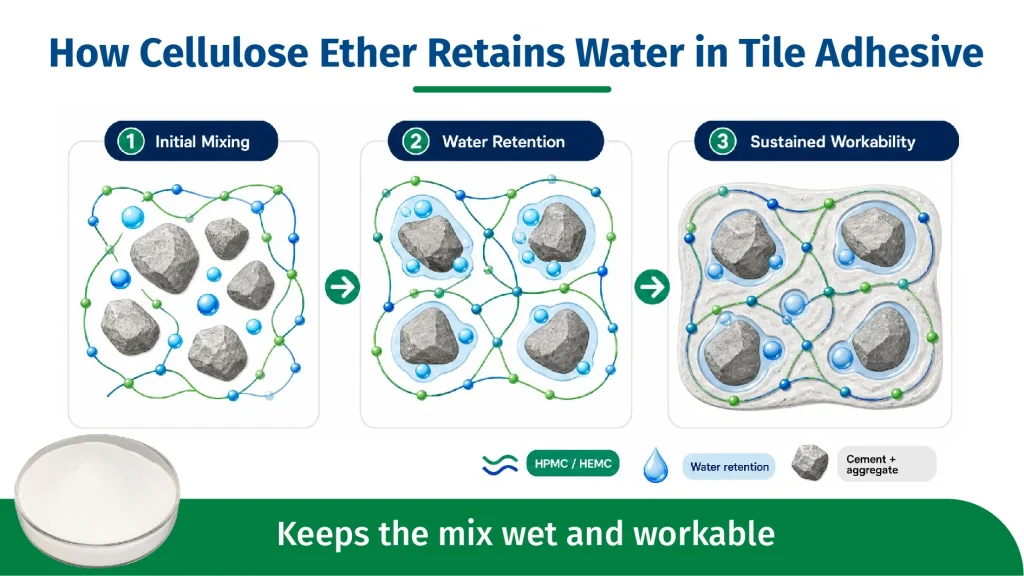
Why HPMC Helps Preserve Open Time
Hydroxypropyl methylcellulose is used in cement-based tile adhesive primarily for water retention, consistency control, and improved workability.
When properly selected and dispersed, HPMC helps retain mixing water inside the mortar. This gives the cement more time to hydrate and slows the rate at which the substrate and surrounding air remove moisture.
The practical benefits can include:
- Longer workable time
- Improved resistance to rapid surface drying
- More stable trowel ridges
- Better mortar consistency
- Easier spreading
- Improved contact between adhesive and tile
- Reduced risk of premature skin formation
Water retention should not be confused with simply making the mortar thicker. A very high viscosity does not automatically produce the longest open time.
If the adhesive becomes excessively heavy or sticky, installers may struggle to spread it uniformly. Poor troweling can reduce ridge quality and coverage even when water retention is high.
The correct HPMC product must therefore balance water retention, viscosity, wetting, trowelability, and application feel.
When HEMC May Be Considered
Hydroxyethyl methylcellulose performs a similar function in dry-mix mortar and can also be evaluated for high-temperature tile adhesive.
For projects where open-time retention under heat is the central concern, HEMC is a useful screening direction. The final comparison should be conducted in the actual cement, sand, filler, redispersible polymer powder, and retarder system.
HPMC and HEMC should not be selected solely by nominal viscosity. Two cellulose ether products with similar viscosity can produce different results in water retention, dissolution, mortar consistency, skinning behavior, and tile wetting.
A summer-grade tile adhesive should be tested after exposure to the expected temperature, humidity, and wind conditions rather than being approved from a room-temperature viscosity result.
Zhiwei HPMC and HEMC Recommendations
At Zhiwei (Jinan) New Materials Co., Ltd., we recommend choosing the cellulose ether according to the required balance of open time and construction performance.
| Formulation requirement | Suggested Zhiwei screening direction |
|---|---|
| General tile adhesive with improved water retention and workability | Construction-grade HPMC |
| Summer formulation requiring stronger open-time retention | High-water-retention HPMC |
| More demanding hot or windy application conditions | Construction-grade HEMC for high-temperature screening |
| Formula requiring both smooth troweling and high-temperature water retention | Comparative HPMC/HEMC testing or a combined cellulose ether approach |
| Large-format or low-absorption tile installation | HPMC or HEMC evaluated together with polymer powder and full adhesive-transfer testing |
We have not assigned a specific Zhiwei model or viscosity grade because the construction plan does not provide the cement type, sand grading, cellulose dosage, polymer powder content, target viscosity, or required open-time test result.
Without those details, recommending a precise model would create a false sense of certainty.
For a meaningful product selection, we would first review:
- Cement and filler composition
- Sand particle-size distribution
- Cellulose ether dosage
- Redispersible polymer powder content
- Retarder type and dosage
- Target water demand
- Required pot life and open time
- Tile size and water absorption
- Expected summer temperature and wind exposure
The selected grade should then be verified in the complete dry-mix formulation.
HPMC, HEMC, and Retarder Do Not Perform the Same Job
Summer-grade tile adhesive often requires both water retention and controlled setting. Cellulose ether and retarder contribute to these goals through different mechanisms.
| Additive | Primary function in summer tile adhesive |
|---|---|
| HPMC | Retains water, controls consistency, supports workability and open time |
| HEMC | Provides cellulose-ether water retention and can be screened for demanding high-temperature performance |
| Citric acid | Retards cement reaction when correctly dosed in the factory formula |
| Sodium gluconate | Helps control cement setting and extend workable time |
| Redispersible polymer powder | Supports adhesion, flexibility, and interface performance |
| Interface treatment | Helps manage difficult or excessively smooth substrates |
Retarders such as citric acid and sodium gluconate may extend workable time by approximately 30%-40% in a properly designed summer formula.
They should be incorporated and controlled during product manufacturing. Adding an unmeasured retarder at the construction site can alter setting, strength development, and final performance.
Cellulose ether cannot replace a retarder when cement hydration is too fast. A retarder cannot replace HPMC or HEMC when the primary problem is rapid water loss and surface skinning.
The two functions must be balanced.
Material Storage Begins the Open-Time Control Process
A suitable formulation can still lose performance when the dry mortar is stored or transported incorrectly.
Tile adhesive should be kept in a dry, ventilated indoor warehouse. The temperature should remain at or below approximately 35°C, and the bags should be protected from direct sunlight.
A practical summer storage arrangement includes:
- A moisture-proof pallet at least 15 cm above the floor
- No more than five bags or layers in a vertical stack
- Separation from dusty cement, aggregate, or contaminating materials
- Intact packaging without moisture damage or hardened lumps
- Batch rotation based on production date
At the construction site, the daily quantity should be moved in smaller batches. Leaving bagged material inside a closed vehicle or under direct sunlight for more than one hour can raise the temperature of both the powder and its packaging.
Hot powder mixed with warm water starts the application process at a disadvantage. The batch reaches its shortened working period before it is even spread.
Control the Mixing Process
The mixing procedure influences hydration, cellulose ether dissolution, consistency, and the usable life of the adhesive.
A typical tile adhesive may use approximately 20-22 kg of water per 100 kg of powder. The product manufacturer’s specified water range must remain the controlling requirement.
A disciplined sequence is:
- Add the measured water to a clean mixing container.
- Add the dry adhesive gradually.
- Mix at 300-500 rpm for two to three minutes.
- Continue until the mortar is uniform and free of dry lumps.
- Allow the mixture to stand for about five minutes.
- Remix for approximately one minute.
- Use the mortar within its verified summer working period.
The resting period allows polymeric additives to hydrate and the mortar consistency to develop. Skipping it can produce an unstable initial consistency and encourage unnecessary water adjustment.
If the manufacturer has validated a limited summer water adjustment, it must remain within the approved range. Uncontrolled water addition lowers the solids concentration and can weaken the final adhesive.
Once the mortar begins to skin or stiffen, remixing without additional water may restore a more uniform consistency. Adding water a second time is not acceptable because it changes the designed water-to-powder ratio after hydration has already started.
Mix Smaller Batches in Hot Weather
Large batches create pressure to use adhesive after its useful working period has passed.
At 35°C, a product that remains workable for two hours at 25°C may provide only 1-1.5 hours. At 40°C, the period can fall below one hour.
The batch size should match the actual installation speed. A crew installing detailed corners, openings, or large-format slabs needs smaller batches than a team covering an unobstructed floor.
The goal is to finish each batch while it still spreads smoothly and transfers properly. Finishing the bucket is not more important than maintaining the bond.
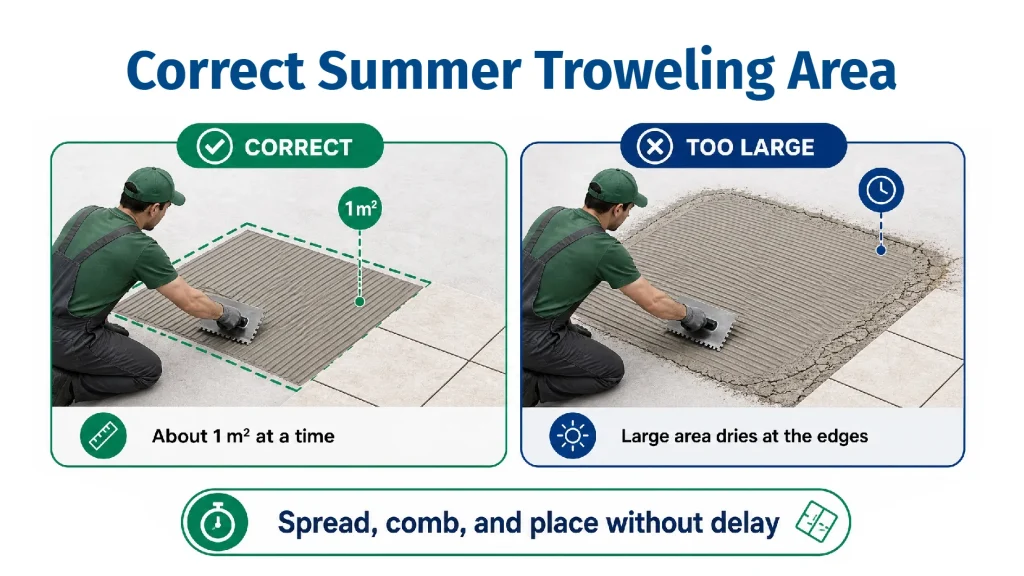
Reduce the Spreading Area
In moderate conditions, an installer may spread 1.5-2 m² at one time. During hot summer work, the recommended single spreading area should be reduced to no more than approximately 1 m².
A smaller area shortens the time between troweling and tile placement. It also allows the installer to monitor skin formation more closely.
Spreading should proceed in sections that can be covered within approximately 15 minutes. Adhesive that has remained exposed for more than 20 minutes should be removed rather than covered with a tile and assumed to be serviceable.
The exact interval will vary with temperature, wind, substrate absorption, and product formulation. For that reason, the installer should also check the adhesive surface and transfer condition rather than relying only on a clock.
Select the Correct Trowel and Coverage
Trowel size determines the amount of mortar applied and the potential contact area.
| Tile size | Reference trowel notch |
|---|---|
| Approximately 300 × 300 mm | 4 mm |
| Approximately 600 × 600 mm | 6 mm |
| Approximately 800 × 800 mm or larger | 8 mm |
The adhesive should be combed at an angle of approximately 45°-60°. Ridges need consistent height and direction, without dry edges or irregular piles.
A general coverage target is at least 85%. Large-format tile installation should reach at least 90%.
Coverage should be confirmed by periodically lifting a newly placed tile and inspecting the back. Continuous ridges that have not collapsed indicate insufficient pressure, unsuitable mortar consistency, premature skinning, or an incorrect troweling method.
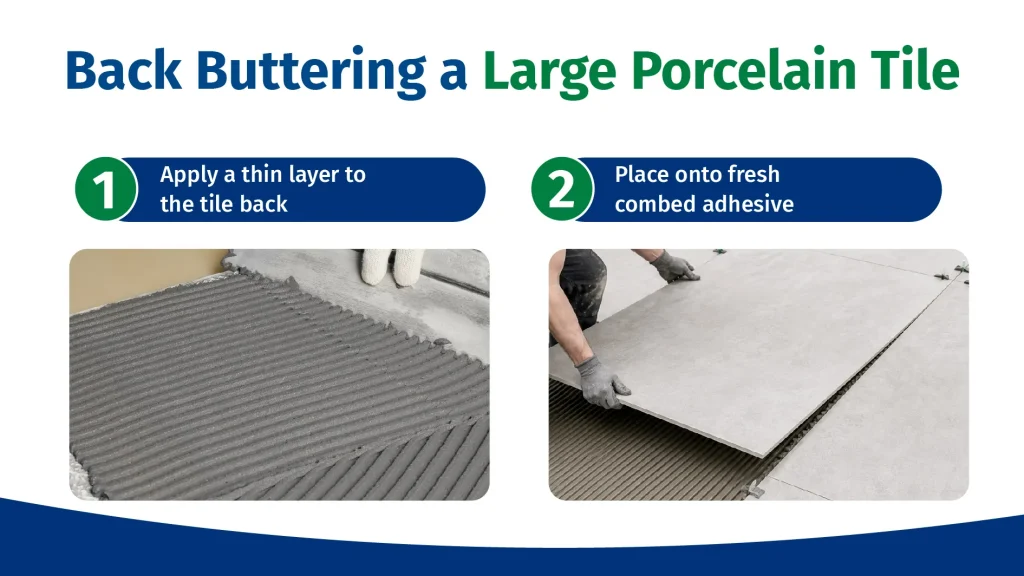
Use Back Buttering for Large or Low-Absorption Tiles
Large-format tiles, vitrified tiles, porcelain surfaces with water absorption below 0.5%, and slabs thicker than approximately 12 mm need additional attention.
A 2-3 mm adhesive layer can be applied to the back of the tile using the flat side of the trowel. The tile should then be installed within approximately three minutes before this thin layer begins to dry.
Tiles larger than about 1200 × 600 mm can require a double-application method, with adhesive applied to both the substrate and tile back.
Back buttering increases contact area, but it does not restore adhesive that has already skinned on the substrate. Both surfaces must still be fresh at the moment of installation.
Avoid the Hottest Part of the Day
Construction between 10:00 and 16:00 carries a higher risk because the air, substrate, tiles, and mixing materials may all be hot.
Recommended summer working periods are approximately:
- 06:00-10:00
- 16:00-19:00
Where work cannot be rescheduled, a shade structure should block direct sunlight. The construction plan uses a shading rate above approximately 80% as a reference.
Wind barriers may also be necessary. Shade reduces radiant heating, but it does not prevent strong air movement from stripping moisture from the trowel ridges.
Prepare the Substrate Correctly
A summer installation requires a clean, sound, level, and appropriately moist substrate.
Using a 2 m straightedge, the maximum gap should remain within approximately 3 mm. Large irregularities should be repaired before tile installation because using tile adhesive as a leveling layer creates inconsistent thickness and drying.
Dust, oil, release agent, and loose material must be removed. Smooth concrete can require mechanical roughening or a compatible interface treatment.
Pre-dampening should produce a uniformly moist surface without standing water. Both extremes create problems:
- A completely dry substrate removes water too quickly.
- A visibly wet substrate can create an interface water film and reduce bond strength.
The correct surface is cool and slightly moist, not saturated.
Recognize Adhesive That Has Lost Open Time
The adhesive should be assessed before each tile is placed.
Fresh material has moist, continuous trowel ridges and transfers readily. A compromised layer shows one or more of the following signs:
- A dry or dull surface
- A thin hard skin
- Cracked ridge edges
- Little adhesive transfer to the tile back
- Ridges that remain intact after pressing
- Material that rolls instead of spreading
- Local drying around the edge of the spread area
Once a clear skin has formed, covering the area with fresh adhesive or adding water does not reliably restore the original interface. The affected material should be removed and replaced.
Protect the Installation During Early Curing
Summer problems do not end after the tiles are positioned.
Daytime temperatures may exceed 35°C and fall by approximately 10°C at night. This temperature difference can create unequal shrinkage between the surface and interior of the adhesive.
The risk increases with large tiles, thin adhesive layers, and direct sunlight.
The newly tiled surface should be protected from rapid drying, wind, traffic, and mechanical loading. The construction plan uses 48 hours of protected curing as a reference.
When temperatures exceed 38°C, shade and controlled local cooling may be required. Water used around the work area must not create standing water at tile edges or wash material out of the joints.
Movement, subsequent construction, and heavy loading should be avoided during the initial curing period.
Common Summer Application Mistakes
Adding Extra Water to Extend Open Time
More water may make the mortar feel softer, but it changes the designed formulation. The apparent improvement in workability can come at the expense of strength, sag resistance, consistency, and curing behavior.
Spreading Too Large an Area
The outer edges can form a skin before the installer reaches them. Smaller application zones provide more reliable control.
Using Adhesive After the Surface Has Skinned
A soft interior does not guarantee a bondable surface. Open time is governed by the exposed interface.
Re-Adding Water to Stiff Mortar
Water added after hydration begins disrupts the designed ratio. Remix without water only when the material remains within its workable period.
Testing Only at Moderate Temperature
A product that performs well at 25°C may lose a large part of its workable time at 35-40°C. Summer-grade development requires high-temperature testing.
Selecting HPMC Only by Viscosity
Nominal viscosity does not fully describe water retention, trowel feel, dissolution, open time, or performance with the selected cement.
Assuming HPMC or HEMC Can Correct Poor Site Practice
Even a high-water-retention cellulose ether cannot fully compensate for direct sunlight, a hot dry substrate, strong wind, or an excessively long delay before tile installation.
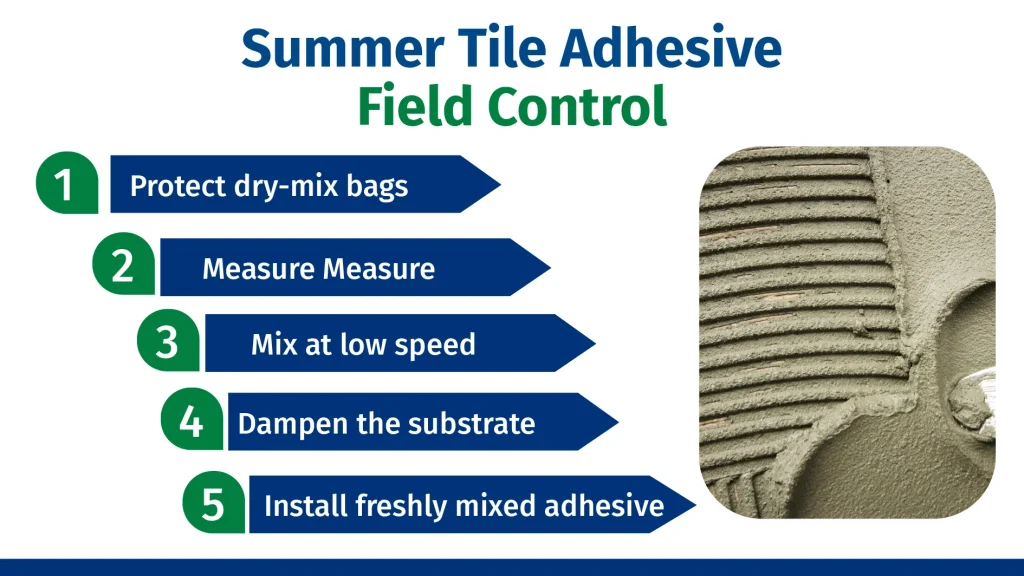
Summer Tile Adhesive Control Checklist
Before Mixing
Confirm that the bags are dry, free from lumps, and protected from sunlight. Check the substrate temperature, moisture condition, levelness, cleanliness, and absorption.
Prepare shade and wind protection before spreading begins.
During Mixing
Measure the water, mix at low speed, allow the mortar to rest, and remix once. Do not shorten the hydration period or repeatedly adjust the consistency with water.
Prepare only the quantity that can be used within the shortened summer pot life.
During Application
Limit each spreading area to approximately 1 m². Use the correct trowel and install the tiles within about 15 minutes.
Watch for skin formation and check transfer by lifting sample tiles. Use back buttering or double application for large and low-absorption tiles.
After Installation
Protect the tiled area from direct sun, wind, traffic, and rapid temperature change. Observe the specified adjustment and curing periods before grouting or loading the surface.
Frequently Asked Questions
Why Does Tile Adhesive Dry So Quickly in Summer?
High temperature accelerates cement hydration and increases water evaporation. Low humidity, wind, direct sunlight, hot materials, and an absorbent substrate can shorten the available bonding period further.
How Much Open Time Does Tile Adhesive Have at High Temperature?
Under summer conditions, the spread adhesive should generally be covered within approximately 15 minutes. Material exposed beyond 20 minutes requires careful assessment and should be discarded if skinning has started.
Is Open Time the Same as Pot Life?
No. Pot life describes the mixed adhesive in the bucket. Open time describes the period after the adhesive has been spread onto the substrate.
Can More Water Extend Open Time?
Uncontrolled water addition is not a reliable solution. It changes the designed water-to-powder ratio and can reduce final performance. Follow the validated water range and never add water again after hydration has started.
How Does HPMC Improve Tile Adhesive?
HPMC retains water, controls consistency, improves workability, and helps reduce premature surface drying. The grade and dosage must balance open time with trowelability, sag resistance, and adhesive transfer.
Is HEMC Better for Hot Weather?
HEMC is a useful product direction for high-temperature screening, particularly when open-time retention is a priority. Whether it performs better in a specific formula must be confirmed using the actual cement, aggregate, polymer, and application conditions.
Can Retarder Replace HPMC or HEMC?
No. Retarder mainly controls cement reaction, while cellulose ether manages water retention and mortar rheology. A summer formula may require both functions.
Should a Summer Formula Use More Cellulose Ether?
Not automatically. Excessive cellulose ether can make the mortar too sticky or difficult to spread. Product selection should be based on water retention, open time, wetting, consistency, and bond performance rather than dosage alone.
Why Does the Adhesive Remain Soft but Fail to Bond?
The exposed surface may have formed a skin while the material underneath remains soft. The tile contacts the dry skin and cannot achieve complete adhesive transfer.
Which Zhiwei Product Should Be Used?
Construction-grade Zhiwei HPMC is a suitable starting point for water retention and workability. For more demanding high-temperature conditions, we recommend screening Zhiwei HEMC or comparing HPMC and HEMC in the complete tile adhesive formula before final selection.
Conclusion
Tile adhesive loses open time at high temperature because cement hydration accelerates and the exposed mortar loses water more rapidly. Low humidity, wind, direct sunlight, dry substrates, hot materials, and excessive spreading areas amplify the problem.
HPMC and HEMC help preserve water and maintain workable consistency, but they must be selected as part of the complete formulation. Retarder, polymer powder, cement, sand grading, water demand, and application method all influence the result.
At Zhiwei, we recommend evaluating cellulose ether under the actual summer conditions the tile adhesive will face. A useful test should reproduce the expected temperature, humidity, wind exposure, tile type, and installation method.
The objective is not simply to produce a thicker mortar. The correct formulation should remain easy to mix and spread, resist premature skinning, transfer fully to the tile, and develop a reliable bond after curing.