
Reliable HPMC testing methods evaluate dispersion, viscosity development, moisture, chemical composition, and inorganic residue under defined conditions. A powder that disappears quickly into water has passed only one part of that assessment.
For instant hydroxypropyl methylcellulose, the key question is how the material behaves throughout mixing. The powder should disperse without persistent lumps, develop the expected viscosity, and deliver consistent performance in the intended formulation.
At Zhiwei, we recommend comparing incoming samples with an approved reference using the same preparation and measurement procedures. This helps buyers distinguish a material difference from a difference in laboratory technique.

What Does “Instant HPMC” Mean In A Quality Test?
“Instant” is a commercial description that needs a measurable definition. It often refers to easy dispersion in cold water, including grades with surface treatment that delays initial hydration.
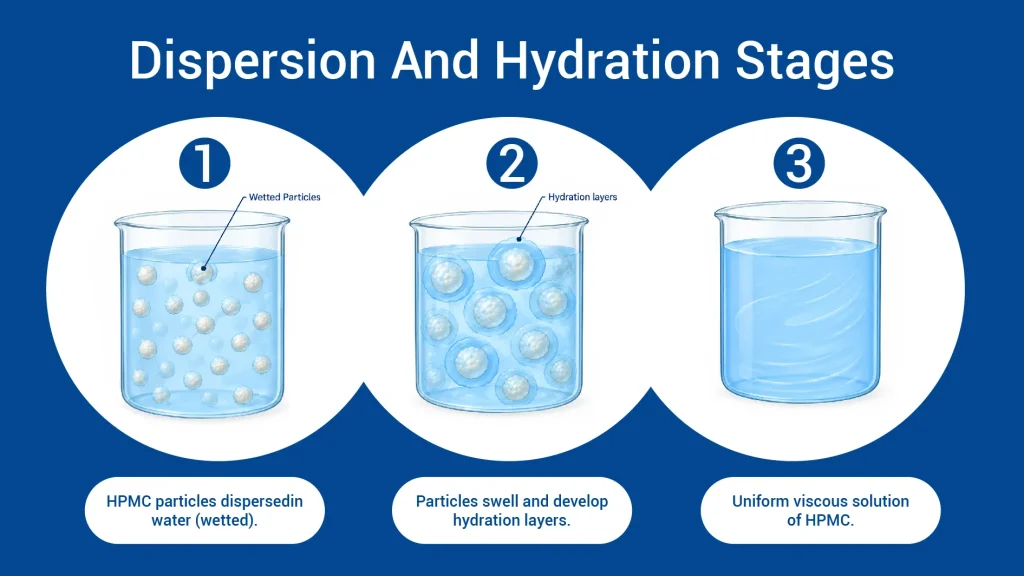
This delay gives particles time to separate before their surfaces become sticky. After dispersion, hydration proceeds and viscosity develops. A sample can therefore disperse quickly while remaining relatively thin for a short period.
Research on HPMC dispersibility has linked lump formation to rapid surface hydration and the formation of a coherent gel layer. Improving particle dispersion changes how water reaches the polymer and how the solution develops. Sharma, Modi, and Bansal, 2015.
Dispersion time and viscosity-development time should be recorded separately. The first describes powder handling. The second indicates when the solution becomes ready for the next manufacturing step.
A related study of surface-treated EM-HEC, another cellulose ether, tracked hydration through viscosity measurements and examined the effects of pH, temperature, salts, and surfactants. It supports this testing approach, although its numerical results cannot be transferred directly to HPMC. Premathasan and Taylor, 2018.
What Should An HPMC Quality-Control Program Include?
| Test | What It Evaluates | Conditions That Must Be Defined |
|---|---|---|
| Powder appearance | Color, visible contamination, and caking | Lighting, sampling, and reference sample |
| Dispersion and hydration | Wetting, lumps, and viscosity development | Concentration, water quality, pH, temperature, and mixing |
| Solution appearance | Haze, particles, sediment, and bubbles | Hydration time, concentration, and observation method |
| Viscosity | Thickening performance under the selected method | Instrument, spindle, speed, temperature, and preparation |
| Loss on drying or water content | Volatile loss or water specifically | Method, temperature, endpoint, and calculation basis |
| Methoxy and hydroxypropoxy content | Substitution chemistry | Validated assay and reporting basis |
| Ash or sulfated ash | Residue after the specified ignition procedure | Pretreatment, furnace conditions, and calculation basis |
| Application testing | Performance in the finished formula | Actual ingredients, dosage, process, and storage conditions |
These tests answer different questions. Low ash does not prove good dispersion, and high solution viscosity does not establish good mortar water retention or detergent stability.
Start With Representative Sampling And Appearance
Record the product name, batch number, packaging condition, and sampling date. Follow an agreed sampling plan across the batch. Keep a sealed retention sample for later comparison.
Spread a small amount of powder on a clean white surface under consistent lighting. Look for unusual discoloration, dark particles, foreign material, and hard moisture-related lumps. White to off-white material is normal, but whiteness alone cannot establish purity.
When particle size affects dosing or dispersion, use a specified sieve or particle-size method. Finger feel cannot replace a measurable particle-size result.
Prepare the solution consistently before comparing its appearance. HPMC can produce clear to slightly opalescent solutions, so mild haze does not automatically indicate failure. The FAO/JECFA specification recognizes this range of appearance. FAO/JECFA HPMC specification.
Persistent sediment, dark particles, or an unexpected odor deserves investigation. These observations help identify a problem but do not establish its cause without further testing.
How To Test Instant HPMC Dispersion And Hydration
Establish A Repeatable Screening Setup
A practical small-scale comparison can use 1.00 g of HPMC in 100 mL of purified water at 25 C, with a 250 mL beaker and controlled stirring at 300 rpm. This produces an approximately 1% mixture; it is not an exact 1.00% solution by mass.
Treat these conditions as a proposed internal screening method. Validate them against the intended grade and process before using the result to accept or reject deliveries.
Use the same stirrer, impeller dimensions, immersion depth, and beaker geometry for each sample. Rotational speed alone does not define mixing intensity. A larger impeller at 300 rpm can disperse powder differently from a small one.
Measure the initial water pH and record the temperature throughout the test. Add the powder steadily over a defined period, and record both the first contact with water and the completion of addition.
Observe The Full Sequence
Watch how the powder wets, separates, and thickens. Record when floating dry powder disappears, whether lumps develop, and when the solution begins to gain viscosity.
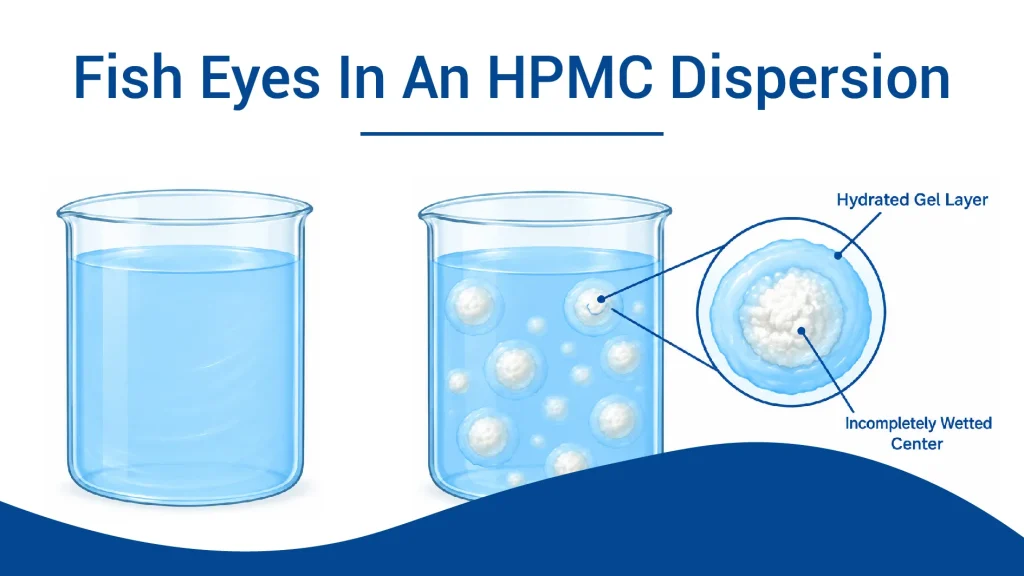
A “fish eye” is a lump with a hydrated outer layer surrounding incompletely wetted material. Its presence can reflect rapid powder addition, inadequate circulation, or a grade that does not suit the preparation method.
For surface-treated grades, pH can affect the delay before hydration. If the agreed procedure includes pH adjustment, record the initial pH, target pH, reagent, and timing. Keep this procedure consistent across samples.
Changing pH midway through only one sample creates an unfair comparison. Likewise, a plant-water trial should be identified separately from the purified-water reference test.
Define The Endpoint Before Testing
Targets such as dispersion within 30 seconds or viscosity development within two to five minutes are meaningful only when linked to a particular grade and method. They are not universal HPMC acceptance limits.
For routine quality control, combine the disappearance of visible lumps with a stable viscosity reading under fixed conditions. A viscosity plateau is a useful operational endpoint, but it does not by itself prove complete molecular dissolution.
A covered sample can also be checked after 24 hours for sediment, persistent gel particles, and further viscosity change. This observation is useful during method development; it does not establish long-term storage stability or make overnight conditioning compulsory for every viscosity test.
Measure Clarity Consistently
If clarity matters, compare samples at the same concentration, temperature, and hydration age after bubbles have been allowed to escape.
A UV-visible spectrophotometer can measure transmittance at a specified wavelength. The report should include wavelength, optical path length, blank, and sample preparation. Without these details, two transparency percentages may describe different tests.
Do not filter away undissolved material and then describe the resulting clear liquid as evidence of complete dissolution. Record any filtration and evaluate the retained material separately.
How To Measure HPMC Viscosity Correctly
Prepare The Specified Concentration
A 2% aqueous solution is common, but the concentration must match the selected test method.
For an as-received 2.00% solution by mass, 2.00 g of powder plus 98.00 g of water gives 100.00 g of solution. Adding 2.00 g to 100.00 g of water produces a lower concentration.
Some specifications require a dry-solids basis. In that case, correct the powder mass for its measured loss on drying and adjust the final solution mass accordingly. The report must identify which basis was used.
Follow the agreed preparation route, whether it uses direct cold-water dispersion or a hot-dispersion/cooling procedure. Prevent evaporation and allow sufficient hydration before measuring.
Match Temperature, Instrument, And Settings
An NDJ result and a Brookfield result should not be treated as interchangeable. Concentrated HPMC solutions can show shear-dependent behavior, so spindle geometry and rotational speed affect the reported apparent viscosity.
Select a spindle and speed suitable for the measurement range and valid instrument torque. Keep the container, immersion depth, reading time, and rest sequence consistent. A single spindle at 12 or 30 rpm cannot cover every grade.
Temperature needs equal attention. A specification measured at 20 C cannot be checked directly against a result obtained at 25 C. The published USP hypromellose method, for example, specifies 20 C and different procedures for different viscosity ranges. USP hypromellose harmonized text.
Compare Results With The Correct Specification
Use repeat readings to check measurement stability. During method validation or an investigation, independently prepared solutions also help reveal preparation errors. Three readings from one beaker assess something different from three separately prepared samples.
The approved specification should define the acceptance range. A blanket tolerance of plus or minus 10% does not apply to all HPMC grades.
Our Zhiwei HPMC 100K provides a practical example: its product page lists 90,000-120,000 mPa.s by NDJ at 2% and 20 C, alongside an RV 2% reference range of 45,000-55,000 mPa.s. These are separate method references, not a universal conversion factor between instruments.
Before reporting a viscosity failure, check concentration, hydration, temperature, air bubbles, and instrument settings against the agreed procedure.

How To Test HPMC Moisture And Loss On Drying
Moisture uptake can promote caking and reduce the amount of dry polymer delivered by a fixed powder weight. This makes moisture control relevant to storage, dosing, and solution preparation.
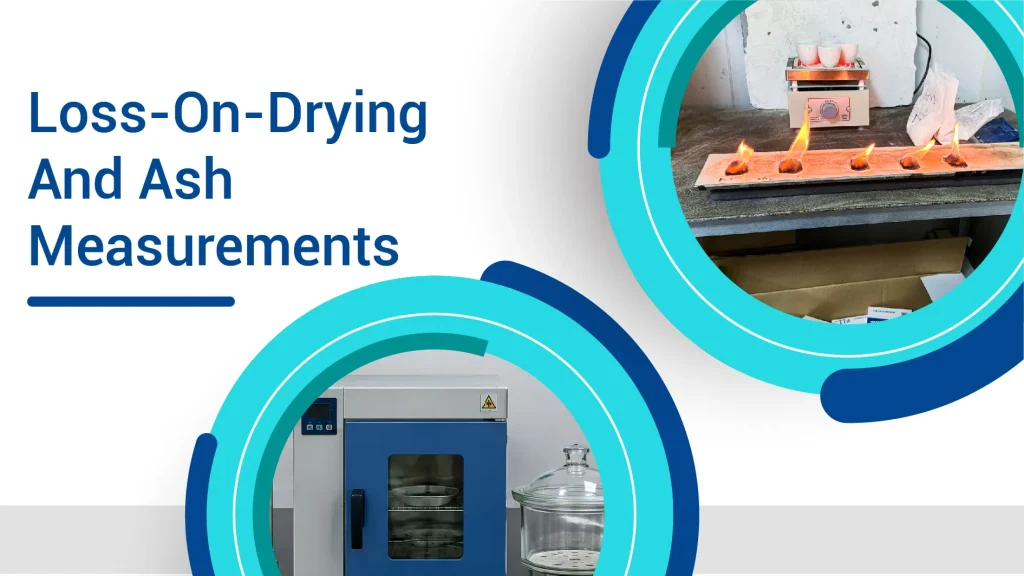
An oven test measures loss on drying. That loss can include water and other volatile material, so it is not always identical to a water-specific measurement.
For an internal oven method, about 2 g of sample at 105 C provides a possible starting setup. The adopted specification must define the drying duration or constant-mass endpoint. A fixed two-hour treatment should be validated rather than assumed sufficient.
Use unambiguous weighing symbols:
| Symbol | Meaning |
|---|---|
| W0 | Mass of the empty, conditioned weighing container |
| W1 | Mass of the container plus sample before drying |
| W2 | Mass of the container plus sample after drying and cooling |
Loss on drying (%) = [(W1 – W2) / (W1 – W0)] x 100
Cool the container in a desiccator and weigh it promptly. Otherwise, the dried powder can reabsorb moisture and distort the result.
Karl Fischer analysis can measure water more specifically, but the sample preparation, extraction, and possible chemical interferences still require validation. Select the method according to the purpose of the measurement and use the moisture limit agreed for that product.
How To Test Methoxy And Hydroxypropoxy Content
Methoxy and hydroxypropoxy groups influence HPMC solubility, thermal behavior, and formulation performance. Their contents help distinguish substitution types that may have similar viscosity labels.
Mass percentages of these groups are not the same quantities as degree of substitution or molar substitution. A test report should identify exactly what was measured and whether the result is calculated on a dried basis.
A validated chemical-cleavage and gas-chromatographic assay can quantify methoxy and hydroxypropoxy groups. The laboratory needs appropriate calibration, reference materials, and checks that the reaction and chromatographic separation perform correctly. Official technical evaluations identify gas chromatography for these determinations. EFSA technical evaluation.
Use the composition range for the declared substitution type. A methoxy range of 19-24% and hydroxypropoxy range of 4-12% describes certain products, including our HPMC 100K specification, but it does not define every HPMC grade.
FTIR can support identity checks, while size-exclusion chromatography can investigate molecular-size distribution. HPLC or colorimetric methods require a defined analyte and validated procedure. These techniques are selected to answer specific questions; none replaces the complete quality-control program.
How To Test HPMC Ash Content
Ash testing measures the residue remaining after a defined ignition procedure. It can help track inorganic residues from raw materials or processing.
Direct ash and sulfated ash require different procedures. Sulfated-ash testing includes chemical treatment that changes the form of the remaining inorganic material. Its result should be compared with a sulfated-ash specification.
A direct-ash screening procedure may use approximately 1 g of sample, controlled preliminary charring, and ignition around 600 C. The adopted method must specify temperature, duration, and the required endpoint. Cooling, weighing, and repeat ignition should follow that method.
Use the following definitions:
| Symbol | Meaning |
|---|---|
| A0 | Mass of the conditioned empty crucible |
| A1 | Mass of the crucible plus sample before ignition |
| A2 | Mass of the crucible plus residue after ignition |
Ash (%) = [(A2 – A0) / (A1 – A0)] x 100
State whether the result is reported on an as-received or dried basis. If the specification expresses residue as a particular salt equivalent, retain that reporting convention.
A 1.0% or 1.5% limit should not be presented as the universal boundary between good and poor HPMC. The FAO/JECFA document, for example, specifies sulfated ash for its defined food-additive scope. That requirement should not be transferred directly to an unrelated construction-grade direct-ash test. FAO/JECFA HPMC specification.
Low ash also does not establish total purity: organic impurities can burn away, and ash testing alone does not identify individual contaminants.
How To Investigate An Unexpected Result
| Observation | First Checks | Useful Follow-Up |
|---|---|---|
| Powder disperses but thickens slowly | Surface-treatment specification, pH, and temperature | Compare viscosity development with the reference batch |
| Fish eyes persist | Addition rate, circulation, and preparation route | Repeat with controlled addition and the approved method |
| Viscosity reads low | Concentration basis, hydration, temperature, and instrument settings | Prepare a fresh independent solution |
| Solution looks cloudy | Entrained bubbles, temperature, and hydration age | Compare transmittance and examine any persistent residue |
| Loss on drying is high | Sampling exposure, packaging, and drying endpoint | Retest a sealed retention sample |
| Ash is unexpectedly high | Crucible condition, complete ignition, method, and reporting basis | Repeat the test and investigate residue composition |
| Water tests pass but formulation fails | Ingredient compatibility and production mixing sequence | Run a controlled application trial |
An unexpected value is the start of an investigation. Comparing the sample and a known reference in the same test session helps distinguish material variation from changes in the method.
Connect Laboratory Results With Application Performance
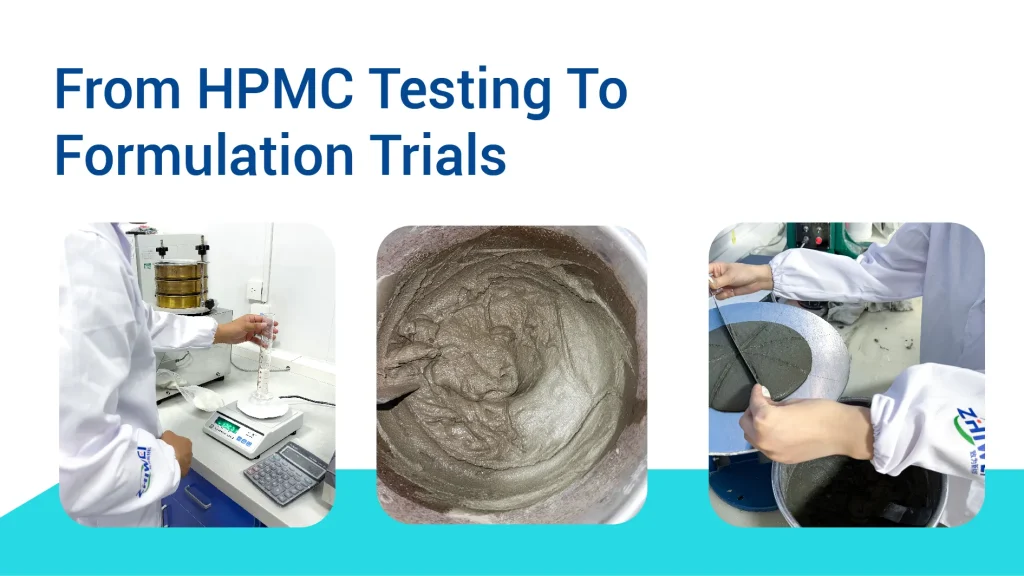
For liquid detergents and other water-based formulations, confirm powder addition, hydration time, final viscosity, clarity, and storage behavior in the complete ingredient system. Purified-water performance cannot predict every interaction with surfactants, salts, fragrances, or preservatives.
For tile adhesive, putty, and mortar, evaluate water retention, workability, open time, air content, and the relevant hardened properties. Dry blending with mineral ingredients changes how the powder meets water.
For cement-based dry-mix applications in China, JC/T 2190-2024 covers cellulose ether classification, requirements, testing, and inspection. Food and pharmaceutical applications require their own applicable specifications and grade documentation.
At Zhiwei, we would screen HPMC 100K where a construction formula needs substantial body, water retention, and vertical stability. Direct addition to a liquid requires separate confirmation of the selected grade’s dispersion treatment and hydration conditions. The viscosity label alone cannot establish those properties.
What Should Buyers Request With An HPMC Sample?
Request a technical data sheet, batch certificate of analysis, and the methods used to generate the reported values. Record the concentration basis, viscosity instrument, temperature, spindle, speed, hydration procedure, moisture method, and ash method.
The dispersion specification should also define the water conditions and timed endpoints. This gives both laboratories a common basis for comparison.
Keep raw measurements and individual repeat results alongside the averages. A consistent record makes a later batch investigation much easier.
Conclusion
Instant HPMC quality becomes easier to judge when the tests follow the material from powder addition through hydration and into the final formula. Dispersion behavior, stable viscosity, loss on drying, substitution chemistry, and ash each provide part of the picture.
At Zhiwei, we recommend agreeing on the test method before comparing samples or setting acceptance limits. Share your formulation type, mixing conditions, and target viscosity with us so we can identify suitable samples and define a practical evaluation plan.