
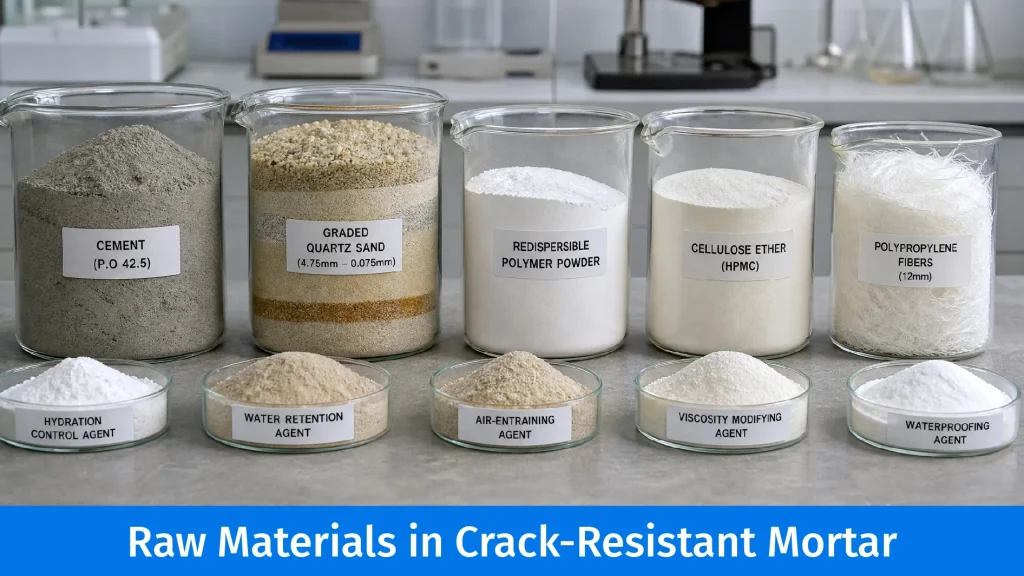
A practical crack-resistant mortar formula combines a controlled cement content, well-graded sand, redispersible polymer powder, cellulose ether, fibers, and carefully selected rheology modifiers.
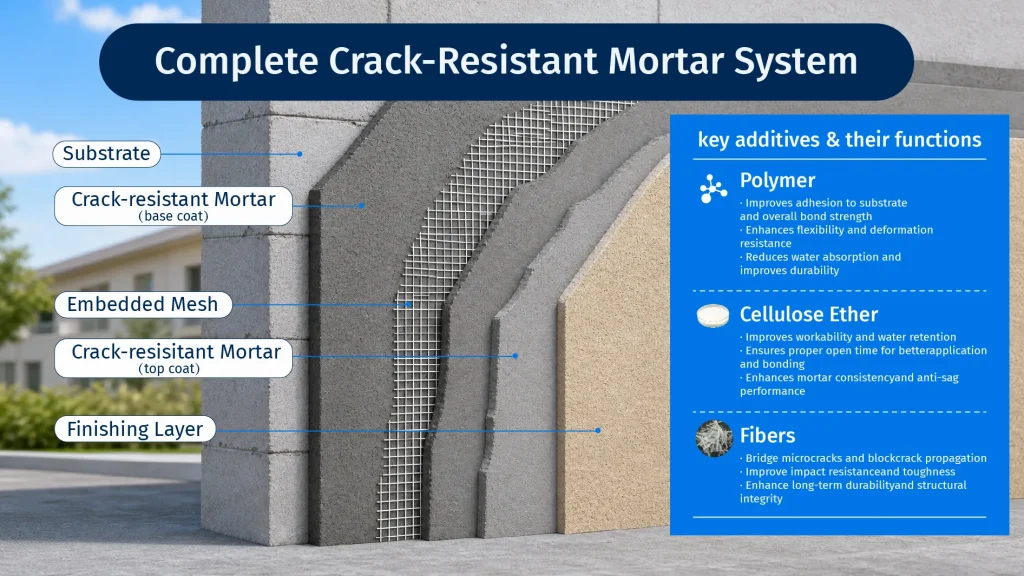
No single additive can make mortar permanently crack-proof. Polymer improves flexibility and adhesion. Fibers help distribute early tensile stress. HPMC or HEMC retains water and stabilizes application properties. Aggregate grading reduces paste demand and shrinkage. Correct substrate preparation and curing complete the system.
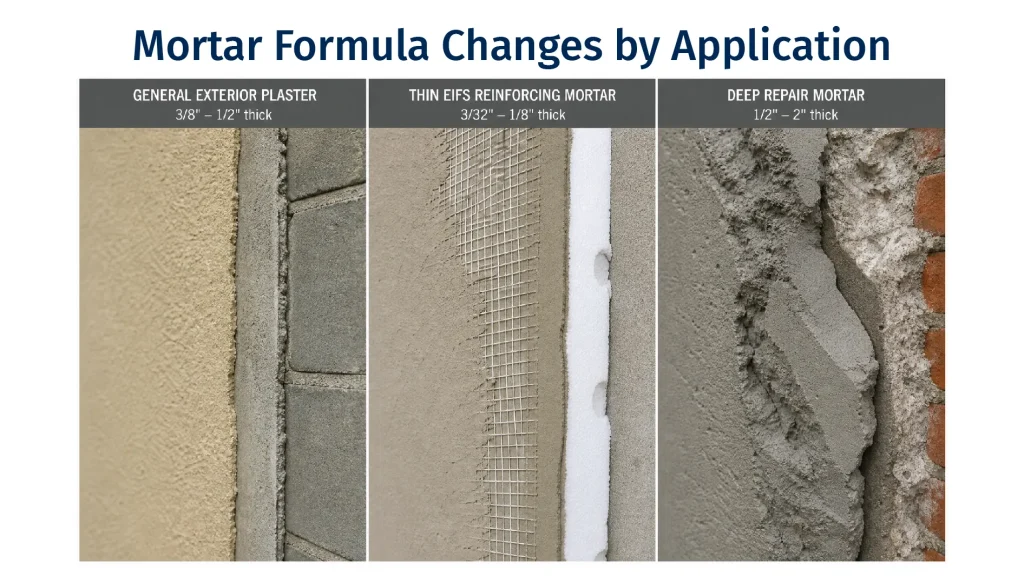
The formulation must also match the intended use. A thin EIFS reinforcing coat, a general exterior plaster, and a 20 mm repair layer should not use the same binder content, aggregate grading, polymer dosage, or cellulose ether grade.
Why Does Mortar Crack?
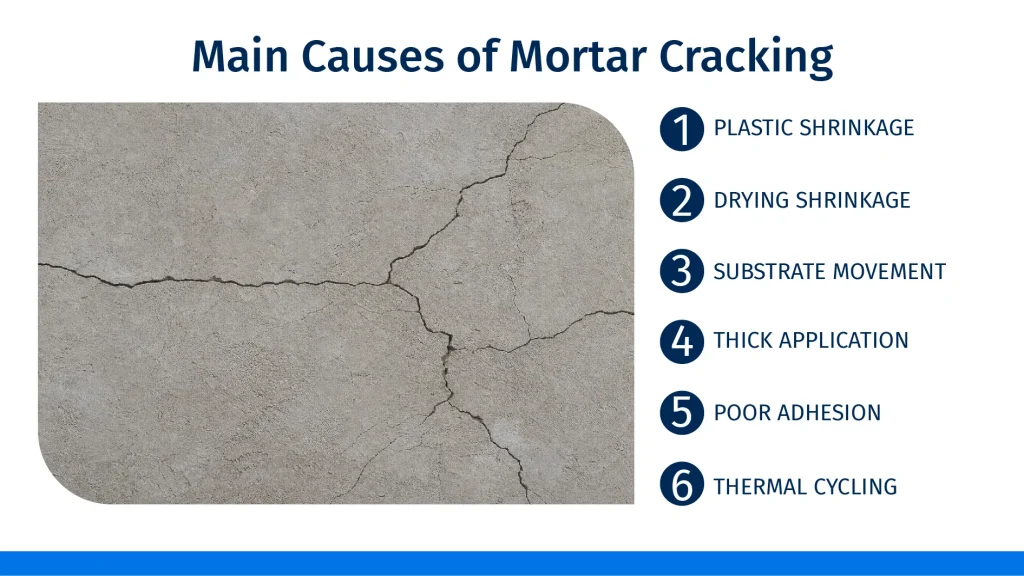
Mortar cracks when tensile stress develops faster than the material can accommodate it. This can happen before setting, during drying, or after the wall enters service.
| Crack Source | What Happens | Formulation Response | Construction Response |
|---|---|---|---|
| Rapid surface drying | Water leaves the surface before the mortar develops enough strength | Improve water retention and cohesion | Protect the wall from wind, sun, and low humidity |
| High water content | Evaporation produces greater volume change and porosity | Reduce water demand through grading and suitable admixtures | Measure water instead of adjusting by feel |
| Poor sand grading | The mix needs more paste and water to fill aggregate voids | Combine compatible coarse and fine fractions | Control sand moisture and batch consistency |
| Weak adhesion | Mortar separates from the substrate and cracks around hollow areas | Use suitable polymer and water retention | Remove dust, oil, paint, and weak material |
| Thick application | Internal drying and temperature differences increase stress | Use a high-build formulation or layered system | Respect the approved thickness per coat |
| Substrate movement | Joints, dissimilar materials, and openings concentrate stress | Improve mortar flexibility | Install mesh, reinforcement, or movement joints |
| Poor curing | Hydration and strength development become uneven | Retain sufficient internal water | Protect and cure according to the system |
| Thermal cycling | Repeated expansion and contraction fatigue the mortar | Balance strength with flexibility | Use the correct wall-system design |
Polypropylene fibers can reduce plastic-shrinkage cracking, but their effectiveness depends on fiber geometry, dosage, dispersion, and the surrounding mortar composition. Research has shown that fibers generally reduce early cracking rather than eliminate the underlying shrinkage mechanism (Composites Science and Technology, Frontiers in Materials).
A crack-resistant mortar formula should therefore address several causes simultaneously.
Reference Crack-Resistant Mortar Formula
The following formulation window can be used as a starting point for a general cement-based exterior-wall mortar.
Reference Formula per 1,000 kg of Dry Mix
| Material | Suggested Starting Range | Main Function |
|---|---|---|
| Portland cement | 350-400 kg | Strength, adhesion, and hydraulic binding |
| Washed and dried quartz sand | 550-600 kg | Skeleton, dimensional stability, and application body |
| VAE redispersible polymer powder | 8-12 kg | Adhesion, flexibility, and water resistance |
| HPMC or HEMC | 2-3 kg | Water retention, consistency, and workability |
| Polypropylene fiber | 1-2 kg | Early crack control and stress distribution |
| Powder polycarboxylate water reducer | 0.1-0.3 kg | Water reduction and density improvement |
| Starch ether | 0.5-0.8 kg | Anti-sag control and trowel feel |
| Compatible filler or adjusted sand | Balance to 1,000 kg | Packing and cost-performance adjustment |
This is an ingredient window, not a universal production recipe. The upper value of every ingredient should not be combined automatically. Sand and filler must be adjusted so that the complete batch totals 1,000 kg.
Cement type, sand shape, sand absorption, polymer chemistry, cellulose ether viscosity, air content, and local test methods can all change the result. A laboratory trial should confirm the final water demand and performance.
How Each Ingredient Controls Cracking
Cement and mineral binder
Cement develops strength and adhesion, but increasing cement content is not always the best way to improve mortar.
A high paste volume can increase heat generation, water demand, and drying shrinkage. If the mortar becomes too rigid, it may also transfer movement into visible cracks instead of accommodating small deformations.
The binder content should be sufficient for strength and adhesion while leaving room for a stable aggregate skeleton. Supplementary mineral materials can sometimes improve particle packing or durability, but their effect on water demand and early strength must be verified.
Graded quartz sand
Aggregate grading is one of the most economical ways to improve dimensional stability.
A single very fine sand fraction creates a large surface area. More cement paste and water are then required to coat the particles. Introducing a compatible coarser fraction can reduce voids, improve body, and lower the paste demand.
A useful general screening direction is to combine a smaller proportion of medium sand with a larger proportion of fine sand. The exact ratio depends on the application thickness and the largest particle size the coating can accept.
Thin EIFS base coats need a finer aggregate system than deep repair mortar. Coarse particles that work well in a 20 mm repair layer may drag, tear, or remain exposed in a 3 mm reinforcing coat.
Redispersible polymer powder
Redispersible polymer powder modifies the brittle cement matrix. After water addition, the powder redisperses, and the polymer can form films or networks within the hardened mortar.
A suitable polymer can improve:
- Tensile bond strength
- Flexibility
- Transverse deformation
- Flexural performance
- Resistance to water penetration
- Adhesion after environmental exposure
Research on VA/VeoVa-modified cement mortar found that increasing the polymer-to-cement ratio improved transverse deformation and fracture energy, although the effect on compressive and flexural properties varied with dosage (Construction and Building Materials).
This is why more polymer is not automatically better. The selected dosage must balance flexibility, strength, air content, setting, water resistance, and cost.
The current Chinese standard JC/T 2189-2024 covers redispersible polymer powder for cement-based dry-mix mortar. Formulators should still evaluate the powder in the complete mortar because two compliant products can produce different application results.
HPMC and HEMC
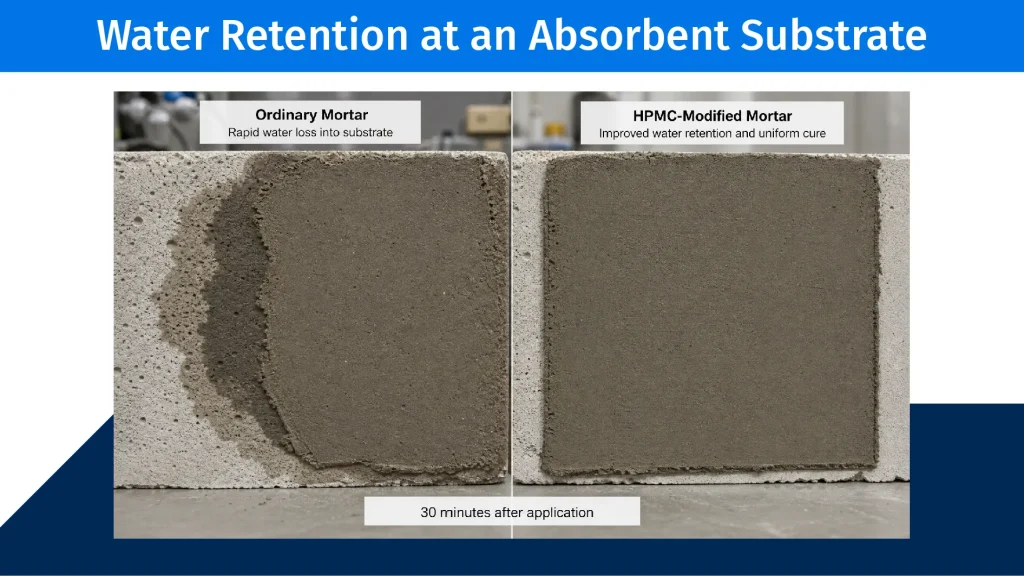
HPMC and HEMC help mortar retain water when it is exposed to an absorbent substrate, wind, warm weather, or a thin application layer.
Water retention supports more consistent cement hydration and reduces the rapid moisture loss that can weaken the interface. Cellulose ether also modifies mortar consistency, improves spreading, and helps the wet material remain stable on a vertical wall.
Academic research confirms that cellulose ether chemistry and molecular parameters affect both water retention and rheological behavior. The results cannot be predicted from a viscosity number alone (Cement and Concrete Research).
An excessive dosage can create another set of problems:
- Heavy or sticky troweling
- Too much anti-sag resistance
- Increased air entrainment
- Longer setting time
- Reduced early strength
- Poor wetting of the substrate
- Difficulty embedding reinforcing mesh
Cellulose ethers can delay Portland cement hydration, and the magnitude of the delay depends on their molecular structure and the cement system (Construction and Building Materials).
The formulation target is therefore controlled water retention and workable body, not the highest possible viscosity.
The current JC/T 2190-2024 standard covers cellulose ether for cement-based dry-mix mortar. Our manufacturing company, Zhejiang Zhiwei New Materials Co., Ltd., is listed among the organizations involved in drafting this standard.
Polypropylene fiber
Short polypropylene fibers form a distributed network throughout the mortar. During the early stage, this network helps resist localized separation and limits the growth of plastic-shrinkage cracks.
Fiber performance depends on:
- Length
- Diameter
- Surface condition
- Dosage
- Dispersion
- Mortar consistency
- Layer thickness
Longer or finer fibers are not automatically suitable for every dry mix. A fiber that cannot disperse during production may form balls, leave surface marks, or create weak areas.
Fibers should be dry-blended until they are distributed uniformly. Mixing performance must be checked at production scale because a laboratory mixer and an industrial mixer do not always produce the same dispersion.
Polycarboxylate water reducer
A compatible powder polycarboxylate water reducer can lower water demand while maintaining workable consistency. Reducing unnecessary water can improve density and limit drying-related volume change.
However, a low dosage does not mean the ingredient can be selected casually. Different products have different active contents and compatibility with cement, polymer powder, cellulose ether, defoamer, and set-control additives.
An excessive or incompatible dosage may produce bleeding, delayed setting, excessive air, or unstable consistency.
Starch ether
Starch ether can improve anti-sag performance and trowel feel. It is particularly useful when a wall mortar slides, feels too loose, or does not hold a textured profile.
Its effect overlaps with cellulose ether. Increasing both additives without a structured trial can make the mortar rubbery or difficult to spread.
A practical test compares starch ether levels while keeping the water content and cellulose ether dosage constant. Anti-sag improvement should be evaluated together with adhesion, wetting, and worker feedback.
How to Adjust the Formula for Different Applications
General exterior-wall plaster
A general exterior plaster needs balanced strength, bond, workability, and resistance to environmental drying.
The reference formulation is a reasonable starting framework. A blend of medium and fine sand can improve packing while retaining a smooth finish. Polymer powder and cellulose ether should support adhesion and moisture control without making the mortar excessively flexible or sticky.
The following tests are particularly useful:
- Water retention
- Wet density and air content
- Fresh consistency
- Tensile bond strength
- Water-immersed bond strength
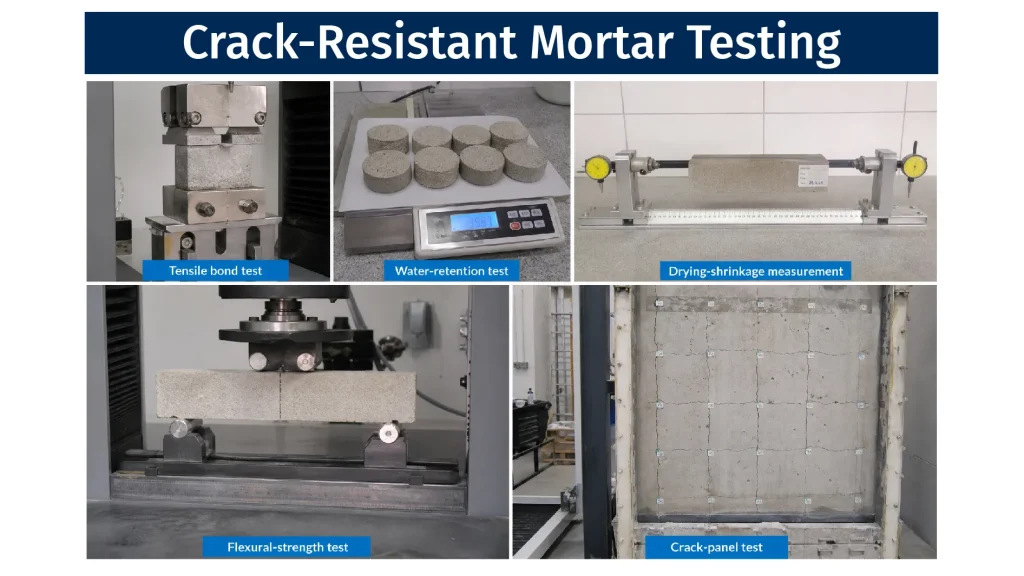
- Drying shrinkage
- Compressive and flexural strength
- Water absorption
- Visible cracking on representative panels
A thin laboratory specimen cannot reveal every field problem. Full-size panels should be applied to the intended substrate and exposed to realistic drying conditions.
EIFS or ETICS reinforcing base coat
An EIFS reinforcing coat must bond to the insulation board, embed alkali-resistant glass-fiber mesh, resist impact, and remain stable through thermal cycling.
Compared with a basic plaster, this system generally requires stronger polymer modification and carefully controlled water retention. The aggregate must be fine enough for a thin, uniform layer.
Silica fume or another fine mineral component may be screened to improve packing, but it can also raise water demand. A compatible hydrophobic additive can support water resistance, although excessive hydrophobicity may affect wetting and adhesion.
The reinforcing mesh is a structural part of the base-coat system. Fibers dispersed in the mortar do not replace it. Around openings, corners, and other stress concentrations, the mesh arrangement and overlap must follow the approved system design.
For expanded-polystyrene thin-render systems in China, GB/T 29906-2013 remains current following its latest review. Compliance must be assessed at the system level rather than inferred from a single mortar value.
Deep repair and high-build mortar
A deep repair mortar needs a stronger aggregate skeleton and better resistance to sagging than a thin exterior skim coat.
The design direction normally includes:
- Broader aggregate grading
- Controlled cement content
- A high-build cellulose ether grade
- Suitable polymer modification
- Shrinkage compensation when required
- Longer workable time for placement and shaping
- Layer thickness confirmed through trials
Expanded perlite or another lightweight aggregate can reduce density, but it also changes water demand, strength, mixing behavior, and finishing quality. It should not be added only because a lower-density formula appears attractive.
Expansion agents require similar caution. Uncontrolled expansion is not a substitute for low shrinkage. The complete formulation should be tested for restrained and unrestrained dimensional change.
Laboratory or certification formula
A formula prepared for third-party testing should represent the product that will be manufactured and sold.
Higher polymer content may improve bond results, but it also changes cost, water demand, setting, and field handling. Pure quartz sand and controlled water improve laboratory repeatability, yet production raw materials must eventually be tested under the same performance requirements.
Important evaluation items can include:
- Original tensile bond strength
- Bond strength after water exposure
- Bond strength after freeze-thaw conditioning
- Workable time
- Water retention
- Compressive-to-flexural strength ratio
- Drying shrinkage
- Crack resistance
- Water absorption
China’s GB/T 29417-2012 provides a test method for drying-shrinkage stress and cracking potential in cement mortar and concrete. Water-retention measurements can also be aligned with the applicable product standard or GB/T 45002-2024.
Zhiwei Product Selection for Crack-Resistant Mortar
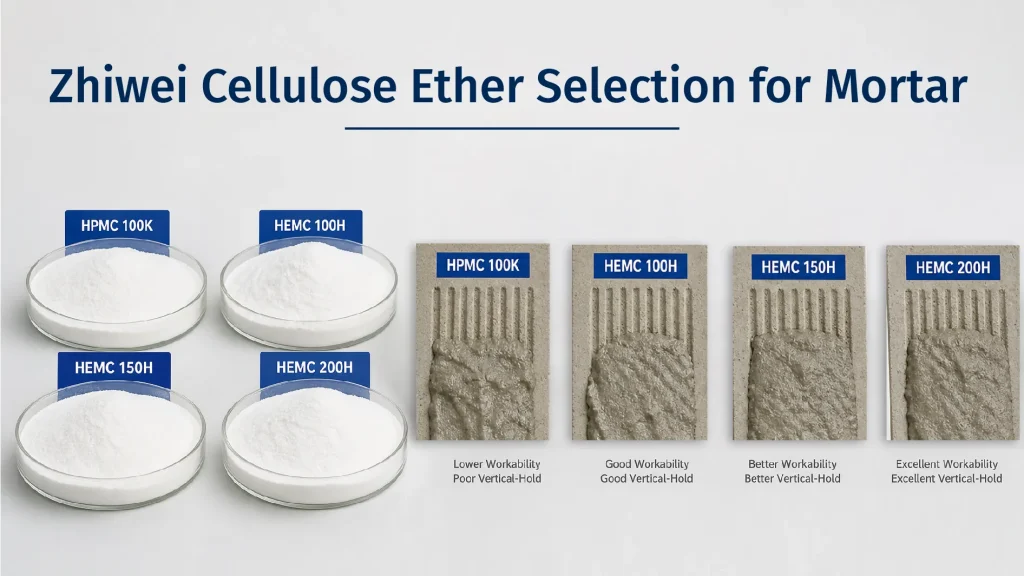
At Zhiwei, we select cellulose ether by application behavior rather than relying only on nominal viscosity.
| Application | Zhiwei Grade Direction | Main Screening Target |
|---|---|---|
| General exterior plaster | HPMC 100K or HEMC 100H | Balanced water retention, spreading, and vertical stability |
| EIFS reinforcing base coat | HEMC 100H or HEMC 150H | Open time, mesh embedding, adhesion support, and warm-weather handling |
| Repair mortar | HPMC 100K or HEMC 150H | Water retention, workable body, and edge stability |
| High-build vertical repair | HEMC 150H or HEMC 200H | Stronger body and sag resistance |
| Hot or dry application conditions | Compare HEMC 100H and HEMC 150H | Water retention and consistency retention |
| Lower-body plaster | Screen a lower-viscosity HEMC grade | Smoother spreading with less drag |
The model name is only the beginning of selection. Viscosity values measured with different instruments, solution concentrations, temperatures, or spindle conditions should not be compared directly.
We recommend testing the chosen grade with the actual cement, sand, polymer powder, fiber, water reducer, starch ether, and water dosage intended for production.
Changing the cellulose ether may alter air content, water demand, resting consistency, setting, adhesion, and strength. For that reason, substitution should be evaluated as a formulation change rather than a direct kilogram-for-kilogram replacement.
A Practical Laboratory Development Process
Step 1: Define the application
Set the intended substrate, application thickness, climate, mixing method, and required working time before selecting additives.
A formula cannot be optimized when “crack resistance” is the only target.
Step 2: Establish the aggregate skeleton
Test at least two or three sand gradings. Compare consistency at equal water content, surface finish, segregation, and hardened shrinkage.
A better grading may reduce both water demand and additive dependence.
Step 3: Set the polymer level
Start with the required bond and flexibility targets. Compare several polymer dosages rather than assuming the most expensive formula will perform best.
Test dry, water-immersed, and conditioned adhesion where relevant.
Step 4: Select HPMC or HEMC
Hold the polymer and aggregate system constant while comparing cellulose ether grades. Observe mixing response, water demand, trowel drag, anti-sag behavior, open time, and air content.
After selecting the grade, optimize its dosage in smaller increments.
Step 5: Add fibers
Fibers should be assessed for both crack control and processability. Inspect the dry mix, wet mortar, applied surface, and hardened cross-section for bundles.
Step 6: Balance secondary additives
Only after the main system is stable should the formulator optimize starch ether, water reducer, defoamer, hydrophobic additive, accelerator, retarder, or expansion component.
Changing several secondary additives at once makes it difficult to identify the cause of an improvement or failure.
Step 7: Test under realistic conditions
Laboratory testing should include hot, dry, cool, or absorbent-substrate conditions when these situations are relevant to the target market.
Pilot production is also necessary. Industrial dry blending can change fiber dispersion and the distribution of low-dosage additives.
Construction Controls That Affect Crack Resistance
A well-designed formula can still crack when site conditions are not controlled.
The substrate must be stable, clean, and free from dust, oil, loose particles, and weak coatings. Highly absorbent surfaces may require controlled preconditioning or a compatible primer. Standing water should not remain beneath cementitious mortar unless the approved system specifically requires it.
Mixing water must be measured. Adding water later to restore workability changes the formula and increases the risk of segregation, shrinkage, and low strength.
During application, the layer thickness should remain within the range verified for the product. Thick repairs may require multiple layers, reinforcement, or a specialized high-build formulation.
Fresh mortar should be protected from direct sun, strong wind, rain, freezing, and rapid moisture loss. The curing method and duration depend on the binder, thickness, weather, and product specification. A fixed curing period should not be applied to every mortar without verification.
Common Problems and Corrective Actions
| Problem | Likely Cause | Corrective Direction |
|---|---|---|
| Fibers form bundles | Insufficient dry mixing, unsuitable fiber, or excessive dosage | Improve dry-blending sequence and verify dispersion |
| Mortar feels sticky | Excessive cellulose ether or starch ether | Reduce rheology modifier and recheck water demand |
| Mortar slides on the wall | Insufficient yield stress or excessive water | Adjust cellulose ether or starch ether and control water |
| Surface dries too quickly | Low water retention, absorbent substrate, wind, or heat | Screen HPMC or HEMC and improve site protection |
| Hollow areas appear | Dust, weak substrate, trapped air, or inadequate compaction | Prepare the substrate and press mortar firmly into contact |
| Early cracks appear | Rapid drying, high water content, poor curing, or insufficient fiber dispersion | Reduce water demand and improve curing and fiber distribution |
| Bond strength is low | Incompatible polymer, dry interface, excess air, or poor wetting | Optimize polymer and cellulose ether together |
| Strength develops slowly | Excessive cellulose ether, retarder, polymer, or low temperature | Review dosage, cement compatibility, and curing temperature |
| Cracks follow door or window corners | Stress concentration or missing reinforcement | Add the specified diagonal or overlapping mesh reinforcement |
| Repair edges crack | Abrupt geometry, weak feather edge, or poor substrate preparation | Recut the repair boundary and use an approved edge detail |
Can a Low-Cost Formula Still Resist Cracking?
Yes, but cost reduction should come from formulation efficiency rather than indiscriminate additive removal.
Better aggregate grading can reduce paste demand. A more efficient polymer may achieve the required bond at a lower dosage. Optimizing cellulose ether can reduce unnecessary water without making the mortar difficult to apply.
Replacing pure redispersible polymer powder with an unidentified compound powder may reduce purchase cost while weakening wet adhesion or flexibility. Removing starch ether may be reasonable when the cellulose ether already provides adequate anti-sag performance, but the decision should come from testing.
The lowest raw-material cost per ton is not always the lowest applied cost. Poor coverage, high water demand, slow application, rework, hollow areas, and field cracking can eliminate the apparent saving.
A cost-optimized formula must pass the same performance requirements as the original product.
Frequently Asked Questions
What is the best crack-resistant mortar formula?
There is no single best formula. A general exterior plaster can begin with 350-400 kg of cement, graded sand, 8-12 kg of redispersible polymer powder, 2-3 kg of HPMC or HEMC, and a controlled amount of fiber per ton.
The final composition must be adjusted for the substrate, thickness, climate, and required standard.
Does adding more HPMC prevent cracking?
Not necessarily. HPMC can retain water and improve mortar stability, but excessive dosage may increase air, retard hydration, reduce early strength, and make the mortar too sticky.
Crack resistance depends on the complete formulation and construction system.
Is HPMC or HEMC better for exterior mortar?
Both can be used. HPMC 100K is a practical starting grade for many general plaster and repair formulations. HEMC is often screened for exterior work where warm-temperature consistency and open time are important.
At Zhiwei, we recommend comparing HPMC 100K with HEMC 100H or HEMC 150H in the customer’s complete formulation.
Can polypropylene fiber replace mesh?
No. Dispersed fibers help control microcracking and early shrinkage. Reinforcing mesh manages stresses across a larger area and around openings, corners, joints, and insulation-board interfaces.
EIFS and ETICS base coats should use the mesh specified by the system design.
Why does crack-resistant mortar still crack after application?
Possible causes include excess water, rapid drying, poor curing, substrate movement, excessive thickness, weak adhesion, missing mesh, or incorrect joint treatment.
The crack pattern should be examined before changing the formula. A crack following a structural joint requires a different response from random surface shrinkage cracks.
How should the formula be adjusted for hot weather?
Hot-weather development should focus on water retention, workable-time retention, controlled set, cool raw materials, shading, and wind protection.
A universal retarder dosage should not be used because cement chemistry and temperature can change the response significantly. HEMC 100H or HEMC 150H can be screened when stronger warm-weather consistency retention is required.
Conclusion
A crack-resistant mortar formula is a balanced system rather than a mixture with one “anti-crack” additive.
Cement provides strength. Graded sand controls paste demand and dimensional stability. Redispersible polymer powder improves adhesion and flexibility. Fibers distribute early tensile stress. HPMC or HEMC manages water retention, consistency, and application behavior. Construction controls protect the mortar while its structure develops.
The formula must then be adapted to the actual application. General exterior plaster needs balanced performance. EIFS base coat requires strong polymer modification and mesh compatibility. Deep repair mortar needs a stable aggregate skeleton and high-build behavior. Products prepared for certification must remain representative of commercial production.
At Zhiwei, HPMC 100K, HEMC 100H, HEMC 150H, and HEMC 200H provide practical screening directions for different crack-resistant plaster and repair systems. We recommend confirming every selection through controlled formulation trials, representative application panels, and the required performance tests.