
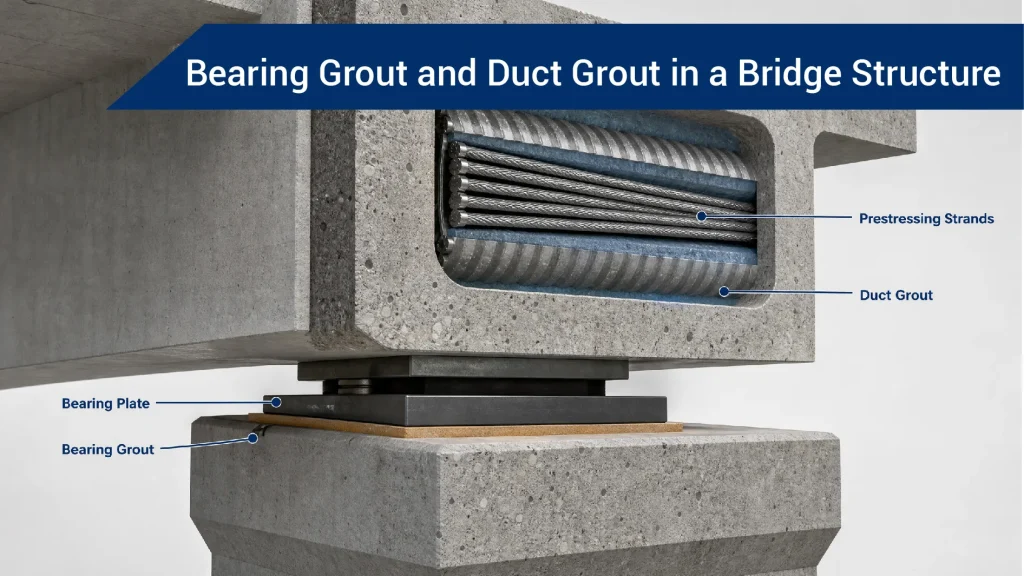
Bearing grouting material forms a load-transfer layer beneath a bridge bearing or bearing base plate. Duct grouting material is pumped through prestressing ducts to fill the spaces around steel strands.
That difference in location determines nearly every other requirement.
Bearing grout must support concentrated structural loads, fill the space beneath the bearing plate, develop the required strength, and remain dimensionally stable. Duct grout must travel through long and confined passages, surround prestressing strands, resist bleeding and segregation, fill high points, and help protect the steel from corrosion.
Although both products may be cement-based, they are not interchangeable. Similar compressive strength values do not mean that two grouts have the same rheology, filling ability, volume stability, or suitability for a particular bridge component.
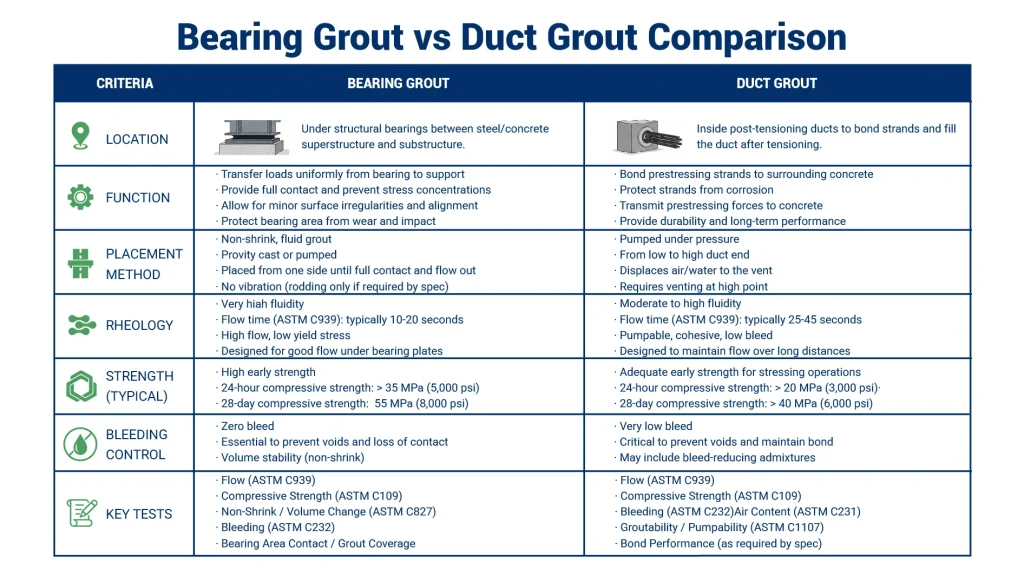
Bearing Grout vs Duct Grout: A Quick Comparison
| Comparison Item | Bearing Grouting Material | Duct Grouting Material |
|---|---|---|
| Primary location | Beneath bridge bearings and base plates | Inside prestressing or post-tensioning ducts |
| Main purpose | Create a dense load-transfer layer | Fill the duct and surround prestressing steel |
| Structural role | Transfer concentrated bearing loads to the supporting concrete | Provide filling, bond, and an alkaline environment around tendons |
| Typical geometry | Short, relatively open gap beneath a plate | Long, narrow, curved, and strand-filled passage |
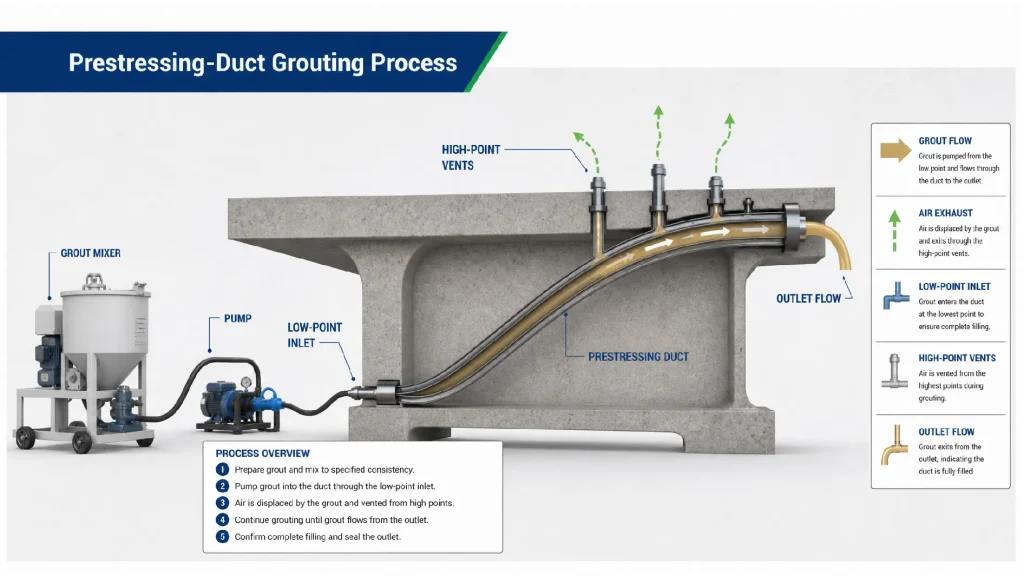
| Placement method | Continuous pouring or pressure placement beneath the bearing | Pumping from an inlet through the duct and out through vents |
| Main rheological demand | High flow with enough cohesion to fill the bearing area | Pumpability, flow retention, low pressure bleed, and complete filling |
| Early strength | Often a major construction-control requirement | Important, but cannot replace filling and bleeding requirements |
| Bleeding control | Needed to prevent settlement and incomplete contact | Critical because bleed water can collect at high points and leave voids |
| Volume stability | Controls settlement, shrinkage, and bearing contact | Controls void formation and separation from strands or duct walls |
| Aggregate system | May contain carefully graded fine aggregate | Normally formulated without coarse aggregate |
| Corrosion-related role | Not its primary function | One of its central durability functions |
| Important tests | Flow, bleeding, expansion, strength, elastic modulus, and effective bearing area | Flow, pressure bleed, strand bleed, filling, air content, strength, and corrosion effects |
| Main Chinese product standard | JT/T 1130-2017 | JT/T 946-2022 |
| Can it replace the other product? | No | No |
What Is Bearing Grouting Material?
Bearing grouting material, also called bridge bearing grout, fills the gap between a bridge bearing base plate and the concrete support beneath it.
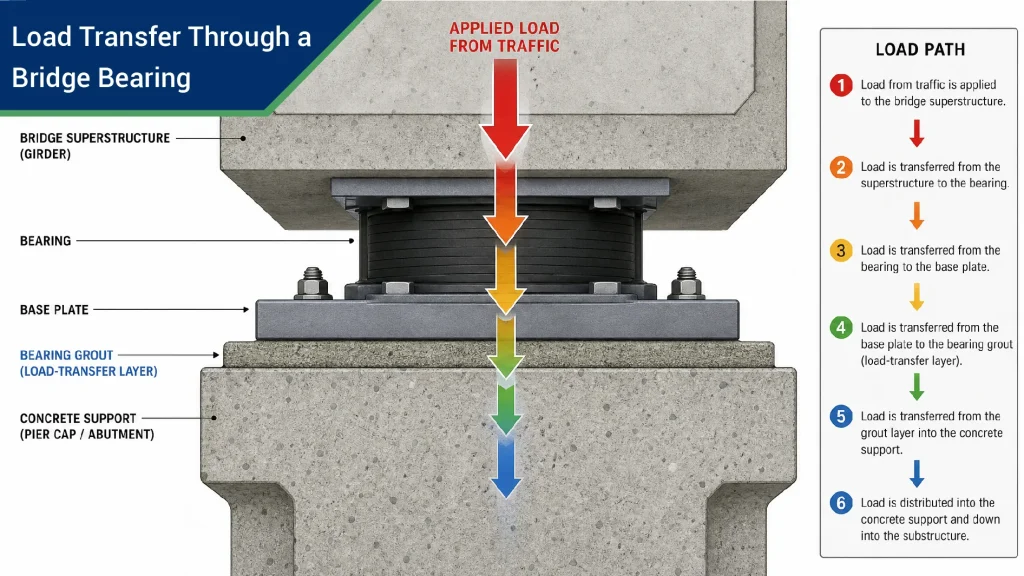
The hardened grout becomes part of the load-transfer path. Loads from the bridge superstructure pass through the bearing, bearing plate, grout layer, and supporting concrete. An incomplete grout layer can create local stress concentrations instead of distributing the load across the intended bearing area.
For this reason, bearing grout must do more than reach a specified compressive strength. It also needs to flow beneath the plate, release trapped air, maintain cohesion, control dimensional change, and harden into a dense and uniform support layer.
China’s JT/T 1130-2017 Bridge Bearing Grouting Materials covers grouting materials used to secure bridge bearing base plates. The standard distinguishes cement-based bearing grouts with different strength-development characteristics and also includes epoxy-resin bearing grouts.
The most important properties of bearing grout
A suitable bearing grout should provide a balanced combination of:
- Sufficient initial flow to reach the entire area beneath the plate
- Flow retention during mixing and placement
- Low bleeding and segregation
- Controlled vertical expansion or shrinkage
- Required early and later-age strength
- Suitable elastic properties
- Dense contact with the bearing plate and supporting concrete
- Reliable performance under the expected installation temperature
Early strength can be especially important when the construction schedule requires rapid bearing installation or early loading. However, accelerating strength at the expense of flow or working time can prevent the grout from filling the complete bearing area.
The correct balance depends on the bearing geometry, grout thickness, ambient temperature, installation procedure, and project specification.
Why effective bearing area matters
A bearing plate may appear fully grouted from the outside even when air pockets remain beneath it. These unfilled zones reduce the effective contact area and can concentrate stresses in isolated sections of the grout.
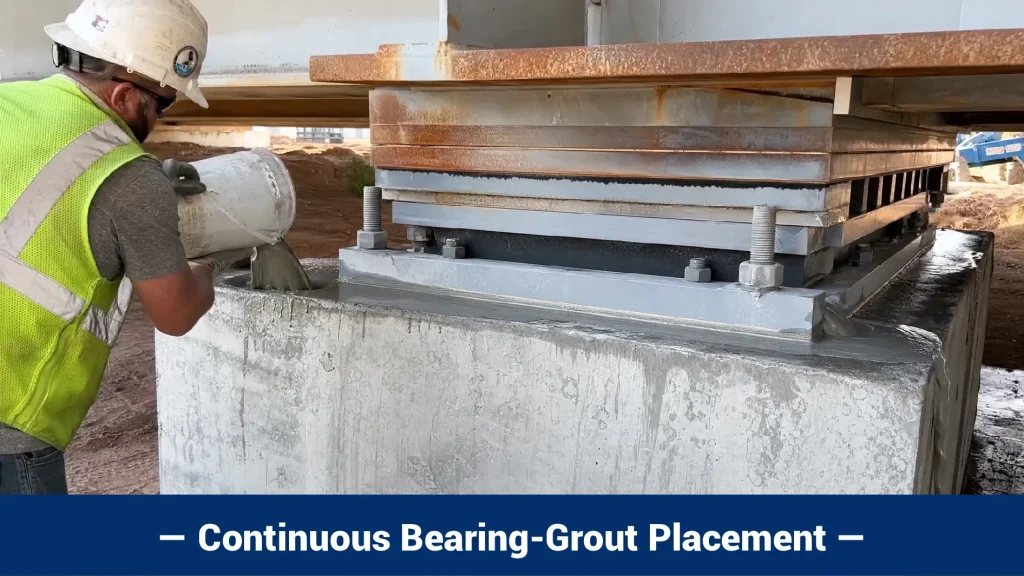
Good placement practice therefore focuses on continuous filling. For many cementitious bearing-grout applications, the material is introduced steadily from one side so that it advances beneath the plate and pushes air toward the opposite side. Pouring separately from several directions can trap air where the grout fronts meet.
The formwork must also be sealed. Water or grout leakage changes the local water-to-binder ratio and can leave weak or incompletely filled areas.
What Is Duct Grouting Material?
Duct grouting material, also known as prestressing duct grout or post-tensioning grout, is pumped into the ducts surrounding prestressing strands after tensioning.
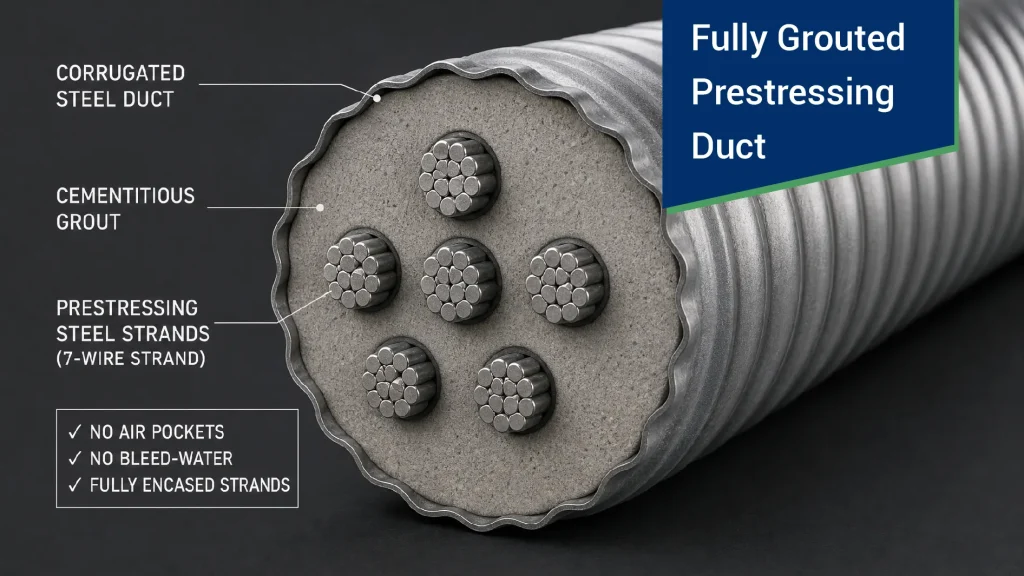
Its first task is complete filling. The grout must pass between strands, along corrugated duct walls, around curves, through changes in elevation, and toward outlet vents without excessive pressure or loss of stability.
Once hardened, it provides an alkaline environment around the steel, limits the movement of water and aggressive substances, and contributes to the bond between the tendon and the surrounding structure in bonded post-tensioning systems.
Research into post-tensioning systems has shown that air voids, bleed-water zones, and poorly consolidated grout can expose strands to conditions that promote corrosion. These defects can also affect bond and stress redistribution within the tendon system (NDT & E International).
Duct grout must remain fluid and stable
High fluidity alone does not make a good duct grout.
Adding extra water can make the grout appear easier to pump, but it also increases the risk of bleeding, settlement, strength loss, and porous zones after hardening. The formulation must achieve pumpability at a controlled water-to-binder ratio.
Bleed resistance becomes particularly important at high points in the duct. Water separating from the grout can migrate upward and collect there. After evaporation or absorption, a void may remain around the strands. Pressure-filter testing has been studied as a way to evaluate this behavior under conditions that more closely represent grouting inside a prestressing duct (PCI Journal).
The current Chinese product standard is JT/T 946-2022 Highway Engineering Prestressed Duct Grouting Materials. It covers the production, inspection, and use of pressure-grouting materials for post-tensioned prestressing ducts.
Why the Two Grouts Cannot Be Used Interchangeably
The most obvious difference is the space each material must fill.
A bearing grout normally moves through a short gap beneath a relatively open plate. Duct grout may need to travel through a long, narrow route containing multiple steel strands, curves, anchor zones, and high points.
This creates different formulation priorities.
Using bearing grout inside a prestressing duct
A bearing grout may contain fine aggregate or may be designed for rapid setting and early load transfer. Inside a prestressing duct, these characteristics can produce several problems:
- Excessive pumping resistance
- Blockage in narrow or congested sections
- Poor penetration between strands
- Rapid loss of working time
- Incomplete filling around anchors and high points
- Increased risk of interrupted grouting
Even when the material can be pumped, it may not have been tested for pressure bleeding, strand-induced bleeding, duct filling, or its effect on prestressing steel.
Using duct grout beneath a bridge bearing
Duct grout is optimized for passage through a confined pumping system. That does not prove that it can create the required support beneath a bearing plate.
It may lack the specified early load-bearing capacity, elastic modulus, effective bearing-area performance, or dimensional behavior for the bearing installation. A flow value measured with a duct-grout method also cannot automatically be substituted for the spread or flow test required for a bearing grout.
Material selection must therefore be based on the component being grouted, not simply on the words “cementitious grout” printed on the package.
How Their Formulations Differ
Both materials may contain cement, mineral components, chemical admixtures, and expansion-control ingredients. The proportions and additive functions are nevertheless different.
Typical bearing-grout formulation logic
A cementitious bearing grout may contain:
- Cement and other cementitious materials
- Carefully graded fine aggregate
- Polycarboxylate superplasticizer
- Expansion-control components
- Setting-time regulators
- Defoamer
- A small amount of rheology or water-retention modifier when necessary
The formulation needs enough flow to fill the bearing area without developing excessive bleeding. At the same time, early strength and dimensional stability must remain within the project requirements.
An aggressive accelerator package may shorten the available placement time, especially in warm weather. Excessive expansion can also be harmful. Expansion should compensate for settlement or shrinkage within the permitted range, rather than force the bearing plate upward.
Typical duct-grout formulation logic
A duct grout generally relies on:
- Cement and compatible fine mineral components
- A high-efficiency water-reducing admixture
- Bleeding and segregation control
- Controlled expansion
- Setting-time adjustment
- Air control
- Ingredients compatible with prestressing steel
The mixture must remain sufficiently fluid at a low water-to-binder ratio. Particles also need to pass through strand bundles and narrow sections without forming deposits or filter cakes.
A 2023 study on high-performance post-tensioning grouts emphasized that grout performance must be evaluated under realistic temperature, water-content, and bleeding conditions rather than judged only from a single initial-flow measurement (Construction and Building Materials).
Can HPMC or HEMC Be Used in These Grouts?
Cellulose ether can help control water separation, segregation, and rheology in some cementitious grout formulations. Its use must be conservative because grout differs from products such as wall putty or hand-applied mortar.
Too much cellulose ether can raise viscosity, reduce flow, entrain additional air, delay hydration, and lower early strength. These effects are particularly important in bearing grout and prestressing duct grout, where complete filling is essential.
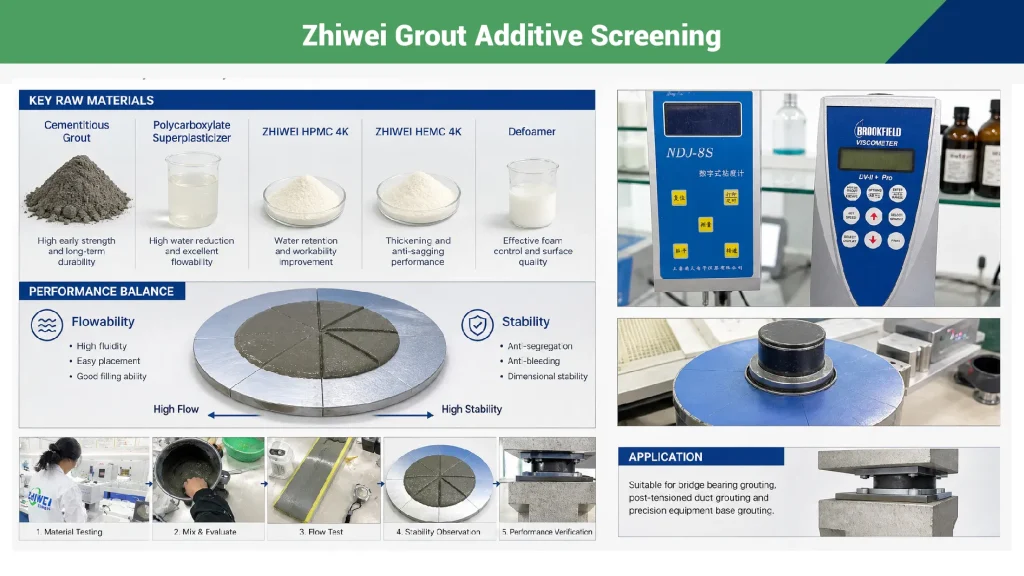
At Zhiwei, we normally treat the water-reducing system as the first formulation lever for high-flow grout. A compatible polycarboxylate superplasticizer can reduce water demand while maintaining the required fluidity.
If bleeding or segregation remains after the cementitious system, water content, superplasticizer, expansion component, and defoamer have been optimized, a low-viscosity cellulose ether can be screened as a secondary adjustment.
Zhiwei screening direction for bearing grout
For cementitious bearing grout, Zhiwei HPMC 4K or HEMC 4K can be evaluated at a low dosage when the mixture shows water separation or insufficient cohesion.
The trial must confirm that the additive does not:
- Reduce the initial or retained flow below the required range
- Interfere with filling beneath the bearing plate
- Increase air content excessively
- Delay early strength development
- Reduce the effective bearing area
- Create an unacceptable change in expansion
High-viscosity grades such as HPMC 40K, 100K, or 200K would not normally be our first screening choice for a high-flow bearing grout. Their stronger thickening effect can work against the required self-flowing behavior.
Zhiwei screening direction for duct grout
In duct grout, a polycarboxylate superplasticizer is generally more central to the formulation than cellulose ether. It supports pumpable flow at a controlled water-to-binder ratio.
A low-viscosity Zhiwei HPMC 4K or HEMC 4K may be considered when pressure bleeding or suspension stability cannot be resolved through the main binder and admixture system. Any such trial must be evaluated for:
- Initial and retained flow
- Pumping pressure
- Free bleeding
- Pressure bleeding
- Strand bleeding
- Air content
- Setting time
- Filling ability
- Strength development
- Corrosion-related requirements
Cellulose ether does not provide corrosion protection by itself. That protection depends on complete duct filling, suitable hardened-grout properties, low harmful-ion content, and correct construction.
Different Construction Procedures
Material performance cannot compensate for an unsuitable construction process. Bearing grouting and duct grouting require different equipment, preparation, and quality-control records.
Bearing-grout placement
Before grouting, the supporting concrete should be sound and free from dust, oil, loose particles, and standing water. Cementitious systems may require surface preconditioning in accordance with the product instructions and project specification.
The formwork must resist the pressure of the fresh grout without leaking. Mixing water should be measured accurately, and the entire batch should be mixed for the specified time.
Placement is normally continuous. Introducing the grout from one side helps the material displace air beneath the plate. The opposite side can function as a visual outlet, confirming that the grout has crossed the complete bearing area.
Once the grout has begun to lose flow, adding water to restore workability is not acceptable. The added water changes the composition and creates a higher risk of bleeding, settlement, and strength variation.
Curing and loading times must follow verified test results rather than an assumed strength-development schedule.
Prestressing-duct grouting
Duct grouting begins with inspection of the duct, inlet, outlet, anchor zone, and vents. The route must allow air and displaced material to leave the system.
Water measurement and mixing sequence require close control. Depending on the project and equipment, high-shear or colloidal mixing may be used to create a uniform grout without dry pockets.
Grouting normally proceeds from a controlled inlet, with vents managed according to their elevation and the approved procedure. The appearance and consistency of grout leaving each outlet provide evidence that air and residual water have been displaced.
Vacuum assistance can be useful in certain systems, but it is a construction method rather than a universal requirement for every duct. Pumping pressure, vent-closing sequence, holding procedure, and acceptance criteria must come from the applicable project specification.
Records should include batch identification, water quantity, material and ambient temperature, mixing time, flow results, grouting time, pressure behavior, vent sequence, interruptions, and test specimens.
The JTG/T 3650-2020 Technical Specifications for Construction of Highway Bridges and Culverts provides the broader construction framework for highway bridge work in China. Product standards and project-specific requirements should be used together with this construction specification.
Different Testing Priorities
Testing both products only for compressive strength leaves important risks undiscovered.
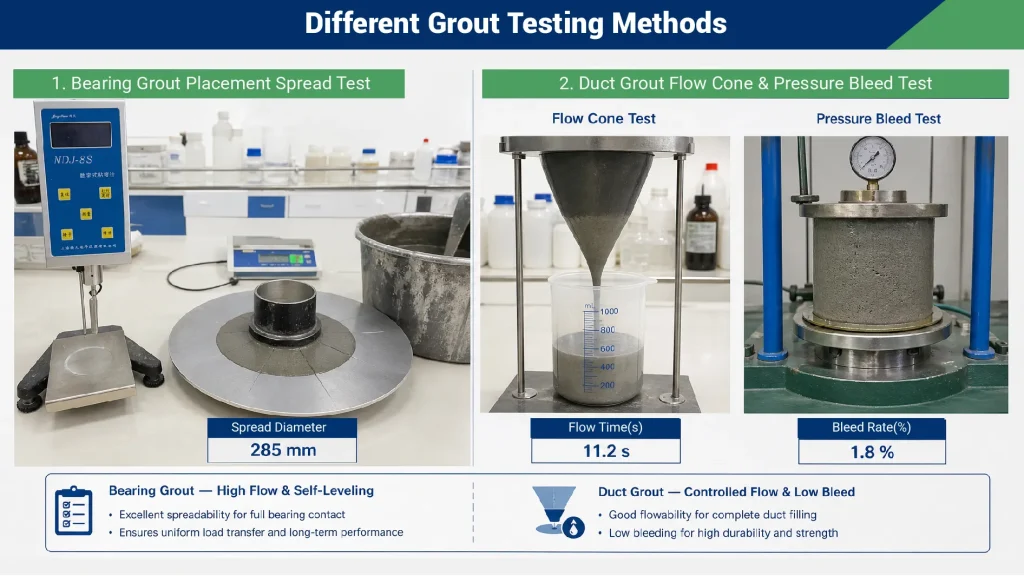
Bearing-grout tests
Depending on the material type and project specification, bearing-grout evaluation may include:
- Initial flow or spread
- Flow retention
- Setting time
- Bleeding
- Vertical or free expansion
- Early and later-age compressive strength
- Flexural strength
- Elastic modulus
- Effective bearing area
- Bonding and shrinkage tests for resin-based systems
The purpose of this test package is to show that the material can be placed successfully and become a stable support beneath the bearing.
Duct-grout tests
A duct-grout test program may include:
- Initial and retained flow
- Free bleeding
- Pressure bleeding
- Strand bleeding
- Free expansion
- Filling performance
- Air content
- Setting time
- Flexural and compressive strength
- Corrosion-related evaluation
Flow must be interpreted together with stability. A very fast flow-cone time can indicate easy pumping, but it can also result from excessive water or inadequate cohesion.
Studies of post-tensioning grout have therefore evaluated flow, expansion, bleeding, strength, absorption, electrical behavior, permeability, and corrosion susceptibility as parts of a broader performance assessment (ACI Materials Journal).
Common Selection and Construction Mistakes
Choosing by compressive strength alone
Two materials can reach similar 28-day strength while behaving very differently during placement. Pumpability, bleeding, expansion, retained flow, and filling ability may determine whether the grout performs successfully.
Adding extra water on site
Additional water improves apparent flow for a short time but changes the designed water-to-binder ratio. The consequences may include bleeding, settlement, delayed strength, higher porosity, and increased batch-to-batch variation.
Using too much thickener
More viscosity does not necessarily mean better stability. An overdosed cellulose ether can prevent a grout from entering narrow gaps or passing through strand bundles.
The correct goal is controlled cohesion with sufficient mobility.
Checking only the initial flow
A grout can pass its initial flow test and then thicken rapidly during transport or placement. Retained-flow testing at the relevant temperature gives a more realistic indication of available working time.
Assuming vacuum grouting is always required
Vacuum assistance is valuable for some duct arrangements and repair procedures. It should not be presented as a mandatory method for every project. Research into tendon-void repair has examined vacuum, pressure, and combined pressure-vacuum methods because the appropriate method depends on the void and access conditions (Transportation Research Record).
Replacing one grout with the other because it is available
A substitution should never be based only on price, availability, or a similar strength label. The replacement must comply with the standard and test requirements for the actual bridge component.
How to Select the Correct Material
The selection can begin with one practical question: where will the grout be placed?
Choose a bearing grouting material when the product will fill the space beneath a bridge bearing or bearing base plate and become part of the direct load-transfer path.
Choose a duct grouting material when the product will be pumped around prestressing strands inside a post-tensioning duct.
After identifying the application, review:
- The project drawing and technical specification
- The applicable product and construction standards
- Gap or duct geometry
- Required placing or pumping distance
- Ambient and material temperature
- Required working time
- Early loading schedule
- Bleeding, expansion, and strength criteria
- Equipment capacity and vent arrangement
- Trial-batch and site-trial results
For a repair involving hardened grout or an existing tendon void, neither fresh bearing grout nor standard duct grout should be selected automatically. The void must first be located and assessed. The repair material and injection procedure should then be designed for the actual defect, access route, moisture condition, and tendon configuration.
Frequently Asked Questions
Is bearing grout the same as ordinary non-shrink grout?
Not always. A cementitious bearing grout may use non-shrink technology, but bridge bearing applications impose additional requirements related to flow retention, early strength, elastic behavior, dimensional stability, and effective bearing area.
An ordinary general-purpose non-shrink grout should not be used beneath a bridge bearing unless its compliance with the project requirements has been verified.
Which material should have higher fluidity?
The two products use different placement methods and may use different test procedures, so their flow values should not be compared directly.
Bearing grout must spread beneath a plate. Duct grout must pass through a pump, strand bundle, curved duct, and vent system. Each material needs the type of fluidity appropriate to its own geometry.
Does duct grout need high compressive strength?
Yes, strength remains important. However, a high compressive-strength result cannot compensate for incomplete filling, excessive bleeding, or voids around the strands.
For post-tensioning grout, fresh-state stability and filling performance are central durability requirements.
Can HPMC improve grout stability?
A small amount of a suitable HPMC grade can improve cohesion and reduce water separation in some formulations. Excessive viscosity or dosage can reduce flow, increase air, and delay early strength.
For high-flow cementitious grout, we recommend beginning with the binder, water-reducer, expansion-control, and defoaming systems. Low-viscosity HPMC or HEMC should be evaluated only when an additional rheology adjustment is needed.
Can bearing grout be pumped into a duct?
It should not be used unless it has been specifically formulated, tested, and approved as a prestressing duct grout. Bearing-grout compliance does not demonstrate pressure-bleed resistance, strand filling, or compatibility with prestressing-steel requirements.
Can duct grout be used beneath a bearing?
Not without verification against the bearing-grout specification. A duct grout may not provide the required early loading performance, effective bearing area, elastic modulus, or dimensional characteristics.
Conclusion
The difference between bearing grouting material and duct grouting material begins with their structural location.
Bearing grout supports a bridge bearing and transfers concentrated loads into the supporting concrete. Its formulation and testing focus on complete bearing contact, dimensional stability, early strength, and long-term load-transfer performance.
Duct grout travels through prestressing ducts and surrounds steel strands. It must combine pumpable flow with low bleeding, filling reliability, controlled expansion, and corrosion-related durability.
Treating these products as interchangeable creates avoidable construction and durability risks. Selection should follow the component function, current standard, project specification, trial-batch results, and actual placement conditions.
At Zhiwei, we can support grout manufacturers with polycarboxylate superplasticizer and carefully selected cellulose ether grades. For high-flow bearing or duct grout, we would normally start with the water-reducing system and then evaluate low-viscosity HPMC 4K or HEMC 4K only when additional bleeding or segregation control is required.
Every recommendation must be confirmed in the customer’s complete formulation. Cement type, mineral composition, expansion agent, defoamer, temperature, mixing energy, and test method can all change the result.