
The global wall putty market
reached 2.56 billion in 2023 and is projected to hit 2.56 billion in 2023 and is projected to hit 4.16 billion by 2030, growing at a CAGR of 7.1% according to QY Research. That growth comes from urbanization, new construction, and renovation activity across Asia, the Middle East, and Latin America. Every bag of wall putty that goes onto those job sites contains a cellulose ether. HEMC (hydroxyethyl methyl cellulose, also called MHEC) is one of the most common choices.
If you produce or distribute wall putty and skim coat products, you need to understand what HEMC does in your formulation, how to pick the right viscosity grade, and when HEMC is a better fit than HPMC. This guide covers all of that.
What HEMC Does in Wall Putty
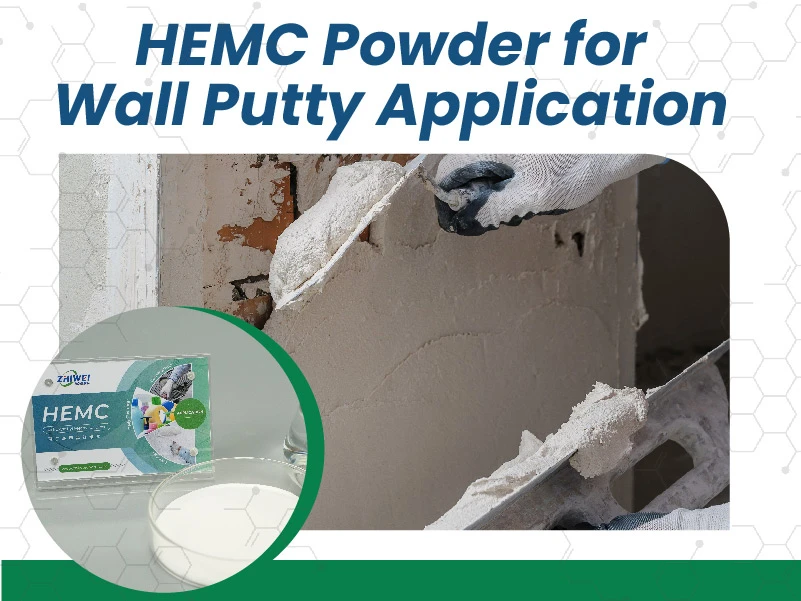
HEMC for wall putty serves two functions that matter on every job site: water retention and workability control. Without a cellulose ether, a cement-based putty loses water too fast into the substrate or to evaporation. The cement does not hydrate fully. The result is a weak, powdery surface that cracks and flakes under paint.
HEMC solves this by forming a hydrated polymer network in the mix. That network holds water in the putty layer long enough for proper cement hydration. It also gives the putty a smooth, buttery feel under the trowel. Workers can spread it thin and even without tearing or dragging.
The other effect is sag resistance. On vertical surfaces, a putty without enough thickener will slide down the wall. HEMC provides enough yield stress to keep the material in place after application, even in thick passes.
HEMC or MHEC: Same Thing
You will see both names in the market. MHEC stands for methyl hydroxyethyl cellulose. HEMC stands for hydroxyethyl methyl cellulose. They refer to the same chemical compound. The difference is just the order of the substituent groups in the name. In this guide we use HEMC throughout, but if your supplier lists MHEC on their COA, that is the same product.
Wall Putty Formulation: Where HEMC Fits
A typical cement-based wall putty formulation contains four groups of ingredients:
| Component | Typical Range | Function |
|---|---|---|
| White cement | 20–40% | Binder, provides strength |
| Calcium carbonate (filler) | 50–70% | Bulk, smoothness, cost control |
| HEMC (cellulose ether) | 0.2–0.5% | Water retention, workability, sag resistance |
| RDP (optional) | 0.5–2.0% | Flexibility, adhesion, crack bridging |
Some formulations also include talc, mica, or grey calcium powder as secondary fillers. Gypsum-based putty replaces white cement with stucco (calcium sulfate hemihydrate) and adjusts the HEMC dosage down slightly, usually to 0.15–0.3%.
HEMC dosage depends on the putty type and climate. Interior wall putty in temperate regions often uses 0.2–0.3%. Exterior putty or hot-climate formulations go up to 0.4–0.5% because water evaporates faster from the wall surface. Adding more HEMC increases water retention but also increases viscosity, which makes troweling harder. You need to find the balance.
Interior vs Exterior Wall Putty
Interior putty needs a smooth finish and good sandability. Workers apply it in thin coats (0.5–1.5 mm) and sand it smooth before painting. Low to medium viscosity HEMC works well here because it gives enough open time without making the mix too stiff.
Exterior putty faces wind, sun, and temperature swings. It needs higher water retention and better adhesion to the substrate. Formulators typically use medium to high viscosity HEMC at higher dosage, and they often add RDP for flexibility and crack resistance.
Choosing the Right HEMC Viscosity Grade
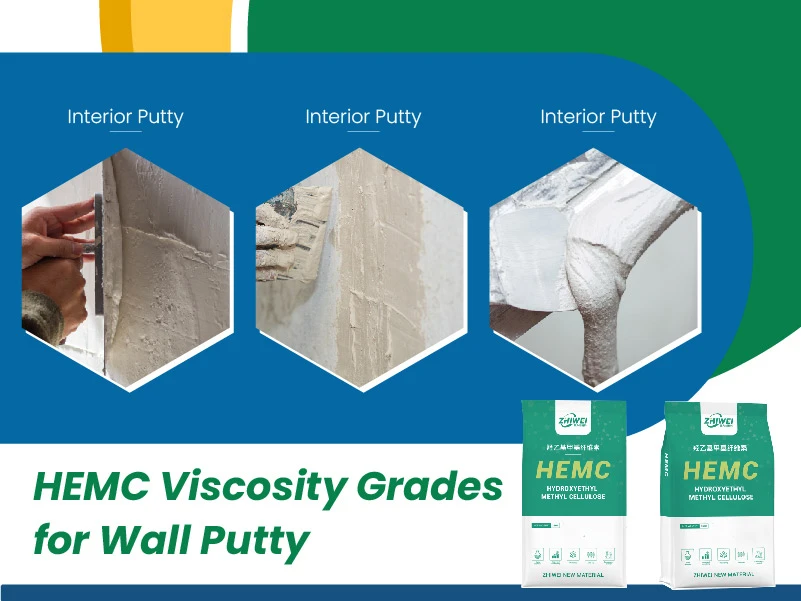
HEMC viscosity is measured on a 2% aqueous solution at 20°C and reported in mPa·s. For wall putty, the useful range spans from about 30,000 to 150,000 mPa·s.
| Viscosity Grade | Best For | Why |
|---|---|---|
| 30,000–40,000 mPa·s | Interior putty, thin-coat skim | Lower viscosity means easier spreading. Good for fine finishing layers. |
| 60,000–75,000 mPa·s | General-purpose wall putty | Balanced workability and sag resistance. The most common grade in the market. |
| 100,000–150,000 mPa·s | Exterior putty, hot-climate putty, thick-coat repair | Higher water retention and sag resistance. Stiffer mix that stays on vertical surfaces. |
Most wall putty producers stock one or two grades. If you serve a range of customers, the 60,000–75,000 mPa·s grade covers interior and general exterior work. Add a 100,000+ grade for customers who need high water retention or who work in hot climates.
HEMC vs HPMC for Wall Putty
Both HEMC and HPMC work in wall putty. They are close cousins in the cellulose ether family. But there are differences that matter depending on your market.
| Factor | HEMC | HPMC |
|---|---|---|
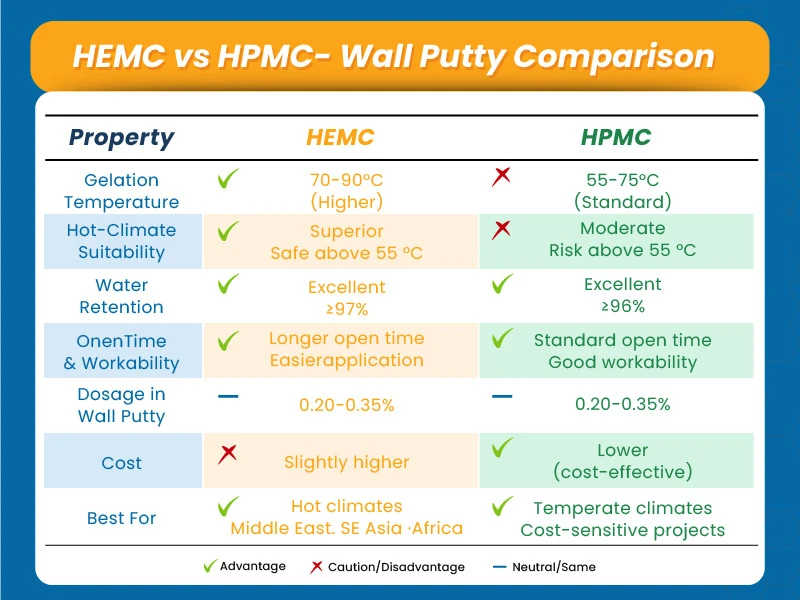
| Thermal gelation temperature | 70–90°C | 55–75°C |
| Water retention at room temperature | Similar to HPMC | Similar to HEMC |
| Water retention above 40°C substrate | Better | Drops off faster |
| Typical price | Often slightly lower | Often slightly higher |
| Market share in wall putty | Growing, especially in hot regions | Still the dominant choice |
| Common name variants | MHEC | None |
The main difference is the thermal gelation temperature. When the substrate or wall surface exceeds about 55°C, HPMC starts to lose water retention capacity because the polymer begins to gel and release water. HEMC maintains its water retention up to about 70°C, which means it performs better in hot-climate construction.
If your customers work in the Middle East, South Asia, or tropical regions, HEMC gives you a practical advantage. In temperate climates, both products perform similarly, and the choice often comes down to price and availability.
Can You Mix HEMC and HPMC?
Some formulators blend the two. A 50/50 blend can give a balance of HEMC’s high-temperature stability and HPMC’s slightly better open time at moderate temperatures. There is no technical reason you cannot do this, but it adds complexity to your sourcing and batch weighing. Most putty producers pick one or the other.
Common Wall Putty Problems and How HEMC Helps
Cracking After Drying
Cement-based putty cracks when it dries too fast. Rapid water loss means incomplete hydration, which leaves a weak, brittle surface. Increasing the HEMC dosage by 0.05–0.1% holds water longer and reduces this problem. Adding RDP at 1–2% also helps by providing flexibility.
Poor Workability and Tearing
If the putty drags under the trowel, workers struggle to get a smooth finish. This usually means the viscosity grade is too high for the application method, or the dosage is too low. Try a lower viscosity HEMC or increase the dosage slightly. Adding a small amount of surfactant (0.01–0.03%) can also improve trowel glide.
Bubbling on the Wall
Bubbles form when air gets trapped during mixing or when the substrate absorbs water unevenly. HEMC helps by slowing water absorption into the substrate, but it cannot eliminate air that is already mixed in. Use a slow-speed mixer to blend the dry putty with water, and let the mix stand for 5–10 minutes before applying.
Powdery Surface After Curing
A powdery surface means the cement did not hydrate fully. This is a water retention problem. Check your HEMC dosage. If it is below 0.2% for a cement-based putty, that is likely the cause. Also check the substrate: highly porous surfaces will pull water out of the putty faster, and you may need to prime the wall first or increase HEMC content.
HEMC for Gypsum-Based Putty

Gypsum-based putty is common in interior applications, especially in markets where gypsum is cheaper than white cement. HEMC works in gypsum formulations too, but the dosage and viscosity requirements differ.
Gypsum sets faster than cement, so the putty has less open time. Use a lower viscosity HEMC (30,000–40,000 mPa·s) at 0.15–0.3% dosage. The goal is enough water retention for the gypsum to set properly, without making the mix so thick that workers cannot spread it in the short working window.
Gypsum putty also requires a retarder (such as citric acid or protein-based retarder) to extend setting time. HEMC does not replace the need for a retarder. It handles water retention and workability; the retarder handles setting time.
Frequently Asked Questions
What viscosity grade of HEMC should I use for interior wall putty? For most interior wall putty, 40,000–75,000 mPa·s works well. Start with 60,000 mPa·s at 0.3% dosage and adjust based on your formulation and troweling feedback from workers.
Can I use HEMC instead of HPMC in my existing wall putty formulation? Yes, in most cases. Start with the same dosage and viscosity grade. Test the putty for water retention, workability, and drying time. If your customers work in hot climates, you may see an improvement because HEMC retains water better at high temperatures.
How much HEMC should I add to cement-based wall putty? The typical range is 0.2–0.5% by weight of the dry mix. Interior putty usually needs 0.2–0.3%. Exterior or hot-climate putty may need 0.3–0.5%. Add too much and the putty becomes stiff and hard to trowel.
Does HEMC work in gypsum-based putty? Yes. Use a lower viscosity grade (30,000–40,000 mPa·s) at 0.15–0.3%. You will still need a retarder to control gypsum setting time.
What is the difference between wall putty and skim coat? The terms are often used interchangeably, but there is a technical difference. Wall putty typically refers to a thicker, cement-based or gypsum-based filler used to level walls. Skim coat is a thinner finishing layer applied over plaster or drywall to create a smooth surface before painting. Both use HEMC, but skim coat formulations often use lower viscosity grades and lower dosage because the application is thinner.
Conclusion
HEMC for wall putty gives you water retention, workability, and sag resistance in a single additive. The viscosity grade you choose and the dosage you run both affect how the putty performs on the wall. For interior work, a 40,000–75,000 mPa·s grade at 0.2–0.3% covers most needs. For exterior or hot-climate applications, move to a higher viscosity and dosage.
If you are currently using HPMC and your customers operate in regions where wall temperatures regularly exceed 40°C, test HEMC as a replacement. Its higher thermal gelation point means more reliable water retention when it matters most.
For HEMC supply, Zhiwei (Jinan) New Materials Co., Ltd. produces HEMC alongside HEC, HPMC, RDP, and PCE at 15,000 tons annual capacity using Xinjiang refined cotton. COAs are provided for every batch. Contact info@zhiweichem.com or +86 183 6616 3707 for samples and specifications. Visit zhiweichem.com for more details.